





































































Smite
Every smiting in the King James Bible and in eight English translations of the Qur'an, 2026
I went looking for every verse in which somebody is smitten, in the King James Bible and in eight English translations of the Qur'an, and found 472: 385 in the Old Testament, 29 in the New and 58 in the Qur'an. Most of the biblical ones are in the books of the conquest and the monarchy, 35 in 2 Samuel and 34 in 1 Samuel, where the word is often the whole of a battle report, as at Judges 15:8, where Samson "smote them hip and thigh with a great slaughter: and he went down and dwelt in the top of the rock Etam."
Some of the count is a count of English choices. Where the King James Version says smite it is mostly translating one Hebrew root, nakah, a plain verb of hitting, and in the Qur'an the word appears only where a translator chose it.
Six uses of the word
Only 203 of the 472 verses tell of a smiting as it happens in the story. The rest are orders and threats, memories of an earlier smiting, laws about what is done to you if you strike your father and figures of speech in which the sun smites or a heart is smitten like grass. I kept all of them, because a verse that threatens a smiting uses the verb as much as one that tells of it.
happening, 203 verses: And David put his hand in his bag, and took thence a stone, and slang it, and smote the Philistine in his forehead, that the stone sunk into his forehead; and he fell upon his face to the earth. (1 Samuel 17:49)
ordered, 39 verses: Now go and smite Amalek, and utterly destroy all that they have, and spare them not; but slay both man and woman, infant and suckling, ox and sheep, camel and ass. (1 Samuel 15:3)
threatened, 84 verses: For I will pass through the land of Egypt this night, and will smite all the firstborn in the land of Egypt, both man and beast… (Exodus 12:12)
remembered, 72 verses: …neither will I again smite any more every thing living, as I have done. (Genesis 8:21)
the law, 20 verses: And he that smiteth his father, or his mother, shall be surely put to death. (Exodus 21:15)
a figure of speech, 54 verses: The sun shall not smite thee by day, nor the moon by night. (Psalm 121:6)
A worm and a gourd
Chronicles retells Samuel and Psalm 78 recites the plagues of Egypt centuries after Exodus, so the 203 verses in which a smiting happens come down to 148 separate events. For each one I set research agents to find what a record of it would hold: where it happened and at what coordinates, who struck whom and why, which animals were there, what kind of blow it was and the season and the hour. Wherever scripture says nothing I entered not stated, and scripture gives the hour for only 10 of the 148. Jonah's gourd is one of them.
- where
- Nineveh, whose ruin mounds face Mosul across the Tigris, 36.36° N 43.15° E
- who struck
- God, by a worm he prepared for it
- what was struck
- the gourd that shaded Jonah, which withered
- why
- so that Jonah, grieving for a plant, would see why God spared Nineveh (Jonah 4:10–11)
- animals
- a worm
- season
- not stated
- time of day
- dawn, "when the morning rose the next day"
Eight translators
I read the 58 verses of the Qur'an in which at least one of eight English translators uses the word. Arberry uses it in 37 of them and Pickthall in 27. Yusuf Ali, Shakir, Sale and Rodwell each use it in between 8 and 14, and the two modern translators, Abdel Haleem and Khattab, in none. In 31 of the 58 verses only one of the eight chose it.
At Qur'an 51:29 Abraham's wife hears she will bear a son in her old age, and five of the eight have her smite her face.
A. J. Arberry: smote her face
Marmaduke Pickthall: smote her face
Abdullah Yusuf Ali: smote her forehead
M. H. Shakir: struck her face
George Sale: smote her face
J. M. Rodwell: smote her face
M. A. S. Abdel Haleem: struck her face
Mustafa Khattab: clasping her forehead
- The Loom
Who strikes whom in all 148 events, sorted into a grouped matrix and drawn as three plates, a large one for the Old Testament, a small one for the New and a pencil drawing for the Qur'an.
- The Ground
The 105 events I could place, at their researched coordinates on a chart I drew from Natural Earth coastlines, with the 43 I couldn't listed underneath and the reason for each.
- The Ledger
All 472 verses on ruled paper, each with the fields I researched beside it and a dash wherever scripture says nothing.
- The Cloth
Every verse embedded on my own machine and laid out in two dimensions, so that verses which read alike lie close together.
- The Audit
The 58 verses of the Qur'an in all eight translations side by side, with the word each translator chose.
Four loops



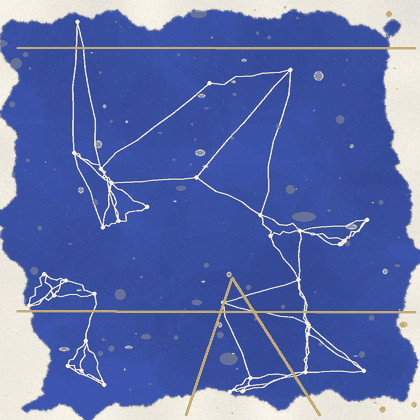




I drew every frame of these four loops in Python, each frame with its own paper grain and its own tremor in the line, and slowed them to 10 frames a second, the stepped rhythm of the embroidered animations Daniela Doe stitches a frame at a time on a sewing machine.
I found the verses with regular expressions run over the King James Version and the eight translations, had language models sort each verse into the six uses and gather the verses into events, and researched the events in batches with research agents, each given its verses and the text around them and told to enter not stated wherever scripture is silent. I embedded the verses on my own machine with bge-m3 and laid them out with UMAP for the Cloth. The paper, tears and spatter on the plates are generated from fixed seeds, so they come out the same on every load.
thiagobodruk/bible, the King James Versionfawazahmed0/quran-api, the Qur'an translations