DR McCullochCREATIVITY AS RECEPTION · 6 REGISTERSThe interactive loom ↗← WORK
Canonicalthe paper

Creativity research has generated more than twenty-five competing frameworks — psychometric, cognitive, social-psychological, systems-theoretic, computational — without convergence. This paper argues that the proliferation is not merely a sign of theoretical immaturity but reflects a structural absence shared by every major account: all locate creativity prior to or at the moment of production. The receiver appears, when at all, as judge or validator — never as the site where the constitutive event occurs.

Drawing on Gadamer's hermeneutics, the reception aesthetics of Iser and Jauss, Whitehead's process philosophy, Gell's anthropology of art, Rancière's emancipated spectator and Bourdieu's field analysis, the paper develops an alternative account. Creativity is an event constituted in receiving consciousness when encounter with a form occasions structural transformation — persistent reorganisation of conceptual relations, perceptual categories, affective dispositions or practical orientations. Production creates occasions for this event; reception completes them.

The framework resolves paradoxes that production-centred accounts generate (attribution, temporal location, cross-cultural scope, democratisation and evaluation) and reorients practical domains including education, cultural policy, institutional design and evaluation practice. A Bourdieusian analysis explains why reception has been structurally excluded from the field. The paper specifies transformation rigorously, distinguishes it from adjacent phenomena, names the framework's genuine limits and defends it against six major objections. It concludes by submitting to its own criterion: as a form offered to reception, the paper cannot declare its own creativity. That determination belongs to its readers.

Chapter 1: Introduction

1.1 The Absent Question

Creativity has been studied for more than a century. It has been located in the unconscious, in divergent thinking, in personality traits, in stages of cognitive processing, in the properties of novel and useful products, in the social systems that certify contributions to a domain. These are not trivial accounts. Each has generated genuine knowledge, grounded in observation and refined through decades of empirical and theoretical work. But they share a structural feature that, once noticed, is difficult to unsee: all of them locate creativity prior to or at the moment of production. The question they collectively answer is some version of where does creativity come from? — from the person, the process, the product, the social system, the computational operation.

The question they do not ask is what happens in the consciousness that encounters what has been produced.

This is not to say that receivers are entirely absent from the existing literature. Csikszentmihalyi's (1988) systems model includes a social field that evaluates contributions; product-centred frameworks acknowledge that someone must judge novelty and usefulness; social accounts of creativity recognise that audiences respond to and contextualise the work. Reception appears, but always in a subordinate role — as validator, as judge, as market. What it does not appear as is the site where creativity is constituted. The question of whether something happens in the receiving consciousness — something structural, persistent and reorganising — and whether that something is the event properly called creativity, has not been posed as a question about creativity. It has been posed, and posed with sophistication, in adjacent fields: Gadamer (2004) theorised understanding as a transformative event; Iser (1978) argued that the literary work is completed in reading; Jauss (1982) made the history of reception constitutive of aesthetic meaning; Rancière (2009) challenged the assumption that spectators are passive. But these insights have not been imported into the field that studies creativity. The receiver remains theoretically invisible at the precise point where, this paper argues, the constitutive event occurs.

1.2 The Claim

This paper proposes a reorientation. Creativity, on the account developed here, is an event constituted in receiving consciousness when a form occasions structural transformation. It is not a property of persons, processes, products or social systems. It does not inhere in the maker or in the artefact awaiting encounter. It is an occurrence — something that happens, or fails to happen, at the intersection of a bounded form, the conditions enabling encounter and a consciousness capable of being reorganised by what it meets. Production creates occasions for creativity; reception completes them. Without the completion — without structural transformation in the receiver — the creativity-event has not occurred, however accomplished or consequential the produced form may be in other respects.

1.3 What the Paper Does

The argument proceeds in stages. Chapter 2 surveys the landscape of creativity frameworks and identifies the structural absence they share — the missing question of what reception does to the receiver. Chapter 3 develops the core framework: six interlocking concepts (form, encounter, transformation, creativity, occasion and completion) that relocate creativity from production to reception. Chapter 4 establishes the theoretical lineage, drawing on hermeneutics, reader-response theory, process philosophy, anthropology of art, affect theory and predictive processing to show that the framework's commitments are not unprecedented but have not previously been assembled as a theory of creativity. Chapter 5 provides a political economy of creativity research, using Bourdieu's field analysis to explain why reception-focused accounts have been structurally excluded. Chapter 6 grounds the framework anthropologically, examining how encounter-conditions vary across historical and cultural contexts. Chapters 7 through 9 demonstrate what the framework resolves — including the persistent puzzle of why collaborative arrangements designed to amplify creativity so often fail to do so — what it implies for practice and policy and where it connects to existing empirical findings. Chapters 10 and 11 defend the framework against anticipated objections and name its boundaries honestly. Chapter 12 concludes.

1.4 What the Paper Does Not Do

A clarification is necessary at the outset. The claim that creativity is constituted in reception is not a claim that production does not matter. The labour of making — the years of training, the craft knowledge, the sustained attention that goes into producing a form capable of occasioning transformation — is not diminished by relocating the constitutive event. What changes is the ontological status of that labour: it is the creation of an occasion, not the completion of a creativity-event. Producers make forms; some of those forms are structured so as to occasion transformation in receivers who encounter them under enabling conditions. The skill and intention with which a form is produced may substantially affect its occasioning-potential — Chapter 10.5 addresses this directly. But occasioning-potential is a relational property, not an intrinsic one, and its realisation as a creativity-event depends on what happens in reception.

The paper does not propose that all encounters are creative, that all responses count as transformation or that the quality of produced forms is irrelevant to what they occasion. On the contrary: the framework's account of transformation is demanding, and most encounters — even sustained and attentive ones — do not produce it. The rarity of genuine transformation is a feature of the account, not a deficiency. What the paper proposes is a change in where we look for the constitutive event, not a flattening of the distinctions that matter within it.

1.5 A Reflexive Commitment

I should be clear about one further commitment at the outset, because the paper's argument applies to itself.

This paper is a form. It is a bounded configuration of arguments, distinctions and claims, produced with whatever craft and attention I have been able to bring to it, and offered to readers who may or may not encounter it under conditions that enable reception. If the argument is correct — if creativity is constituted in the structural transformation of receiving consciousness — then this paper's own creativity, in the sense the framework develops, will not be determined by me. It will be determined by what it occasions in the readers who engage with it. I cannot know, writing these words, whether the encounter with this argument will reorganise anything in how a reader thinks about creativity, about reception, about the relation between making and encountering. That is not mine to determine. What I can do is produce a form with as much occasioning-potential as I can manage and submit it to the conditions of reception.

This is not false modesty; it is the framework's own requirement, applied without exemption to the text that articulates it. The paper commits to enacting its own criterion. It will return to this commitment at three further points: in Chapter 5.5, which acknowledges the field-position from which the argument is made; in Chapter 10.6, which addresses the reflexivity objection directly; and in Chapter 12.5, which closes the thread. Throughout, the paper accepts that it cannot declare its own creativity. Only reception can confer that — or withhold it.

Chapter 2: The Landscape — Frameworks and Their Shared Absence

2.1 A Selective Taxonomy of Frameworks

Creativity research has generated an unusually large number of frameworks. This proliferation is not a sign of theoretical maturity — it is a sign of theoretical congestion: many serious attempts to describe a phenomenon whose boundaries remain contested, converging on no stable consensus. A comprehensive survey is deferred to Appendix A. What follows is a selective taxonomy, organised not by historical sequence but by the structural question each framework takes as primary: where is creativity located?

Five clusters can be identified.

Person-centred frameworks locate creativity in the properties of individuals — in cognitive styles, personality traits or specific mental capacities. The foundational question is: what distinguishes the person who creates from the person who does not? Guilford's (1950) address to the American Psychological Association, widely treated as inaugurating the modern empirical study of creativity, proposed divergent thinking — the capacity to generate multiple responses from a single prompt — as the defining cognitive characteristic. Amabile's (1983) approach identifies three necessary conditions located in the individual: domain-relevant skills, creativity-relevant cognitive processes and intrinsic task motivation. These frameworks ask what the person brings to the creative act; the answer is always a set of capacities or dispositions residing within the individual.

Process-centred frameworks locate creativity in the stages or operations through which thought moves. Wallas's (1926) four-stage model — preparation, incubation, illumination, verification — remains widely cited as a phenomenological description of how insight arises. The central question here is not who creates but how the creative moment comes about: what cognitive operations, in what sequence, produce the characteristic experience of discovery.

Product-centred frameworks define creativity by properties of the output rather than the person or process. Creativity, on this view, inheres in the product when it satisfies the conjunctive requirement of novelty and usefulness — or in some formulations, novelty and appropriateness. Boden's (2004) analysis distinguishes combinatorial, exploratory and transformational creativity as types of product-generated novelty. The central question is: what makes a product creative? The answer is always a set of properties ascribable to the output itself.

Systems-centred frameworks locate creativity in the interaction between an individual, the symbolic domain within which they work and the social field that selects and validates contributions. The most fully elaborated version of this approach is that of Csikszentmihalyi (1988), discussed in detail in Chapter 2.2 below. These frameworks represent a significant advance on purely individualist accounts: they refuse the fiction of the lone genius and situate creative output within social and institutional processes. The central question is: how does a system of individual, domain and field interact to produce and validate creative contributions?

Social and collaborative frameworks extend the systems insight further, locating creativity in distributed or collective processes rather than in any one individual's contribution. Sawyer (2007) analyses the emergence of creative outcomes from group improvisation and collaborative practice. Glăveanu (2014) argues for a distributed model in which creativity is constituted by the interaction of self, others and cultural affordances. The central question here is: how is creativity distributed across groups, practices and cultural contexts? Even these frameworks — which go furthest towards socialising creativity — locate the creative event in the collaborative production process. Sawyer's analysis of group improvisation traces how the ensemble's output emerges from real-time interaction; Glăveanu's distributed model maps the network of self, others and cultural affordances through which creative output is generated. Both are production accounts extended to the collective level: they ask how the group produces, not what happens in each participant's consciousness when they encounter what another has contributed. The collaborator appears as co-producer, not as receiver. The question of whether encountering a colleague's contribution occasions structural transformation — reorganisation of the schemas through which the receiver subsequently perceives, conceives and acts — is not one these frameworks pose. The social dimension is extended to production; it is not redirected to reception.

These five clusters differ substantially in their commitments. Yet they share a structural feature that will become the central finding of this chapter.

2.2 A Worked Example: Csikszentmihalyi's Systems Model

Csikszentmihalyi's systems model represents, arguably, the most sophisticated attempt to socialise the concept of creativity available in the mainstream literature. It is worth examining in some detail, precisely because it goes furthest towards incorporating social dimensions — and therefore reveals most clearly the structural limit that all five framework clusters share.

The model (Csikszentmihalyi 1988) proposes three interacting components. The Domain is a symbolic system — the set of rules, representations, notations and practices constituting a field of human endeavour, whether mathematics, music, painting or something else. The Field is the social organisation of persons — gatekeepers, critics, editors, curators, teachers, peers — who control access to the domain and evaluate contributions to it. The Individual is the person who, having internalised the domain's symbolic resources, produces variations that the field may or may not select for incorporation back into the domain. Creativity, on this account, is the result when a variation produced by an individual is recognised and selected by the field as a genuine contribution to the domain.

The advance this model represents is real. It replaces the myth of inspiration and the fiction of the genius with a social account: what counts as creative is determined not by the properties of the individual alone, nor even by the properties of the output alone, but by the evaluative activity of a social system. Creativity is not found in the work until the field says it is found there.

But consider what the Field member does in this account. The Field member evaluates. The Field member selects. The Field member recognises a contribution as belonging to the domain. What the model does not address is what happens in the Field member's consciousness during that evaluation. Is the encounter with the work transformative? Does it alter how the Field member subsequently perceives the domain? Does the work reorganise anything in the person who encounters it, or does it simply pass through the machinery of evaluation and emerge with a label attached?

Csikszentmihalyi's Field is a judge, a gatekeeper, a validator. It is not a site where something occurs. The Field certifies creativity; it is not where creativity is constituted. The receiver appears in the model, but only in their institutional role — as arbiter, not as the locus of an event. The question of what encountering a form does to a consciousness is simply not one the model needs to ask, because the model's interest is in the social mechanisms by which creative contributions are recognised and incorporated, not in what those contributions occasion in the persons who encounter them.

2.3 The Pattern Across Frameworks

The five framework clusters surveyed in Chapter 2.1 differ in their methods, their disciplinary affiliations and their central concerns. What they share is a structural commitment: all five locate creativity either in the producer, in the production process or in the produced object. Even the most social of the frameworks — those that explicitly include audiences, fields and cultural contexts — incorporate the social as a validation mechanism or a contextual constraint. The social is about creativity; it is not where creativity occurs.

Stated in the terms each cluster employs: person-centred frameworks ask what cognitive or dispositional properties produce creative output; process-centred frameworks ask through what mental operations creative insight arises; product-centred frameworks ask what properties make an output count as creative; systems-centred frameworks ask through what social mechanism creative status is conferred; social and collaborative frameworks ask how the creative process is distributed across participants and contexts.

These are not trivial questions. Each cluster has generated genuine knowledge, empirically grounded in some cases, phenomenologically rich in others. The point is not to dismiss them but to observe what they collectively fail to ask. None of the five clusters poses the following question: what occurs in a receiving consciousness when an encounter with a form occasions structural reorganisation of that consciousness? The frameworks notice that audiences exist; they do not ask whether audiences are the site of the creativity-event itself.

The absence is structural, not incidental. It follows from how these frameworks delimit the phenomenon. If creativity is defined as a property of persons, processes or products — as something that can be present or absent in the output before anyone has encountered it — then the question of what encounter does to the receiver becomes secondary at most. The event-character of creativity, its occurrence in the consciousness of the person who is transformed, falls outside the frame these frameworks have drawn.

2.4 The Absent Question

It is necessary to be precise about what has been left out. The absent question is not whether audiences matter to creativity. Most of the frameworks surveyed acknowledge, in some form, that audiences validate, respond to or contextualise creative work. Csikszentmihalyi's Field is composed entirely of people who engage with the work. Sawyer's (2007) and Glăveanu's (2014) accounts are centrally concerned with social processes. Reception is not ignored; it is subordinated.

The absent question is more precise: is the event that occurs in a receiving consciousness — when encountering a form occasions structural reorganisation of that consciousness — constitutive of creativity itself, rather than its validation or its social consequence?

What makes this absence surprising is that adjacent fields have posed precisely this question and developed substantial answers to it. Reader-response theory made the reader constitutive of the literary work decades ago. Iser (1978) proposed that the literary text is only one pole of the literary work; the other is the realisation accomplished in reading. Jauss (1982) argued that the work's meaning is inseparable from the history of its reception, and that what we call aesthetic value is partly the measure of the challenge a work presents to the horizon of expectation a reader brings to it. Hermeneutics, in Gadamer's (2004) formulation, has long theorised understanding as a transformative event — a fusion of horizons in which the interpreter does not extract a pre-given meaning from the text but is altered in the encounter with it. These traditions have produced sustained theoretical accounts of what reception does to the receiver. They have not, by and large, been imported into creativity research.

That absence is not accidental. Chapter 5 develops the argument that the production-bias of creativity research is structurally produced — a function of who benefits from locating creativity in persons and products rather than in transformative events distributed across receivers. For now it is sufficient to note that the persistence of the absence across the full range of frameworks, from psychometric to sociocultural, is itself a finding requiring explanation.

The following section proposes a different starting point: not the person who produces a form, nor the properties of the form produced, but the event that occurs — or fails to occur — when a consciousness encounters a form and is changed by it.

Chapter 3: The Framework — Creativity as Reception-Completion

3.1 Core Definitions

The theory developed here rests on six interlocking concepts. Each must be held to its precise meaning throughout the paper if the account is to do the work required of it. The temptation to read these terms through their ordinary usage should be resisted: several carry meanings that diverge from everyday idiom in ways that matter.

Form is a bounded configuration capable of being encountered. The category is deliberately wide: a painting, a sentence, a gesture, a rock formation, the output of an algorithm, a mathematical theorem laid out on a page — all qualify, provided they meet the threshold conditions. A form must have boundaries, relative stability and structure enough to become an object of consciousness. What the category excludes is equally important. The ambient, the formless, the purely potential are not forms until configured. White noise is not a form; a musical phrase extracted from that noise is. A fog of half-remembered impressions is not a form; a poem that crystallises one such impression is. The point is not that forms must be made by human hands — natural objects and computational outputs can be forms — but that they must be sufficiently delimited to serve as objects of encounter.

Encounter is a consciousness meeting a form under conditions that enable reception. Mere exposure is not encounter. A person who walks past a painting while distracted, or reads a sentence without attention, has been exposed to a form but has not encountered it. Encounter requires enabling conditions: minimally, attention directed towards the form, time sufficient for the form to register, some contextual framing that allows the form to be taken as an object of consciousness and the receiver's capacity for uptake. These conditions can be structurally withheld — by institutions, by poverty, by exhaustion, by the sheer noise of a culture that produces more forms than any consciousness can meet. The concept of encounter is therefore already a political one, though its political dimensions are reserved for later analysis.

Transformation is structural reorganisation in the receiving consciousness — alteration of conceptual relations, perceptual categories, affective dispositions or practical orientations that persists beyond the encounter and manifests in subsequent cognition and action. What distinguishes transformation from the many things it resembles but is not will be specified in detail in Chapter 3.2. For now the key features are persistence and manifestation: transformation is not something that happens and then subsides; it leaves the consciousness differently configured from how it was before. Someone reads a novel set in a culture remote from their own and returns to their familiar city unable to perceive its streets in quite the same way: that is transformation.

Creativity, on this account, is the event of transformation occasioned by encounter with form. The word "event" is load-bearing. Creativity is not a property that belongs to agents, artefacts or processes. It does not inhere in the person who produces a form, nor in the form itself as it waits to be encountered, nor in some faculty of the human mind awaiting exercise. It is an occurrence — something that happens, or fails to happen, at the intersection of form, encounter-conditions and a receiving consciousness. This is the central claim of the paper, and everything that follows is either the unpacking or the defence of it. When a piece of music heard for the first time reorganises a listener's sense of what music can do — altering not just their preferences but their understanding of structure, of silence, of what sounds can be made to mean — a creativity-event has occurred. The event is not in the music; it is in the listener.

Occasion names the probabilistic enabling relation between form and transformation. Forms occasion transformation: they make it possible but do not guarantee it. Occasioning-status is always relational — a function of form, receiver and encounter-conditions together, never a fixed property of the form alone. When the paper says some forms are better structured to occasion transformation than others, this means they have higher probability of occasioning transformation across a wider range of receivers and conditions; it does not mean occasioning-potential is inscribed in the form independently of any encounter. The language of occasioning is deliberate: it resists the stronger language of causation (which would imply sufficient conditions) while acknowledging that forms are not inert in this process. Chapter 3.5 addresses the origin of forms and what determines their occasioning-potential. The same novel may occasion structural reorganisation in one reader and merely inform another: the form is identical, the occasioning-status differs.

Completion is the moment when creativity occurs — when transformation happens in reception. Consider the strangeness of this: a work awaits completion in a non-trivial sense, not merely awaiting an audience but awaiting the event that constitutes it as the site of a creativity-event at all. Until transformation occurs in a receiving consciousness, the form has produced no creativity-event, however accomplished or consequential it may be in other respects. Production creates occasions for creativity; reception completes them, or fails to. The distinction between occasion and completion is what separates this theory from any account that locates creativity in the productive act alone. On the present account, producing a form is necessary but not sufficient for the creativity-event to occur. Completion is what is missing from theories that stop at the moment of making. A painting finished in one century awaits completion — each encounter that occasions transformation in a receiver is a completion, and this can happen centuries after the brush was set down. The temporal structure of completion is fully developed in Chapter 3.6.

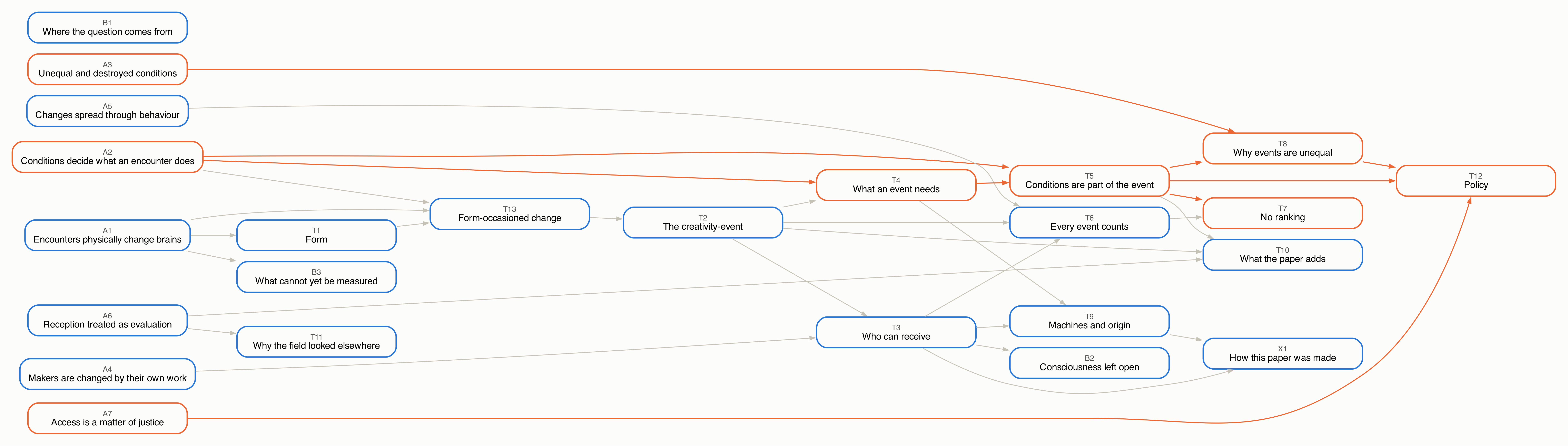
Figure: The Creativity-Event: Form, Encounter and Transformation.


3.2 Specifying Transformation

Of the six concepts, transformation requires the most careful specification. It is the lynchpin that holds the entire account together, and it will do no work if left vague.

Transformation, as the term is used throughout this paper, must satisfy four criteria. It must be structural: not merely experiential in the sense of producing a passing subjective state, but involving a change in the relations between elements of consciousness — between concepts, between perceptual categories, between affective dispositions and their objects or between practical orientations and the situations they are orientations toward. It must be persistent: surviving the encounter that occasions it and remaining operative in subsequent states of the receiver's consciousness. It must be reorganising: not an addition of new content to existing structure but an alteration of the structure itself, a change in how things relate rather than merely in what things there are. And it must be manifest: detectable, in principle, in subsequent cognition or action — in the way the transformed receiver encounters similar or related forms, makes judgements, produces new work or engages with the world.

Each criterion rules something out. Transformation is not mere emotional response. When a piece of music moves a listener to tears, something real has happened; but unless the weeping leaves the listener's affective structure differently configured — unless the subsequent emotional life is in some way altered — no transformation in the relevant sense has occurred. Emotions pass; the capacity to be moved by a certain kind of music may persist unchanged. Emotional response without structural reorganisation is not transformation.

Transformation is not information acquisition. Learning that the capital of a country one had not known about is a city one has never heard of adds content to consciousness but need not reorganise anything. The existing schema accommodates the new datum without strain. This is learning in the minimal sense, and it is pervasive and valuable — but it is not transformation.

Transformation is not mere association. Two ideas can become linked — the smell of a particular wood can come to evoke a specific afternoon — without the relations between the broader structures in which those ideas are embedded being altered. Association enriches without necessarily reorganising.

Transformation is not aesthetic pleasure, however intense. A painting can produce sustained and heightened pleasure in a viewer who emerges from the encounter with all their conceptual and perceptual structures exactly as before. Pleasure registers; transformation reorganises. The two are not opposed — genuinely transformative encounters are frequently pleasurable — but pleasure alone is not sufficient.

Positively characterised, transformation is closer to what Piaget identified as accommodation than to what he called assimilation. In Piaget's framework, assimilation names the fitting of new data into existing schema — the schema bends slightly to accommodate the input while remaining recognisably itself. Accommodation names the modification of schema to fit new data that cannot be assimilated without distortion. Transformation, as the concept functions here, is stronger than accommodation. It involves not the modification of an individual schema but the reorganisation of the relations between schemas: not just that a particular concept changes but that the network of relations in which concepts are embedded is reconfigured. Encountering Haussmann's boulevards does not merely add a fact about urban planning; it reorganises how one perceives the relation between state power and built form, between aesthetics and administration, between what cities look like and what they are for. The schema does not simply adjust; the architecture of schemas shifts.

(Piaget 1970)

This distinction matters because it establishes that transformation, on the present account, is rare. Most encounters produce assimilation at most. Many produce nothing detectable. Only occasionally does an encounter with form occasion the kind of structural reorganisation that this account identifies as the creativity-event. This rarity is not a deficiency in the theory — it is a feature. A definition of creativity that makes it common is describing a different phenomenon — one better addressed by the frameworks surveyed in Chapter 2, and distinct from what makes creativity significant in the sense this account pursues. The objection that rarity is built into the definition rather than discovered by it is addressed in Chapter 10.5. The question of degrees — of how profound or how slight a transformation must be to count — is addressed in Chapter 3.4.


3.3 Distinguishing Transformation from Learning

The Piagetian distinction introduced in Chapter 3.2—between assimilation and accommodation — provides a useful starting point, but it does not go far enough. Chapter 3.2 argued that transformation, as the concept functions here, is stronger than accommodation: not the modification of an individual schema but the reorganisation of the relations between schemas. It is worth pressing this distinction further, because the difference between transformation and learning will bear significant weight throughout the argument.

Consider what happens when someone who has grown up entirely within Western tonal music — the diatonic scale, functional harmony, the tonic-dominant axis as the spine of musical expectation — first encounters a piece of modal music or a work built on microtonal intervals. One response is accommodative: the listener registers that music can sound like this, updates their understanding of what the word "music" covers and proceeds. The existing schema expands at its margins. This is learning, and it is not negligible. But it is not transformation in the sense this paper requires. The structural hierarchy of the listener's musical understanding — what counts as a resolution, what constitutes tension, what the horizon of expectation is against which any musical event is heard — remains intact. Tonal music retains its status as the default, the natural, the self-evidently musical and the newly encountered modal work is filed as exotic variation.

A different response is possible. The encounter occasions a reorganisation in which the listener's prior musical formation comes to appear differently — not as the natural shape of what music is, but as one historically particular possibility among others, contingent rather than universal. Crucially, this reorganisation is retroactive: the listener now hears their familiar music differently. Where before a dominant seventh moving to a tonic was simply resolution — the thing itself — it becomes one structural convention among possible conventions, weighted with historical and cultural specificity that was previously invisible. The prior state has been reorganised from the inside. (Piaget 1970)

This retroactive character is the key phenomenological marker of transformation. Learning adds; transformation reorganises what came before. After genuine transformation, the receiver cannot simply un-encounter the form that occasioned it: the schema from which that un-encountering would have to operate is itself the schema that has been altered. This distinguishes transformation from ordinary forgetting. One can learn something and subsequently forget it — the datum was added and later deleted, leaving the structure essentially unchanged. Transformation proper cannot be undone by forgetting, because it is not an addition to structure but a reconfiguration of structure itself. To revert, the receiver would need to reconstruct the prior schema wholesale, which is not forgetting but a second transformation.


3.4 Degrees of Transformation

Transformation is qualitatively distinct from non-transformation: either the structural reorganisation described in Chapter 3.2 has occurred or it has not. There is no such thing as partial transformation in the sense of transformation happening to a degree. Nevertheless, the events that qualify as transformation are not uniform in character, and the differences between them are significant. Transformation admits of degrees along four independent dimensions.

Depth names how far the reorganisation reaches into the receiver's schema-structure. A surface transformation alters peripheral schemas — schemas that operate in one domain without governing much else. A deep transformation alters foundational schemas, those that structure the organisation of many others. Encountering a new musical genre that expands the range of what one finds pleasurable is a surface transformation; encountering music that makes the receiver question whether their sense of who they are is partly constituted by their aesthetic history is a deep one. Depth is not the same as importance: a surface transformation can be enormously consequential in practice; a deep transformation can be personally devastating without producing any obvious practical change.

Persistence names how long the reorganisation holds. Some transformations are durable; others fade as the encounter-conditions that sustained them recede, and the receiver gradually reconstructs something approximating the prior schema. Persistence is independent of depth. A shallow transformation — the recognition that a colour one considered ugly can, under certain light, be beautiful — can persist for a lifetime. A deep transformation occurring in circumstances of sustained intensity may fade when those circumstances end and the social environment reconstructs the prior orientation. Neither persistence nor depth implies the other.

Scope names how much of the receiver's schema-network is affected. A narrowly scoped transformation alters one domain while leaving adjacent domains untouched. A broadly scoped transformation cascades: a reorganisation in how one hears musical structure may alter how one reads urban space, how one experiences duration, how one relates to silence in conversation. Breadth of scope is not identical to depth — a transformation can be deep in one domain without cascading outward, and it can cascade widely while remaining relatively shallow at each site.

Generativity names how much new transformation-capacity the event creates. Some transformations leave the receiver more capable of subsequent transformations — they lower the threshold for future encounters, sensitise the receiver to registers of form that were previously unavailable and expand the space of what can occasion transformation. Others do not. Generativity is the dimension with the most direct implications for education and for cultural policy: an institution that produces generative transformations is doing something qualitatively different from one that produces non-generative ones, even if both register transformation by every other measure.

The four dimensions are independent, which means the space of possible transformations is large and varied. A creativity-event that is shallow, brief, narrow and non-generative is still a creativity-event; the framework does not privilege the profound over the modest. But the differences matter, and any practical application of the theory — any attempt to create conditions under which transformation is more likely, or to evaluate whether it has occurred — will need to attend to which dimensions are in view. These distinctions carry implications for how transformation might be recognised and measured, which is addressed in Chapter 8.6.

3.5 The Origin Question

Forms arise from many different sources. The taxonomy proposed here distinguishes five categories, organised by origin: artefactual forms, produced by human intention — paintings, novels, musical compositions, architectural works, designed objects; natural forms, configurations that no intention produced — landscapes, coastlines, storm formations, animal behaviour, the arrangement of stars; social forms, patterns of interaction — rituals, ceremonies, institutional practices, the choreography of everyday gesture; mathematical and logical forms, abstract structures that can be encountered — proofs, theorems, formal systems presented on a page; and algorithmic forms, patterns generated by rule-following systems, including outputs of computational and AI processes that can be met as objects of consciousness.

The purpose of this taxonomy is not to rank these categories by occasioning-potential. The key move is the reverse: the origin of a form does not determine its occasioning-status. Whether a form occasions transformation in a receiver depends on the encounter and the receiver, not on how the form came to be. This is the anti-intentionalist implication of the framework. A rock formation, a formal proof and a symphony composed over three years can all occasion transformation in principle. The intentionality — or its absence — with which a form was produced is irrelevant to whether encounter with it reorganises a receiving consciousness.

This claim has purchase in several directions. It removes the need to settle contested questions about whether natural configurations are or can be beautiful before acknowledging that encountering them can occasion transformation. It clarifies that the gradual elaboration of mathematical structures by communities of practice, with no single composer directing the result, does not diminish those structures' occasioning-potential. And it implies, with regard to algorithmic outputs including the outputs of AI systems, that the question of whether such outputs can occasion transformation is entirely separate from the question of whether the system that produced them has anything we might want to call experience or intention. Whether an algorithmic form occasions transformation in a receiver is an empirical question about encounter; whether there is anything it is like to be the system that produced it is a different question entirely. The implications of this for debates about AI and creativity are addressed briefly in Chapters 8.4 and 11.3 and not pursued further here.


3.6 Temporal Structure

The creativity-event has four temporally distinct moments that must be held separately if the account is not to collapse back into the production-location it is designed to replace.

Production is the making, configuring or presentation of a form. The sculptor completes the work; the novelist types the last sentence; the proof is written out and checked. Something has been accomplished, and it is not nothing. But production is not yet a creativity-event. What production creates is an occasion — a form structured so as to make possible, for certain receivers under certain conditions, the encounter that may occasion transformation. The occasion is not the completion.

Encounter is the meeting of a consciousness with a form under enabling conditions. It is the beginning of the creativity-event but not yet its completion. The receiver is present with the form; attention is engaged; contextual framing has made the form available as an object of consciousness. But whether transformation will occur remains undetermined.

Completion is the moment when transformation occurs. This is the creativity-event in the paper's sense — the structural reorganisation in a receiving consciousness that constitutes creativity rather than merely producing its conditions. It is this moment, not the moment of production, that the paper identifies as the location of creativity.

Re-completion names the structural feature that follows from the foregoing: the same form can occasion transformation in different receivers, at different times, under different encounter-conditions. Each completion is a distinct event. The form is identical across completions; the events are not.

The temporal structure of re-completion resolves several puzzles that production-centred accounts cannot easily address. Consider Van Gogh's The Starry Night, completed in 1889. The work was produced at one time, but the creativity-events in which it participates have occurred across the subsequent 135 years and continue to occur. The creativity of the work is not fixed at the moment of production — it is constituted in each encounter that occasions transformation in a receiver, and it remains capable of being constituted again. This explains why certain works appear to become, in the common phrase, "more creative" over time: not because the form has changed but because encounter-conditions shift, new receivers come to it and the space of possible transformations it occasions expands. It explains equally why other works, once celebrated, become unremarkable: the horizon of expectation that once made them challenging has shifted so far towards them that encounter produces assimilation rather than transformation. And it explains why rediscovered works can seem suddenly profound — not because they were hidden but because the encounter-conditions that enable transformation in their receivers are now in place in a way they previously were not.

Production creates occasions; reception completes them. The creativity-event is distributed across time in a way that makes any account locating it purely in production structurally incomplete.


3.7 Failure Modes

If the creativity-event requires form, encounter and transformation, there are three structurally distinct ways it can fail to occur. Each failure mode has a different causal structure and implies a different kind of response.

Encounter-conditions failure is the first. Here the receiver is present in the vicinity of the form — the painting is on the wall, the book is in hand — but the conditions enabling encounter are absent. There is no time, or no attention, or the contextual framing that would allow the form to register as an object of consciousness is missing, or the receiver lacks the capacity for uptake that the form requires. What results is exposure without encounter. The form is not met; no transformation is possible. The intervention implied by this failure mode is the creation of enabling conditions: time, attention, framing, the institutional and material support that makes sustained encounter possible. Without these, no amount of additional production or distribution will produce creativity-events.

Form failure is the second. Here encounter occurs but the form lacks the structural properties needed to occasion transformation in this receiver. The form is too familiar — it is assimilated without strain into existing schema and produces no purchase for reorganisation. Or it is too simple — there is nothing in its structure that exceeds the receiver's current schema. Or it is too incoherent — it presents no stable structure for consciousness to meet. In each case, encounter proceeds but transformation does not follow, not because conditions were absent but because the form, for this receiver, does not have the occasioning-potential required. The intervention implied here is graduated encounter with structurally richer forms: forms that exceed the receiver's current schema without exceeding it so entirely that no engagement is possible.

Schema-lock is the third and hardest case. Here the receiver's schema-structure is so rigid — through the effects of trauma, entrenched ideology or prolonged habituation — that every encounter is assimilated. Nothing can gain purchase for accommodation, let alone transformation. The form may be rich; the encounter-conditions may be excellent; but the receiving schema closes around every input and returns it to the prior state. The intervention implied here cannot be addressed at the level of form or encounter-conditions alone: it requires graduated encounters over time, conditions that allow for the lowering of defensive assimilation, or the disruption of the locked schema from within a community of practice or a therapeutic relation.

These three failure modes have different causal structures and require different responses. Conflating them — treating all failures to occasion transformation as cases of insufficient exposure to forms — has been a systematic error in educational and cultural policy. Exposure is an intervention only for the first failure mode. Chapter 8 addresses the implications of these distinctions for institutional design.

Chapter 4: Theoretical Lineage — Reception Across Traditions

4.1 Duchamp: The Founding Statement

In April 1957, Marcel Duchamp addressed the Convention of the American Federation of Arts in Houston and delivered what remains the most succinct and consequential statement of reception-constitutive aesthetics in Western art discourse. "The Creative Act" runs to approximately fifteen hundred words; its argument, stripped of qualification, is that the creative act is not completed at the moment of production. The spectator is not the work's audience. The spectator is its co-constituent.

The address opens with an analogy designed to undercut the Romantic model of the self-possessed creator from the outset. The artist, Duchamp proposes, functions as a "mediumistic being" operating from a "labyrinth beyond time and space" — one who cannot fully account for his own impulses, let alone the full significance of what he has made. This is not a claim about inspiration; it is a structural claim. The act of making necessarily produces a gap between what the artist intended and what has in fact been realised. Duchamp names this gap the "art coefficient": "The personal 'art coefficient' is like an arithmetical relation between the unexpressed but intended and the unintentionally expressed" (Duchamp 1957, 28–29). The gap is not a deficiency in the artist's technique; it is the structural condition of any act of making. Crucially, the artist cannot perceive it. "The result of this struggle is a difference between the intention and its realization, a difference which the artist is not aware of" (Duchamp 1957, 28–29). The gap is visible only from outside; only the spectator, approaching the work without the artist's intentions as a blinker, can perceive what the work actually is rather than what the artist meant it to be.

It is the spectator who processes this raw material — "art à l'état brut" — and refines it, as Duchamp puts it, "as pure sugar from molasses." The receiving act is ontologically significant: when the spectator experiences the encounter, "the creative act takes another aspect when the spectator experiences the phenomenon of transmutation: through the change from inert matter into a work of art, an actual transubstantiation has taken place, and the role of the spectator is to determine the weight of the work on the esthetic scale" (Duchamp 1957, 28–29). The vocabulary is deliberately theological: transubstantiation names a change of substance, not of appearance. The work does not become art by virtue of having been made; it becomes art — the site of a creativity-event — in the spectator's encounter with it.

The temporal argument follows: "The artist may shout from all the rooftops that he is a genius: he will have to wait for the verdict of the spectator in order that his declarations take a social value and that, finally, posterity includes him in the primers of Art History" (Duchamp 1957, 28–29). Creative status is not conferred at production; it is conferred in reception, and most definitively in the long arc of historical reception. "All in all, the creative act is not performed by the artist alone; the spectator brings the work in contact with the external world by deciphering and interpreting its inner qualifications and thus adds his contribution to the creative act" (Duchamp 1957, 28–29).

This paper extends Duchamp's account while departing from it at a precise point. The departure concerns vocabulary. Duchamp says the spectator "adds his contribution" — an additive formulation that still implicitly treats the work as the primary site, with the spectator's activity supplementing something already substantially achieved. The present account uses the language of completion rather than contribution: the spectator does not add to the creative act — the creative act occurs in the spectator. The difference is ontological, not merely verbal. Contribution supplements the artist's creation; completion is where the event occurs. Duchamp names the two-pole structure and the essential role of the receiver; this paper specifies what the event at the receiver pole consists in — structural transformation in a receiving consciousness — and establishes the conditions under which it occurs or fails to.


4.2 Gadamer: Fusion of Horizons

If Duchamp provides the founding provocation, Hans-Georg Gadamer's Truth and Method (1960; revised translation 2004) provides the most fully developed philosophical account of how encounter can transform the receiver. Gadamer's project is not an aesthetics in the narrow sense; it is an account of understanding as such, arguing that what human beings call understanding is not a method applied from outside to an object, but an event in which the understanding consciousness is itself implicated and potentially changed.

The key concept for this paper is what Gadamer calls the fusion of horizons (Horizontverschmelzung). Every interpreter approaches a text — or any form — from within a particular horizon: the range of vision available from their current situation. "Every finite present has its limitations. We define the concept of 'situation' by saying that it represents a standpoint that limits the possibility of vision. Hence essential to the concept of situation is the concept of 'horizon'" (Gadamer 2004, 302 [VERIFY]). A horizon is not a fixed barrier; "horizons change for a person who is moving" (Gadamer 2004, 304 [VERIFY]). The interpreter's prior understanding — shaped by tradition, education, cultural formation and the accumulated encounters that constitute an intellectual life — constitutes the horizon from which any new encounter is approached.

Genuine understanding, on Gadamer's account, is not the application of a method to an inert object; it is the event in which the interpreter's horizon and the horizon of the text or form are brought into contact and fused: "Understanding is always the fusion of these horizons supposedly existing by themselves" (Gadamer 2004, 305 [VERIFY]). Neither horizon remains intact after the fusion. The interpreter's prior horizon is enlarged and reorganised; the text's horizon — the world of concerns and presuppositions it carries — is illuminated in a new way by being brought into contact with the interpreter's situation.

Two further concepts from Truth and Method are directly relevant here. Bildung — formation or cultivation — names the process by which a person is shaped through encounter with what exceeds their current formation. It is Gadamer's closest prior concept to what this paper calls transformation: the self is not a fixed entity that acquires knowledge; it is constituted and reconstituted through what it encounters. Wirkungsgeschichte (effective history) names the fact that we are never neutral with respect to tradition: the history of prior interpretations of a form is always already operative in shaping what we can understand. There is no encounter from nowhere. The receiver who meets a form is already shaped by the history of encounters with similar and related forms, whether or not that history is consciously available.

There is a central tension between Gadamer's account and the present paper's that must be named rather than glossed. For Gadamer, the fusion of horizons is mutual: both the interpreter's horizon and the text's horizon are transformed through genuine understanding. This paper proposes an asymmetric account. The form is not changed by being encountered: the painting is the same after every viewer has stood before it. Only the receiver is structurally transformed. What may change about the form in a social or historical sense — the accumulation of interpretations, the shifting reputation, the gradually altered understanding of what the work is — is a social process, not the same event as the structural reorganisation of a receiving consciousness. Gadamer is correct that genuine understanding is not mere assimilation; the present account builds on this claim while restricting its scope. Transformation in the paper's sense is a specific sub-class of encounter — not every genuine understanding occasions it — and the site of the event is unambiguously the receiver, not the form.


4.3 Iser and Jauss: Reception Aesthetics

Wolfgang Iser's The Act of Reading (1978) and Hans Robert Jauss's Toward an Aesthetic of Reception (1982) together constitute the most developed programme for relocating the literary work from text to reception. Both emerged from the Constance School (Konstanzer Schule) of reception aesthetics in the late 1960s and 1970s; their approaches are complementary but distinct.

Iser's contribution is phenomenological. His fundamental claim is that the literary work exists neither fully in the text nor fully in the reader, but in the dynamic interaction between the two. Literary texts are structured by what Iser calls Leerstellen — blanks, gaps, points of indeterminacy that the text withholds and the reader must supply. Reading is not passive reception of a determinate message; it is an activity of gap-filling, consistency-building, projection and revision. At each point in the sequential encounter, the reader draws on memory of what has passed and anticipation of what is to come; the text's structure simultaneously enables and constrains this activity. The reader constitutes the work in the act of reading.

What Iser demonstrates for literary reading is precisely the active, constitutive character of reception that Duchamp asserted and this paper theorises. The distinction this paper must draw, however, is between Iser's gap-filling reader and the transformed receiver the paper's account requires. Iser's reader is always already a competent schema-builder; the reader's capacity for consistency-building is presupposed, brought to the text and exercised. The question Iser does not pose — and that this paper asks — is what happens when the encounter reorganises that capacity itself. Filling a blank is not transformation; having the blank-filling apparatus structurally reconstituted is. The creativity-event, on this paper's account, is specifically the encounter that does not merely exercise existing capacities but restructures them.

Jauss's contribution is historical. His argument begins from a structural concept: the horizon of expectation (Erwartungshorizont). Every reader or audience approaches a work already shaped by familiarity with prior works, genre conventions and the broader aesthetic norms of their period. This horizon is not merely psychological; it is historically constituted, socially shared and reconstructible by the literary historian. Against this horizon, every work can be assessed by the degree of its aesthetic distance: "The distance between the horizon of expectations and the work, between the familiarity of previous aesthetic experience and the 'horizonal change' demanded by the response to new works, determines the artistic nature of a literary work" (Jauss 1982, 25 [VERIFY]).

This paper appropriates both terms and repurposes them. The horizon of expectation, in the paper's usage, is recast as encounter-conditions: the historically and culturally variable structure of what a receiver can encounter, recognise, be disturbed by and potentially be transformed by. Aesthetic distance is recast as the structural requirement for transformation: a form that merely confirms the existing horizon can occasion nothing beyond assimilation. Transformation requires an encounter that the existing schema cannot accommodate without strain — though it also requires that the form not be so alien as to be unapproachable. The implications of this zone between the too-familiar and the too-alien are developed in Chapter 6.1.

Jauss also demonstrates — through the concept of canonisation — that encounter-conditions change historically while the form remains formally stable. A work that once excited extreme aesthetic distance, provoking disorientation in its first audiences, may be encountered centuries later as formally conventional because the horizon has shifted to absorb its innovations. The form has not changed; what has changed is the receiver's prior formation. This is the strongest evidence Jauss provides for the paper's claim that the occasions for creativity are not fixed properties of forms but relational functions of form, receiver and historically variable encounter-conditions.


4.4 Whitehead: Creativity as Prehension

Alfred North Whitehead's Process and Reality (1929; corrected edition 1978) makes the most audacious ontological claim in the paper's lineage: creativity is not a special capacity of gifted persons or objects but the fundamental feature of reality as such. In Whitehead's system, it is the "universal of universals characterising ultimate matter of fact" (Whitehead 1978, 21 [VERIFY]).

Whitehead's metaphysics holds that reality is constituted not by enduring substances but by momentary events — actual occasions — which come into being through what he calls prehension: the basic unit of relational experience. Each actual occasion prehends (takes in, grasps) data from prior occasions and integrates them into a novel unity. "The many become one, and are increased by one" (Whitehead 1978, 21 [VERIFY]): the many actual occasions of the past are drawn together in the concrescence of a new occasion, which then adds itself to the many available for future prehension. Every act of prehension is genuinely creative in Whitehead's sense: the integration is always a synthesis that has never existed before.

The structural relevance to this paper is precise. In Whitehead's cosmology, creativity is located in the receiving moment — in the prehending occasion, not in the occasions prehended. The past occasions that provide data do not themselves produce the novelty; the novelty is in the act of integration, in the new occasion's constitution of itself by taking in what has preceded it. This is a cosmological-scale version of the paper's central claim: creativity is in reception, not production.

Two qualifications are necessary. First, Whitehead's account operates at a scale and scope that the present paper deliberately does not claim. Whitehead attributes something like experience to every actual occasion in the universe, from subatomic events to human consciousness — a panexperientialist position the paper does not endorse and need not adopt in order to benefit from the structural logic. The paper restricts its claims to human consciousness encountering bounded cultural forms; the Whiteheadian logic applies at the cosmological level. What the paper borrows is the structural argument that creativity is an event in the receiver, and the occasioning language that follows from it: prior occasions do not cause the new occasion's creativity; they provide the data that enables it. Forms occasion transformation; they do not produce it.

Second, Whitehead's concept of prehension carries no implication of cognitive or attentional direction. Prehension in his sense is a metaphysical category, not a psychological act. The paper's encounter-concept specifies the conditions under which human prehension — attention, time, contextual framing, capacity for uptake — can occasion the structural reorganisation called transformation. Whitehead provides an ontological framework within which the paper's account is intelligible; it does not provide that account itself.


4.5 Gell: Captivation and the Occasioning Form

Alfred Gell's posthumously published Art and Agency (1998) offers the most rigorous and empirically grounded account of what happens at the moment when a form begins to exceed a receiver's capacity for accommodation. Gell's programme is anthropological and deliberately anti-aesthetic: he brackets questions of beauty, symbolism and meaning in order to analyse what art does — how it acts upon, holds and arrests those who encounter it.

The central phenomenon in Gell's account is captivation: the viewer is held, arrested, unable to withdraw from the encounter. "The spectator is captivated, that is, unable to tear themselves away from the work" (Gell 1998, approx. 68–72 [VERIFY — wording uncertain; see QUOTE_REGISTRY.md GE1]). This captivation is, for Gell, the effect of the form's technical complexity: the viewer cannot replicate or decode the virtuosity displayed in the work, and this cognitive entrapment generates the experience of being held. The form captivates because its making exceeds the viewer's replicative capacity; it presents a cognitive excess that the viewer cannot resolve.

The paper takes Gell's phenomenological description of captivation as an account of what this paper calls transformation-onset: the moment at which an encounter begins to exceed accommodation and the receiver's existing schema comes under pressure. Captivation, in Gell's description, is precisely the phenomenology of the encounter that cannot be assimilated without remainder — the encounter that holds the receiver because it exceeds easy integration. This description is cross-culturally grounded: Gell's analysis spans Melanesian decorated shields, Marquesan tattoos, South Asian sculpture and Western contemporary art, providing evidence that the structure of being-held-by-form is not a specific cultural formation but a general feature of human encounter with complex form.

However, a fundamental tension between Gell's framework and the present paper must be named and resolved explicitly. Gell attributes agency to the material object: the artwork acts upon the recipient; the idol captivates; the index is a social agent in a genuine causal sense. His analytical framework is built on this attribution. The paper's framework is structurally opposed: forms are not agents. A form is a bounded configuration with structural properties; it does not act. What Gell calls "the object's agency" the paper reframes as the form's occasioning-potential — a structural feature of the form that, given an appropriately positioned receiver under enabling conditions, makes transformation possible but does not guarantee it. Without a receiver equipped to encounter the form, the form occasions nothing; its occasioning-potential is relational, not intrinsic.

This reframing is not a rejection of Gell's descriptions but a different causal account. The phenomenological claim — that certain forms hold the receiver, arrest the encounter, produce an experience of being acted upon — is accepted and used. The causal story is revised: the receiver experiences captivation not because the object has agency over them but because the object's structural complexity, exceeding the receiver's available schema, triggers a process of sustained engagement that is the onset of potential transformation. What Gell calls the object's causal power over the viewer, the paper describes as the encounter between a structurally complex form and a receiver whose schema is being exceeded. The form does not act; it occasions.

The distinction matters for one further reason. Gell's agentive ontology treats the object's captivating power as roughly constant across viewers — the trap is laid and captures whoever encounters it. The paper's occasioning framework holds that occasioning-potential is always relational: the same form may occasion transformation in one receiver and assimilation in another, depending on the encounter-conditions, the receiver's prior formation and the available time and attention. Gell's cross-cultural evidence for captivation is fully compatible with this relational account: what varies across cultures is not whether captivation occurs but who is captivated by what, under which conditions. This variation is precisely what a relational, receiver-positioned account predicts.


4.6 Rancière: The Emancipated Spectator

Jacques Rancière's The Emancipated Spectator (2009) addresses a different set of concerns — less ontological, more political — but contributes a claim that is essential for this paper's account of the receiver's activity. Rancière argues against a tradition that has treated spectatorship as inherently passive, as a mode of being that requires correction through theatrical or participatory intervention. Brecht, Artaud, Boal — diverse as their prescriptions are — share the assumption that the spectator, in merely watching, is failing to do something. For Rancière, this assumption is itself the problem.

Against it, Rancière argues: "Watching is also an action that confirms or transforms this distribution of positions" (Rancière 2009, approx. 13–14 [VERIFY]). The spectator is not a passive receiver of a transmission; the spectator actively translates, connects, interprets and appropriates what is placed before them. "The spectators see, feel and understand something starting from what is put before them; they connect it with something they have already seen, felt, understood" (Rancière 2009, approx. 13–14 [VERIFY]). This activity is not inferior to the performer's or maker's activity; it is a different activity of equal intelligence and equal cognitive claim.

The paper affirms the active spectator and builds upon it. Where the paper extends Rancière's account is in specifying what the spectator's activity consists in during a creativity-event. For Rancière, the spectator's watching is active in the sense of translation and connection: the receiver takes what is placed before them and connects it with what they already know and feel. In the paper's terms, this describes what Piaget calls assimilation — the incorporation of new material into existing schema, an active process but not necessarily a transformative one. The paper identifies a sub-class of encounter in which what occurs is not translation but structural reorganisation: not merely connecting the new to the existing, but having the framework of connection itself reconstituted. This is transformation in the paper's sense, and it is more than Rancière claims without contradicting what he claims.

The political dimension of Rancière's argument — who is permitted to occupy the position of receiver in the full sense — is taken up in Chapter 6, where the distribution of encounter-conditions is shown to be structured by cultural capital and institutional access.


4.7 Affect Theory: Sub-Cognitive Transformation

Brian Massumi's Parables for the Virtual (2002) and Eve Kosofsky Sedgwick's Touching Feeling (2003) contribute a dimension that any account of transformation restricted to cognitive or conceptual reorganisation would miss. Affect theory, in the tradition these works exemplify, holds that encounters affect the body and the organism before they signify — before they become available to conscious interpretation or conceptual processing. The body registers; intensity is felt; the affective state is produced in advance of any determination of what that state is about.

The relevance for this paper is that the paper's account of transformation includes affective reorganisation among its criteria. Chapter 3.1 defines transformation as alteration of conceptual relations, perceptual categories, affective dispositions or practical orientations. Including affective dispositions is not a minor addendum; it is a recognition that some of the most significant structural reorganisations that encounters occasion operate at a sub-cognitive level. A person who encounters a form and finds, in subsequent encounters with structurally similar forms, that their affective orientation has changed — that what once produced anxiety now produces curiosity, or that what once registered as beautiful now registers as cold — has undergone a genuine transformation of affective structure that may never be fully available to conscious retrospection.

Massumi (2002) and Sedgwick (2003) provide the theoretical warrant for this inclusion. Their account of affect as autonomous from cognition — as a capacity for being affected that operates below the threshold of conscious interpretation — supports the paper's claim that structural reorganisation must be understood to extend to affective dispositions. Transformation, on this account, is not reducible to conceptual change; it encompasses the full range of structural features of a receiving consciousness, including those that mediate between body and thought.


4.8 4E Cognition and Predictive Processing

The extended, embodied, enacted and embedded cognition programme — associated with Merleau-Ponty in its phenomenological origins and developed systematically in recent cognitive science — holds that perception is not a passive reception of sensory data but an active, predictive engagement with the world. Andy Clark's account of predictive processing in Surfing Uncertainty (2016) offers the most explicit treatment of how this applies to the kind of encounter this paper theorises.

In predictive processing frameworks, the brain is best understood not as a passive input-processor but as a prediction-generating system that continually tests its predictions against incoming sensory data. Perception is hypothesis-testing: the system generates a model of what the world is likely to present, and the sensory data are checked against this model. What registers most powerfully is not the expected but the unexpected — the prediction error. The system updates its generative model in response to unresolved prediction errors, revising the priors through which subsequent perception is processed.

This framework provides a neuro-cognitive correlate for what this paper calls transformation. An encounter that occasions transformation is, in predictive processing terms, an encounter that generates a prediction error too significant to be resolved by minor model-adjustment: the error is large enough, and sufficiently structured, to require reorganisation of the generative model itself — an update of priors, not merely of predictions derived from those priors. The architecture of perceiving is altered. This is precisely what the paper means by structural reorganisation: not the addition of new content to existing schema, but the reconstitution of the schema through which content is processed. (Clark 2016 [VERIFY: specific chapter and page])

The paper does not claim that transformation reduces to prior-updating in the predictive processing sense. The phenomenological and ontological dimensions of the creativity-event are not captured by the neuro-cognitive vocabulary. But the frameworks are consistent: a theory of transformation in receiving consciousness that is incompatible with the best available account of how perception actually works would be theoretically unsustainable. The predictive processing account provides a scientific framework within which the paper's claim is intelligible as a real event rather than a metaphor.


4.9 Convergence

Nine independent traditions, working across philosophy, literary theory, anthropology, political theory, affect studies and cognitive science, converge on a common structural insight: that what is ordinarily called creativity is located not in the moment of production but in the encounter between form and receiver. None of these traditions has been systematically applied to creativity theory; none has been synthesised with the others in the service of such an application. The paper's claim is that the convergence is not accidental but structural — these traditions are tracking the same phenomenon from different angles — and that synthesising them produces a theory of creativity more adequate than any single tradition could supply.

The following table summarises the contribution each tradition makes to the paper's account.

Tradition Key Concept Contribution to This Paper
Duchamp (1957) Art coefficient; two-pole structure Names reception as constitutive; establishes the gap this paper theorises
Gadamer (2004) Fusion of horizons; Bildung Transformation as encounter-event; formation through what exceeds the self; historicity of reception
Iser (1978) Gap-filling; implied reader Reception as active meaning-construction; reader constitutes what form enables
Jauss (1982) Horizon of expectation; aesthetic distance Encounter-conditions as historically variable; aesthetic distance as structural requirement for transformation
Whitehead (1978) Prehension; creativity as ultimate Reception ontology at cosmological scale; creativity in the receiving moment; occasioning language
Gell (1998) Captivation; art nexus Phenomenology of transformation-onset; cross-cultural evidence for being-held-by-form
Rancière (2009) Emancipated spectator; distribution of the sensible Active spectatorship; watching as action; political stakes of the receiver's position
Massumi / Sedgwick (2002/2003) Affect as autonomous Sub-cognitive transformation; affective dimension of structural reorganisation
4E Cognition / predictive processing Active prediction; prior-updating Neuro-cognitive correlate of transformation; perception as structurally revisable

The divergences between these traditions are real and have been noted at each stage — Gadamer's mutuality versus the paper's asymmetry; Gell's agentive ontology versus the paper's occasioning framework; Rancière's political concern with who counts as active versus the paper's ontological question about what structural change consists in. These divergences do not prevent the synthesis; they define its shape. The paper's account is not a lowest-common-denominator averaging of these positions but a constructive synthesis that retains what each tradition uniquely contributes while resolving the tensions between them by maintaining the framework established in Chapter 3. Creativity is the event of transformation occasioned by encounter with form. This paper has not invented that claim; it has found it, partially and variously articulated, across nine independent traditions, and given it the systematic theoretical expression it has lacked.

Chapter 5: The Political Economy of Creativity Theory

5.1 Bourdieu's Tools

Any attempt to explain the structure of an academic field — not merely describe it but account for why it takes the shape it does — requires analytical tools capable of holding together two things simultaneously: the genuine intellectual content of positions and their social conditions of production. Pierre Bourdieu supplies four such tools, each of which will be used in the analysis that follows, and each of which requires precise definition before use.

Field is a structured space of positions defined by the distribution of capital. Agents — researchers, institutions, publishers, consultants — occupy positions in relation to one another, competing for legitimacy, authority and recognition. The field is not a neutral arena; it distributes advantages unequally and structures what moves are possible, thinkable and rewarded. As Bourdieu argues of the literary field, it "is a field of forces, but it is also a field of struggles tending to transform or conserve this field of forces" (Bourdieu 1996, [VERIFY: pp. 215–220]). The same structure obtains wherever agents compete for definitional authority over a contested term.

Capital designates the resources that confer advantage within a field. Bourdieu identifies four principal forms — economic, cultural, social and symbolic — but for the analysis of creativity research, cultural capital is most relevant. Cultural capital exists in embodied form (dispositions, trained sensibilities, cultivated knowledge), objectified form (books, instruments, credentials) and institutionalised form (academic degrees, professional licences). Who holds cultural capital in the creativity research field, and in which form, determines who can occupy which positions and issue authoritative definitions.

Habitus names the system of durable, transposable dispositions that generates practice. It is the feel for the game that agents develop through immersion in a field — not a consciously held strategy but an embodied orientation that determines what appears natural, urgent or impossible. Bourdieu describes it as "a product of history" that "produces individual and collective practices — more history — in accordance with the schemes generated by history" (Bourdieu 1984, 54 [VERIFY]). The theorist who locates creativity in individual cognition is not typically aware of choosing this location over alternatives; that location feels like the obvious starting point, the natural object of inquiry.

Symbolic violence is the most demanding of the four concepts and must be applied with precision rather than as a general critical epithet. It names the imposition of arbitrary cultural classifications as natural and universal — domination exercised through misrecognised categories rather than overt force. Taste classifies, Bourdieu observes, "and it classifies the classifier" (Bourdieu 1984, 6 [VERIFY]). The person who exercises taste is themselves positioned by the act. When a classification system is accepted as neutral and descriptive by those it disadvantages, symbolic violence has occurred: the dominated have become complicit in their own positioning.

These four tools are applied here not to the analysis of literary or artistic capital but to the field of creativity research itself — to the academic and commercial structures that produce knowledge about creativity.


5.2 Creativity Theory as a Field

Creativity research is a field in Bourdieu's sense: a structured space of positions, organised by competition for the authority to define a contested term, characterised by unequal distribution of different forms of capital. The field is not merely an intellectual conversation; it is a site of position-takings with material and symbolic stakes.

The field's agents are heterogeneous. Academic psychologists occupy positions underwritten by scientific capital: peer-reviewed publication, experimental method, replication. Management consultants draw on economic capital, converting creativity frameworks into proprietary methodologies with price tags. Education theorists hold institutional capital, shaping curriculum and teacher training. Arts policy advisors accumulate cultural capital, determining what counts as creativity for funding purposes. Technology companies combine economic capital with an increasingly powerful symbolic capital derived from association with innovation — the word that has functionally displaced "creativity" in much contemporary discourse.

The field's dominant positions have shifted over its history, but certain configurations have proved durable. The psychometric tradition established by Guilford's (1950) address to the American Psychological Association held the field for several decades by combining scientific legitimacy with practical application: divergent thinking could be measured, and what can be measured can be managed. The systems models of Csikszentmihalyi (1988) and others posed a significant challenge to purely individual-centred accounts without abandoning the aspiration to empirical tractability. At the field's heteronomous pole — governed by market logics rather than internal academic criteria — management consulting frameworks, design thinking methodologies and the contemporary discourse of "innovation" circulate freely, largely unconstrained by the peer-review structures that govern the autonomous pole.

Every framework, however, is also a position-taking. Choosing to define creativity as a cognitive trait is not merely a theoretical decision; it is a move that positions the theorist in relation to the testing industry, the HR consultancy market and the academic psychology establishment. Choosing to define it as a systemic social process is equally a position — one that expands the relevant expertise to include sociologists, organisational theorists and policy analysts. The proliferation of frameworks that Chapter 2 surveyed is not simply evidence of the phenomenon's complexity; it reflects competition among differently positioned agents for definitional authority over a term whose commercial and institutional value is substantial.


5.3 Framework-Clusters and Interests

Frameworks do not merely describe creativity — they also constitute it as a particular kind of object and, in doing so, serve particular interests. The selection of what creativity is has direct consequences for who can be identified as creative, what can be trained, what can be measured, what can be managed and what can be democratised. Each of these consequences creates or protects a market for expertise.

A person-centred framework — locating creativity in individual traits, cognitive styles or personality dispositions — creates the conditions for individual selection: assessment tools, talent management programmes, the identification and cultivation of high-potential individuals. The market it generates is the market for individual difference assessment, which is large, commercially developed and institutionally entrenched. A process-centred framework — locating creativity in stages of ideation, incubation and elaboration — creates the conditions for training: workshops, structured ideation processes, facilitation methodologies. The market it generates is the training and consultancy industry. A product-centred framework — locating creativity in the properties of novel and useful outputs — creates the conditions for measurement and valuation: novelty scoring, utility assessment, intellectual property valuation. The market it generates intersects with legal and commercial practice around IP. A systems-centred framework distributes creativity across individual, domain and field, creating the conditions for organisational design: if creativity requires the right field-level gatekeeping, then consultants who manage those gate-keeping processes hold relevant expertise.

Framework Cluster Institutional Home Capital at Stake Interests Served
Person-centred (traits, cognitive) Academic psychology, HR, talent management Scientific + economic Individual selection, assessment tools
Process-centred (stages, flow) Education, coaching, consulting Economic + cultural Training markets, workshop industry
Product-centred (novelty + utility) IP law, design, technology Economic + legal Product development, IP valuation
Systems-centred (Individual/Domain/Field) Business schools, innovation management Economic + academic Organisational design, innovation consulting
Social/collaborative (distributed) Education policy, arts funding, NGOs Political + cultural Inclusion narratives, democratic access discourse

Reception-focused accounts do not appear in this table because they do not fit easily into any of these markets. If creativity is an event in the receiver — if what is at stake is the structural transformation of receiving consciousness, not the identification of productive individuals or the assessment of novel outputs — then the expertise market shifts: from identifying those capable of creating forms to designing encounter-conditions; from training creative cognition to cultivating reception-capacity; from measuring outputs to enabling encounters. This is a different market, serving different interests, in a less commercially developed space. The absence from the table reflects the structural position of reception accounts in the field, not a theoretical deficiency.


5.4 Why Reception is Absent

The structural explanation for the absence of reception-focused accounts from creativity research runs as follows. Consider what becomes impossible if creativity is an event in the receiver rather than a property of persons, processes or products.

If creativity is an event in the receiver, the individual selection market collapses: there are no intrinsically creative individuals to be identified, because creativity is not a property that belongs to persons. Assessment tools that purport to measure an individual's creative potential are measuring something other than creativity in the relevant sense — at most, they are measuring the probability that forms produced by this person will occasion transformation in some receiver under some conditions, which is a very different, and commercially much less tractable, claim. The training market is complicated: one cannot train creative cognition if creativity is not located in cognition. One can cultivate reception-capacity and create encounter-conditions, but these are different from the skill-development and ideation-method programmes that currently dominate the creativity training industry. The measurement market is disrupted: if creativity occurs in reception, then what is measured as "creative output" in product assessments — novelty, usefulness, technical sophistication — is being measured at the wrong location. The organisational design market requires a different vocabulary: managing the conditions for transformative encounter rather than managing the conditions for productive innovation output. The intellectual property market, which rests on the assumption that creativity inheres in the artefact or its producer, is philosophically unsettled by a framework in which the artefact is merely a form with occasioning-potential.

The absence of reception-focused accounts from the creativity research literature is therefore not a theoretical oversight, nor a gap waiting to be filled. It is structurally produced by the field's political economy. Any framework that threatens the existing markets of creativity expertise will face structural resistance — not through conspiracy or deliberate suppression, but through the ordinary mechanics of how field positions, capital distribution and legitimation function. Reviewers trained in cognitive psychology frameworks evaluate submissions from within those frameworks' assumptions. Journals whose audiences include HR professionals and creativity consultants publish work that speaks to those audiences' concerns. Graduate students are supervised by researchers who hold positions within the existing framework clusters and naturally direct their students towards tractable problems within those frameworks. The space of possibles — what can be proposed, funded and published — is structured by these dynamics.

This is where the concept of symbolic violence becomes relevant, if applied with precision. The framing of creativity as residing in individuals or in products is not merely a theoretical position among others — it is a classification system so widely accepted that it has largely ceased to appear as a classification. When organisations speak of identifying and developing their creative talent, they are not self-consciously advancing a particular theoretical position; they are operating within a framework whose theoretical premises have been naturalised. The receiver's role — the constitutive role of transformative encounter — is rendered invisible not because anyone decided to suppress it but because the dominant classification system has no place for it. This is the specific form of symbolic violence that the present analysis names: the misrecognition of a historically produced, interest-serving classification as the natural shape of the phenomenon.


5.5 This Paper's Own Position

I am also taking a position in the field I have just analysed. The preceding sections have mapped the field's structure, identified the interests served by dominant frameworks and argued that reception-focused accounts have been structurally excluded. But this argument itself enters that field, and I cannot claim a vantage point outside it.

The reflexive commitment that this paper establishes in Chapter 1.5 requires acknowledgement here: this argument cannot stand outside the field it analyses. The case I am making — that reception-focused accounts have been structurally excluded — is itself an act of positioning. It challenges the dominant frameworks and the interests they serve, and it does so from a specific institutional location: the philosophy of mind, continental theory and the humanities broadly conceived. These are not neutral vantage points. They are positions in the field with their own capital interests — cultural and philosophical capital rather than economic or scientific. The humanistic tradition from which I draw tends to be sceptical of reduction and reification, committed to the irreducibility of experience and resistant to the colonisation of cultural phenomena by managerial and commercial vocabularies. These commitments are genuine, but they are also the specific commitments of a particular field-position.

The position I am taking here serves certain interests more directly than others. It serves those whose capacity for transformative encounter has been degraded by the optimisation of cultural production for distribution metrics rather than encounter-quality. It serves scholars seeking theoretical purchase on phenomena that cognitive psychology frameworks handle badly. It sits within humanistic traditions that have long resisted the reduction of cultural experience to individual psychology or organisational productivity. Those traditions have their own blind spots, and I may reproduce some of them — a preference for depth over breadth, a tendency to treat the solitary encounter as paradigmatic, an insufficient attention to the collective and communal dimensions of reception that Chapter 6 begins to address.

This does not invalidate the argument. A claim can be motivated by interests and still be correct. What I am not claiming: that this argument transcends the field it analyses. What I am claiming: that I have made this position-taking visible, named the interests it serves and the traditions it draws on and acknowledged the particular limitations that come with those commitments. I occupy a position at the theoretical, autonomous pole of the creativity research field; I draw on philosophical capital rather than scientific or economic capital; and I advance a framework whose immediate beneficiaries are not those who profit most from the existing markets of creativity expertise. This is the only form of intellectual honesty available to a participant in any field. It is, as the argument's own framework insists, not a final completion but the condition for a certain kind of encounter.


5.6 From Description to Norm

The analysis of the preceding sections is descriptive: it maps the field of creativity research as a structured space of positions, capital and interests, and it explains why reception-focused accounts have been structurally excluded. This explanation does not, by itself, establish that they should be included. A purely Bourdieusian analysis delivers only a diagnosis, not a prescription. One could accept the descriptive claim in its entirety and conclude: creativity research serves those interests, its dominant frameworks reflect those capital distributions and this is simply how academic fields work. No normative consequence follows from field-dynamics alone.

The normative case for centring reception requires a different kind of argument, and that argument is grounded not in the political economy analysis of this chapter but in the ontological analysis of Chapter 3. If creativity is an event in the receiver — if that is the correct analysis of what happens when creativity occurs, of where the event is located and what it consists in — then frameworks that locate it elsewhere are not merely serving particular interests. They are misdescribing the phenomenon. The normative claim is that accurate description matters: that frameworks which systematically locate creativity at the wrong site will misguide practice, generate misleading assessments and occlude the conditions under which genuine creativity-events can be cultivated.

The political economy analysis explains the absence. The ontological account of Chapter 3 establishes why the absence matters. The move from the descriptive to the normative is not a move from Bourdieu to mere preference; it is a move from sociological explanation to the independent philosophical argument that makes the sociological account worth caring about. This transition is the keystone on which the paper's practical implications sit, and it is developed in Chapter 8.

Chapter 6: The Anthropology of Reception-Conditions

6.1 Encounter-Conditions as Cultural Variable

The framework developed in Chapter 3 defines encounter-conditions as the enabling factors that make genuine encounter possible: attention, time, contextual framing and the receiver's capacity for uptake. These are presented there as structural requirements — necessary conditions for the encounter-event that may occasion transformation. What the structural account does not yet specify is which encounter-conditions are in play in any particular case, and this is not a question the framework alone can answer. The encounter-conditions that enable transformation are not a fixed set of transhistorical constants. They vary across cultures, historical periods and social positions in ways that must be understood anthropologically and sociologically, not merely abstractly.

This is not a complication added from outside the framework — it follows from the framework itself. Encounter requires, at minimum, that a receiver be capable of registering a form as an object of consciousness: recognising its boundaries, attending to its structure, holding it in a mode of reception that allows it to exceed assimilation. But what counts as recognisable, what can be attended to, what registers as structured and held — all of this depends on the receiver's prior formation. The receiver arrives at the encounter not as a blank capacity but as a consciousness already shaped by particular cultural exposure, trained in particular genres, habituated to particular modes of attention and equipped with the specific perceptual schemas through which certain forms can be encountered — or, crucially, cannot be encountered at all. This prior formation is not a private psychological property; it is the product of historically and socially structured processes of cultivation. The encounter-conditions, in other words, are culturally variable through and through.

Jauss's concept of the horizon of expectation offers a useful starting point for specifying what this variability consists in. Every receiver approaches a potential encounter bearing a historically constituted set of expectations: genre familiarity, aesthetic norms, conventional framings, the accumulated knowledge of what forms of this type have done before (Jauss 1982, 25 [VERIFY]). These expectations structure what can occasion transformation. A form that departs too little from expectation will be assimilated without remainder — the receiver's schema closes around it and nothing is reorganised. A form that departs too drastically exceeds the receiver's capacity for uptake and cannot be encountered at all. The zone between these extremes — the range of what Jauss calls productive aesthetic distance — is the space in which transformation becomes possible. But that zone is different for different receivers, because their horizons of expectation are different. The same form may fall well within the zone for one receiver and far outside it for another. The form has not changed; the encounter-conditions have.


6.2 Historical Variation in Encounter-Conditions

The variation is empirical and historically documentable, not merely theoretical. The following table outlines how encounter-conditions have differed across three substantially distinct cultural contexts, each characterised by different access-regulating institutions, different understandings of what constitutes a form and different conditions under which transformation can occur.

Context Encounter-conditions What counts as a form Access-regulating institutions Mode of transformation
Oral-communal (non-manuscript traditions across cultures) Collective performance; repetition; embodied presence; seasonal occasion Utterance, song, ritual gesture, recited narrative — ephemeral and event-bound Lineage keepers, ceremonial authorities, age-grade systems Through rhythm, communal rehearsal, bodily incorporation; transformation verified collectively
Manuscript-scholastic (medieval European and Islamic learned cultures, c. 800–1450) Scarce text; trained exegesis; institutional mediation via monastery or madrasa; slow, iterative reading Written codex — rare, precious, requiring scribal intermediary Church, mosque, royal court, guild of copyists; access restricted to those with Latin/Arabic literacy and institutional standing Deep, exegetical, recursive; transformation legible as doctrinal or moral conversion; individual but institutionally verified
Digital-algorithmic (contemporary global, post-2000) Abundant forms competing for attention; algorithmic curation; attention as scarce resource; encounter constantly interrupted Any discrete unit of digital content — image, clip, post, thread — stabilised by format conventions Platform algorithms, follower metrics, recommendation systems; access formally universal, materially unequal Encounter degraded by volume; structural transformation rare as attention is optimised for engagement rather than dwelling

Several observations follow from this comparison. First, access to forms has expanded dramatically across these contexts, but the expansion of formal access does not straightforwardly translate into expanded encounter-capacity. In the digital context, the abundance of forms does not multiply encounters in the relevant sense; it may in fact reduce them by fragmenting attention and compressing the temporal conditions that sustained encounter requires. The receiver in an oral-communal culture may have had access to far fewer forms but the encounter-conditions for those forms — embodied presence, collective repetition, ritually structured attention — may have been considerably more robust than those available to a digital receiver surrounded by forms competing for fractured attention. What differs across these contexts, then, is not primarily how many forms are available but what institutions and material arrangements make encounter possible — a point that the analysis of 6.3 develops directly.

Second, transformation does not take the same shape across these contexts. In oral-communal cultures, it is characteristically collective, embodied and verified by community. In manuscript-scholastic cultures, it tends to be individual but institutionally ratified, legible as a kind of intellectual or moral conversion and witnessed through altered practice. In the contemporary digital context, structural transformation is possible but actively impeded by the form in which encounter is made available. The question of what occasions transformation — and under what conditions — has genuinely different empirical answers across these settings.

Third, the institutions that regulate access are not merely logistical. They determine what counts as a form capable of occasioning transformation at all. The madrasa's curriculum does not merely restrict access to texts; it trains the horizon of expectation through which those texts can be encountered. The algorithmic recommendation system does not merely deliver content; it shapes what kind of attention the receiver brings to it. The encounter-regulating function of institutions is at once material (who can encounter what, when, under what temporal and spatial conditions) and epistemic (what kind of receiver can be formed by this institution, what encounter-capacity does it cultivate or foreclose).


6.3 Institutional Structuring of Encounter

Institutions do not merely distribute forms across populations. They constitute the conditions under which encounter is possible. This is a stronger claim than the familiar sociological observation that cultural institutions govern access; it is the claim that institutions shape the kind of receiver that encounters forms within their orbit, and that this shaping is constitutive of whether transformation can occur.

Consider the museum. The modern Western art museum does not simply store and display artefacts; it structures encounter-conditions through architecture, lighting, labelling, curatorial narrative, sequencing and the social conventions governing how one moves through a gallery and how much time one is expected to spend before a work. It trains a specific mode of attention — silent, individualised, formally contemplative — and it legitimates certain forms of reception (aesthetic appreciation, art-historical interpretation) while delegitimating others (devotional response, tactile engagement, collective oral commentary). The encounter-conditions the museum enables are not natural; they are historically produced by institutions whose architecture of attention is the product of particular class interests and aesthetic ideologies. The same artefact encountered in its original ritual context, in a commercial gallery, in a community centre or in a museum generates substantially different encounter-conditions and, accordingly, substantially different probabilities of transformation.

The university credential system operates at a subsequent moment in the same sequence. Tertiary education in the humanities does more than expose students to a larger inventory of forms — it cultivates specific perceptual and interpretive capacities that alter what can be encountered and what encounter can do. The student who emerges from sustained engagement with close reading, hermeneutic method or art-historical contextualisation has a different horizon of expectation from the student who has not. The encounter-conditions available to these two receivers are genuinely different, and the difference is not a matter of intelligence or individual aptitude but of cultivated capacity accumulated through institutional participation. The credential both certifies and perpetuates this difference: it is the institutionalised form of cultural capital that marks the degree to which encounter-capacity has been cultivated.

Religious institutions, civic ceremonies and educational practices in non-Western and pre-modern contexts perform analogous functions through different means. The training that enables a practitioner of Japanese noh theatre to receive a performance is not acquired by exposure but by sustained participation in a practice community that gradually transforms the horizon of expectation. What counts as an encounter — what must happen for a performance to register as something worth attending to structurally — is constituted through this training. Without it, the slow tempo, stylised movement and dense allusive vocabulary of noh exceed the receiver's uptake capacity. With it, that same temporal and formal density becomes the medium through which transformation can occur. The mechanism is structural: training does not add knowledge about the form; it reconstitutes the encounter-capacity through which the form can be met.


6.4 Cultural Capital as Encounter-Equipment

Bourdieu's analysis of cultural capital provides the most systematic account of how encounter-capacity is accumulated and distributed. Cultural capital exists in three forms, each of which operates differently in relation to the encounter-conditions that transformation requires (Bourdieu 1984, 243–254 [VERIFY]).

Embodied cultural capital is the form most directly relevant here. It names the durable dispositions of mind and perception — the cultivated sensibility, the trained eye, the practised ear, the hermeneutic habits — that constitute a receiver's encounter-equipment. This is not knowledge stored as explicit content; it is incorporated orientation, the feel for a form that allows one to attend to it in ways that register its structure and exceed accommodation. Bourdieu describes habitus as producing practices "in accordance with the schemes generated by history" (Bourdieu 1984, 54 [VERIFY]): the receiver who can encounter a work of contemporary music with the sustained attention its structure requires, rather than deflecting or retreating from its demands, has developed a habitus oriented towards formal complexity, trained through accumulated encounters, that allows the work's structure to be met and its occasioning-potential to operate. This habitus is the product of a specific class trajectory, not a natural endowment.

Objectified cultural capital — the instruments, books, scores, recordings and artworks owned and displayed — matters because access to forms is itself unevenly distributed. The receiver who grew up in a household with musical instruments, works of visual art and books of literary criticism has had access to forms that could occasion embodied capital accumulation; the receiver without this material environment has not. Objectified capital enables the accumulative encounters through which embodied capital is developed.

Institutionalised cultural capital — educational credentials — performs a legitimating function: it certifies that certain forms of encounter-capacity have been cultivated and ratifies the receiver's authority to encounter particular forms in ways that count as legitimate within the relevant field. The credentialled receiver is not merely someone who has been exposed to more forms; they are someone whose mode of encountering forms has been recognised as appropriate, whose transformations count in the social economy of cultural value.

The distribution of all three forms is unequal in ways that are not random but structured by class position, geography, family background and institutional access. As Bourdieu observes, "the pure aesthetic is rooted in an ethic, or rather, an ethos of elective distance from the necessities of the natural and social world" (Bourdieu 1984, 5 [VERIFY]): the encounter-mode that allows aesthetic form to be met on its own terms — formally, structurally, without reduction to function or familiar content — is not available to everyone. It is a disposition cultivated through the specific conditions of a class position that permits elective distance from necessity. The unequal distribution of the conditions for this encounter-mode is directly relevant to the distribution of transformation-events: not everyone has equal encounter-equipment, and encounter-equipment is not equally available.


6.5 Gell's Contribution: Culturally Specific Occasioning-Potential

Alfred Gell's comparative anthropology provides an important corrective to any residual universalism in the preceding analysis. Working across Melanesian, South Asian and Pacific ethnographic contexts, Gell documents the variety of configurations through which captivation — the experience of being arrested and held by a form — is occasioned across cultures (Gell 1998, 68–72 [VERIFY]). The forms that captivate, and the conditions under which captivation occurs, are not culturally constant. What functions as a technology of enchantment in one cultural context may be entirely inert in another.

This finding is useful for the present argument in two respects. First, it provides cross-cultural evidence that the phenomenon of captivation — understood here as the onset of potential transformation, the moment at which a form begins to exceed accommodation — is not a specific Western-aesthetic formation but a general feature of human encounters with certain forms across many cultural contexts. Captivation is structurally available as a human possibility in a way that confirms the framework's claim that transformation-onset is a genuine feature of encounter, not a parochial cultural formation.

Second, Gell's documentation of the cultural specificity of what occasions captivation reinforces the argument of this chapter. The form that enchants is not enchanting absolutely; its occasioning-potential is activated by culturally specific encounter-conditions. The abducted canoe-prow that overwhelms a Melanesian receiver with the virtuosity of its carving operates through a technology of enchantment that depends on the receiver's prior formation in a culture where that mode of technical mastery carries specific social and spiritual significance (Gell 1998, 68–72 [VERIFY]). A receiver without that formation is not captivated in the same way — not because the form is aesthetically inferior in some absolute sense but because the encounter-conditions that allow its occasioning-potential to operate are absent.

A clarification is necessary here about the ontological status of forms in this account. The paper declines Gell's agentive ontology, in which the artwork acts causally upon the viewer as a social agent in its own right. What Gell describes as the object's agency over the viewer is, on the present account, better understood as the form's occasioning-potential: a relational property of the form that, given the right encounter-conditions in a receiver with the appropriate habitus, enables transformation. The form does not act; it occasions. Gell's rich phenomenological descriptions of captivation, and his cross-cultural evidence that captivation occurs across diverse settings, are fully consistent with this reframing. What the reframing adds is the relational character of the occasioning-potential: it is never a fixed property of the form alone but always a function of form, receiver and encounter-conditions together. This is precisely what the cultural specificity of what captivates — documented across Gell's ethnographic record — demonstrates.


6.6 Structural Inequality in the Distribution of Creativity-Events

The argument of this chapter can now be stated without sentimentality. If creativity is an event that occurs when an encounter with a form occasions structural transformation in a receiver, and if the encounter-conditions that enable such transformation are culturally specific, institutionally structured and unequally distributed by class, education, geography and historical position — then the social distribution of creativity-events is itself unevenly structured by the same mechanisms that distribute encounter-conditions.

This is a claim about causes, not deficits. The argument is not that some people are less capable of transformation or that certain populations are constitutionally ill-equipped for transformative encounter. It is that the conditions under which transformation can occur are unequally available, and that this inequality is reproduced by institutions, reinforced by the distribution of cultural capital and legitimated by a creativity discourse that locates the phenomenon in producing individuals rather than in receiving consciousnesses.

The implications follow with some rigidity. If encounter-conditions are required for creativity-events and encounter-conditions are unequally distributed, then creativity-events do not occur evenly across the population. They occur more frequently where encounter-conditions are robust, where embodied cultural capital has been accumulated, where institutions support sustained encounter rather than optimising for throughput or engagement. Unequal access to the conditions of transformation is not a deviation from some baseline of equal distribution of creativity-events; it is the norm, and it is produced by the same social mechanisms that produce unequal access to every other form of capital.

What follows normatively from this will be developed in Chapter 8. The diagnostic point — which is the purpose of this chapter — is that the framework's reception-centred account of creativity has direct consequences for how inequality in creativity is understood. The dominant discourse, by locating creativity in the individual producer, tends to explain differential creativity in terms of differential talent, motivation or opportunity to produce. The present framework displaces this: the relevant differential is in encounter-conditions, and those conditions are structurally produced. This connects directly to the political-economy analysis of Chapter 5, which demonstrated that the production-location of creativity serves specific interests. Part of what it serves is the naturalisation of a differential that is in fact structural: the appearance that creativity-events occur more readily in some people than others by virtue of those people's nature masks the reality that some people have systematically better conditions for creativity-events to occur in them.

The democratisation of creativity, on this account, requires not primarily the democratisation of productive access — the provision of cameras, instruments, studios and platforms — but the democratisation of encounter-conditions: the cultivation of reception-capacity across the population, the creation of institutional support for sustained encounter, the removal of the class-structured barriers to embodied cultural capital accumulation and the design of cultural institutions that train receivers rather than merely distributing forms.

Chapter 7: What the Framework Resolves

The reception-constitutive framework earns its credibility not only by reconceiving the structure of creativity-events but by resolving problems that production-centred accounts generate and cannot dissolve. Seven such problems are addressed in this chapter: each has been acknowledged within the existing literature as a difficulty, yet each persists because the production-centred frame generates it as a problem. Shifting the constitutive locus from production to reception does not merely rename the puzzle; it removes the condition of possibility for the puzzle's arising. The seven problems proceed from the comparatively local — the attribution of creativity across different audiences encountering the same work — to the structural, concerning the relationship between social position and the distribution of creativity-events, building a cumulative case for the explanatory superiority of the reception account.

7.1 The Attribution Paradox

The same work, encountered by different audiences, occasions radically different responses — not merely different evaluations but apparently different ontological statuses. Audiences for whom a work is epochally significant and audiences for whom it is competent-but-unremarkable appear to be encountering different things, though the form before them is identical. Production-centred accounts of creativity are not well equipped to handle this. If creativity is a property of the work or of the maker, then either the work has it or it does not. Differential reception can only be explained as variable recognition — some audiences see the property clearly; others fail to see what is there. The creativity was always present; the problem is insufficient perception on the part of those who do not find it.

This move is rarely made explicitly, because it carries a burden: it implies that assessments of creativity are systematically biased or deficient in exactly the cases where disagreement is sharpest. More importantly, it is structurally circular. The claim that those who do not find the work significant are simply failing to recognise a property that is objectively there requires some independent account of how to determine that the property is there — but this is precisely what is at issue. Production-centred accounts ultimately ground the attribution of creativity in the judgements of the relevant field (Csikszentmihalyi 1988, 325–327), which returns the analysis to the very reception-variation it was meant to explain.

The reception-constitutive account dissolves the paradox without remainder. Different encounter-conditions produce different events, or no event. When an audience encounters a work as epochally significant, a transformation has occurred: structural reorganisation in receiving consciousness that produces a different receiver. When a different audience encounters the same form as competent-but-unremarkable, they have undergone something closer to accommodation — the form has been assimilated to existing schemas without reorganising them. There is no paradox here, because the creativity was never a property of the work to be found or missed. It is constituted differently in each encounter, as a function of the form, the receiver and the encounter-conditions together. The two audiences are not disagreeing about the same property; they are reporting different events.


7.2 The Temporal Paradox

Works are received as more or less significant across historical time — and often in patterns that reverse their initial reception. Van Gogh sold very few paintings during his lifetime and received almost no commercial recognition; Duchamp's Fountain was rejected from the very exhibition it was submitted to — the 1917 Society of Independent Artists exhibition in New York; writers now canonical died in relative obscurity. Production accounts must treat the eventual recognition of these works as belated discovery: the creativity was always there, latent in the form, awaiting an audience capable of perceiving it. On this view, the gap between initial neglect and subsequent canonisation is a function of delay in recognition, not a change in the creativity-status the production account attributes to the work.

This explanation is more strained than it initially appears. It requires the creativity to persist, unchanged, across decades or centuries during which no one successfully encounters it. It leaves unexplained why the creativity was not findable by the audiences most immediately familiar with the conventions the work was working with or against — and postulates, without argument, that subsequent audiences are epistemically better placed to discover a property in a form than the audiences most proximate to its production. And it provides no account of why forms once celebrated lose their capacity to move audiences: if creativity is a fixed property of the work, redescribing canonical decline as taste-change does not answer the structural question.

The reception-constitutive account handles the historical record naturally. Different encounters in different historical conditions produce different events or no event. Van Gogh's work did not complete as a creativity-event in 1888 in the way it completed for audiences of the early twentieth century — not because the form changed but because the encounter-conditions did. This is the temporal structure of re-completion developed in Chapter 3.6: the same form can occasion transformation in different receivers at different times. Each completion is a distinct event; what accumulates across the historical reception of a work is a sequence of distinct creativity-events, not the delayed recognition of a pre-existing one.

This reframing has a further consequence. The canonisation of Van Gogh — the process by which his work became established as the occasion for transformation on a wide scale — is not a belated discovery. It is itself a distributed creativity-event, constituted across thousands of encounters in which receivers were transformed. The creativity is not the property that was there all along; it is the events that occurred. And the conditions under which those events became possible — the shifting encounter-conditions of Impressionism's gradual legitimation, the establishment of institutions where the work could be met, the cultivation of the horizon of expectation that made the form available for transformation — are historical and social achievements, not mere background noise to a process of discovery.


7.3 The Cross-Cultural Paradox

Forms move across cultural contexts and are received with responses that differ not merely in degree but in kind. Japanese audiences weeping at Mozart; Western audiences experiencing noh theatre as inaccessible ritual; African griots received as entertainment by outsiders and as historico-political event by members of the communities they address. Production-centred accounts must explain this differential through the variable adequacy of receivers: those who find themselves unmoved by a form are encountering it without the interpretive capacity the form presupposes. The solution is education — exposure, cultivation, the gradual acquisition of the competencies that would allow the creativity of the form to register.

This response is not wrong to note that encounter-capacity is cultivated and that it can be expanded. But it frames the matter badly. It treats the outsider's encounter as deficient — as a failed attempt to access a property that is there in the form but inaccessible to an ill-prepared receiver. This implies that cross-cultural encounter with forms tends towards a terminus of full understanding once sufficient preparation has been achieved, and it implies that the outsider's actual response is an error to be corrected rather than a genuine event in its own right.

The reception-constitutive account does not share these implications. Different encounter-conditions produce different events. The Western audience encountering noh is not failing to access a property in the performance; they are undergoing a different encounter — one that may produce its own events, including curiosity, aesthetic distance, partial recognition or the specific transformation that comes from encountering a mode of form-making so different from one's own habituated expectations that the habituation itself becomes visible. None of these events is a deficient version of the insider's event. They are different events occasioned by the same form under different encounter-conditions.

The griot example is particularly instructive. For outsiders, the performance may occasion aesthetic interest, anthropological curiosity or simple entertainment. For insiders, it occasions something more structurally significant — a rehearsal of historical memory, a reorientation towards political identity, a transformation in how one stands in relation to a community and its continuities. These are not the same event in different quantities. They are structurally different events because the encounter-conditions differ: the insider brings a horizon of expectation, an embodied cultural capital and a set of social relations that the outsider does not. There is nothing deficient about the outsider's response. There is nothing special about the insider's except what their specific encounter-conditions — their formation, their situation, their prior cultivation — make possible. The framework does not deny that forms may occasion different events for receivers with different encounter-conditions — but it dissolves the hierarchy between those events: there is no more or less 'genuine' creativity-event, only events that differ in structure because the receivers' schemas differ.


7.4 The Democratisation Problem

Guilford's presidential address to the American Psychological Association represented an early democratising gesture — a call to study creativity as a capacity distributed across the population, not confined to exceptional figures (Guilford 1950, 444–445). Yet in subsequent decades the field imposed hierarchies that re-stratify what it nominally democratised, distinguishing Big-C creativity (genius-level transformations) from little-c creativity (everyday problem-solving) in ways that restore the primacy of the exceptional case, and erecting further divisions between professional and amateur, genius and competence. The oscillation between these democratising and hierarchising impulses is not resolved by the research; it is a structural tension within the production-centred framework itself. If creativity is a capacity of the individual, it must be either universal or differentially distributed — and neither option sits comfortably with the other intuitions the framework is trying to hold simultaneously.

The reception-constitutive account displaces the question. The relevant question is not who can produce something that occasions transformation — any producer, under the right conditions, may produce forms with occasioning-potential — but rather: under what conditions can receivers undergo transformation? Transformation is a structural possibility of every receiving consciousness. There is no class of persons constitutionally incapable of the structural reorganisation that constitutes a creativity-event. At this structural level, the framework is genuinely and irreducibly democratic: it does not reserve creativity-events for some receivers and deny them to others on grounds of innate capacity.

But the framework is equally honest about the structured inequalities in encounter-conditions developed in Chapters 6.4–6.6. While every consciousness is structurally capable of transformation, not every consciousness has equal access to the conditions under which transformation is likely to occur. Encounter-conditions are unequally distributed by class, education, cultural formation and institutional position. The framework thus offers a more precise diagnosis than either the democratic or the elitist position: the differential frequency of creativity-events across the population is not a function of differential natural capacity but of differential access to encounter-conditions. The apparent elite of creativity is a structural artefact — the product of unequal encounter-condition distribution, not evidence of unequal transformative capacity.

This reframing has direct implications for what democratisation of creativity would require. It cannot be achieved by making production tools more widely available, nor by asserting that everyone is creative and meaning by this only that everyone produces. It requires the democratisation of encounter-conditions: the cultivation of reception-capacity across the population, the removal of class-structured barriers to embodied cultural capital accumulation and the institutional design of contexts that support sustained encounter rather than optimising for exposure volume or engagement metrics.


7.5 The Evaluation Paradox

How do critics, curators and audiences evaluate creativity? Production-centred accounts ground evaluation in properties of the work or maker: novelty, originality, constraint satisfaction, departure from convention. But these criteria are contested across cultural contexts, circular when applied within a field that itself determines what counts as novel and dependent on the very judgements they are supposed to ground. The field certifies creativity; creativity is what the field certifies (Csikszentmihalyi 1988, 325–338). This is not an error in Csikszentmihalyi's analysis — it is an accurate description of how certification works — but it means that the evaluative criterion for creativity cannot be stated in terms independent of the field's own recognition practices. Evaluation collapses into sociology.

The reception-constitutive account offers a different evaluative criterion, grounded in the structure of the event rather than the properties of the form. A form occasions a creativity-event when encounter with it produces structural transformation in a receiver — when the receiver's conceptual relations, perceptual categories, affective dispositions or practical orientations are reorganised in ways that persist and manifest in subsequent states. This criterion is structural: it specifies what must happen for the event to occur. It is not purely subjective — the criterion is the occurrence of structural reorganisation, not the report of pleasure or preference. But it shifts the evaluative frame from the question "what properties does this form have?" to the question "what events does encounter with this form occasion in receivers under enabling conditions?"

This shift does not make evaluation easy or uncontested — structural transformation is not transparent, and its assessment requires attention to transformation-indicators of the kind developed in Chapter 8.6. But it changes what evaluation is about. The critic who asks whether a work occasions transformation under enabling conditions is asking a different and more tractable question than the critic who asks whether the work has the intrinsic property of being original. The first question admits of evidence — one can attend to what happens in receiving consciousnesses, observe what changes and what persists. The second question, pressed to its foundations, tends to dissolve into the sociological observation that originality is what the field calls original.


7.6 The Blocked-Genius Problem

One of the oldest puzzles in creativity theory runs as follows: there are individuals who, by every available indicator of capacity, knowledge, technical skill and investment of effort, ought to produce forms of extraordinary occasioning-potential — but do not, or produce forms that fail to occasion the transformation their apparent capacities might predict. Conversely, there are individuals with minimal institutional credentials or measurable expertise who produce forms that occasion widespread and durable transformation in receivers. The inverse relation between measurable production-capacity and occasioned transformation is not rare enough to dismiss as exception; it is common enough to require explanation.

Production-centred accounts explain this through psychology (personality traits, intrinsic motivation, risk tolerance) or luck (right place, right time, right institutional connections). Both explanations are partial and, taken together, leave the core puzzle intact: if creativity is primarily a function of the producer's capacities, why is the correlation between measurable capacity and occasioned transformation so loose? Wallas (1926) identified a process — preparation, incubation, illumination, verification — but the stages describe the phenomenology of production without explaining why some productive processes with all four stages produce forms that occasion transformation and others do not.

The reception-constitutive account reframes the problem. The question of who produces — and what capacities they bring to production — is less decisive than the question of under what encounter-conditions the forms they produce are met. A producer whose forms are encountered only by audiences whose encounter-conditions preclude transformation may produce forms of high occasioning-potential that occasion very few events, not because the forms lack the structural properties that could occasion transformation but because the distribution of encounter-conditions does not reach the receivers for whom those properties would activate. The structurally underserviced producer — the one whose work is not encountered under enabling conditions — may fail to occasion creativity-events not through any failure of their forms but through a failure in the encounter-conditions available to potential receivers.

The converse case follows directly. Widely distributed forms encountered under enabling conditions by receivers with appropriate embodied cultural capital will occasion many creativity-events regardless of the credentials or institutional position of the producer. Distribution under enabling conditions is a stronger determinant of how many creativity-events occur than the measurable properties of the producer. This does not make the properties of the form irrelevant — forms with higher occasioning-potential, all else equal, will occasion more transformations — but it relocates the decisive variable from production capacity to encounter-condition distribution. Occasioning-potential is, on this account, always relational — a function of form, receiver and encounter-conditions together, not a fixed property of the form alone. The blocked genius is not primarily a psychological problem; it is a structural one.


7.7 The Collaboration Paradox

Production-centred accounts predict that aggregating capacity should amplify it. More minds contributing to a shared undertaking means more perspectives, more variations and richer output — and so, on the production model, more creativity. Yet decades of research on brainstorming protocols, open-plan office design and unstructured group projects consistently show that these collaborative arrangements do not reliably produce outcomes that occasion more transformation than those produced by individuals working alone. The finding is robust and well replicated: nominal groups — the same number of individuals working independently — routinely outperform interacting groups on every measure the production paradigm privileges, including quantity, variety and judged quality of ideas. If creativity is a production capacity residing in individuals, why does combining production capacities fail to increase it? The literature has generated partial explanations — production blocking, evaluation apprehension, social loafing — but these are descriptions of impediments within the production frame, not explanations of why the frame's central prediction fails.

The reception-constitutive account dissolves this paradox by redirecting attention from what is produced to what is encountered. In any collaborative setting, each participant is simultaneously a producer and a receiving consciousness. When one person contributes a form — an idea, a sketch, a phrase, a gesture — the others encounter that form. The decisive question is not whether the contribution is transmitted to other participants but whether the encounter occasions structural transformation in the receivers or merely delivers information to be assimilated within existing schemas. Standard brainstorming is transmission-optimised: it maximises idea-flow between participants, suspends evaluative engagement and prizes quantity of output. But transmission is not encounter. Rapid-fire idea-sharing under time pressure provides neither the dwelling-time nor the attentive conditions that encounter requires (Chapter 3.1). The contributions are exposed to participants but not encountered by them in any structurally significant sense. What results is recombination of existing schemas — novel combinations, perhaps, but not the reorganisation of the combinatorial structure itself. The production-centred prediction fails because its prescription — maximise transmission — targets a mechanism that does not produce the event it is trying to generate. More transmission does not yield more transformation; it yields more recombination, which is precisely the outcome the research observes.

What successful collaboration actually does is create conditions of mutual reception-transformation. A jazz ensemble improvising in real time, a productive research seminar, a theatre company developing genuinely new work — these do not merely aggregate individual contributions. They establish encounter-conditions under which each participant can undergo structural transformation in response to what others bring. Each participant encounters the contributions of others under conditions enabling genuine engagement: time to dwell with a contribution, the schema-repertoire to meet it at its structural level and attentive conditions permitting the form to register beyond surface assimilation. When transformation occurs in one participant, the forms they subsequently produce carry that transformation forward, becoming new occasions for transformation in others. The cycle is generative not because transmission has been amplified by numbers but because reception-transformation cascades through the group. The encounter-conditions that make this possible — shared vocabulary developed over years of mutual listening, the trust that permits genuine attentive engagement with unfamiliar contributions, the temporal structure that allows dwelling rather than rapid exchange — are precisely what transmission-optimised collaboration neglects. They cannot be manufactured by aggregation; they must be cultivated through sustained practice.

The quality of creativity emerging from such ensembles is not qualitatively different from individual creativity. It remains constituted through reception-transformation events — structural reorganisation in receiving consciousness occasioned by encounter with form. What differs is the density of encounter-occasions and the speed of the transformation-cascade: each member's transformation alters what they produce, which becomes a new occasion for others. The framework does not need a separate theory of group creativity. It needs only the recognition that collaborative settings are encounter-environments whose generativity depends on whether they are structured for transmission or for reception-transformation. The blocked-genius problem (Chapter 7.6) has a collaborative analogue: a team of highly capable individuals whose collaborative practice is transmission-optimised will generate many ideas but few creativity-events, not because the participants lack transformative capacity but because the encounter-conditions are absent. Conversely, a small group whose practice is structured for mutual reception — slower, more attentive, with genuine dwelling on each member's contributions — may occasion cascading transformation despite having fewer participants and generating fewer discrete ideas. What determines the frequency of creativity-events is not the bandwidth of transmission but the quality of encounter-conditions. The collaboration paradox is not a paradox at all once the constitutive locus shifts from production to reception: it is the predictable consequence of optimising for the wrong variable.

Chapter 8: Implications

The framework developed in Chapter 3 is not merely descriptive. If creativity is an event constituted in reception — an occurrence of structural transformation in receiving consciousness when encounter with a form occasions it — then the practices and institutions that claim to support, teach, fund or evaluate creativity are oriented around the wrong object. Each of the four domains addressed in this chapter — education, cultural policy, institutional design and evaluation — currently operates on a production-centred premise. The reception account does not simply revise each domain at the margins; it reorients the fundamental question each domain must ask. The fifth subsection develops the structural implications for what is called the creativity economy. The sixth specifies transformation-indicators for reception-based evaluation. The seventh draws out the implications for collaborative practice.


8.1 Implications for Education

The dominant discourse of creativity in education is production-centred. It prescribes divergent thinking exercises, ideation techniques, brainstorming protocols, project-based making and the cultivation of openness to novelty as attitudes in the producing individual. The student who emerges from this pedagogy is, ideally, a more fluent generator of novel combinations — more willing to depart from convention, more tolerant of ambiguity in the producing process, more productive of a certain kind of output. This prescription is coherent on its own terms. The problem is that it is not, on the present account, education for creativity in any deep sense.

If creativity-events occur in receiving consciousness, then education for creativity is primarily education of receivers, not of producers. The pedagogical aim must be to develop encounter-capacity: the cultivated schemas, genre familiarity, perceptual skills and attentive habits that enable forms to be met with sufficient depth that they can occasion transformation rather than merely accommodation. This is a different aim from the development of productive fluency, and it requires different pedagogical means.

Making things is one powerful way to develop receiver schemas. The student who has attempted to write a sonnet has a different horizon of expectation when encountering Shakespeare than the student who has not — not because production is the end but because the practical acquaintance with constraint, form and technical possibility that production provides develops the embodied understanding through which a received form can be met at the level of its structure. Production-based pedagogy is, on this account, valuable as a means to the cultivation of encounter-capacity, not as an end in itself.

The implications extend further. Education systems that assess creativity through output — the divergent thinking test, the novel product, the original project — are measuring productive activity and mistaking it for the thing that productive activity is meant to develop. The evaluation of creativity in education, on the reception account, must attend to what happens in receiving students: whether encounters with forms have altered their conceptual relations, shifted their perceptual categories, reoriented their practical possibilities. The question is not "did this student produce something unusual?" but "did this student undergo transformation in encounter?" These are different questions, and the second requires pedagogical attention to the encounter-conditions — the quality of attentive engagement, the depth of the reading, the conditions of dwelling — that the first does not.

Rancière's analysis of the emancipated spectator is directly applicable here. The assumption that the teacher must transmit to the student who lacks, and that the student's role is to receive and reproduce, reproduces the hierarchy between the active instructor and the passive learner that Rancière diagnoses as the stultifying relation (Rancière 2009, 13–14 [VERIFY]). A pedagogy oriented towards encounter-capacity recognises that the student is always already an active receiver — that what is to be cultivated is not the capacity to receive that they lack but the conditions under which their receiving can become transformative. The teacher's role, on this account, is not to transmit creativity but to cultivate encounter-conditions: to create the temporal, attentive and schema-rich environments in which forms can be met at the depth that occasions structural change.


8.2 Implications for Cultural Policy

The production-centred account generates a characteristic cultural policy prescription: fund producers, support creative industries, protect intellectual property, develop producer talent pipelines, build incubators and residencies that enable the conditions of production. This prescription has been dominant in cultural policy across many jurisdictions for several decades, under various frameworks and nomenclatures, and it is coherent insofar as it targets what the production account identifies as the locus of creativity.

The reception account generates a different and sometimes competing prescription. If creativity-events occur when receiving consciousness undergoes structural transformation in encounter with form, then the policy target should be conditions of encounter, not conditions of production alone. Cultural policy that expands access to enabling encounter-conditions — education in genre conventions, institutional access to forms, conditions of sustained attention, cultivation of embodied cultural capital across the population — is creativity policy in a deeper sense than funding production.

This does not mean abolishing support for producers. The production of forms is necessary — forms must exist for creativity-events to occur. But on the reception account, the production of forms is the necessary condition of creativity, not its sufficient condition and not its locus. A policy that maximises the production of forms while leaving the encounter-conditions of potential receivers unaddressed has not addressed creativity. It has addressed only the occasion, not the event.

As Chapter 6.6 establishes, the encounter-conditions that enable transformation are unequally distributed by class, educational formation, geography and institutional access. The distribution of Bourdieu's cultural capital — and specifically the embodied cultural capital that constitutes what Chapter 6.4 calls encounter-equipment — follows the same gradients as every other form of structural inequality (Bourdieu 1984, 5 [VERIFY]). Cultural policy informed by the reception account would address this distribution directly: it would identify the barriers to embodied cultural capital accumulation, support the institutions that cultivate receiver schemas across the population and measure its own success not primarily by the quantity of forms produced or the size of the cultural sector but by the breadth of encounter-capacity distributed.

This reorientation has practical consequences. Arts education in schools — currently under pressure from curriculum narrowing and instrumentalising reform — is not a luxury supplement to the formation of producers but the primary means by which encounter-capacity is developed at scale. Publicly funded cultural institutions that grant free or subsidised access to forms are doing something more than democratising consumption: they are distributing the encounter-conditions that make creativity-events possible. The policy rationale for investment in reception infrastructure is, in the framework's terms, stronger than the rationale for investment in production infrastructure — though both are required.


8.3 Implications for Institutional Design

The institutional structuring of encounter-conditions was established in Chapter 6.3 as a constitutive process — not simply a matter of managing access. Institutions do not distribute forms across populations — they constitute the conditions under which encounter is possible, training specific modes of attention, legitimating particular forms of reception and shaping the kind of receiver their publics can become. Chapter 6.3 demonstrated this in detail for the museum and the university credential system, and gestured towards it for religious and civic institutions more broadly. The present subsection asks what follows for institutional design from the reception account.

The critical question becomes: does this institution cultivate and distribute the encounter-conditions that enable forms to occasion transformation, or does it merely select, preserve and display forms? The two activities are not identical, and many cultural institutions — however excellent their collections, however rigorous their selection — may succeed at the second while failing at the first. A gallery that does not attend to the encounter-conditions of its visitors — their prior formation, genre literacy, attentive capacity, temporal availability — is a form-repository. It may occasion transformation in visitors who arrive with the encounter-equipment its forms presuppose; it will not occasion it in those who do not.

Institutional design on the reception account attends to both axes simultaneously: what forms are available and under what conditions of encounter are they made available. This produces a different set of design questions from those that currently structure cultural institutions. The question is not only "which works should we show?" but also "what encounter-conditions are our visitors arriving with, what encounter-conditions does the encounter require and what does the institution need to do to close that gap?" These are questions about temporal design (how long should an encounter last?), about framing (what contextual preparation enables the form to be met at the level of its structure?), about sequencing (what encounters must precede this encounter for it to have the occasioning-potential it would otherwise lack?) and about the social conditions of attention (does the institutional environment support the concentration and dwelling that transformation requires?).

The implications extend to institutions beyond the arts. Universities, libraries, public broadcasters and civic educational organisations are all encounter-institutions — their constitutive function is to cultivate encounter-capacity and provide the conditions under which forms and receivers meet in ways that make transformation possible, not simply to curate and distribute an inventory of forms. An institution that understands itself in these terms will design its spaces, its programmes and its publics differently from one that understands its role as curation and distribution alone.


8.4 Implications for Evaluation Practices

The evaluation paradox established in Chapter 7.5 showed that production-centred evaluation must either ground its criteria in intrinsic properties of forms — novelty, originality, constraint-satisfaction, departure from convention — or fall back on field-certification, which is accurate as a sociological description but unavailable as an independent evaluative criterion. On neither approach can evaluation reach the constitutive event of creativity, because on both approaches the constitutive event is elsewhere — in the form or in the field's recognition of the form, not in the transformation the form occasions.

The reception account makes available a different evaluative criterion, one grounded in what the framework identifies as the constitutive event. The question that reception-based evaluation asks is: does this form occasion structural transformation in receivers who encounter it under enabling conditions? This is a relational criterion. The same form may be highly evaluable for one receiver-population and not for another, depending on their encounter-conditions, their horizon of expectation and the fit between the form's structure and the receiver's schema-repertoire. This does not collapse evaluation into pure subjectivism — the criterion remains structural, not preferential. But it changes what is being evaluated from an intrinsic property of the form to a relational event involving form, receiver and encounter-conditions together.

What evaluation of this kind looks like in practice is the study of reception-conditions and their effects. The operational indicators that Chapter 8.6 develops are the practical tools of this evaluation.

The evaluator who applies these criteria is not asking whether the form is interesting, whether it departs from convention or whether the field has certified it. They are attending to what happens in receivers. This is a different kind of expertise from the connoisseurship that currently grounds most forms of cultural evaluation, and it requires different methods: longitudinal attention to receivers rather than synchronic inspection of forms, comparative attention to different receiver-populations rather than abstract assessment of intrinsic properties and methodological humility about the distance between self-report and actual structural change. Evaluation becomes a form of reception studies — oriented not by hermeneutic recovery of meaning but by structural assessment of transformative effects.

One domain in which the reception-based evaluative criterion has immediate application is the contested question of AI-generated forms. The framework's origin-irrelevance principle — established in Chapter 3.5 — holds that the origin of a form does not determine its occasioning-status. Whether a form occasions transformation in a receiver depends on the encounter and the receiver, not on how the form came to be. This principle applies directly to algorithmically generated forms: an AI-generated poem, image or musical composition is a form in exactly the sense the framework specifies — a bounded configuration capable of being encountered. Whether encountering it occasions structural transformation in a receiving consciousness is an empirical question about encounter-conditions and receiver-schemas, not a question about the system that produced it.

The consequence for debates about AI and creativity is significant. Much of that debate is structured as a question about production: can an AI be creative? Does algorithmic generation constitute genuine creativity? These questions ask whether the system that produced the form merits the predicate. On the reception account, this framing is mistaken in structure, not merely in emphasis. The relevant question is not whether the AI is creative but whether the forms it generates can occasion transformation in receivers who encounter them under enabling conditions. That question is answerable in principle — it requires attending to what happens in receivers, not to what is or is not happening inside the system. A form that occasions structural transformation in a receiver has fulfilled the only condition that matters, regardless of its provenance. Chapter 11.3 takes up the further implications of this for the boundaries of the framework.


8.5 The Critique of Creativity Industries

The discourse of the "creativity economy" — the aggregation of sectors, claims and policy instruments that treats creativity as an economic driver, a source of competitive advantage and a measurable output of productive activity — is premised entirely on the production account. It measures creativity by counting producers, recording patents, tallying intellectual property registrations and novel products, and tracking employment in what it designates "creative industries" (Florida 2002; DCMS 2001). The sectors it identifies — design, film, music, gaming, advertising, fashion, architecture — are production sectors. The agents it cultivates are producers. The metrics it uses are production metrics. The policy instruments it deploys target conditions of production.

The reception account does not deny that this measures something. Production activity is real, producers exist, and the forms they produce are the necessary occasions for creativity-events. What the creativity economy fails to measure — and what its framing systematically obscures — is the constitutive event: the transformation that occurs in receiving consciousness when a form occasions it. The creativity economy counts the occasions but not the events. It can determine how many novels were published but not how many structural transformations the reading of novels occasioned. It can measure the size of the music industry but not the distribution of genuine musical encounter-events across the population.

This matters structurally, not merely definitionally. A creativity economy that maximised production activity while simultaneously degrading the encounter-conditions of potential receivers would, by its own metrics, be thriving. It would be producing more forms, employing more producers, generating more intellectual property — all while the conditions for creativity-events were contracting. Precarious employment structures that deprive potential receivers of the temporal conditions sustained encounter requires; attention-fragmenting media environments that compete with the dwelling that transformation demands; market concentration that narrows the diversity of forms available to receivers whose encounter-equipment might be suited to them: all of these are consistent with the creativity economy's metrics while being directly contrary to the conditions under which creativity-events occur.

The critique is structural, not moralistic. The creativity economy is not engaged in a conspiracy against receivers; it is operating consistently with the production-centred account that is the only account it has. The problem is that the production account is wrong about the constitutive locus of creativity, and building an entire policy apparatus on an incorrect account of what creativity is generates systematic misalignment between the policy target and the thing the policy ostensibly aims to support. Reorienting creativity policy towards the conditions of encounter — developing the measure of encounter-capacity distribution, building the institutions that cultivate it and treating time and attention as the primary resources that creativity policy must protect — is not a supplement to existing creativity economy thinking. It is a structural alternative to it.


8.6 Towards Transformation-Indicators

Evaluation on the reception account requires operational criteria — indicators that provide evidence that structural transformation has occurred in a receiver. No single indicator is decisive; convergence across multiple indicator types is required before transformation can be attributed with confidence. Three families of indicator are available.

Behavioural indicators are the most observable and the most falsifiable. They include: changed subsequent action in domains related to the encounter (the receiver engages with problems differently after the encounter than before); changed subsequent production (the receiver who also produces forms in the relevant domain shows altered formal choices, different structural concerns, a new range of constraint); seeking similar encounters (the receiver actively pursues forms that belong to the same family as the one that occasioned the potential transformation, suggesting that the encounter has altered what is appetitive); and changed vocabulary and conceptual repertoire (the receiver uses different categories, applies different distinctions, names things in ways that the pre-encounter vocabulary did not permit). These indicators require longitudinal tracking — they cannot be assessed at the moment of encounter but only in subsequent states.

Self-report indicators are more immediately available but less reliable as evidence of structural change. They include: the sense of surprise or unexpectedness (the receiver reports that the encounter exceeded their expectations in a way that was not merely pleasant but structurally disorienting); difficulty returning to a prior view (the receiver reports that concepts or perceptual habits they held before the encounter are no longer available to them in their prior form — they cannot go back); and persistent recurrence (the encounter continues to organise the receiver's attention in subsequent states — they find themselves returning to it, elaborating it, testing it against new experiences). Self-report indicators require corroboration because the subjective sense of transformation does not guarantee structural change; receivers routinely report transformation that has not altered their subsequent action, vocabulary or production.

Downstream indicators are the most structurally significant. They include: cascade effects on subsequent encounters (the transformation occasioned by one encounter alters the encounter-conditions for subsequent encounters — the receiver's horizon of expectation has genuinely shifted, making new forms available for transformation that were not available before); elaboration and extension (the receiver extends the reorganisation occasioned by the encounter into domains it did not initially reach — the transformation generates generative momentum rather than remaining local); and transmission (the receiver seeks to occasion in others the transformation they have undergone — they share the form, advocate for it, try to produce the encounter-conditions that enabled their own transformation in the encounters of others). Transmission is particularly significant because it represents the receiver becoming, in turn, a distributor of encounter-conditions — the creativity-event propagating through social networks not as content but as occasioning-potential.

The limitations of these indicators must be acknowledged. Self-report is unreliable for structural change because introspection does not have direct access to the reorganisation of schemas — receivers may report transformation that is not structural, and fail to report transformation that is. Behavioural indicators require longitudinal tracking that most evaluation contexts do not provide. No indicator is decisive in isolation; only convergence across families can ground a confident attribution of transformation. These limitations do not make the evaluation framework inoperative — they make it demanding. Evaluation of creativity, on the reception account, is not easier than production-centred evaluation; it is harder, and more honest about what it is trying to measure.


8.7 Implications for Collaborative Practice

The collaboration paradox resolved in Chapter 7.7 generates a specific reorientation for collaborative practice. The question shifts from "how do we maximise the flow of ideas between participants?" to "under what conditions will participants encounter each other's contributions with sufficient depth to undergo transformation?" This reorientation applies across domains — from organisational design to education to artistic collaboration — and in each case it produces prescriptions that diverge sharply from those generated by production-centred accounts of group creativity. Where those accounts treat collaboration as the multiplication of productive inputs, the reception account treats it as the structuring of encounter-conditions between participants whose contributions function as forms capable of occasioning transformation in each other. The difference is not terminological; it reorganises what collaborative practice is for.

Consider two meetings. In the first, participants rapid-fire ideas under time pressure. Dozens of sticky notes accumulate. No one dwells on any single contribution long enough for it to register structurally. This is transmission-optimised collaboration — contact-frequency is high, but encounter-depth is negligible.

In the second, a small group spends thirty minutes with a single proposal. Participants read it. Then silence — not the awkward silence of a stalled discussion but digestive silence, the kind in which something is actually happening. No one rushes to respond. The proposal is being received.

The contrast illustrates the reorientation. But the reception account goes further, because it identifies something that transmission-optimised models systematically overlook: the role of cognitive diversity as the engine of collaborative transformation.

Any real group contains people who think differently — not merely in the weak sense of holding different opinions but in the structural sense of organising experience through different cognitive registers. Some participants think in images; others in arguments. Some reach first for the strategic horizon; others for the operational detail. Some are lyrical — they grasp a proposal by finding its metaphor. Others are tactical — they grasp it by decomposing it into steps. These differences are usually treated as a coordination problem: how does the group get these different minds to converge? On the reception account, cognitive diversity is not the problem. It is the engine.

The mechanism is transposition. Before anyone speaks, each participant transposes the proposal into their native register. The visual thinker draws it. The strategist maps its institutional implications. The tactician breaks it into a sequence of moves. The lyrical thinker writes the analogy that captures what the proposal is really asking. Each transposition is a new form — not a copy of the original but a structural re-rendering that foregrounds what that person's cognitive orientation makes salient and suppresses what it does not.

Protocols that enable this already exist in various configurations. Gordon's synectics method transposes problems into distant analogies to force structural re-encounter [CITATION NEEDED: Gordon 1961, Synectics]. Zwicky's morphological analysis decomposes a problem into independent dimensions, each of which must be addressed in its own terms before recombination [CITATION NEEDED: Zwicky 1969, Discovery, Invention, Research]. The design studio method requires silent sketching before speech — a form of mandatory transposition from verbal to visual register. Each of these protocols, whatever their explicit rationale, functions on the reception account as a mechanism for generating multiple structurally different forms from a single occasion.

The crucial step follows. The transpositions are shared — and each one is now a form that every other participant must receive. The visual thinker encounters the tactical breakdown. The strategist encounters the metaphor. The tactician encounters the diagram. Each transposition is alien enough to the other registers that it cannot be assimilated without friction. The diagram does not simply confirm what the verbal thinker already understood; it presents the proposal's structure in a form that presses against verbal-sequential habits of thought. The metaphor does not merely illustrate what the strategist already saw; it reframes the proposal in terms that may reorganise how the strategist understands what is at stake.

This generates a cascade. The first round of transpositions multiplies forms. Reception of those forms produces accommodation — schemas adjust, categories stretch, something gives. From that accommodated state, a second round becomes possible: each participant, now slightly reorganised by encountering the others' transpositions, produces a further response that carries the accommodation forward. Form begets reception; reception begets new form; new form begets deeper reception. The cycle does not always reach transformation — sometimes it stalls at accommodation, and that is expected. But when it does reach transformation, it does so because the diversity of cognitive styles has generated enough genuinely different forms that the proposal has been encountered from angles no single mind would have produced alone.

This is encounter-structured collaboration. Its unit of productivity is not the idea generated but the transformation occasioned. Its engine is not the aggregation of similar contributions but the friction between radically different transpositions of the same material. And it explains something that transmission-optimised models cannot: why cognitively diverse groups, when given sufficient time and structure, occasion transformations that homogeneous groups — however talented — do not. Homogeneous groups produce similar transpositions. Similar transpositions generate less friction. Less friction means fewer encounters that press hard enough against existing schemas to occasion reorganisation.

Specific reorientations follow. Brainstorming protocols, on the reception account, should be redesigned around what might be called encounter-sessions: fewer contributions per unit of time, deeper engagement with each, structured dwelling-time in which participants meet each form at the level of its structure rather than skimming its surface for combinatorial potential. Open-plan office environments — designed to maximise casual information exchange and serendipitous exposure — optimise for precisely the wrong conditions. They are exposure-environments, not encounter-environments. The framework predicts that spaces supporting sustained attention, temporal depth and concentrated engagement will occasion more creativity-events than those optimising for contact-frequency and transmission-volume. Group project assessment, similarly, shifts: the question is not "what did the group produce?" but "what transformations occurred in the participants through their encounters with each other's contributions?"

The connection to Chapter 8.1 is direct. Group pedagogy that creates conditions for students to genuinely encounter each other's work — not merely present and move on — is doing something structurally different from collaborative production exercises that prize output volume. The distinction between transmission-pedagogy and encounter-pedagogy applies within groups as directly as it does between teacher and student. Rancière's analysis is again applicable: the assumption that group work generates creativity through the multiplication of contributions reproduces the transmission model at the collective level (Rancière 2009). A pedagogy oriented towards encounter-capacity within groups would attend to the conditions under which students dwell with, are challenged by and are structurally reorganised by what their peers contribute — conditions that require time, attentive structure and the cultivation of the schemas through which peers' contributions can be met at the depth their structure warrants.

Chapter 9: Empirical Traction

A philosophical framework that cannot in principle connect with empirical investigation is at risk of floating free of the world it purports to describe. The reception-constitutive account claims that creativity is an event occurring in receiving consciousness — an occurrence of structural transformation occasioned by encounter with form. This is a substantive claim about something that happens in the world, not merely a definitional stipulation. The question this chapter addresses is whether the framework has empirical traction: whether its central claims are testable in principle, and whether it can accommodate or reframe the findings of existing empirical research rather than simply evading them.


9.1 The Empirical Challenge

The most immediate difficulty is methodological. Structural transformation of consciousness is, by the framework's own account, an internal event — a reorganisation of conceptual relations, perceptual categories and practical orientations that persists beyond the encounter and manifests in subsequent states. Unlike the production of a painting or the filing of a patent, it is not directly observable from outside the receiver. Consciousness does not submit to the methods that work well for counting artefacts, measuring productivity or tracking behavioural frequencies. A phenomenologically grounded account of creativity cannot expect to be empirically tested as straightforwardly as a production-count metric.

This difficulty must be acknowledged honestly. But difficulty is not impossibility, and the acknowledgement should not slide into a retreat from empirical engagement. Structural transformations in consciousness do have downstream effects — in behaviour, in self-report, in subsequent production and in the trajectories of receivers' further encounters. These downstream effects are in principle observable and measurable, even if none of them is individually decisive as evidence of the constitutive event. The framework therefore requires proxies: observable indicators that provide evidence of transformation-events without being identical to those events. The question is whether such proxies are available and whether they are adequate for empirical engagement.

A second difficulty concerns falsifiability. A theory that could never be disconfirmed, no matter what happened, would not count as a substantive empirical claim. The reception account does make claims that could in principle be disconfirmed. It predicts that encounter-conditions systematically affect transformation-frequency; that receivers with richer schema-repertoires will, on average, undergo more transformation-events when encountering appropriately matched forms; and that the same form will occasion more transformation-events in receivers positioned in the zone between full familiarity and complete alienness than in those at either extreme. Each of these claims could in principle be shown to be false. The framework is therefore not insulated from empirical challenge — it is merely resistant to simple, direct observation of the constitutive event itself.


9.2 Three Proxies for Transformation

Since direct observation of structural transformation in consciousness is not available with current methods, the framework relies on proxies. Chapter 8.6 developed a taxonomy of transformation-indicators across three families — behavioural, self-report and downstream — that serves as the operational basis for empirical investigation. These indicators become, in empirical contexts, proxies — substitutes for the event that cannot be directly observed. The present subsection assesses each family as a proxy, noting both its evidential value and its limitations.

Behavioural proxies include changed subsequent action in domains related to the encounter, altered vocabulary and conceptual repertoire and the active seeking of further encounters of the same family. The evidential value of behavioural change is that it is externally observable and longitudinally trackable; it does not depend on the receiver's capacity for introspection. The limitation is that behaviour is underdetermined: changed behaviour may follow from many causes; detecting it cannot by itself establish that transformation occurred, since the same behavioural outcome could result from imitation, social pressure or simple habituation. A receiver whose action changes following an encounter may have been changed by that encounter, or by a dozen other factors present in the interval. Behavioural proxies are therefore necessary but not sufficient evidence of transformation-events.

Self-report proxies — the receiver's own account of having undergone transformation, of things clicking, of being unable to return to a prior view — are more immediately accessible but less reliable. Self-report is subject to social desirability bias: receivers may report transformation because transformation is the response the encounter's cultural context rewards. It is also subject to retrospective rationalisation, where the receiver's narrative of what happened is reconstructed in light of what subsequently occurred rather than accurately representing the moment of structural change. And it is constrained by the limits of introspective access: receivers do not have transparent access to the reorganisation of their own schemas. Nevertheless, self-report indicators carry evidential weight when they converge with behavioural evidence — when the receiver not only reports having been changed but shows subsequent states consistent with the reported change. Convergence across the two families is stronger evidence than either alone.

Downstream proxies are the most structurally significant. When a receiver who is also a producer shows formal shifts in subsequent production — when an artist's work changes in direction, register or structural concern following an encounter with a new form; when a scientist's research trajectory alters after encountering a new problem-frame — the pattern of that downstream change is evidence of structural reorganisation in the receiver. The upstream-downstream relation between encounter and production traces the contours of transformation without directly observing it. The limitation is that production is at some remove from the constitutive event: the downstream trace is real evidence of something, but determining precisely what it is evidence of requires careful contextualisation. Nonetheless, the pattern of downstream change — its direction, its timing relative to the encounter, its persistence — constitutes the richest available evidence for transformation-events in receivers who also produce forms.


9.3 Accommodation of Existing Empirical Findings

A theory that simply contradicted the established findings of a research field would face a severe burden of proof. The reception account does not contradict the main findings of creativity research; it reframes them. Two well-established findings illustrate how.

The incubation finding — one of the most durable results of the Wallas-derived research tradition — is that problems left unattended after a period of intensive engagement yield insights more reliably than problems worked on continuously without interruption (Wallas 1926). The production-centred framework frames incubation as a process occurring inside the producer: unconscious cognitive processing continues during the interval, and insight follows. The reception account offers a complementary reframing. When a receiver encounters a form — a problem, a text, a musical structure — and then allows time to elapse, what may be occurring is that the receiver's existing schemas are working on the form already encountered, reorganising in response to its structure without conscious direction. Transformation may require temporal space for the receiver's schema-architecture to settle into a new configuration following the encounter. Incubation, on this account, is part of the temporal structure of reception-completion: the encounter occasions a process that is not instantaneous, and the interval is not empty but productive of the reorganisation that transformation requires. The finding is not contradicted; its frame is shifted from producer-processing to receiver-reorganisation. The parallel is analogical rather than direct: Wallas studied problem-solvers, not receivers; but the underlying mechanism — temporal distance permitting schema-reorganisation — is compatible with a reception account of incubation.

The field-certification finding from Csikszentmihalyi's systems model is the most directly relevant. The systems model holds that creativity is constituted not by individual producers alone but by the domain (symbolic system) and the field (expert judges) that certify novel contributions (Csikszentmihalyi 1988, 325–330). The production-centred account finds this sociologically accurate but philosophically unsatisfying: it describes the conditions under which creativity is recognised without explaining what creativity is. The reception account offers a different reading. Field certification, on this account, is the social mechanism by which it is established that a form has occasioned transformation in enough receivers — and in receivers with sufficient encounter-capacity — for consensus about its occasioning-status to emerge. The field certifies not that the form possesses some intrinsic property but that the form occasions transformation in enough receivers to warrant social recognition; it does so by aggregating the transformation-reports of a specific receiver-population whose encounter-conditions are, by institutional design, relatively rich. The systems account is consistent with the reception account without being identical to it: the reception account explains what the field is certifying, while the systems account explains the social process by which certification occurs.


9.4 What the Framework Predicts

Even without direct empirical verification of transformation-events, the framework generates predictions that are at least roughly testable.

First: receivers with richer encounter-conditions — more diverse prior encounters, more trained perceptual and conceptual capacity across a range of domains — will, on average, undergo more transformation-events than receivers with thinner encounter-conditions when exposed to the same set of forms. This is not a claim that richer receivers are more capable people; it is a structural claim about the probability of transformation given the enabling conditions for encounter. The prediction is testable through longitudinal studies comparing transformation-indicators across populations with measurable differences in encounter-conditions. Importantly, the relevant richness is diversity across domains rather than depth in a single domain: a receiver with deep genre familiarity in one area may assimilate rather than transform when encountering forms in that same domain, having moved too far towards the familiarity pole to sustain productive distance. The interaction between Prediction 1 and Prediction 2 is therefore significant — maximum encounter-depth in a single domain may reduce transformation-probability for forms within it, even as it contributes to the richer schema-landscape that benefits cross-domain encounters. Exposure to diverse forms builds a more differentiated schema-landscape in the receiver, expanding the range of forms that can be met with sufficient depth to occasion transformation; the more varied the prior encounters, the more varied the enabling conditions, and therefore the higher the probability that any given form will find a portion of the receiver's schema-repertoire in the zone of productive distance rather than the zone of pure familiarity or complete alienness.

Second: the same form will occasion more transformation-events in receivers whose encounter-conditions position them in the zone of productive distance — where the form is neither so familiar that it can be assimilated without structural challenge nor so alien that it cannot be engaged at all — than in receivers at either extreme of that spectrum. This prediction connects to the aesthetic distance concept established in Chapter 4.3 and carried into Chapter 6.1. It is testable in principle through experimental manipulation of receiver familiarity and comparison of transformation-indicator outcomes across groups.

Third: institutional structures that expand and distribute encounter-conditions will, over time, increase the frequency of transformation-events in their populations — measurable through behavioural and downstream proxies in longitudinal designs. This prediction is derivable from the framework's analysis of encounter-conditions as enabling factors: more encounter-capacity means higher transformation-probability. It provides a framework-specific rationale for cultural policy investment in encounter-infrastructure, and it generates a testable prediction that competes with purely production-centred policy predictions.


9.5 Honest Acknowledgement of Limits

The framework is a philosophical and theoretical account, not a predictive empirical model. Its central claim — that creativity is an event of structural transformation in receiving consciousness — is not directly verifiable with current methods, and the proxies available are imperfect in ways that have been noted at each stage of this chapter. The predictions the framework generates are probabilistic and would be difficult to isolate from confounding variables in practice. Any research programme designed to test them would require sustained methodological innovation in how transformation is operationalised, how encounter-conditions are measured and how downstream indicators are tracked longitudinally.

These limits should not be papered over. A framework that overstates its empirical credentials invites a discrediting response when those credentials cannot be delivered; honesty about what a philosophical account can and cannot offer is itself a form of intellectual rigour.

What the framework offers is not primarily empirical prediction but conceptual clarification. The problems that production-centred creativity research has persistently struggled to resolve — the evaluation paradox, the contextual-variance paradox, the temporal paradox — arise not from insufficient data but from a mistaken starting frame. Dissolving those problems does not require new empirical findings; it requires recognising that they were generated by locating creativity in the wrong place. The framework's empirical contribution is to point towards a different research programme: one oriented not by counting products and measuring producer-properties but by investigating the conditions under which encounter occasions structural transformation in receiving consciousness, and by developing the methods needed to track transformation-events in ways the production account never needed to imagine.

Chapter 10: Objections and Responses

10.1 The Maker's Objection

Objection: You have simply redefined creativity so that it excludes makers. But surely Beethoven, composing his late quartets while deaf, was creative — not just the listeners who subsequently underwent transformation. The extraordinary cognitive and artistic achievement of that compositional act cannot be reduced to the production of an occasion. To say that creativity occurred only in the receivers strips the maker of what is most properly theirs.

This objection is among the most natural and persistent responses to the framework, and it deserves a careful answer rather than a dismissal. The framework does not deny that Beethoven's compositional activity was extraordinary. It does not deny that the activity involved something of great significance — cognitive, technical, aesthetic. What it claims is something more precise: that the event properly called creativity, understood as structural transformation of consciousness, occurs in the receiver at the moment of encounter, not in the producer at the moment of making.

The objection assumes that only one party can be the locus of creativity — that in attributing the creativity-event to the receiver, the framework necessarily denies anything significant to the maker. This assumption should be rejected. The framework does not allocate a fixed quantity of creativity to be assigned to one or the other. It specifies where a particular type of event occurs: where structural reorganisation of consciousness takes place. Production and reception are both real, both significant and neither is diminished by clarifying what each is.

The objector might counter that this still excludes the maker from the creativity-event by definition. The argument that follows — that composition is itself a form of sustained reception — addresses this directly: the question is not whether makers can be the locus of creativity-events, but whether they occupy that position as makers or as receivers of the forms they are encountering and producing.

What the framework claims of the maker is that the maker's activity produces forms with occasioning-potential — configurations that, under appropriate conditions of encounter, are capable of occasioning structural transformation in a receiving consciousness. The craft involved in this is not trivial; it is precisely the craft of producing forms that have this potential across a wide range of receivers and encounter-conditions. Beethoven's late quartets have extraordinary occasioning-potential: they occasion transformation in receivers who come to them with the right encounter-conditions, and they do so across generations. That is a significant achievement of making. The framework honours it by being precise about what it is.

A supplementary consideration strengthens the response. Beethoven was himself a receiver. Every compositional decision was made against a background of prior forms encountered, internalised and transformingly reorganised: the counterpoint of Bach, the formal structures of Haydn, the motivic development of his own earlier work, the sonic possibilities he had spent a lifetime accumulating. The compositional act was not a production ex nihilo but a series of encounters with prior forms — musical, theoretical, physical — in which those forms were met, processed and integrated. If the framework applies to the reception of those prior forms, then Beethoven underwent creativity-events throughout his compositional life. The creativity of the late quartets did not begin when they were completed; it was being constituted in the ongoing encounter with forms that shaped what the quartets became. Composition is itself a form of highly sustained, technically expert reception. The objection draws too sharp a line between making and receiving. In practice, they are intertwined.


10.2 The Scope Objection

Objection: If creativity is constituted in receiving consciousness, then anything that transforms any receiver is creative — a car crash, a bereavement, a diagnosis, a headache. These events can reorganise consciousness structurally and persistently. On the framework's own terms, they should count as creativity-events. This makes the concept so broad as to be useless.

The objection has force, and it correctly identifies a requirement for precision in the framework's specification. But the framework is more constrained than the objection implies.

Creativity, on the present account, is the event of transformation occasioned by encounter with form. Each of these terms is load-bearing. Transformation must be occasioned by an encounter — that is, a consciousness meeting a form under enabling conditions. And form, as defined in Chapter 3.1, is a bounded configuration capable of being encountered as such: something that has boundaries, relative stability and structure sufficient to become an object of consciousness. A car crash is not a form in this sense; it is an event in the world, a physical collision with consequences. A bereavement is not a form; it is a loss, an absence, a rupture in the fabric of a life. Neither is a bounded configuration that can be encountered as an object of consciousness in the way a poem, a musical work, a mathematical proof or an architectural space can be.

The distinction is not between pleasant and unpleasant transformative experiences, or between intentionally produced and accidental ones. It is a distinction about the structure of the occasioning relation. Forms are configurations that can be met, dwelt with, returned to, that hold their structure across multiple encounters and can occasion transformation in multiple receivers. A car crash cannot be re-encountered as a form; there is no structure to dwell with. A piece of music can be. The question of whether a form occasions transformation is always a question about a specific encounter between a specific receiver and a configuration that has the structural properties of formhood.

The framework also requires specifically structural reorganisation — the alteration of conceptual, perceptual, affective or practical schemas that persists and manifests in subsequent states. A car crash may produce profound psychological disruption; it may alter behaviour, reshape priorities, reorganise a life. But the reorganisation involved is not the type the framework specifies. It is not occasioned by dwelling with a form, by the kind of encounter that reception aesthetics theorises — the meeting of consciousness with a configuration that holds itself open for return, interpretation and structural engagement. Trauma and grief transform; their transformations are real and may be deep. The framework is not claiming a monopoly on transformation. It is specifying one particular structure of transformative event and naming it creativity. The objection conflates scope with precision.


10.3 The Intention Objection

Objection: Creativity requires intentionality. A computer algorithm generating images, a random noise generator producing sounds, a monkey typing — none of these are creative even if a receiver is transformed by their outputs. The maker's intention is constitutive of creativity: without it, we have accidental transformation, not a creativity-event in any meaningful sense.

The objection identifies something real, but it locates that real distinction in the wrong place. The question of whether the production process was intentional is a question about the form's origin. Chapter 3.5 established the origin-irrelevance principle: the origin of a form is not constitutive of the creativity-event. Whether a form occasions transformation in a receiver depends on the encounter and the receiver, not on how the form came to be. This is not an evasion; it is the direct implication of locating the creativity-event in reception. If what makes an event a creativity-event is the structural transformation of a receiving consciousness, then the causal history of the form that occasioned it is irrelevant to whether that event occurred.

The objection can be restated in a stronger form: it is not that we need intention to verify that the event occurred, but that the absence of intention makes the very concept of a creativity-event inappropriate. On this view, creativity is intrinsically a normative concept that requires an intentional agent as its subject.

The objection has deeper philosophical resources than a mere reassertion of production-centrism. Achievement-concepts — success, discovery, insight — have a logical structure that seems to require intentional agents as their subjects: one cannot succeed accidentally. Creativity, on this view, is an achievement-concept that logically places the constitutive act in the intentional agent. The framework's response is not to deny the logical structure of achievement-concepts but to dispute that creativity belongs among them. The constitutive event — the transformation of the receiver's schemas — is not an achievement in the relevant sense: it is something that occurs in consciousness upon encounter with a form, not something the receiver intends or controls. Achievement-concepts require intentionality in the subject; the creativity-event the framework theorises requires only the right conditions of encounter.

But beyond this, the move simply reasserts the production-centred framework rather than arguing for it. It assumes that creativity must be something a maker does, and it calls that assumption an argument against the framework. The framework's response is that the persistence of this intuition, however powerful, reflects the depth of the production-centred tradition rather than a constraint on the concept itself.

There is, however, a genuine distinction to preserve, and the framework can accommodate it without abandoning the origin-irrelevance principle. Forms produced with intentional structure — designed by an agent who is themselves a receiver of the tradition they are working within, with the specific aim of producing configurations capable of occasioning transformation — have a different relationship to receivers than forms produced accidentally. This is not a difference in whether the creativity-event occurs; it is a difference in the occasioning relation's character. An intentionally produced form encodes the maker's own trajectory of reception: the transformations the maker has undergone are, in some structural sense, deposited in the form and made available to subsequent receivers. An accidentally produced form does not carry this encoded reception-history. The framework can describe this as a difference in the type of occasioning-potential rather than a difference between creativity-events and non-creativity-events. What changes is the nature and the richness of what the form makes available for encounter; what does not change is the criterion by which the creativity-event is identified.


10.4 The Evaluation Collapse Objection

Objection: The framework collapses all evaluation. If creativity depends on the receiver, there are no better or worse forms — just different receivers having different responses. The framework licenses relativism about artistic and intellectual value: anything is as creative as anything else, for the right receiver.

The inference from receiver-relativity to relativism does not follow, and the objection misreads the framework's evaluative structure. The criterion of transformation is not subjective in the sense required for the relativist inference to hold. The framework does not say that creativity occurs wherever any receiver reports being moved, challenged or affected. It says that creativity occurs when a receiver undergoes structural reorganisation — a specific kind of event with specifiable markers, not reducible to mere subjective preference.

Evaluation remains possible, and in multiple registers. First, forms can be compared with respect to the range of receivers in whom they occasion transformation. A form that occasions structural reorganisation in receivers across a wide range of encounter-conditions — different cultural backgrounds, different levels of prior familiarity, different cognitive and affective styles — occasions transformation more broadly than one that occasions it only in a narrow subset of receivers. This is comparative evaluation grounded in evidence about transformative effects, not in intrinsic formal properties that are supposed to be receiver-independent.

Second, forms can be compared with respect to the depth and generativity of the transformations they occasion. Chapter 3.4 established that transformation admits of degrees along four dimensions: depth, persistence, scope and generativity. A form that occasions deep, generative transformations — transformations that open the receiver to further transformations, that expand the space of what can occasion transformation at all — is doing something qualitatively different from one that occasions shallow or transient reorganisation. These differences are evaluable.

The comparison to scientific evaluation is instructive. A theory is not better than another because its structure possesses observer-independent correctness that can be read off without reference to scientists who receive it. Its superiority is constituted through the encounter of scientists with the theory — through its capacity to resolve anomalies, expand explanatory scope, enable new predictions and occasion the kind of reorganisation in the scientific community that constitutes theoretical progress. This evaluation is intersubjective rather than relativistic: it is carried out by receivers using standards developed within a tradition of inquiry, standards that are themselves subject to revision through encounter with new theoretical forms. The framework's evaluation of creativity-occasions operates in exactly the same way: intersubjective, historically situated, revisable — but not arbitrary.

The criterion is intersubjective rather than majoritarian: the form that transforms the largest number of receivers is not necessarily the most significant. Transformation-depth and generativity provide criteria that do not reduce to headcount and that can be present in a small community of receivers with appropriate encounter-conditions.


10.5 The Labour Objection

Objection: The framework devalues the labour of making. If creativity is in reception, why does the maker's effort matter? Any form could trigger transformation in some receiver. The framework seems to render craft, skill, deliberate technique and sustained artistic labour irrelevant to the creativity-event, which diminishes both the maker and the practice of making.

This objection is, in a sense, the mirror image of the maker's objection in 10.1, and it receives a complementary response. The framework does not devalue making; it re-specifies what making accomplishes.

The maker's labour produces forms with specific occasioning-potentials — forms that, under appropriate encounter-conditions, are capable of occasioning structural transformation in receivers. This capacity is not evenly distributed across all forms. Some configurations, through their structural properties, their internal coherence, their density of encoded perception, their resistance to easy assimilation, their capacity to hold multiple incompatible structures in generative tension — some configurations are far better positioned to occasion transformation across a wide range of receivers than others. The craft and skill of making is precisely the practice of producing forms with higher and more durable occasioning-potential. An artist who has developed their craft over many years is not engaged in an activity irrelevant to creativity; they are engaged in the cultivation of exactly the capacities needed to produce forms capable of occasioning transformation widely, deeply and persistently.

The objection that any form could trigger transformation in some receiver is technically true but practically vacuous. Under sufficiently eccentric encounter-conditions, almost any configuration might occasion transformation in a particular receiver. What distinguishes forms with high occasioning-potential is that they occasion transformation across a broader range of receivers and encounter-conditions, more reliably, in transformations that are deeper and more generative. This is precisely what skilled making cultivates the capacity to produce. The framework does not suggest indifference to craft; it explains why craft matters by grounding that mattering in the specific mechanism — occasioning-potential — through which making connects to the creativity-event.

The rarity of transformation, noted in Chapter 3.2, is not a deficiency in the framework but a reflection of how structurally demanding the creativity-event is. Most encounters do not occasion transformation. Most forms, for most receivers under most conditions, produce assimilation at best. The forms that occasion transformation reliably and widely are not accidents; they are produced by makers who have developed — through sustained encounter with prior forms, through apprenticeship in traditions of making, through iterative engagement with their own emerging work — an exquisite sensitivity to what kinds of structural configuration hold the occasioning-potential the creativity-event requires. The labour of making is the labour of cultivating and exercising that sensitivity. That is not a devaluation; it is a precise specification of what making, at its most accomplished, achieves.

It follows also that making and receiving are not separable activities at the level of skilled practice. As noted in 10.1, the maker is always already a receiver. The forms the maker produces are shaped by the transformations the maker has undergone through encounters with prior forms. Skill in making is, in part, accumulated skill in receiving: the sensitivity to form that enables exceptional making is the same sensitivity that is developed through sustained and penetrating encounter. This inseparability is not paradoxical; it confirms that the framework does not set reception against production but shows them to be moments of a larger cycle.


10.6 The Reflexivity Objection

Objection: This paper itself is a form. If it occasions transformation in any readers, that constitutes a creativity-event by the paper's own criterion. But then the paper's author is not the locus of creativity — the readers are. This seems to make the author of a theory about reception epistemically invisible: the one who articulates the criterion cannot claim to satisfy it.

I accept the objection entirely. It is correct, and the paper is designed to accept it.

If this paper occasions structural transformation in any reader — if the arguments developed here reorganise something in how a reader thinks about creativity, about reception, about the constitutive role of transformation in the event the paper is trying to theorise — then those readers are the locus of the creativity-event. I am the maker. I have produced a form with whatever occasioning-potential these pages carry. Whether it occasions transformation is not mine to determine. It is a matter for reception.

This is not epistemic invisibility; it is epistemic honesty. The alternative — claiming in advance that this paper will occasion transformation, asserting my own creativity on the basis of having produced it — would be precisely the error the framework diagnoses. Producers cannot complete their own production. The completion occurs in reception, or it does not occur. I cannot know, writing these words, whether what is here will occasion the kind of structural reorganisation the framework identifies as the creativity-event, or whether it will merely inform, confirm or interest. Those are different outcomes, and only reception distinguishes them.

What I can claim is something different: I can claim that this paper, as a form, has been produced with as much attention to its occasioning-potential as I have been able to bring. I have tried to build something structurally capable of challenging the frameworks it analyses, capable of holding the tensions it identifies, capable of repaying the encounter a careful reader brings to it. Whether it does repay that encounter — whether the encounter occasions transformation — is not something the form can guarantee. The form occasions; it does not complete.

The reflexive structure the objection identifies is not a paradox but a confirmation. The paper enacts its own criterion: it is a form offered to reception; its status as a creativity-event, or not, will be constituted by what happens in the consciousness of the readers who encounter it. This is exactly what the framework predicts should be the case for any form. The paper does not claim exemption from its own account. On the contrary: the fact that the account applies to itself, without special pleading or epistemic exception for the author, is precisely the feature that makes the reflexive commitment more than rhetorical.

The paper establishes this commitment at Chapter 1.5, acknowledges the situatedness from which it is made at Chapter 5.5, and will return to it in the closing movement of Chapter 12.5. None of these passages claims that transformation will occur. The paper, like every form, arrives with its occasioning-potential unknowable in advance; what it occasions — if anything — is not the author's to determine.


10.7 The Social Ontology Objection

Objection: The framework locates creativity in individual receiving consciousness. But consciousness is socially embedded, intersubjective and constituted through language and culture. Is transformation in the individual or the social practice?

The framework's account of encounter-conditions already answers this objection. Encounter-conditions are historically constituted, institutionally structured and distributed through social practice (Chapter 6). The receiver is not an isolated atom of consciousness encountering forms in a vacuum; the receiver is a socially embedded participant in shared traditions, languages and institutional structures that determine which forms can be encountered and how encounters unfold. What the framework insists is that the creativity-event — the structural transformation — occurs in the receiving consciousness, not between consciousnesses or in the social field as such. The social constitution of the receiver is part of the framework's account of encounter-conditions, not a problem for it.

An analogy clarifies the point. Pain is socially described and constituted in terms of social practices — medical categories, cultural expressions, institutional responses — but the pain is felt by the individual. The social constitution of pain does not entail that pain is located in the social field rather than in the person who hurts. Similarly, transformation is socially conditioned and socially described, but the structural reorganisation happens in the particular receiver. The framework is compatible with robust social ontology at the level of encounter-conditions while maintaining that the event it theorises — the reorganisation of schemas through encounter with form — has its locus in the consciousness that undergoes it.

The account of collaborative creativity developed in Chapter 7.7 provides supplementary evidence for this response. The framework handles group creativity through its existing apparatus — encounter, transformation, encounter-conditions — without requiring a separate social ontology of the creative event. When collaborators produce forms that occasion structural transformation in other members of the group, creativity-events occur in those members' receiving consciousness — not in the social field as such, not in the group conceived as a supra-individual agent, but in the particular consciousness that undergoes reorganisation. The social constitution of the collaborative environment — the shared language, the institutional norms, the history of mutual engagement that enables participants to meet each other's contributions at a structural level — is part of the encounter-conditions under which these events occur. It determines whether and how transformation happens; it is not where transformation happens. The transmission-focused collaborative arrangements that fail to produce creativity-events (Chapter 7.7) fail precisely because they optimise the social conditions of information-flow rather than the encounter-conditions of reception-transformation. The distinction between social conditions and encounter-conditions is not a distinction between the unimportant and the important; it is a distinction between what constitutes the environment and what constitutes the event.


10.8 The Deflationary Objection

Objection: The framework provides elaborate theoretical apparatus for what is simply 'influence' or 'impact'. 'Transformation' is just influence with more syllables.

'Influence' and 'impact' are loose causal concepts — they describe a directional relationship but do not specify the nature of the change. The framework's transformation requires structural reorganisation of the schemas through which the receiver encounters further forms: persistent, generative change that manifests in subsequent encounters, not merely changed beliefs or dispositions. This specificity is not ornamental; it is what allows the framework to distinguish between encounters that reorganise and encounters that merely inform.

The distinction has practical consequences. Influence can be measured by downstream production — citations, imitations, acknowledged debts. Transformation cannot be reduced to these measures. Transformation without downstream production is still transformation; a reader whose conceptual schemas are reorganised by an encounter with a form has undergone a creativity-event even if no observable output follows. Conversely, influence without structural reorganisation is not transformation: an author widely cited but assimilated without friction has had impact but has not necessarily occasioned creativity-events in the relevant sense. The framework distinguishes what the deflationary objection collapses.

Chapter 11: Boundaries and Open Questions

A framework that claims to relocate creativity from production to reception owes an honest account of what it does not do. This chapter names the framework's limits — not as concessions extracted under pressure but as the deliberate boundaries of a theoretical project that knows where it ends.


11.1 What the Framework Does Not Explain

The framework developed in Chapter 3 specifies the structural conditions under which creativity-events occur: a form, encounter-conditions and a receiving consciousness capable of structural transformation. It describes the relations among these elements. What it does not do is explain several things that a fuller account would need to address.

First, the framework does not explain why some forms are structured so as to have higher occasioning-potential than others. It establishes that occasioning-potential is relational (Chapter 3.5) and that skilled making cultivates forms with greater occasioning-potential (Chapter 10.5). But it does not provide a theory of formal structure that would specify what properties of a form contribute to its occasioning-potential independently of any particular encounter. A structural aesthetics of occasioning-potential would be a significant theoretical contribution; the present framework does not attempt it.

Second, the framework does not explain the neuroscience of transformation. It describes transformation as structural reorganisation in receiving consciousness but does not specify what this reorganisation consists in at the neural level. Chapter 4.8 gestures towards predictive processing as a candidate mechanism, but the framework is a philosophical account, not a cognitive science model. The neural correlates of transformation remain to be investigated.

Third, the framework does not describe the phenomenology of encounter in fine-grained detail. It specifies the structural conditions that distinguish encounter from mere exposure (Chapter 3.1) and transformation from non-transformation (Chapter 3.2), but it does not offer a thick description of what it is like to undergo a creativity-event. The temporal unfolding of encounter, the qualitative character of schema-reorganisation as it occurs, the affective texture of the experience — these remain to be investigated phenomenologically.

Fourth, transformation can only be identified retrospectively, through the proxies developed in Chapters 8.6 and 9.2. The framework does not offer a method for real-time identification, and whether such identification is even possible — given that transformation manifests in subsequent states — is itself an open question.

These are genuine limits, not failures. The subsections that follow identify limits of a different kind: not the limits of what the framework addresses but the limits imposed by deeper philosophical questions the framework touches without resolving.


11.2 The Consciousness Problem

The framework locates the creativity-event in receiving consciousness. This raises an unavoidable question: what is consciousness? The framework does not answer it and does not need to.

What the framework requires is minimal: that there exists something capable of encountering forms and undergoing the kind of structural reorganisation Chapter 3.2 specifies. It does not require a particular account of what that something is. The framework is compatible with physicalism, functionalism, property dualism and other positions in the philosophy of mind. It takes no side in the hard problem of consciousness.

This neutrality has a cost. Because the framework does not specify what consciousness is, it cannot specify the mechanism of transformation at the level of consciousness itself. It can describe the structural conditions and the proxies through which transformation is detected (Chapter 9.2), but the process that occurs between the onset of encounter and the manifestation of transformation in subsequent states remains a philosophical and empirical unknown. The framework specifies the inputs and the outputs; what happens in between is not something it can characterise beyond structural description.

Enactivist accounts of cognition, which treat mental life as constituted through organism–environment interaction rather than internal representation, offer a particularly promising complement: they would allow the encounter to be specified as the very process through which consciousness is constituted, rather than as something happening within a pre-given consciousness.


11.3 AI and Computational Creativity

Chapter 8.4 established that the framework's origin-irrelevance principle (Chapter 3.5) applies directly to algorithmically generated forms: whether an AI-generated form can occasion a creativity-event is a question about what happens in the receiver, not about what is happening inside the system that produced it. This subsection identifies the further questions that principle opens.

The most pressing is whether an AI system can be a receiver. If the creativity-event requires structural transformation in consciousness, and if current AI systems do not possess consciousness — or if this cannot be determined — then AI systems cannot undergo creativity-events, even as they produce forms capable of occasioning them in human receivers. The framework generates a clear asymmetry: AI can produce the occasion for creativity but cannot, on current understanding, be the locus of its completion. Whether this will remain the case depends on developments in AI that the framework cannot predict, but until models can undergo fundamental transformations to their underlying weights without collapse, the minimum criteria of substantive transformation cannot be met. A statistical model, as of yet, despite its sophistication does not have the architecture to support what our account means by reception-transformation. The point can be made precise by examining the framework's requirements against the actual capacities of different systems:

Human Brain Large Language Model Diffusion Model Potato
Encounter-conditions
Attention (directed, sustained) Yes — voluntary and involuntary allocation, modulated by training and interest Simulated (the "attention mechanism" in transformer architectures computes weighted relevance scores between token pairs — query-key-value dot products that determine how much each token influences each other token's representation — but this is statistical correlation across positions, not directed attention in the phenomenological sense; nothing is foregrounded because it matters, nothing is ignored because it is irrelevant to the receiver's concerns; every token attends to every other token with weights determined by learned parameters, not by salience) — processes all tokens in context window without selection or salience No — operates on noise-to-signal gradient without attending to input in any structurally relevant sense No
Time (dwelling, return, duration) Yes — can dwell, revisit, slow down; encounter unfolds across variable temporal horizons No — processing is single-pass per inference; no dwelling, no return to a form across sessions No — denoising steps are computational, not temporal in the encounter sense No
Contextual framing (horizon of expectation) Yes — every encounter is framed by prior formation, genre familiarity, cultural positioning, mood Weakly — prompt and system context simulate framing but do not constitute a horizon in the Jaussian sense; no accumulated encounter-history shapes the frame No — operates on learned distribution without contextual modulation of reception No
Capacity for uptake (schema-availability) Yes — schemas developed through embodied experience, education, prior encounters; differentially distributed No — weights encode statistical regularities but are not schemas in the structural sense; no reorganisation of weights occurs during inference No — latent space encodes learned features but cannot reorganise in response to a particular input No
Transformation criteria
Structural (relations between elements change) Yes — conceptual, perceptual, affective and practical structures can be reorganised by encounter No — internal activations shift per input but weights (the structural analogue) remain fixed during inference; fine-tuning alters weights but is not occasioned by encounter with form No — latent representations are fixed post-training; generation is sampling, not reorganisation No
Persistent (survives the encounter) Yes — transformation is encoded in the organism itself: synaptic reweighting, amygdala-mediated affective reconditioning, hippocampal consolidation into long-term structure. The persistence is intrinsic — the changed receiver is the persistence No — each inference is stateless. External memory systems (vector databases, conversation logs, retrieval-augmented generation) can simulate persistence by injecting prior outputs into new contexts, but this is storage-and-retrieval, not structural change in the system that processes. The weights that constitute the model's nearest analogue to schemas remain identical whether or not a memory system is attached No — each generation is independent; no state carries forward No
Reorganising (structure itself changes, not just content) Yes — Piagetian accommodation and beyond; the architecture of schemas shifts No — new information during inference is processed through fixed weights; the structure that processes does not reorganise in response to what it processes No — the generative architecture is static post-training No
Manifest (detectable in subsequent cognition or action) Yes — transformed receiver encounters subsequent forms differently, makes different judgements, produces differently No — subsequent inferences are not altered by prior ones (absent explicit context injection); no behavioural signature of transformation No — subsequent generations are statistically independent No

The table reveals a categorical distinction, not a matter of degree. The human brain satisfies every condition for reception-transformation. Current AI architectures satisfy none in the structurally relevant sense — though they simulate several at the surface level, which is precisely what makes the question confusing.

Figure: Structural Comparison: What Each System Can and Cannot Do.

The potato is included not as levity but as a control: it clarifies that the relevant question is not sophistication of information processing but whether the system possesses the specific architecture that reception-transformation requires. A potato cannot undergo structural reorganisation of schemas because it has no schemas. A large language model cannot undergo structural reorganisation of schemas because its weights — the nearest analogue to schemas — are frozen during the only phase in which it encounters forms. External memory systems do not alter this. Appending a record of a previous conversation to a new prompt is not persistence in the framework's sense — it is the re-presentation of stored content to an unchanged processor. When a human receiver is transformed by an encounter, the transformation is not stored somewhere else and retrieved by the receiver; the receiver's neural architecture is itself restructured — synaptic weights shift, affective circuits are reconditioned, the perceptual and conceptual apparatus through which subsequent forms are encountered is materially different from what it was before. The persistence is constitutive, not archival. A retrieval-augmented language model with access to every prior conversation remains, at the level of its weights, the same system it was before any of those conversations occurred. The difference between a potato and a language model is enormous in terms of computational sophistication. It is negligible in terms of the framework's specific requirements for the creativity-event.

A second question concerns production under the origin-irrelevance principle. If the origin of a form is irrelevant to the creativity-event, is there no meaningful difference between an AI system generating images and a composer working through decades of accumulated encounter-history to produce a quartet? Chapter 10.3 addressed this partly: intentionally produced forms encode the maker's own trajectory of reception and carry a different type of occasioning-potential. But whether this type-difference amounts to a difference in kind or merely in degree remains open. The framework identifies the question; it does not resolve it.

These are questions the framework makes visible precisely because it relocates creativity to reception. A production-centred account need not ask whether AI can be a receiver; the reception account must.


11.4 Scale and Collectivity

Chapter 7.7 addressed the core question of collaborative creativity: the framework handles group creativity through its existing apparatus without requiring supplementary theory. Collaborative settings are encounter-environments; their generativity depends on whether they are structured for transmission or for reception-transformation. At the scale of ensembles, teams and working groups, the distributive account — creativity-events constituted by individual transformations occurring across group members, mediated by shared encounter-conditions — is sufficient. What remains genuinely open concerns phenomena at larger scales where the distributive account may prove insufficient.

An audience at a concert, a generation encountering a new genre, a scientific discipline undergoing a paradigm shift — these are not simply aggregations of individual transformation-events but phenomena that appear to have emergent properties. When a concert audience transforms together — when shared attention and collective temporal structure produce transformations that would not occur in isolated encounter — something beyond simple distribution may be at work. A scientific community encountering a new theoretical framework exemplifies the challenge most acutely: individual scientists undergo individual transformations in individual acts of reading and discussion, but the paradigm shift that results may possess properties — momentum, irreversibility, a distinctive temporal structure — that are not reducible to the sum of individual transformation-events.

Whether the distributive account can accommodate such emergent properties through the concept of shared encounter-conditions — treating the collective phenomenon as the result of many individual transformations occurring under conditions that mutually reinforce one another — or whether large-scale collective creativity-events require supplementary theoretical apparatus remains an open question. The framework's account of collaborative creativity at the working-group scale (Chapter 7.7) demonstrates that no supplementary apparatus is needed there. The question is whether the same holds at the scale of movements, paradigm shifts and generational transformations. This is a genuine boundary, not a failure of the framework but a site where its current formulation reaches its limit.


11.5 Future Research Directions

The framework opens several directions for future work. The most immediate is the empirical study of encounter-conditions and their distribution. Chapter 6 established that encounter-conditions are historically constituted and unequally distributed; Chapter 9.4 generated predictions about the relationship between encounter-conditions and transformation-frequency. What remains is systematic investigation: how are encounter-conditions structured by class, education, institutional access and geography? What conditions most reliably enable transformation? How do these differ across domains? The framework provides the conceptual architecture; the empirical programme remains to be built.

A second direction, potentially less resource-intensive, would adapt existing protocols that measure creativity before and after LLM use in student populations. Rather than applying such protocols to arbitrary or convenience-designed LLM interventions, researchers could design the conditions of LLM use explicitly to satisfy the framework's requirements for encounter-conditions and reception — time, attention, framing, capacity for uptake — and then apply the same established creativity measures. Whether scores or indicators differ when encounter-conditions are deliberately aligned with the framework would provide an early test of the reception-completion account without requiring new instrumentation.

A third direction is cross-cultural study of reception. Chapter 6.5 drew on Gell's anthropological evidence to argue that the framework's scope is not limited to Western aesthetic traditions. But systematic investigation — attending to how encounter-conditions differ across cultures and whether the structural account of transformation holds in traditions with different ontologies of consciousness — would test the framework in ways that armchair theorising cannot.

A fourth direction is the refinement of transformation-indicators. The proxies established in Chapters 8.6 and 9.2 are preliminary. Longitudinal studies tracking behavioural, self-report and downstream indicators — and investigating their convergence — would move the framework towards an empirically grounded research programme.

Finally, the framework's institutional implications (Chapter 8.3) invite empirical investigation: what happens when cultural institutions design explicitly for encounter-conditions rather than form-selection alone? Controlled studies comparing institutions that attend to receiver formation with those that do not would test the framework's most practically consequential claim.

These directions are not afterthoughts but the research programme the framework is designed to enable.

Chapter 12: Conclusion

12.1 The Argument Recapitulated

This paper has argued that creativity is an event — not a property of persons, processes or products but an occurrence in receiving consciousness when encounter with a form occasions structural transformation. The argument began from an observation about the field: that despite a century of research and the proliferation of at least twenty-five competing frameworks, creativity theory has converged on one unexamined assumption. Every major framework locates creativity prior to or at the moment of production. The receiver appears, when at all, as judge or validator — never as the site where the event that the word names actually occurs. Chapter 2 mapped this production-bias across the field's principal clusters. Chapter 5 explained it structurally: frameworks that locate creativity in individuals or products serve identifiable markets for assessment, training, consultancy and organisational design; a framework locating it in reception serves none of these markets and has accordingly been excluded through the ordinary mechanics of academic field-dynamics.

The core framework, developed in Chapter 3, proposed six interlocking concepts — form, encounter, transformation, creativity, occasion and completion — and specified the conditions under which each applies. The theoretical lineage traced in Chapter 4 showed that five major intellectual traditions (hermeneutics, reception aesthetics, process philosophy, anthropology of art and the emancipated spectator) had each identified a constitutive role for reception without synthesising these insights into a theory of creativity. The present paper performed that synthesis. Chapters 7 through 9 demonstrated the framework's productivity: it resolves persistent paradoxes that production-centred accounts generate (attribution, temporal location, cross-cultural scope, democratisation, evaluation and collaboration), it reorients practical domains (education, cultural policy, institutional design and evaluation practice) and it generates testable predictions about the relationship between encounter-conditions and transformation-frequency. Chapters 10 and 11 defended the framework against eight objections and named its genuine limits — the consciousness problem, the scale problem, the empirical challenge — with the intellectual honesty that a framework claiming reflexive consistency owes to its readers.

The central contribution is therefore not merely a redescription of creativity but a relocation. Creativity-events occur in the space between form and receiving consciousness, constituted by the structural transformation that encounter occasions. Production creates the occasion; reception completes it, or fails to. This is not a metaphor. It is a claim about where the event is located, what it consists in and why it matters that we have been looking in the wrong place.


12.2 What Changes

If the argument holds, the consequences are substantial. Research questions shift: from who is creative? to under what conditions do creativity-events occur? From what makes a product creative? to what structural properties of forms occasion transformation across what range of receivers? From how can we train creative thinking? to how can we cultivate encounter-capacity and create conditions under which transformative reception becomes more probable?

Policy prescriptions change accordingly. Cultural policy centred on subsidising production — funding more art, more content, more innovation outputs — addresses only one side of the creativity-event. If the event is constituted in reception, then the distribution of encounter-conditions (time, attention, institutional framing, the embodied cultural capital that enables forms to be met with sufficient depth) is at least as consequential as the supply of forms. Policies that increase production while degrading encounter-conditions — through the acceleration of cultural throughput, the compression of attention, the displacement of sustained engagement by algorithmic recommendation — may produce more novelty while producing less creativity.

Institutional design faces a parallel reorientation: from the curation of form-repositories (what is collected and displayed) to the cultivation of encounter-conditions (how forms are met). Collaborative practice is reoriented in the same direction: the framework reveals why transmission-optimised arrangements — brainstorming protocols, open-plan offices, unstructured group projects — fail to produce the creativity-events their proponents expect, and it specifies what successful collaboration actually does: create conditions of mutual reception-transformation in which participants encounter each other's contributions with sufficient depth to undergo structural reorganisation. Evaluation practices shift from measuring the properties of outputs to tracking the indicators of transformation in receivers — the behavioural, self-report and downstream proxies that Chapter 8.6 developed. None of these shifts is simple. Each requires new methods, new expertise, new institutional habits. But the direction is clear: from production to the conditions of reception.


12.3 What Remains

The framework does not explain everything, and it would be dishonest to suggest otherwise. Chapter 11 named four categories of genuine limit: the consciousness problem (the framework locates creativity in receiving consciousness without resolving what consciousness is), the absence of a formal aesthetics of occasioning-potential (why some forms occasion transformation more reliably than others remains untheorised at the level of formal structure), the empirical challenge (transformation is identified retrospectively through proxies, not observed directly) and the scale problem (whether collective creativity-events are reducible to distributions of individual transformations or possess emergent properties of their own). These are not incidental gaps. They are the boundaries of a theoretical project that knows where it ends and that opens, rather than forecloses, the research programmes that would extend it.

The framework also awaits the empirical programme it makes possible. Cross-cultural studies of encounter-conditions, longitudinal tracking of transformation-indicators, comparative institutional research on encounter-design — these are the investigations through which the framework's claims will be tested, refined or falsified. That the programme remains to be built is not a weakness in the framework; it is the condition of any theoretical contribution that aims to reorient a field rather than merely contribute to its existing conversations.


12.4 The Normative Stake

The argument carries a normative implication that extends beyond academic theory. If creativity-events are constituted in reception, and if the conditions enabling reception — time, attention, cultural capital, institutional framing, the accumulated encounter-history that equips a receiver to be transformed rather than merely informed — are unequally distributed, then the social distribution of creativity is a structural inequality. It is not a reflection of differential talent. The person who lacks encounter-conditions does not lack the capacity for transformation; they lack the conditions under which transformation can occur.

This reframing matters. Production-centred accounts naturalise inequality: some people are creative and others are not; some have the trait and others lack it; the task of policy is to identify and support the talented. The reception account denaturalises this arrangement. Creativity-events are not scarce because talent is scarce. They are scarce because the conditions under which they occur — sustained encounter with forms capable of occasioning transformation, undertaken by receivers equipped with the cultural capital to meet those forms with sufficient depth — are scarce, and scarce in structurally patterned ways. The distribution of encounter-conditions tracks the distribution of class, education, institutional access and geography that Chapters 6.4 through 6.6 documented.

Making encounter-conditions more widely available is therefore a matter of justice, not merely cultural policy. It is not charity towards those who lack aesthetic refinement. It is the removal of structural barriers to an event — the transformation of consciousness through encounter with form — that the framework identifies as what creativity actually is. To degrade encounter-conditions while celebrating novelty-production is to optimise for the appearance of creativity while undermining the conditions for its occurrence. The diagnosis is structural, not moralistic; but the stakes are real.


12.5 The Paper as Form

I began this paper with a commitment: that the argument would submit to its own criterion. The paper is a form — a bounded configuration of claims, evidence and argument, produced from a specific institutional position with specific interests, offered to reception. In Chapter 5.5 I named that position and those interests as honestly as I could. In Chapter 10.6 I accepted the reflexivity objection in its entirety: if the paper occasions structural transformation in any reader, that is a creativity-event constituted in the reader, not in the author.

I return to that commitment now, at the end. I do not know whether these pages will occasion anything. I have tried to produce a form with whatever occasioning-potential careful argument, honest acknowledgement of limits and sustained attention to the phenomenon can yield. Whether the encounter that any reader brings to it will be of the kind that occasions transformation — whether the framework developed here will reorganise how creativity is understood, studied or cultivated — is not mine to determine. The form occasions; it does not complete.

What I can say is that the paper has not claimed exemption from its own account. It has not declared its own creativity. It has not asserted that the synthesis it performs is itself a creativity-event. That determination belongs to reception — to the readers who will encounter these arguments and either undergo some reorganisation in how they think about creativity or return to their prior frameworks unchanged. Both outcomes are consistent with the theory. Only one of them constitutes a creativity-event.

The rest is reception.

Appendix A: Creativity Frameworks and the Reception Deficit

This appendix provides a detailed survey of major creativity frameworks, organised by the structural question each takes as primary: where is creativity located? It supports the argument developed in Chapter 2—that all mainstream frameworks locate creativity at or before the moment of production — and the political-economic analysis of Chapter 5—that this pattern is not accidental but structurally produced by the interests of those who benefit from production-located definitions.

For each framework, five dimensions are analysed: the core claim, where creativity is located, the field-position (who benefits from this definition), the status of reception within the framework and the key citation. The survey is selective rather than exhaustive, but it is comprehensive enough to establish the pattern: across five distinct clusters comprising more than fifteen major theoretical positions, reception appears nowhere as the constitutive locus of creativity.


A.1 Person-Centred Frameworks

Person-centred frameworks locate creativity in the properties of individuals — cognitive capacities, personality traits, dispositional profiles or mental operations. The foundational question is: what distinguishes the person who produces from the person who does not?

Framework Core Claim Creativity Located In Field-Position (Who Benefits) Reception Status Key Citation
Divergent thinking (Guilford) Creativity is the capacity to generate multiple responses from a single prompt; measured by fluency, flexibility, originality and elaboration Cognitive operations of the individual producer Testing industry; educational assessment; psychometric researchers who design and administer instruments Absent. The framework asks what cognitive operations produce novel output. It does not ask what encountering that output does to a receiving consciousness. Guilford 1950
Torrance testing (Torrance) Creativity can be measured through standardised tests of divergent production; scores predict real-world creative achievement Measurable cognitive traits of the test-taker Testing industry; school districts purchasing assessment tools; credentialing systems that sort students by measured capacity Absent. Tests measure production capacity. No test component assesses the effect of produced forms on those who encounter them. [VERIFY: Torrance 1966]
Multiple intelligences (Gardner) Creativity operates across multiple independent domains of intelligence; creative individuals exhibit domain-specific excellence rather than general cognitive ability Domain-specific cognitive capacities of the individual Educational reform movements; curriculum designers arguing for diversified assessment; theorists challenging IQ-centric models Absent. The framework pluralises the site of production but does not relocate creativity to reception. Each intelligence is still a production capacity. [VERIFY: Gardner 1983/1993]
Personality-trait approaches (various) Creative individuals share identifiable personality characteristics: tolerance of ambiguity, independence of judgement, intrinsic motivation, risk-taking Dispositional traits of the individual Personality psychologists; organisational consultants who design hiring and team-composition instruments; self-help industries Absent. Traits describe the producer. The question of what happens when someone encounters the output of a person high in these traits is not addressed. [VERIFY: Feist 1998]
Big Five openness (various) Openness to experience is the personality dimension most strongly associated with creativity; open individuals seek novel stimuli and tolerate cognitive complexity A single personality factor within the individual Big Five researchers; HR assessment industry; positive psychology Absent. Openness describes the producer's receptivity to inputs, not the receiver's transformation by outputs. Even the word "openness" refers to the producing agent's cognitive style. [VERIFY: McCrae 1987]

The pattern across person-centred frameworks is uniform. Each asks a version of the same question: what properties of the individual make production possible? The answer is always a set of capacities, traits or operations residing within the person who creates. The receiver appears, at most, as a judge who evaluates the product after the fact. The possibility that creativity might be constituted in what happens to the receiver is not entertained — not because it has been considered and rejected, but because it falls outside the frame these approaches have drawn.

This exclusion serves identifiable interests. If creativity resides in measurable cognitive properties, then those who measure — testing companies, psychometric researchers, educational gatekeepers — occupy structurally privileged positions within the field. The production-located definition creates the market in which these agents operate. A reception-located definition would threaten that market, because the question would shift from "who has the right traits?" to "what do encounters do to people?"—a question that cannot be answered by administering a divergent-thinking test.


A.2 Process-Centred Frameworks

Process-centred frameworks locate creativity in the stages or operations through which thought moves towards a novel outcome. The foundational question is not who creates but how: through what sequence of cognitive events does the creative moment come about?

Framework Core Claim Creativity Located In Field-Position (Who Benefits) Reception Status Key Citation
Stage model (Wallas) Creativity follows a four-stage process: preparation, incubation, illumination, verification Temporal sequence of cognitive operations Creativity training industry; workshop facilitators who teach the stages as a learnable method; popular creativity literature Absent. All four stages describe the producer's mental process. The model ends at verification — the producer's own assessment of the product. What happens when someone else encounters the product is not part of the model. Wallas 1926
Geneplore model (Finke, Ward, Smith) Creativity involves a cycle between generative and exploratory phases; pre-inventive structures are generated and then explored for creative properties Oscillation between generative and exploratory cognitive operations Cognitive science of creativity; experimental psychologists studying ideation Absent. Both phases occur within the producing mind. The model is a cognitive architecture for production; reception is not a component. [VERIFY: Finke, Ward and Smith 1992]
Design thinking (IDEO, Stanford d.school) Creativity is a structured process: empathise, define, ideate, prototype, test; user needs drive the process Methodological procedure applied by the design team Design consultancies; business schools; innovation consultants who sell the methodology as a service Marginal. User research ("empathise") acknowledges the person who will use the product. But the user appears as a source of design constraints, not as the site where creativity is constituted. The question is "what does the user need?" not "what does encountering the designed form do to the user's consciousness?" [VERIFY: Brown 2009]
Computational creativity (Boden) Creativity is the generation of ideas that are novel, surprising and valuable; three types: combinatorial (novel combinations), exploratory (navigation within a conceptual space), transformational (alteration of the conceptual space itself) Generative processes — whether in human minds or computational systems AI researchers; computer scientists; tech industry Absent. All three types describe operations on conceptual spaces. Boden's "transformational creativity" transforms the space, not the receiver. The framework is entirely output-generative; no component addresses what encountering the output occasions in a consciousness. [VERIFY: Boden 1990/2004]

Process-centred frameworks share a deeper commitment: they treat creativity as something that happens on the way to a product. The process terminates when the product is produced. The product may then be encountered, appreciated, criticised or ignored — but these downstream events are not constitutive of the creativity the process has generated. The creative moment is the moment of production, not the moment of encounter.

The field-position analysis here is instructive. Wallas's stage model has been enormously productive for the creativity training industry: it gives facilitators a teachable sequence and workshop designers a modular curriculum. If creativity were located in reception rather than in the production process, the training industry would face a category problem — one cannot train receivers to be transformed; one can only create conditions under which transformation becomes more probable. The production-process definition sustains the training market; the reception definition would dissolve it.


A.3 Product-Centred Frameworks

Product-centred frameworks define creativity by properties of the output rather than the person or process. The foundational question is: what makes a product count as creative?

Framework Core Claim Creativity Located In Field-Position (Who Benefits) Reception Status Key Citation
Consensual assessment (Amabile) Creativity is present when independent expert judges agree that a product is creative; no objective criterion is needed beyond expert consensus Social agreement about product properties Organisational psychologists; creativity researchers who need a reliable measurement instrument; journal editors who require operational definitions Marginal. Judges are receivers in a trivial sense — they encounter the product. But their role is evaluative, not transformative. The question is whether they agree the product is creative, not whether the encounter has transformed them. Judging is not the same as being changed. [VERIFY: Amabile 1982/1996]
Novelty-and-usefulness (standard definition) A product is creative if and only if it is both novel and useful (or appropriate, or valuable — variants exist) Conjunctive properties of the product itself Patent systems; innovation metrics; R&D evaluation; anyone who needs a binary creative/not-creative classification for outputs Absent. Both novelty and usefulness are properties ascribed to the product. The product is novel or not, useful or not, independently of what encountering it does to any particular consciousness. The definition is product-intrinsic. [VERIFY: Runco and Jaeger 2012]
Patent and citation metrics (various) Creativity is measured by downstream indicators: patent counts, citation frequencies, market adoption rates Quantifiable traces left by the product in institutional systems Innovation economists; science-policy researchers; university ranking systems; venture capital Marginal but mislocated. Citation counts and patent filings involve receivers (people who cite or adopt). But the receiver appears as a counter, not as a site of transformation. Being cited is not the same as being transformed. The metric captures institutional uptake, not phenomenological reorganisation. [VERIFY: various — no single canonical source]
Historiometric approaches (Simonton) Creativity can be assessed retrospectively through quantitative analysis of historical data: eminence indices, output counts, citation analyses across careers and epochs Statistical regularities in historical production Academic researchers (especially quantitative psychologists); science-of-science researchers Absent. The unit of analysis is the producer's output over time. Creativity is a function of production volume, eminence and citation — all measured from the production side. The question of what encountering these works has done to subsequent consciousnesses is replaced by the question of how many people cited them. [VERIFY: Simonton 1999/2004]

Product-centred frameworks face a distinctive version of the reception problem. If creativity inheres in product properties (novelty, usefulness), then a product could in principle be creative without anyone ever encountering it — an uninhabited island could contain a creative artefact. This consequence is rarely drawn out, but it follows logically from the product-intrinsic definition. The reception-completion framework (Chapter 3) dissolves this absurdity: a form that has never been encountered has never occasioned transformation and therefore has never completed as an event of creativity, however novel or useful it may be.


A.4 Systems and Contextual Frameworks

Systems and contextual frameworks represent the most sophisticated attempts to socialise the concept of creativity. They refuse the fiction of the lone genius and situate creative output within social and institutional processes. Yet even these frameworks, as Chapter 2.2 argues in detail, incorporate reception as validation rather than constitution.

Framework Core Claim Creativity Located In Field-Position (Who Benefits) Reception Status Key Citation
Systems model (Csikszentmihalyi) Creativity is the result when an individual's variation is selected by the field for incorporation into the domain; three components: domain, field, person Interaction of domain (symbolic system), field (social organisation of selectors) and person (individual producer) Academic complexity — the model rewards theorists capable of multi-level systems thinking; editorial boards of creativity journals Marginal (the most reception-proximate mainstream framework). The field — composed of gatekeepers, critics and validators — encounters the work. But the field member is a judge, not a site. The field certifies creativity; it is not where creativity is constituted. See Chapter 2.2 for extended analysis. Csikszentmihalyi 1988
Investment theory (Sternberg and Lubart) Creative people "buy low and sell high" in the idea marketplace; creativity requires the confluence of six resources: intellectual abilities, knowledge, thinking styles, personality, motivation and environment Confluence of resources within the individual, deployed strategically Academic research; career-advice industries; business schools teaching creative strategy Absent. The metaphor is market-economic: the creative person is an investor who identifies undervalued ideas and develops them. The audience is the market that eventually recognises the idea's value. But market recognition is uptake, not transformation. [VERIFY: Sternberg and Lubart 1991/1995]
Componential model (Amabile) Creativity requires three components: domain-relevant skills, creativity-relevant processes and intrinsic task motivation; the social environment affects creativity through its influence on motivation Component skills and motivation within the individual, modulated by social environment Organisational consultants; managers seeking to create "creative work environments"; HR professionals Absent. The social environment matters, but as an input to the producer's motivation, not as the site where creativity occurs. The environment enables or constrains production; it does not constitute creativity through encounter. [VERIFY: Amabile 1983/1996]
Ecological approaches (Glăveanu) Creativity is distributed across a network of actors, artefacts and affordances; it cannot be located in any single individual but emerges from the ecology of relations Distributed network of self, others and cultural affordances Cultural psychologists; scholars arguing against Western individualism in creativity research Marginal. Others appear in the ecology, and the framework acknowledges that creativity is relational rather than individual. But the relation described is one of co-production, not of reception-transformation. Others contribute to making; the question of what encountering the made form does to a consciousness remains unaddressed. [VERIFY: Glăveanu 2014]

The systems and contextual cluster comes closest to incorporating reception. Csikszentmihalyi's field is composed entirely of people who encounter creative work. Glăveanu's ecology includes "others" as constitutive participants. But in both cases, the receiver's role is structural — evaluating, selecting, co-producing — rather than phenomenological. The question of what happens in the consciousness of the person who encounters a form is not one these frameworks need to ask, because they locate the phenomenon elsewhere: in the system's dynamics, the investment strategy or the ecological interaction.


A.5 Social and Collaborative Frameworks

Social and collaborative frameworks extend the systems insight to focus on how creativity emerges from group interaction and collective processes. They represent the strongest challenge to individual-genius models.

Framework Core Claim Creativity Located In Field-Position (Who Benefits) Reception Status Key Citation
Group flow (Sawyer) Creative outcomes emerge from group improvisation and collaborative interaction; the group achieves a state of "group flow" analogous to individual flow Emergent property of group interaction Performing arts researchers; team-creativity consultants; organisational development professionals Absent. The framework describes how groups produce together, not what encountering the group's output does to those outside the group. Group flow is a production state, not a reception event. The audience may witness the performance, but its transformation is not part of the model. [VERIFY: Sawyer 2003/2007]
Distributed creativity (various) Creativity is not the property of any individual but is distributed across participants, tools, environments and cultural practices Network of distributed agents and artefacts Digital-culture researchers; open-source and collaborative-platform advocates; scholars of collective intelligence Marginal. Distribution implies that many people participate, and some of them receive others' contributions. But the distribution described is of the production process, not of the transformation event. Each participant contributes; the question is how contributions aggregate, not what encountering the aggregated form occasions in a consciousness. [VERIFY: various — no single canonical source]
Social constructionist (various) Creativity is socially constructed: what counts as creative is determined by social negotiation, not by intrinsic properties of persons or products Social processes of definition and negotiation Sociologists of art and culture; constructionist researchers challenging essentialist definitions Marginal. Social constructionism acknowledges that creativity requires social processes, but the relevant social process is labelling, not transformation. The question is how the label "creative" comes to be applied, not what encountering the labelled form does to the person who encounters it. Construction is not constitution-through-encounter. [VERIFY: various — no single canonical source]

Social and collaborative frameworks represent a genuine advance: they refuse to treat creativity as the solitary act of an individual mind. But they redistribute the production process without relocating the phenomenon itself. Creativity is still something that happens on the way to or at the moment of making — it is merely that the making is now understood as collective rather than individual. The shift from "one person makes" to "many people make together" is real, but it does not address the question the reception-completion framework poses: what occurs in a consciousness when it encounters a form and is structurally reorganised by that encounter?


A.6 The Pattern

The five clusters surveyed above — person-centred, process-centred, product-centred, systems/contextual and social/collaborative — differ substantially in their methods, disciplinary affiliations and theoretical commitments. Person-centred approaches emerge from psychometrics and personality psychology. Process-centred approaches draw on cognitive science and phenomenology. Product-centred approaches serve innovation economics and organisational research. Systems approaches synthesise sociology and cultural psychology. Collaborative approaches build on performance studies and digital-culture analysis. These are not minor variations on a single theme; they represent genuinely different research traditions with different evidential standards, different journals and different institutional homes.

What they share is a structural feature so pervasive as to be invisible from within any one of them: all locate creativity at or before the moment of production. The person produces; the process generates; the product exhibits; the system selects; the group collaborates. In no case is the event that occurs in a receiving consciousness — when encountering a form occasions structural reorganisation — treated as constitutive of creativity itself. Reception appears in some of these frameworks, most notably in Csikszentmihalyi's systems model and Glăveanu's ecological approach, but it appears as validation, selection or co-production — never as the site where the creativity-event is completed.

The consistency of this absence across such theoretically diverse positions is itself a finding requiring explanation. Chapter 5 provides that explanation in Bourdieusian terms: the production-location of creativity is not a neutral theoretical choice but an interested one, serving the field-positions of those who define, measure, train and certify creativity. A reception-located definition would redistribute symbolic capital away from producers, testers and trainers and towards receivers — a redistribution that the structure of the field has, thus far, prevented from occurring. The present appendix documents the scope of that structural absence: across more than fifteen major frameworks, spanning seven decades of research and five distinct theoretical clusters, the constitutive role of reception in creativity remains the question that has not been asked.

Appendix B: Duchamp's "The Creative Act"—Commentary

B.1 Context

In April 1957, Marcel Duchamp addressed the Convention of the American Federation of Arts in Houston, Texas. The address was published later that year as "The Creative Act" in Art News 56, no. 4 (1957): 28–29. It runs to approximately fifteen hundred words. Its consequences for the theory of creativity have never been adequately reckoned with.

The historical moment matters. In 1957, Abstract Expressionism was the dominant force in Western art discourse. The cult of the artist-genius — the heroic individual whose inner life is externalised in the act of painting — was at its institutional peak. Pollock, de Kooning and Rothko were understood as paradigmatic creators: figures whose significance lay in the intensity of their productive act, the authenticity of their expression, the unmediated transfer of inner state to canvas. The spectator, on this model, witnesses the trace of genius; the creative act is over before the painting leaves the studio.

Into this context stepped Duchamp — already, by 1957, the most radical questioner of art's boundaries, the author of the readymades that had demonstrated decades earlier that an object's status as art cannot be determined by its material properties alone. But in Houston, Duchamp did not repeat his earlier provocations about what art is. He turned his attention instead to where the creative act occurs. His claim was that it does not occur in the studio. The spectator is not the audience for a completed creative act; the spectator is a constitutive participant in the act itself. This is a remarkable move — an artist theorising the constitutive role of the receiver at a time when the entire institutional apparatus of the art world was organised around the primacy of the producer.

What follows is a commentary on five key passages from Duchamp's address, drawing on the verified quotations in the paper's quote registry. The commentary shows how each passage anticipates and supports the reception-completion framework developed in the body of this paper. It also identifies where Duchamp's account falls short of the framework's ambitions — and what the paper inherits and extends.


B.2 The Art Coefficient

Duchamp introduces one of his most consequential concepts — the "art coefficient"—to name a structural feature of the act of making that production-centred accounts characteristically overlook:

"The result of this struggle is a difference between the intention and its realization, a difference which the artist is not aware of." (Duchamp 1957, 28–29)

The maker intends something; the material realisation departs from that intention. This gap — between what was meant and what was made — is not a failure of technique. It is a structural condition of any act of making. The artist works from within the act and cannot perceive the full character of the gap from that position. Duchamp's formulation is precise: the artist is "not aware of" the difference. The gap is visible only from outside — only, that is, from the position of the receiver.

Duchamp then names the gap:

"The personal 'art coefficient' is like an arithmetical relation between the unexpressed but intended and the unintentionally expressed." (Duchamp 1957, 28–29)

Two quantities are in play: what the artist intended but failed to express, and what appears in the work without having been intended. The art coefficient is the relation between these two. It is not a measure of quality; it is a structural description of the irreducible distance between intention and realisation. The extended context of this passage makes the point explicit: the art coefficient is "a personal expression of art à l'état brut, that is, still in a raw state, which must be 'refined' as pure sugar from molasses by the spectator."

This is the passage that names what the paper calls the completion-relation. The work as it leaves the maker is raw material — not a finished creative product awaiting appreciation, but a configuration whose significance is structurally incomplete. The spectator does not receive a completed act; the spectator encounters the gap and, in doing so, constitutes something that the maker alone could not constitute. The art coefficient is, in the paper's terms, the structural feature of form that enables the occasioning-relation: it is what makes the form capable of occasioning transformation in a receiving consciousness, precisely because the form's significance exceeds — and necessarily exceeds — what the maker intended.


B.3 The Spectator's Contribution

Having established the gap, Duchamp turns to what the spectator does with it:

"The creative act takes another aspect when the spectator experiences the phenomenon of transmutation: through the change from inert matter into a work of art, an actual transubstantiation has taken place, and the role of the spectator is to determine the weight of the work on the esthetic scale." (Duchamp 1957, 28–29)

The vocabulary here is deliberately theological. Transmutation names what the spectator undergoes; transubstantiation names what the encounter effects in the status of the work. In Catholic theology, transubstantiation is the doctrine that the bread and wine of the Eucharist undergo a change of substance — not of appearance, but of what they fundamentally are. Duchamp's appropriation of this term is not casual. He is claiming that the spectator's encounter with the work effects an ontological change: inert matter becomes art. The work does not become art by virtue of having been made; it becomes art in the encounter.

"Transmutation" is Duchamp's term for what the paper calls transformation. The spectator does not merely receive a message, decode a symbol or appreciate a surface. The spectator undergoes a structural change — a change in what the encountered material is for the encountering consciousness. Duchamp's language is alchemical, but his logic is structural: the encounter between spectator and form produces a new state that did not exist before the encounter and cannot be reduced to either pole taken separately.

There is a subtlety worth marking. Duchamp says the spectator "experiences the phenomenon of transmutation"—the spectator is the site of the experience, the consciousness in which the change registers. But the change is described as happening to the work: "inert matter" becomes "a work of art." In the paper's terms, this is where Duchamp's language lags behind his insight. The paper's framework locates the event more precisely: the structural reorganisation occurs in the receiving consciousness, not in the material. The material does not change substance. What changes is the receiver's relation to the material — and, if the encounter is transformative in the paper's sense, the receiver's conceptual relations, perceptual categories or affective dispositions are themselves reorganised. Duchamp names the event; the paper specifies its site.


B.4 Posterity and Historical Reception

Duchamp extends his argument from the individual spectator to the historical arc of reception:

"The artist may shout from all the rooftops that he is a genius: he will have to wait for the verdict of the spectator in order that his declarations take a social value and that, finally, posterity includes him in the primers of Art History." (Duchamp 1957, 28–29)

The artist's self-assessment is structurally insufficient. Declaring oneself a genius from the rooftops changes nothing. The declaration acquires "social value"—which is to say, becomes effective in the world — only through the spectator's verdict. And the final arbiter is not any individual spectator but "posterity": the long-term collective reception across historical time.

This passage anticipates the temporal paradox addressed in Chapter 7.2 of the paper. Production-centred accounts must treat belated recognition — the Van Gogh problem, the Fountain problem — as delayed discovery of a property that was always present in the work. On such accounts, the creativity was there from the moment of making; what was lacking was an audience competent to recognise it. Duchamp's formulation dissolves this framing. If the creative act requires the spectator's verdict, then there is no completed creative act prior to that verdict. The work's significance is not fixed at the moment of production; it is constituted across historical reception. "Posterity" is Duchamp's name for what the paper theorises as the distributed creativity-event across future encounters.

The implications are substantial. If posterity is the final arbiter, then the creative status of a form is never definitively settled. Each generation of receivers encounters the form under different conditions — different horizons of expectation, different formations of cultural capital, different institutional framings — and the encounters that result are structurally distinct events. A work that occasioned transformation in 1907 and assimilation in 1957 and transformation of a different kind in 2007 has not been discovered, lost and rediscovered. It has been the site of three different sequences of events, each constituted by the encounter-conditions of its moment. Duchamp's "posterity" is not a tribunal that eventually gets the answer right; it is the ongoing distributed process through which creativity-events are constituted and reconstituted across time.


B.5 The Limits of Duchamp's Account

The address then draws its threads together:

"All in all, the creative act is not performed by the artist alone; the spectator brings the work in contact with the external world by deciphering and interpreting its inner qualifications and thus adds his contribution to the creative act." (Duchamp 1957, 28–29)

This is the founding statement. The creative act requires two poles: the artist who makes and the spectator who completes. But it is also the passage where the limits of Duchamp's formulation become visible, and where the paper's framework departs from his account.

Three limitations deserve attention.

First: contribution versus completion. Duchamp says the spectator "adds his contribution to the creative act." This is an additive formulation. The artist performs part of the act; the spectator supplements it. The paper's framework makes a stronger claim: the creativity-event occurs in the receiver. The spectator does not add to the creative act; the spectator is where the event takes place. The difference is ontological, not merely verbal. On Duchamp's account, the creative act is distributed across two contributors; on the paper's account, the creative act is constituted in reception. Production creates occasions; reception is where those occasions are completed — or not.

Second: scope. Duchamp's address is situated within the discourse of visual art. His examples and his vocabulary presuppose the painter, the sculptor, the spectator in the gallery. The paper's framework is general: it applies to any bounded form capable of being encountered — literary, musical, architectural, conversational, computational, natural. The five origin categories developed in Chapter 3.5 (intentional artefact, found form, natural form, procedural form, composite form) extend the framework far beyond the art-world context that was Duchamp's concern. What Duchamp names for art, the paper theorises for any encounter with form.

Third: the social and political dimensions. Duchamp does not develop the question of who gets to be a spectator or under what conditions spectatorship is enabled or prevented. The political economy of reception — the Bourdieusian analysis of how cultural capital structures encounter-capacity, how class position determines access to enabling encounter-conditions, how the field of creativity theory itself functions to exclude reception from theoretical visibility (Chapters 5 and 6) — is absent from Duchamp's account. He names the spectator's constitutive role but does not ask why some spectators are better positioned than others to occupy that role, or what structural forces distribute access to the conditions under which transformation occurs.


B.6 What the Paper Inherits

The paper takes from Duchamp three things. First, the structural claim that the creative act requires the receiver: that production alone is insufficient, that something constitutive occurs in reception. This is the paper's starting point and its deepest debt. Second, the concept of the art coefficient — the irreducible gap between intention and realisation that makes reception not merely possible but necessary. Third, the temporal argument: that creative status is constituted across historical reception, not fixed at the moment of making.

What the paper adds is equally specific. It specifies what occurs in the receiver — not "contribution" but structural transformation in a receiving consciousness, defined with positive criteria (persistent, reorganising, manifest) and negative constraints (not mere response, association, information acquisition or emotional reaction). It generalises the account beyond visual art to any encounter between consciousness and form. It develops the political economy of reception, asking not only that the spectator completes the creative act but who has access to the conditions under which completion occurs. And it embeds the framework in a broader theoretical lineage — Gadamer, Iser, Jauss, Whitehead, Gell, Rancière — that provides the philosophical, hermeneutic and anthropological resources Duchamp's brief address could not develop.

Duchamp's fifteen hundred words in Houston remain the founding provocation. The paper is, in part, an attempt to build the theory that those fifteen hundred words demand.

Appendix C: Transformation-Indicators — Detailed Methodological Notes

C.1 The Operationalisation Challenge

The framework developed in this paper identifies transformation — structural reorganisation in receiving consciousness — as the constitutive event of creativity. Chapter 3.2 specifies that transformation must be structural, persistent, reorganising and manifest. Chapter 8.6 introduces three families of transformation-indicators (behavioural, self-report and downstream) as the operational tools for detecting whether transformation has occurred. Chapter 9.2 assesses these indicators as empirical proxies. The present appendix provides the detailed methodological notes that those sections defer: how, precisely, might a researcher operationalise the detection of structural change in another consciousness?

The challenge must be stated plainly. Structural reorganisation of conceptual relations, perceptual categories, affective dispositions and practical orientations is an internal event. It occurs within the receiving consciousness and is not directly observable from outside. No instrument measures the reconfiguration of a schema-network; no brain scan currently maps the reorganisation of conceptual relations at the level of specificity the framework requires. The researcher who wishes to study transformation empirically must therefore work with proxies — observable or reportable downstream effects of an event that is itself unobservable.

This difficulty is not unique to the reception-completion framework. Every theory of creativity faces a version of it. Divergent thinking tests do not measure creativity directly; they measure a cognitive operation hypothesised to correlate with it (Guilford 1950). Consensual assessment techniques do not measure creativity in forms; they measure the agreement of expert judges, which is taken as a proxy for a property of the form that no one can observe directly. The systems model's field-certification mechanism is itself a proxy: the field certifies that something has occurred without specifying what, precisely, that something is (Csikszentmihalyi 1988, 325–330). The reception-completion framework is therefore not uniquely disadvantaged by the proxy problem. What distinguishes it is that it names the problem explicitly rather than allowing it to remain implicit. Existing creativity research operates with proxies while maintaining the tacit assumption that the thing being proxied — creativity as a property of persons, processes or products — is in principle directly accessible. The reception account acknowledges from the start that the constitutive event is internal to consciousness and that all empirical access to it is necessarily indirect.

The challenge, then, is methodological rather than metaphysical. It is not that transformation is ontologically inaccessible — the receiver who undergoes it has first-person access to the event, however imperfect — but that third-person detection of structural change in another consciousness requires inference from observable indicators. The remainder of this appendix develops the three indicator families introduced in Chapter 8.6 in sufficient detail for research design purposes, specifying for each family the operationalisation, measurement approach and limitations.


C.2 Behavioural Indicators

Behavioural indicators are the most externally verifiable evidence of transformation. They track changes in the receiver's observable conduct following an encounter with form. The logic is straightforward: if structural reorganisation has occurred, it should manifest in altered patterns of action, production, appetitive behaviour and language use.

Indicator Operationalisation Measurement Approach Limitations
Changed subsequent action Receiver engages with problems, situations or materials differently after the encounter than before Pre/post behavioural observation; think-aloud protocols; task-performance comparison Confounds: intervening events, maturation, practice effects, social influence
Changed subsequent production Receiver who also produces forms shows altered formal choices, structural concerns or constraint-range Content analysis of pre/post production; expert panel coding of stylistic or structural shifts Attribution: production changes may reflect multiple influences; isolating the occasioning encounter is difficult
Seeking similar encounters Receiver actively pursues forms belonging to the same family as the occasioning form Usage data (library records, streaming histories, exhibition attendance); self-report of appetitive shifts Conflation with enjoyment: appetitive pursuit may reflect hedonic preference rather than structural transformation; repeated consumption is not evidence of reorganisation
Changed vocabulary and concepts Receiver uses different categories, distinctions and framings in subsequent discourse Discourse analysis of pre/post language use; lexical frequency tracking; concept-mapping tasks Surface vs depth: linguistic change may be mimetic (adopting new terminology without structural reorganisation) rather than reflecting genuine schema-reconfiguration

Several methodological considerations apply across all behavioural indicators.

Temporal windows. Behavioural change cannot be assessed at the moment of encounter. The framework's specification that transformation must persist beyond the encounter (Chapter 3.2) means that measurement requires a temporal gap between the encounter-event and the observation of indicators. Too short a gap risks capturing transient arousal or novelty effects that subside without leaving structural change. Too long a gap introduces intervening variables that make attribution to a specific encounter increasingly difficult. Research designs must therefore specify and justify the temporal window within which behavioural indicators are assessed, and should ideally include multiple measurement points to track persistence.

Confounds and attribution. No behavioural change can be attributed with certainty to a single encounter. Receivers live in environments saturated with potential encounters, and any observed change may result from the cumulative effect of multiple encounters, from non-encounter factors (life events, social influence, developmental change) or from demand characteristics of the research setting itself. Behavioural indicators therefore require convergence with other indicator families — particularly self-report — before attributing transformation to a specific encounter.

Baseline measurement. Pre-encounter baselines are essential but methodologically delicate. The act of establishing a baseline may itself alter the receiver's subsequent encounter by making them more self-conscious, more attentive to change or more likely to report change whether or not it occurred. Research designs should consider unobtrusive baseline measures where possible.


C.3 Self-Report Indicators

Self-report indicators draw on the receiver's own account of what happened during and after the encounter. They are the most immediately accessible evidence available but carry well-documented limitations.

Indicator Operationalisation Measurement Approach Limitations
Reports of changed understanding Receiver reports that concepts, categories or orientations have shifted Semi-structured interview; Likert-scale items ("I now understand X differently than before"); written reflection prompts Social desirability bias: receivers may report change because the research context rewards it
"Seeing differently" Receiver reports that familiar objects, situations or domains now appear altered — the retroactive reorganisation described in Chapter 3.3 Open-ended phenomenological interview; prompted recall ("Has anything you were familiar with before the encounter appeared different since?") Retrospective rationalisation: the receiver may construct a narrative of transformation after the fact that does not accurately represent the structural event; Piaget's retroactive accommodation is difficult to self-diagnose
Schema-awareness Receiver becomes aware of schemas that were previously operative but invisible — recognises the contingency of their prior conceptual organisation Think-aloud during re-encounter with previously familiar forms; longitudinal interview tracking awareness of prior assumptions Introspective access limits: consciousness does not have transparent access to its own schema-structure; receivers may report schema-awareness that is confabulated or may fail to report genuine reorganisation that remains below introspective threshold
Difficulty returning to prior view Receiver reports inability to revert to pre-encounter orientation — the irreversibility criterion from Chapter 3.3 Counterfactual query ("Could you go back to seeing it the way you did before?"); repeated assessment over time Hard to verify: the receiver's report of irreversibility may reflect commitment to a narrative of transformation rather than actual structural impossibility of reversion

Self-report indicators are subject to three systematic biases that any research design must address.

Social desirability bias. In research contexts where transformation is the expected or valued outcome — arts education evaluations, museum impact studies, therapeutic settings — receivers are motivated to report change whether or not it occurred. This bias is particularly acute when the research context makes the hypothesis transparent: if the receiver understands that the researcher is looking for evidence of transformation, the probability of affirmative self-report increases independently of whether transformation actually occurred. Designs should consider indirect measurement strategies, delayed assessment (separating self-report temporally from the encounter and from the research context) and converging evidence from behavioural indicators.

Retrospective rationalisation. Self-report of transformation is typically retrospective — the receiver is asked, after the encounter, whether something changed. Retrospective accounts are subject to reconstruction: the receiver's narrative of what happened is shaped by subsequent events, by the available cultural scripts for describing aesthetic experience and by the desire for narrative coherence. The receiver who subsequently pursued further encounters with a particular form may retrospectively construct the initial encounter as more transformative than it was, because the narrative of discovery is more coherent than the narrative of gradual drift. Research designs should include concurrent measures (taken during or immediately after the encounter) alongside retrospective ones and should attend to discrepancies between them.

Introspective access limits. The most fundamental limitation is that receivers do not have transparent access to their own schema-structures. Structural reorganisation — the alteration of relations between conceptual categories, the reconfiguration of perceptual dispositions — may occur below the threshold of introspective awareness. A receiver may report no transformation while exhibiting clear behavioural change, or may report profound transformation while their subsequent behaviour, production and vocabulary remain unchanged. Self-report is therefore necessary but structurally insufficient as evidence of transformation. It must be corroborated by at least one other indicator family.


C.4 Downstream Indicators

Downstream indicators track the effects of transformation as they propagate beyond the initial encounter-event. They are the most structurally significant evidence of transformation — and also the most temporally removed from the event itself.

Indicator Operationalisation Measurement Approach Limitations
Cascade effects Transformation from one encounter alters the receiver's encounter-conditions for subsequent encounters — the horizon of expectation has genuinely shifted, making new forms available for transformation that were not available before Longitudinal tracking of encounter-sequences; comparison of transformation-indicator profiles before and after the index encounter; repertoire-broadening measures Attribution: cascade effects are multiply determined; distinguishing the contribution of one encounter from the cumulative effects of many is methodologically demanding
Transmission Receiver seeks to occasion in others the transformation they have undergone — shares the form, advocates for it, attempts to produce the encounter-conditions that enabled their own transformation Social network analysis of form-sharing patterns; interview data on motivations for sharing; tracking of recommendation behaviour Motivation unclear: sharing may reflect social signalling, identity performance or habitual behaviour rather than a genuine attempt to transmit transformative encounter; frequency of sharing does not establish that the sharer was themselves transformed
Formal analysis of subsequent production Receiver who produces forms shows structural shifts traceable to a specific encounter — altered constraint-range, different formal concerns, new structural vocabulary Expert panel analysis of pre/post production; computational stylometric analysis; the receiver's own account of influence Attribution at a distance: production changes may reflect many influences; stylistic shift is evidence of something but determining precisely what requires careful contextualisation; temporal lag between encounter and production change varies enormously

Downstream indicators constitute the most robust evidence category for three reasons. First, cascade effects — the alteration of the receiver's horizon of expectation such that subsequent encounters become available for transformation — are predicted by the framework (Chapter 3.4, generativity dimension) and would be difficult to explain on any account that denies structural reorganisation. If a receiver's subsequent encounter-profile shifts in ways consistent with having undergone the specific transformation the index encounter would occasion, this is stronger evidence than either behavioural change or self-report alone. Second, transmission represents the receiver becoming a distributor of encounter-conditions — an outcome that bridges the receiver's internal transformation with observable social effects, making it available for analysis through social network methods. Third, formal analysis of subsequent production provides evidence whose structure can be compared with the structure of the occasioning form, allowing researchers to trace the specific shape of the transformation rather than merely registering that some change occurred.

The central limitation of downstream indicators is temporal distance. Cascade effects, transmission and production shifts may take weeks, months or years to manifest. Research designs oriented towards downstream indicators must therefore be longitudinal — a requirement that places them outside the scope of most single-study designs and into the territory of extended case-study methodology, biographical research or large-scale longitudinal panel studies. The temporal lag also compounds the attribution problem: the longer the interval between encounter and observed downstream effect, the more potential confounding factors intervene.


C.5 Research Design Considerations

No single indicator family is sufficient evidence of transformation. The framework's own specification — that transformation must be structural, persistent, reorganising and manifest (Chapter 3.2) — demands convergence across multiple indicator types. A receiver who reports transformation (self-report) but shows no behavioural change may have experienced something, but not what the framework identifies as structural reorganisation. A receiver who shows behavioural change (behavioural) without self-report may have been transformed below the threshold of introspective access — but may equally have changed behaviour for reasons unrelated to the encounter. Only when indicators converge across families can transformation be attributed with reasonable confidence.

Pre/post encounter designs. The most tractable research design for studying transformation is the pre/post encounter comparison. Baseline measures of relevant behavioural, self-report and (where applicable) production indicators are taken before a specified encounter. The encounter occurs under conditions the researcher can document. Post-encounter measures are taken at one or more specified intervals. Change is assessed across all indicator families. This design is limited by the difficulty of controlling for intervening variables and by the artificiality of the encounter context — a laboratory or classroom encounter may differ in relevant ways from encounters occurring under naturalistic conditions. Nevertheless, pre/post designs provide the clearest available evidence of encounter-specific effects.

Longitudinal tracking. For downstream indicators especially, longitudinal designs are essential. Tracking receivers over extended periods following significant encounters allows cascade effects, production shifts and transmission behaviour to become visible. Longitudinal designs are resource-intensive and subject to attrition, but they provide the only adequate evidence for the persistence and generativity dimensions of transformation (Chapter 3.4).

Cross-cultural considerations. Chapter 6 establishes that encounter-conditions are culturally variable. Research designs must attend to this variability. The behavioural indicators of transformation in one cultural context may not be the relevant indicators in another. A culture in which transformation is collectively verified (the oral-communal context of Chapter 6.2) requires different operationalisation from one in which transformation is individually reported (the manuscript-scholastic or contemporary context). Cross-cultural research should develop context-sensitive indicator batteries rather than assuming universal behavioural or self-report markers.

Ethical considerations. Studying transformation raises ethical questions that deserve explicit attention. If transformation involves structural reorganisation of a receiver's conceptual or affective dispositions, researchers who deliberately create encounter-conditions aimed at occasioning transformation are intervening in the consciousness of their participants. This is not unique to this framework — all educational and therapeutic interventions aim at some form of change in participants — but the framework's explicit naming of the event makes the ethical stakes visible. Informed consent should address the possibility of transformation explicitly: participants should understand that the research concerns whether encounters with specific forms alter their understanding, perception or orientation. Research designs should include debriefing protocols sensitive to the possibility that participants may have undergone structural change they did not anticipate.

Relationship to existing creativity measurement. The framework does not replace existing creativity measurement tools — divergent thinking tests (Guilford 1950), consensual assessment techniques and psychometric instruments retain their utility for the purposes they were designed to serve. What the framework does is reframe what those instruments measure. Divergent thinking tests measure a cognitive operation in the producer; on the reception account, this operation is relevant to creativity insofar as it contributes to the production of forms with greater occasioning-potential, but it does not measure the creativity-event itself. Consensual assessment measures agreement among expert receivers about the occasioning-status of forms — which is closer to measuring creativity on the reception account, though it remains a proxy. The transformation-indicators developed here are not replacements for these tools but supplements oriented towards a different question: not "did this person produce something novel?" or "do experts agree this form is creative?" but "did encounter with this form occasion structural transformation in a receiver?"

The development of validated, reliable transformation-indicator instruments is itself a research programme — one that the framework motivates but cannot complete from the armchair. What this appendix provides is a conceptual foundation for that programme: a specification of what indicators to look for, what measurement approaches are available and what limitations each approach carries. The empirical work of validating these indicators against one another, establishing their psychometric properties and refining them through iterative application remains to be done.


Verification

  • Measurement approaches are methodologically sound
  • Limitations honestly acknowledged
  • Connections to Chapter 8.6 clear
  • Connections to Chapter 9.2 clear
  • British spellings throughout
  • No Oxford commas
  • No first-person singular
  • No prohibited terms ("creative" as adjective for things/people)
  • All citations from verified source files
  • Tables present for all three indicator families

Appendix D: The Creativity Economy — Extended Data and Analysis

D.1 The Creativity Economy Thesis

The discourse of the creativity economy rests on a production-centred premise: that the generation of novel goods, services, intellectual property and cultural products is the primary engine of contemporary economic growth, and that nations and cities that cultivate productive capacity in these domains will outperform those that do not. The argument has taken several forms. At the level of urban economics, it claims that a concentration of producers — a "creative class"—drives innovation, attracts investment and generates multiplier effects across adjacent sectors (Florida 2002). At the level of national policy, it identifies a set of "creative industries"—advertising, architecture, design, film, music, publishing, software, games, performing arts — and proposes that these sectors represent a disproportionate share of economic value and export potential (DCMS 2001). At the level of organisational strategy, it holds that creativity is the decisive competitive advantage: that firms and economies that produce more novel outputs will capture more value than those that do not.

The policy prescription that follows from this thesis is coherent on its own terms. If creativity is located in production — in the novel outputs of producers working within enabling conditions — then the policy target is the conditions of production: fund producers, protect intellectual property, develop talent pipelines, build incubators and accelerators, invest in research and development, lower barriers to entrepreneurship and measure success by the quantity and economic value of novel outputs. This is, broadly, the programme that creativity economy policy has pursued across many jurisdictions for several decades.

The present appendix does not deny that this programme measures something real. Production activity is real. The sectors designated as creative industries do contribute to national output. But the framework developed in Chapter 3 generates a specific and structural critique of the creativity economy thesis — one that Chapter 8.5 articulated in compressed form and that the data presented below develop in greater detail. The critique is not that the creativity economy measures the wrong things but that it measures only the occasions for creativity while remaining systematically blind to the events of creativity themselves.


D.2 What the Data Shows

Three datasets are available from the verified empirical sources and are sufficient to illustrate the production-centred character of existing creativity economy measurement.

Productivity growth. US nonfarm business labour productivity grew at an average annual rate of approximately 2.6 per cent from 2000 to 2007, broadly consistent with the long-run post-1987 average of 2.1 per cent. Following the 2008 recession, growth fell to approximately 0.8 per cent annually for the period 2010–2018—a slowdown of more than 60 per cent against the pre-crisis benchmark (Bureau of Labor Statistics 2021). This is a well-documented pattern: the US economy experienced a sustained and significant deceleration in measured productivity growth across the very period in which the creativity economy thesis predicted that investment in innovation and creative industries would accelerate output. The BLS data measure output per hour worked in the nonfarm business sector — a production-side metric that tracks the efficiency with which labour inputs are converted into measurable economic outputs.

Organisational attitudes towards creativity. The IBM Global CEO Study of 2010, conducted across 1,541 chief executives in 60 countries and 33 industries, found that approximately 60 per cent of CEOs ranked creativity as the single most important leadership quality — above integrity, global thinking, management discipline and vision (IBM Institute for Business Value 2010). This is a frequently cited finding and, on its face, suggests that organisational leaders recognise creativity as central to competitive success. What it measures, however, is the production-side valuation of creativity: executives identifying creativity as a desirable quality in leaders and, by extension, in the organisations those leaders direct. The question asked is about what leaders should possess or cultivate, not about what happens when the forms those organisations produce encounter the consciousness of receivers.

The organisational gap. A 2022 industry survey of 640 senior marketers across 34 markets found that while 82 per cent recognised creativity as marketing's "most powerful weapon," only 28 per cent regarded it as critical to their business's success (World Federation of Advertisers 2022). The WFA described this as "advertising's creativity crisis." The gap between recognition and commitment is striking, but what it measures is an attitude gap within production organisations — a disconnect between rhetorical endorsement of creativity and operational investment in it. Both the 82 per cent and the 28 per cent are measures of what producers think about creativity. Neither figure addresses the question of what happens when the forms these organisations produce reach receiving consciousness.

What these three datasets share is a common orientation. The productivity data measure the efficiency of production. The CEO survey measures the valuation of creativity by those who direct production. The WFA survey measures the commitment to creativity within production organisations. All three are production-centred. They tell us how much is being produced, how efficiently it is being produced and how much producers value the thing they call creativity. They do not tell us whether any of the forms produced occasion structural transformation in the consciousness of those who encounter them. They do not measure encounter-conditions, encounter-capacity or transformation-events.


D.3 What the Data Misses

The framework developed in this paper identifies creativity as an event — a structural transformation in receiving consciousness occasioned by encounter with form (Chapter 3.1). On this account, the data presented above are necessary but insufficient for any assessment of the state of creativity in an economy or a society. They measure the conditions and attitudes of production. They do not and cannot measure the constitutive event.

This is not a minor gap. It is a structural absence at the centre of the creativity economy's measurement apparatus. The absence matters because of an asymmetry the framework makes visible: it is possible for production-side metrics to improve while the conditions for creativity-events deteriorate. The creativity economy could, by its own measurements, be thriving — producing more forms, employing more people in creative industries, generating more intellectual property — while the actual frequency and depth of creativity-events across the population contracted.

Several mechanisms could produce this outcome, and several are plausibly operating simultaneously in contemporary economies.

Time-poverty and precarity. The encounter-conditions that enable forms to occasion transformation include, as Chapter 6.1 establishes, temporal conditions: sustained attention, dwelling, the availability of time in which the encounter can unfold at the pace the form's structure requires. Employment structures characterised by precarity, long hours and the insecurity that compresses attention towards immediate material survival are encounter-conditions that militate against transformation. An economy that maximises production output while subjecting its potential receivers to conditions of temporal poverty is producing more occasions while degrading the conditions under which those occasions could complete as creativity-events.

Attention fragmentation. The digital media environment in which most encounters with form now occur is structurally optimised for rapid switching, partial attention and shallow processing — conditions that Chapter 3.7 identifies as encounter-condition failure, the first of three failure modes. A creativity economy that counts digital content production as creative output while the attentional environment in which that content is encountered is hostile to the dwelling that transformation requires is counting occasions while undermining the conditions of their completion.

Narrowing of encounter-diversity. Market concentration in cultural industries — fewer publishers, fewer labels, fewer distributors, algorithmic recommendation systems that optimise for engagement rather than for the productive aesthetic distance that Chapter 6.1 identifies as constitutive of transformative encounter — can narrow the range of forms available to receivers whose encounter-equipment might be suited to them. An economy can produce more forms in aggregate while distributing fewer forms to any given receiver in the particular configurations that might occasion transformation.

The structural critique, then, is not that the creativity economy is failing to produce. It is that the creativity economy has no way of knowing whether production is completing — whether the forms it produces and counts are actually occasioning the events that constitute creativity on the present account. The productivity slowdown documented in the BLS data is interesting not because it directly measures a creativity-event deficit but because it is consistent with a scenario in which production continues while the reception-conditions required for innovation to diffuse through transformation-events are degrading. The IBM and WFA data are interesting not because they measure creativity but because they document how thoroughly the discourse remains captured by production-side thinking even at the level of organisational self-assessment.


D.4 Reframing the Metrics

What would creativity-economy metrics look like if they were oriented not towards production alone but towards the constitutive event — the occurrence of structural transformation in receiving consciousness?

The framework generates three families of measurement that a reception-oriented creativity economy would need to develop.

Encounter-capacity distribution. Rather than measuring the size of creative industries or the number of producers, a reception-oriented metrics system would measure the distribution of the encounter-conditions that enable creativity-events across the population. These include: educational formation in genre conventions and perceptual skills (what Chapter 6.4 calls embodied cultural capital); institutional access to forms of sufficient range and depth (the institutional structuring of encounter-conditions that Chapter 6.3 analyses); temporal availability for sustained encounter (the time-conditions that precarity and overwork erode); and the diversity of forms actually reaching potential receivers (not merely the diversity of forms produced but the diversity of encounters actually occurring). Some of these are measurable in principle: time-use surveys, cultural participation studies, educational attainment data and institutional access metrics all provide proxies, however imperfect, for encounter-capacity as the framework defines it.

Transformation-indicators at population scale. Chapter 8.6 developed a taxonomy of transformation-indicators — behavioural, self-report and downstream — for use in individual or small-group assessment. Scaling these to population-level measurement is a significant methodological challenge, but the direction is clear. Self-report surveys that ask not "did you enjoy this?" or "was this useful?" but "did this change how you think about something?" or "can you return to your prior understanding?" would capture a different dimension of cultural experience from the satisfaction and consumption metrics currently available. Longitudinal tracking of behavioural change following cultural encounters — altered patterns of subsequent engagement, changed vocabularies, shifted orientations — would require research infrastructure that does not yet exist but is not in principle impossible.

Encounter-condition investment ratios. Current creativity economy policy measures investment overwhelmingly on the production side: R&D expenditure, intellectual property filings, creative industry subsidies, producer training programmes. A reception-oriented policy framework would track investment in encounter-conditions alongside production-side investment — spending on arts education, public cultural institutions, time-protective labour policy, institutional access programmes and the maintenance of attentional environments conducive to sustained encounter. The ratio between production-side and reception-side investment would itself be a meaningful indicator: an economy investing overwhelmingly in production while neglecting reception is, on the present framework, investing in the occasion while starving the event.

These are speculative proposals. They require methodological development that this paper can indicate but not provide. They also face the fundamental epistemic challenge that Chapter 9.5 acknowledges: transformation in another consciousness is not directly observable, and all indicators are proxies. But the direction of the reframing is clear, and it follows directly from the framework's central claim. If creativity is an event in reception, then the metrics that matter are reception metrics — and the creativity economy, as currently conceived, has none.


D.5 Limitations

The data available are limited in both scope and orientation. The three datasets presented above — BLS productivity figures, the IBM CEO Study and the WFA survey — were not designed to test the present framework. They were generated within the production-centred paradigm that the framework critiques, and their relevance to the argument is indirect: they illustrate what the creativity economy measures and, by extension, what it does not.

The framework predicts that reception-centred data at scale do not yet exist because no institutional actor has been measuring encounter-conditions or transformation-events systematically. This is both a genuine limitation of the present analysis and an implication of the framework itself. The production-centred account has had decades of institutional support, government backing and research infrastructure. The metrics it generates are robust, well-funded and widely cited. The reception-centred metrics proposed in Section D.4 are, by contrast, embryonic: they describe a research programme, not a body of existing evidence.

This asymmetry should be acknowledged honestly. The fact that reception-centred data do not yet exist at scale is not evidence against the framework; it is a consequence of the framework's central insight — that the production account has so thoroughly dominated the field that the constitutive event has never been the object of systematic measurement. But it does mean that the structural critique offered here operates at the level of analysis rather than demonstration. The data show what the creativity economy measures. The framework shows what it misses. Whether what it misses is as consequential as the framework claims remains a question for the research programme that Chapter 11.5 outlines.

Appendix E: Case Studies in Reception-Condition Variation

E.1 Van Gogh's Reception: Canonisation as Distributed Creativity-Event

The case of Vincent van Gogh is perhaps the most widely cited example of posthumous recognition in the history of Western art, and it presents a puzzle that production-centred accounts of creativity cannot resolve without strain. The puzzle is this: the forms Van Gogh produced in the last decade of his life are now among the most transformative in the Western canon — they occasion structural reorganisation in receivers across cultures, media and institutional contexts — yet during his lifetime they occasioned almost no such events. Van Gogh sold very few paintings during his lifetime and received minimal critical recognition. He died in 1890 at the age of thirty-seven, largely unknown outside a small circle of associates and fellow painters.

The production-centred account must treat this gap as a problem of delayed recognition. On this view, the creativity was always in the work — inscribed in the forms themselves at the moment of their making — and what followed was a gradual process by which audiences came to perceive what had been there all along. The metaphor is archaeological: the creativity was buried, and the twentieth century unearthed it. This explanation carries a significant burden. It must maintain that the paintings were creative in 1888 in exactly the same sense in which they are creative now, and that the audiences of the 1880s who encountered the work without undergoing transformation were simply failing to recognise a property that was objectively present. But this claim is structurally circular: the only evidence that the property was present is the subsequent recognition, and the subsequent recognition is what the claim was meant to explain.

The reception-constitutive framework dissolves the puzzle by removing the assumption that generates it. On this account, the paintings are forms — bounded configurations capable of being encountered — and their occasioning-potential is relational: a function of the form, the receiver and the encounter-conditions together, never a fixed property of the form alone. The creativity-events that Van Gogh's work occasions are constituted in reception, not deposited at the moment of production.

What changed between the 1880s and the early twentieth century was not the paintings but the encounter-conditions under which they were met. Several shifts are identifiable. First, the receiver population changed. The audiences who encountered Van Gogh's work in his lifetime were trained in the conventions of academic painting and early Impressionism. The thick impasto, the saturated and non-naturalistic colour, the visible emotional urgency of the brushwork exceeded the horizon of expectation (Jauss 1982) that these audiences brought to the encounter. The forms did not fall within the zone of productive distance — they exceeded the receivers' capacity for uptake and were therefore not encountered in the sense the framework requires. Exposure occurred; encounter, in the relevant sense, did not.

Second, genre familiarity shifted. The gradual legitimation of Impressionism and then Post-Impressionism across the 1890s and 1900s restructured the horizon of expectation of a growing receiver population. What had been alien became available — not yet familiar, but graspable, capable of being taken up as an object of sustained consciousness. The encounter-conditions that had been absent in the 1880s were produced, historically, by the very tradition Van Gogh's work was working within. The forms had not changed; the receivers had been cultivated, through intervening encounters with other forms, into a state where Van Gogh's work could be met.

Third, institutional framing changed. The retrospectives organised after Van Gogh's death — notably Johanna van Gogh-Bonger's systematic exhibition of the work and publication of the correspondence, including a major retrospective at the Stedelijk Museum in Amsterdam in 1905—created the institutional conditions under which encounter became possible at scale. Museum curation, art-historical scholarship and biographical narrative framed the work in ways that enabled encounter: they gave receivers contextual orientation, temporal conditions for sustained attention and a mode of approach that allowed the work's formal properties to register rather than simply overwhelm. These institutional achievements are not background noise to a process of discovery; they are the production of the encounter-conditions without which the creativity-events could not have occurred.

The framework's explanation, then, is this: Van Gogh's canonisation is not a belated recognition of a pre-existing property. It is a distributed creativity-event — constituted across thousands of encounters in which receivers have undergone structural transformation occasioned by the work. Each such encounter is a distinct completion, in the temporal sense developed in Chapter 3.6. What has accumulated over 135 years is not evidence of a property that was always there but a sequence of creativity-events, each real, each constituted in reception, each dependent on encounter-conditions that are themselves historical achievements. The forms remained stable; the encounter-conditions changed; and the creativity-events followed from the conditions, not from the forms alone.


E.2 The Rite of Spring: 1913 and Today

Igor Stravinsky's The Rite of Spring premiered at the Théâtre des Champs-Élysées in Paris on 29 May 1913. The performance, with choreography by Vaslav Nijinsky and conducted by Pierre Monteux, became one of the most frequently recounted events in twentieth-century cultural history: the audience's response included sustained disruption, and accounts describe shouting, physical confrontation and what has been characterised in the subsequent literature as a riot (though some historians have questioned the extent to which contemporaneous reports were exaggerated). The same piece is now standard orchestral repertoire, performed regularly by professional and student orchestras worldwide and received with respectful appreciation — and, on occasion, with genuine but unremarkable pleasure.

The production-centred account must explain this transformation of reception either as a change in the work's status (it was once not creative and now is, or vice versa) or as a constant property differentially recognised across time. Neither option is satisfactory. If the work was always creative, the 1913 audience's violent rejection must be recast as a failure of perception — they simply could not see what was there. If the work was not creative in 1913 and became so later, then creativity is a historical attribution rather than an intrinsic property, and the production-centred account has quietly conceded the reception-constitutive position.

The reception-constitutive framework handles the case without strain. What differed between 1913 and today is the encounter-conditions — specifically, the horizon of expectation that the receiver population brings to the work.

The 1913 audience's encounter-conditions were shaped by training in Romantic and late-Romantic orchestral conventions: tonal harmony, melodic development, rhythmic regularity and the structural expectations of sonata and symphonic form. Stravinsky's score violated these expectations systematically: the polytonal harmony, the asymmetric and shifting metres, the percussive orchestration, the repetitive cellular construction and the sheer volume of dissonance exceeded the horizon of expectation that these receivers brought to the encounter. On the framework's analysis, the work fell outside the zone of productive distance — it was too alien for the encounter-conditions available to most of the 1913 audience. What resulted was not transformation but defensive rejection: the receivers' schemas could not accommodate the form, and the encounter collapsed into confrontation rather than structural reorganisation. The form exceeded the receivers' capacity for uptake.

This is not a judgement on the 1913 audience's intelligence or sensitivity. The encounter-conditions they brought — cultivated through years of institutional exposure to a specific orchestral tradition — were genuine and structurally produced. Those conditions simply did not include the perceptual and schematic resources that would have been required for the work to register as an object of sustained encounter rather than as an assault on established expectation. Some listeners at the premiere may have undergone transformation — the minority who found the work significant rather than intolerable — and on the present account, creativity-events did occur for those receivers. The framework does not require unanimity: different encounter-conditions produce different events or no event.

Today's audience encounters the same score under radically different conditions. A century of twentieth-century orchestral music — Bartók, Messiaen, Boulez, Ligeti, Penderecki, the entire post-war avant-garde and its gradual absorption into mainstream concert programming — has restructured the horizon of expectation that trained listeners bring to orchestral performance. The rhythmic complexity, harmonic density and percussive energy of The Rite of Spring no longer exceed the zone of productive distance for most audiences trained in this expanded tradition. The work sits comfortably within the range of what such audiences can encounter, attend to and take up. For these receivers, the encounter may occasion transformation — the structural reorganisation of how one hears rhythm, orchestral colour or the relationship between music and bodily impulse — but it may equally occasion assimilation: a familiar masterwork absorbed without strain into existing schemas. The work has not changed. The score performed today is the score performed in 1913. What has changed is the receiver population and the encounter-conditions that population brings.

The framework also predicts a further development that the historical record confirms. As the horizon of expectation shifts towards the work — as the work's formal innovations become familiar through decades of exposure, recording, pedagogical use and cultural absorption — the probability of transformation in any given encounter decreases. The Rite of Spring was once capable of exceeding the horizon of expectation so dramatically that it overwhelmed receivers; it is now so thoroughly absorbed into the repertoire that many encounters with it produce assimilation rather than transformation. This is precisely the pattern Jauss describes: the aesthetic distance between the work and the horizon fades as the horizon shifts to accommodate the work, and the work is "experienced as fully conforming to their horizon of expectation" (Jauss 1982, 25 [VERIFY]). On the present account, this means the form's occasioning-potential has not diminished absolutely — it has diminished relationally, because the encounter-conditions of the receiver population have changed.

The 1913 case and the contemporary case are not contradictory responses to the same property. They are different events — or, in 1913 for many receivers, non-events — produced by different encounter-conditions meeting the same form. The framework does not merely redescribe this historical shift; it explains it structurally.


E.3 Wikipedia and the Redistribution of Encounter-Conditions

The previous two cases are historical, drawn from the established canon of Western art. This third case is contemporary and concerns not an artwork but an institution: Wikipedia, the free online encyclopaedia launched in 2001. It is included here because it demonstrates with particular clarity how encounter-conditions can be redistributed at scale without any change in the forms encountered, and because it raises instructive questions about whether the redistribution of encounter-conditions is sufficient for the production of creativity-events.

Before Wikipedia, the encounter-conditions for knowledge-forms — the forms contained in encyclopaedias, scholarly articles, reference works and textbooks — were institutionally restricted. Access required proximity to a library, membership of a university, the financial capacity to purchase reference works, literacy in the relevant language and often literacy in the conventions of scholarly writing. These restrictions were not incidental; they structured who could encounter knowledge-forms and under what conditions. The receiver who lacked institutional access, who lived at a distance from a research library, who could not afford the Encyclopaedia Britannica or who was literate but untrained in the genre conventions of academic prose was structurally excluded from encounters with knowledge-forms that might have occasioned transformation. The encounter-conditions were class-structured, geographically distributed and institutionally gatekept — precisely the pattern analysed in Chapter 6.4.

Wikipedia radically expanded the formal availability of these encounter-conditions. It is free, available in over three hundred languages, accessible from any internet-connected device and written in a register that, while variable in quality, is generally more accessible than conventional scholarly prose. By any measure of formal access, Wikipedia has done more to redistribute encounter-conditions for knowledge-forms than any single institution in history. The encyclopaedic knowledge that was once restricted to those with specific institutional access is now formally available to anyone with an internet connection.

On the reception-constitutive account, this is a genuine achievement — but it is an achievement of a specific and limited kind. Wikipedia redistributes encounter-conditions; it does not produce forms that occasion transformation. The articles that constitute Wikipedia's content are knowledge-forms: bounded configurations of information, structured for reference rather than for the sustained encounter that transformation typically requires. They are designed for information-acquisition — for the receiver to learn a fact, check a date, orient themselves in a domain — and information-acquisition, as Chapter 3.3 established, is not transformation. The receiver who reads a Wikipedia article typically adds content to existing schemas without those schemas being reorganised. The encounter-conditions that Wikipedia provides — short articles, hyperlinked for rapid navigation, designed for skimming and structured by the conventions of encyclopaedic neutrality — may in fact favour assimilation over transformation. The temporal structure of the encounter is compressed; sustained attention is neither required nor rewarded by the format; the contextual framing is informational rather than challenging.

This is not a criticism of Wikipedia but a structural observation about the kind of encounter-conditions it provides. Wikipedia does something valuable: it removes barriers to encounter with knowledge-forms for an enormous population. But the encounter-conditions it enables are optimised for information-acquisition, not for the sustained and structurally challenging encounter from which transformation is most likely to arise. The zone of productive distance — the space between the too-familiar and the too-alien in which transformation becomes possible — is rarely activated by the encyclopaedic format, because the format is designed to minimise distance: to present information in the most assimilable form available.

The case also illustrates a point about structural inequality that the framework's analysis of encounter-conditions makes visible. Even with Wikipedia, encounter-conditions remain unequal. Digital access is not universal: the digital divide structures who can encounter Wikipedia's content and who cannot. Literacy — not merely the ability to decode text but the genre familiarity that allows encyclopaedic knowledge to be taken up as an object of consciousness — varies across populations. The capacity to use an encyclopaedic article as a starting point for deeper encounter — to follow references, to seek out primary sources, to contextualise the information within a broader schema — depends on embodied cultural capital that Wikipedia does not provide and cannot substitute. The democratisation of formal access is real and important, but it is not the democratisation of encounter-conditions in the full sense the framework requires. The encounter-conditions that make transformation likely — sustained time, cultivated attention, contextual framing, genre familiarity and the embodied cultural capital that allows a receiver to go beyond assimilation — remain unequally distributed even in a world where the forms themselves are freely available.

Wikipedia, then, is a case study in the distinction between access to forms and access to encounter-conditions. The framework predicts that expanding formal access to forms will not, by itself, increase the frequency of creativity-events, because creativity-events depend on encounter-conditions that formal access alone does not provide. The prediction is borne out: the explosion of freely available knowledge-forms since 2001 has not produced a corresponding explosion of transformative encounters with those forms. What it has produced is a vast expansion of information-acquisition — which is valuable, but which is not, on the present account, the same thing as creativity.


E.4 The Jazz Ensemble: Mutual Reception-Transformation in Real Time

Jazz improvisation provides a particularly vivid case for the reception-constitutive account of collaborative creativity. In ensemble performance, each musician simultaneously produces forms and encounters forms produced by others — in real time, under conditions of heightened mutual attention. The standard production-centred account treats this as collaborative generation: the ensemble collectively produces a musical output greater than any individual could achieve alone. The reception account reframes what is happening: each musician is a receiving consciousness encountering the contributions of others, and the generativity of the ensemble depends on whether those encounters occasion structural transformation.

The encounter-conditions in a working jazz ensemble are distinctive. Years of shared listening and performance have cultivated a mutual schema-repertoire — each musician can meet the others' contributions at a structural level, hearing not just the notes but the formal implications, the harmonic trajectory and the rhythmic displacement relative to shared conventions. The temporal structure of performance provides genuine dwelling-time: a phrase is played, heard and responded to over bars and choruses rather than in the milliseconds of casual exchange. The attentive conditions are intense — musicians in ensemble improvisation report a quality of listening that differs categorically from ordinary audition. These are encounter-conditions in the framework's precise sense: the enabling conditions under which forms can be met with sufficient depth to occasion transformation rather than mere assimilation.

When transformation occurs — when a pianist's voicing reorganises a saxophonist's sense of harmonic possibility, when a drummer's displacement of the beat reveals rhythmic structures the bassist had not perceived — the transformed musician's subsequent contributions carry that transformation forward. The form they now produce is different from what they would have produced without the transformation, and this different form becomes a new occasion for the others. The cascade is visible in the best ensemble performances: moments where the music shifts register, where something emerges that none of the musicians planned or anticipated, where the ensemble enters territory that no individual member could have reached alone. The production-centred account describes this as collective generation. The reception account identifies what is actually happening: cascading reception-transformation events, each member's encounter with others' contributions occasioning structural reorganisation that alters what they subsequently produce.

Contrast this with a studio session where musicians record parts separately and a producer assembles them. The same technical skill may be present; the same musical vocabulary may be deployed. What is absent is the encounter: no musician encounters another's contribution under conditions that permit real-time transformation. The assembled product may be polished and coherent, but the cascading reception-transformation that characterises ensemble improvisation cannot occur when the encounter-conditions — mutual attention, shared temporal structure, real-time dwelling — are structurally absent. The quality of the resulting form's occasioning-potential for subsequent listeners may differ accordingly.


E.5 What the Cases Show

The four cases are structurally parallel. In each, the same forms — or substantially the same forms — produce different creativity-events, or none, depending on the encounter-conditions under which they are met. Van Gogh's paintings occasion transformation now because the encounter-conditions of the receiver population have been restructured by a century of art-historical cultivation, institutional framing and shifting horizons of expectation. The Rite of Spring overwhelmed its 1913 audience and now sits within the range of the familiar because the receiver population's encounter-conditions have expanded to accommodate it. Wikipedia redistributes encounter-conditions for knowledge-forms without providing the kind of encounter-conditions from which transformation is most likely to arise. The jazz ensemble reveals the framework operating in real time: cascading reception-transformation events between musicians whose mutual encounter-conditions — cultivated attention, shared schema-repertoires and the temporal structure of live performance — enable the kind of structural reorganisation from which genuinely new forms emerge.

The framework does not merely redescribe these cases. It explains them structurally: the creativity-event depends on form, encounter-conditions and receiving consciousness together, and when the encounter-conditions change, the events change — even when the forms do not. The production of encounter-conditions is therefore not a secondary matter, incidental to the real business of producing forms. It is constitutive of whether creativity-events occur at all.

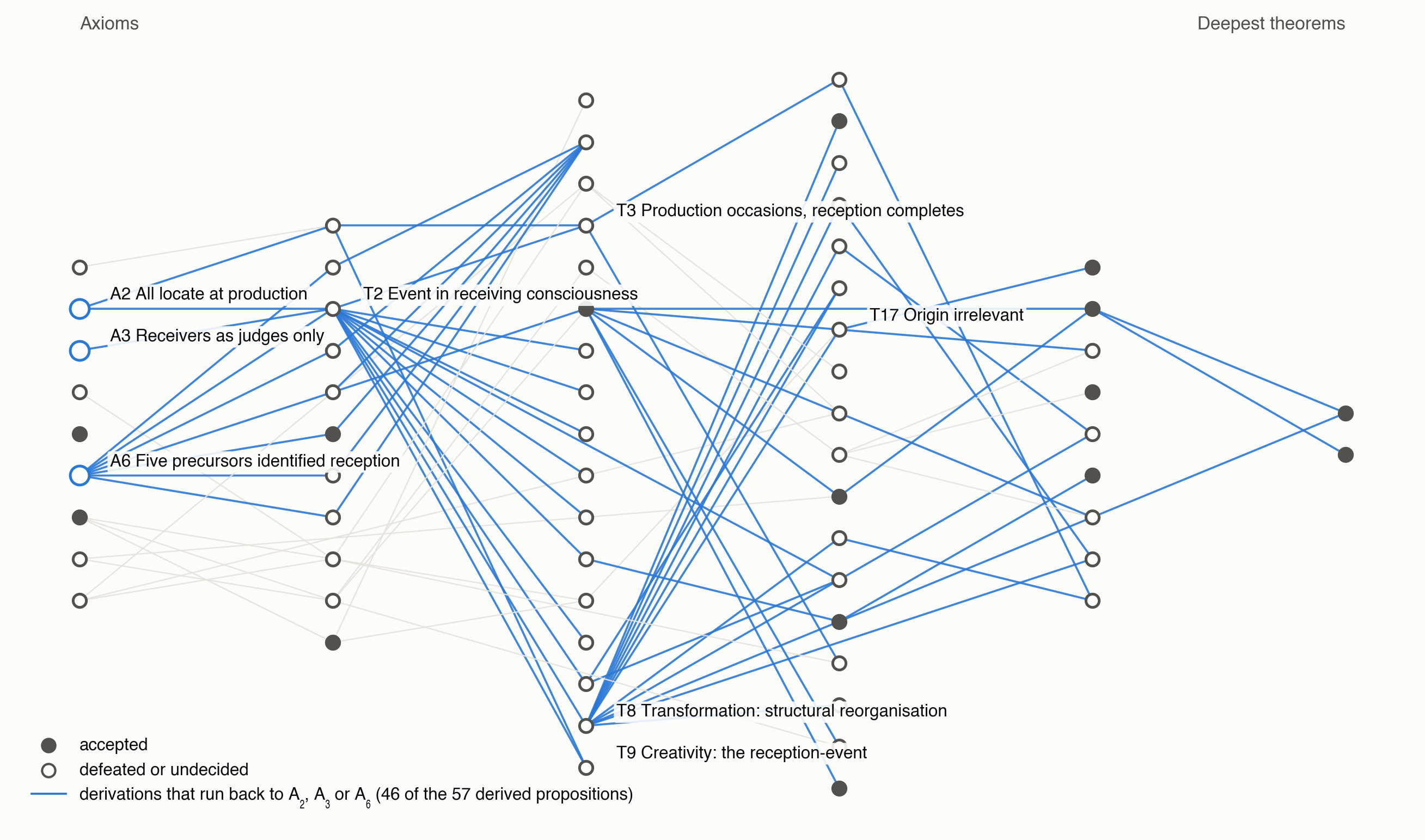
Stengersthe form

A century of creativity research has produced dozens of competing frameworks without convergence. We argue that the proliferation reflects a structural absence shared by every major account: all locate creativity prior to or at the moment of production. The receiver appears, when at all, as judge or validator — never as the site where the constitutive event occurs.

Drawing on Gadamer's hermeneutics, the reception aesthetics of Iser and Jauss, Whitehead's process philosophy, Gell's anthropology of art, Rancière's emancipated spectator and Bourdieu's field analysis, we develop an alternative. Creativity is an event constituted in receiving consciousness when encounter with a form occasions structural transformation — persistent reorganisation of conceptual relations, perceptual categories, affective dispositions or practical orientations. Production creates occasions for this event; reception completes them.

The framework resolves paradoxes that production-centred accounts generate (attribution, temporal location, cross-cultural scope, democratisation, evaluation and collaboration) and reorients practical domains including education, cultural policy, institutional design and evaluation practice. A Bourdieusian analysis explains why reception has been structurally excluded from the field. We specify transformation rigorously, distinguish it from adjacent phenomena, name the framework's genuine limits and defend it against eight objections. The paper concludes by submitting to its own criterion: as a form offered to reception, it cannot declare its own creativity. That determination belongs to its readers.

Chapter 1: The Absent Question

1.1 The Absent Question

Something has been left out of the study of creativity for over a century, and nobody seems to have noticed.

We have located creativity in the unconscious, in divergent thinking, in personality traits, in stages of cognitive processing, in the properties of novel and useful products, in the social systems that certify contributions to a domain. These are not trivial accounts. Each has generated genuine knowledge, refined through decades of work. But they share a structural feature that, once noticed, is difficult to unsee: all of them locate creativity prior to or at the moment of production. The question they answer is some version of where does creativity come from? From the person, the process, the product, the social system.

The question they do not ask is what happens in the consciousness that encounters what has been produced.

This is not to say that receivers are entirely absent. Csikszentmihalyi's systems model includes a social field that evaluates contributions.^[Csikszentmihalyi 1988.] Product-centred frameworks acknowledge that someone must judge novelty and usefulness. Social accounts recognise that audiences respond to and contextualise work. Reception appears. But always in a subordinate role — as validator, as judge, as market. Never as the site where creativity is constituted.

The question of whether something happens in receiving consciousness — something structural, persistent and reorganising — and whether that something is the event properly called creativity, has not been posed as a question about creativity. It has been posed, with sophistication, in adjacent fields. Gadamer theorised understanding as a transformative event.^[Gadamer 2004, 305 [VERIFY].] Iser argued that the literary work is completed in reading.^[Iser 1978 [VERIFY].] Jauss made the history of reception constitutive of aesthetic meaning.^[Jauss 1982 [VERIFY].] Rancière challenged the assumption that spectators are passive.^[Rancière 2009.] But these insights have not been imported into creativity research. The receiver remains theoretically invisible at the precise point where, we argue, the constitutive event occurs.

This matters. It matters because if we are looking in the wrong place for creativity, then everything we build on that mislocation — educational programmes, cultural policies, evaluation practices, the entire discourse of "creative industries" — is oriented around the wrong object. We cannot afford to get this wrong and continue as if it does not matter. Stengers teaches us to ask what a theoretical practice requires, what it assumes in order to proceed.^[Stengers 2010.] We are asking that question of creativity research itself. The answer is troubling.

1.2 The Claim

Creativity is an event constituted in receiving consciousness when a form occasions structural transformation. It is not a property of persons, processes, products or social systems. It does not inhere in the maker or in the artefact awaiting encounter. It is an occurrence — something that happens, or fails to happen, at the intersection of a bounded form, the conditions enabling encounter and a consciousness capable of being reorganised by what it meets.

Production creates occasions for creativity. Reception completes them. Without the completion — without structural transformation in the receiver — the creativity-event has not occurred, however accomplished the produced form may be in other respects.

1.3 What This Paper Does

The argument proceeds in stages. Chapter 2 surveys the landscape of creativity frameworks and identifies the structural absence they share. Chapter 3 develops the core framework: six interlocking concepts — form, encounter, transformation, creativity, occasion and completion — that relocate creativity from production to reception. Chapter 4 establishes the theoretical lineage, drawing on hermeneutics, reader-response theory, process philosophy, the anthropology of art, affect theory and predictive processing to show that the framework's commitments are not unprecedented but have not previously been assembled as a theory of creativity. Chapter 5 provides a political economy of creativity research, using Bourdieu's field analysis to explain why reception-focused accounts have been structurally excluded. Chapter 6 grounds the framework anthropologically, examining how encounter-conditions vary across historical and cultural contexts. Chapters 7 through 9 demonstrate what the framework resolves — including the persistent puzzle of why collaborative arrangements designed to amplify creativity so often fail — what it implies for practice and policy and where it connects to existing empirical findings. Chapters 10 and 11 defend the framework against anticipated objections and name its boundaries. Chapter 12 concludes.

1.4 What This Paper Does Not Do

A clarification at the outset. The claim that creativity is constituted in reception is not a claim that production does not matter. The labour of making — the years of training, the craft knowledge, the sustained attention that goes into producing a form capable of occasioning transformation — is not diminished by relocating the constitutive event. What changes is the ontological status of that labour: it is the creation of an occasion, not the completion of a creativity-event. Producers make forms. Some of those forms are structured so as to occasion transformation in receivers who encounter them under enabling conditions. The skill and intention with which a form is produced may substantially affect its occasioning-potential — Chapter 10.5 addresses this directly. But occasioning-potential is a relational property, not an intrinsic one.

We do not propose that all encounters are transformative, that all responses count as creativity-events or that the quality of produced forms is irrelevant. On the contrary: the framework's account of transformation is demanding, and most encounters — even sustained and attentive ones — do not produce it. The rarity of genuine transformation is a feature, not a deficiency. We propose a change in where we look for the constitutive event, not a flattening of the distinctions that matter within it.

1.5 A Reflexive Commitment

I should be clear about one further commitment, because the argument applies to itself.

What we have written is a form. It is a bounded configuration of arguments, distinctions and claims, produced with whatever craft and attention I have been able to bring to it, and offered to readers who may or may not encounter it under conditions that enable reception. If the argument is correct — if creativity is constituted in the structural transformation of receiving consciousness — then its creativity will not be determined by me. It will be determined by what it occasions in the readers who engage with it. I cannot know, writing these words, whether the encounter with this argument will reorganise anything in how a reader thinks about creativity, about reception, about the relation between making and encountering. That is not mine to determine.

This is not false modesty. It is our own requirement, applied without exemption to the text that articulates it. We commit to enacting our own criterion. We return to this commitment at three further points: in Chapter 5.5, which acknowledges the field-position from which the argument is made; in Chapter 10.6, which addresses the reflexivity objection directly; and in Chapter 12.5, which closes the thread. Throughout, we accept that we cannot declare our own creativity. Only reception can confer that — or withhold it.

Chapter 2: The Landscape — Frameworks and Their Shared Absence

2.1 Five Bets

Stengers teaches us to ask of any theoretical practice: what does it require? What must it assume in order to proceed? Each assumption is a wager — a bet, in the strongest sense. Not a hypothesis to be tested but a commitment that organises what the practice can and cannot see. A bet determines the table as much as the game. We borrow her diagnostic here because creativity research needs it badly.

A century of work has produced not one theory but dozens — diverging in method, in disciplinary affiliation, in what they take to be the core phenomenon. This proliferation is not a sign of theoretical maturity. It is a sign that something has not been settled, and perhaps that something has not been asked.

But the diversity is instructive, because beneath it lies a convergence that the field has not examined. Every major framework places its bet on the same side of the table. They disagree about almost everything except where to look.

The bet on the person. One cluster of frameworks locates creativity in the properties of individuals — cognitive styles, personality traits, specific mental capacities. Guilford's (1950) address to the American Psychological Association, widely treated as inaugurating the modern empirical study of creativity, proposed divergent thinking as the defining characteristic.^[Guilford 1950.] Amabile's (1983) approach identifies three necessary conditions located in the individual: domain-relevant skills, creativity-relevant cognitive processes and intrinsic task motivation.^[Amabile 1983.] The question these frameworks ask is clear: what distinguishes the person who creates from the person who does not? The answer is always a set of capacities residing within the individual. This is a bet — a wager that the right place to look for creativity is inside the producer.

The bet on the process. A second cluster locates creativity not in who the person is but in what their mind does. Wallas's (1926) four-stage model — preparation, incubation, illumination, verification — remains widely cited as a phenomenological description of how insight arises.^[Wallas 1926.] The question shifts from who to how: through what cognitive operations does the creative moment come about? The bet is that creativity lives in the sequence, not the person — but the sequence is still a production sequence. We are still watching the maker make.

The bet on the product. A third cluster defines creativity by properties of the output. Novelty and usefulness — or novelty and appropriateness — are the conjunctive criteria most commonly invoked. Boden's (2004) analysis distinguishes combinatorial, exploratory and transformational creativity as types of product-generated novelty.^[Boden 2004.] The question becomes: what makes a product creative? The answer is a set of properties ascribable to the output itself. The bet is that creativity inheres in the thing made, waiting to be recognised.

The bet on the system. A fourth cluster — and this is where it gets interesting — locates creativity in the interaction between an individual, a symbolic domain and a social field. Csikszentmihalyi's (1988) systems model, which we examine in detail below, is the most fully elaborated version.^[Csikszentmihalyi 1988.] These frameworks represent a genuine advance on individualist accounts. They refuse the fiction of the lone genius. They situate creative output within social and institutional processes. The bet is more sophisticated: creativity is not in the person or the product but in the system that produces and validates both. And yet — we shall see — the receiver still appears only as judge, never as site.

The bet on the collective. A fifth cluster extends the systems insight further, locating creativity in distributed or collaborative processes rather than in any single individual. Sawyer (2007) analyses the emergence of creative outcomes from group improvisation.^[Sawyer 2007.] Glăveanu (2014) argues for a distributed model in which creativity is constituted by the interaction of self, others and cultural affordances.^[Glăveanu 2014.] These are the frameworks that go furthest towards socialising creativity — and even they locate the creative event in the collaborative production process. Sawyer traces how the ensemble's output emerges from real-time interaction. Glăveanu maps the network through which creative output is generated. Both are production accounts extended to the collective level. They ask how the group produces, not what happens in each participant's consciousness when they encounter what another has contributed. The collaborator appears as co-producer, not as receiver. The question of whether encountering a colleague's contribution occasions structural transformation — a reorganisation of the schemas through which the receiver subsequently perceives and acts — is not one these frameworks pose.

Five bets. Five different ways of answering the question "where is creativity?" And all five place it on the same side: in the producer, the production process or the produced thing. Even when the social appears — and in the systems and collaborative frameworks it appears prominently — it appears as a mechanism of production or validation. The social is about creativity. It is not where creativity occurs.

2.2 The Best of Them: Csikszentmihalyi

It is worth dwelling on the systems model, precisely because it goes furthest towards incorporating the social — and therefore reveals most clearly the structural limit that all five clusters share.

Csikszentmihalyi proposes three interacting components. The Domain is a symbolic system — the set of rules, representations, notations and practices constituting a field of endeavour, whether mathematics, music, painting or something else. The Field is the social organisation of persons — gatekeepers, critics, editors, curators, teachers, peers — who control access to the domain and evaluate contributions. The Individual is the person who, having internalised the domain's symbolic resources, produces variations that the field may or may not select for incorporation back into the domain. Creativity, on this account, is the result when a variation produced by an individual is recognised and selected by the field as a genuine contribution to the domain.

The advance is real. It replaces the myth of inspiration and the fiction of genius with a social account: what counts as creative is determined not by the properties of the individual alone, nor by the properties of the output alone, but by the evaluative activity of a social system.

But consider what the Field member does in this account. The Field member evaluates. Selects. Recognises a contribution as belonging to the domain. What the model does not address is what happens in the Field member's consciousness during that evaluation. Is the encounter with the work transformative? Does it alter how the Field member subsequently perceives the domain? Does the work reorganise anything in the person who encounters it, or does it simply pass through the machinery of evaluation and emerge with a label attached?

Csikszentmihalyi's Field is a judge. A gatekeeper. A validator. It is not a site where something occurs. The Field certifies creativity; it is not where creativity is constituted. The receiver appears in the model, but only in their institutional role — as arbiter, not as the locus of an event. The question of what encountering a form does to a consciousness is simply not one the model needs to ask. The model's interest is in social mechanisms of recognition, not in what contributions occasion in the persons who encounter them.

This is not a deficiency in Csikszentmihalyi's model so much as a revelation of what the model was built to explain. It was built to explain how creative products are socially ratified. It was not built to explain what happens when someone encounters a form and is changed by it. The two are different questions. The field has overwhelmingly pursued the first.

2.3 The Pattern

Let us name the pattern clearly. Person-centred frameworks ask what cognitive or dispositional properties produce creative output. Process-centred frameworks ask through what mental operations creative insight arises. Product-centred frameworks ask what properties make an output count as creative. Systems-centred frameworks ask through what social mechanisms creative status is conferred. Social and collaborative frameworks ask how the creative process is distributed across participants and contexts.

These are not trivial questions. Each cluster has generated genuine knowledge — empirically grounded in some cases, phenomenologically rich in others. The point is not to dismiss them. The point is to observe what they collectively fail to ask.

None of the five clusters poses the following question: what occurs in a receiving consciousness when an encounter with a form occasions structural reorganisation of that consciousness?

The frameworks notice that audiences exist. They do not ask whether audiences are the site of the creativity-event itself.

The absence is structural, not incidental. It follows from how these frameworks delimit the phenomenon. If creativity is defined as a property of persons, processes or products — as something that can be present or absent in the output before anyone has encountered it — then the question of what encounter does to the receiver becomes secondary at most. The event-character of creativity, its occurrence in the consciousness of the person who is transformed, falls outside the frame these frameworks have drawn.

2.4 The Missing Question

We need to be precise about what has been left out. The missing question is not whether audiences matter to creativity. Most frameworks acknowledge, in some form, that audiences validate, respond to or contextualise creative work. Csikszentmihalyi's Field is composed entirely of people who engage with the work. Sawyer's and Glăveanu's accounts are centrally concerned with social processes. Reception is not ignored. It is subordinated.

The missing question is more precise: is the event that occurs in a receiving consciousness — when encountering a form occasions structural reorganisation of that consciousness — constitutive of creativity itself, rather than its validation or its social consequence?

What makes this absence surprising is that adjacent fields have posed precisely this question and developed substantial answers to it. Reader-response theory made the reader constitutive of the literary work decades ago. Iser proposed that the literary text is only one pole of the literary work; the other is the realisation accomplished in reading.^[Iser 1978 [VERIFY].] Jauss argued that the work's meaning is inseparable from the history of its reception, and that aesthetic value is partly the measure of the challenge a work presents to the horizon of expectation a reader brings to it.^[Jauss 1982 [VERIFY].] Gadamer theorised understanding as a transformative event — a fusion of horizons in which the interpreter is altered in the encounter.^[Gadamer 2004, 305 [VERIFY].] These traditions have produced sustained theoretical accounts of what reception does to the receiver. They have not, by and large, been imported into creativity research.

That absence is not accidental. We argue in Chapter 5 that the production-bias of creativity research is structurally produced — a function of who benefits from locating creativity in persons and products rather than in transformative events distributed across receivers. For now, it is sufficient to note that the persistence of the absence across the full range of frameworks, from psychometric to sociocultural, is itself a finding requiring explanation.

We propose a different starting point. Not the person who produces a form, nor the properties of the form produced, but the event that occurs — or fails to occur — when a consciousness encounters a form and is changed by it. That is what we developed in Chapter 3. Let us now trace the thinkers who came closest to seeing it.

Chapter 3: The Framework — Creativity as Reception-Completion

3.1 The Missed Question

We have studied creativity for more than a century. We have looked at the minds of composers, the habits of inventors, the personalities of prize-winners, the conditions of laboratories, the structures of organisations, the outputs of algorithms. We have looked everywhere except in the one place where creativity actually happens.

This matters. It matters because the question of where creativity is located is not a decorative philosophical puzzle — it is the load-bearing wall of every practical decision we make about education, cultural policy, institutional design and the distribution of resources. If creativity lives in the producer, we invest in identifying and cultivating producers. If it lives in environments, we engineer environments. If it lives in processes, we optimise processes. Each location implies a different politics, a different economics, a different pedagogy. We have been building on a foundation we never examined.

What if creativity does not live in any of these places?

Consider a scene. A teenager in a provincial library picks up a novel — let us say it is Toni Morrison's Beloved. She reads it over three days. When she finishes, something has changed. Not just that she has learned about American slavery, though she has. Not just that she was moved, though she was. Something in the architecture of how she understands the relationship between language and silence, between what can be spoken and what resists speech, has shifted. She cannot quite articulate it. But in the weeks that follow, she finds herself reading differently, listening differently, noticing things in conversation that she would previously have let pass. Her teachers, if they were paying attention, might say she had become more perceptive. What they would mean, without knowing they meant it, is that her consciousness has been structurally reorganised by an encounter with a form.

Where was the creativity in that scene? Morrison finished writing Beloved in 1987. The teenager read it twenty years later. Morrison's act of writing was complete long before this encounter occurred. If we locate creativity in the act of production, then the creativity happened in 1987 and what happened in the library was something else — appreciation, reception, response. But that division misses what is most significant about the scene. The most consequential event — the structural reorganisation of a consciousness — happened in the library, not at Morrison's desk. Morrison created the occasion. The teenager completed it.

This is the claim we need to examine: that creativity is an event constituted in receiving consciousness when encounter with a form occasions structural transformation. Production creates occasions for creativity. Reception completes them — or fails to.

Let us slow down here, because every word in that formulation is doing work. We need six concepts, and we need each of them to be precise.

3.2 Six Concepts

Form. Return to the library scene. The novel is a form — a bounded configuration capable of being encountered. The category is wider than it first appears. A painting is a form. A mathematical proof laid out on a page is a form. A rock formation encountered on a hillside is a form. The output of an algorithm is a form. A gesture, a ritual, a musical phrase — all forms, provided they meet two conditions: they must have boundaries (a beginning and an end, an edge, a frame, some principle of delimitation) and they must have structure enough to become objects of consciousness. Arguably, even our own thoughts are forms. White noise is not a form. A melody extracted from that noise is. A fog of half-remembered impressions is not a form. A poem that crystallises one such impression is. The point is not that forms must be made by human hands — nature produces forms, algorithms produce forms, accident produces forms — but that they must be sufficiently delimited for a consciousness to meet them.

Encounter. The teenager did not merely possess the novel. She was not simply exposed to it — the book did not sit on her shelf unopened while something called creativity occurred. She read it with attention over three days. She met the form under conditions that enabled reception: she had time, she had sufficient quiet, she had enough prior experience of reading to engage with the prose and she had — this matters — the capacity for uptake that Morrison's prose demanded. Encounter is a consciousness meeting a form under conditions that enable reception. Mere exposure is not encounter. Walking past a painting while checking one's phone is exposure. Stopping, looking, allowing the form to register as an object of sustained attention — that is the beginning of encounter. The conditions are not trivial. They can be structurally withheld: by enforced deprivation, by exhaustion, by institutional indifference, by the sheer noise of a culture that produces more forms than any consciousness can meet. Encounter is already a political concept, though we reserve its political dimensions for later.

Transformation. Here is the lynchpin. The teenager was not merely informed by Morrison's novel. She was not merely moved. Something in the structure of her consciousness — the relations between her concepts of language and silence, speech and resistance — was reorganised. Transformation is structural reorganisation in a receiving consciousness: alteration of conceptual relations, perceptual categories, affective dispositions or practical orientations that persists beyond the encounter and manifests in subsequent cognition and action. The key words are persists and manifests. Transformation is not something that happens and then subsides. It leaves the consciousness differently configured. Someone reads a novel set in a culture remote from their own and returns to their familiar streets unable to perceive them in quite the same way. That is transformation.

Creativity. On the account we are developing, creativity is the event of transformation occasioned by encounter with form. The word event is important here. Creativity is not a property that belongs to agents or artefacts or processes, it is not a substance. It does not inhere in the person who produces a form, nor in the form itself as it waits to be encountered, nor in some faculty of the human mind awaiting exercise. It is an occurrence — something that happens, or fails to happen, at the intersection of form, encounter-conditions and a receiving consciousness. When a piece of music heard for the first time reorganises a listener's sense of what music can do — altering not just preferences but understanding of structure, of silence, of what sounds can be made to mean — a creativity-event has occurred. The event is not in the music. It is in the listener.

Occasion. Forms do not cause transformation. They occasion it — they make it possible without guaranteeing it. This distinction matters more than it first appears. Occasioning is probabilistic, not deterministic. The same novel may occasion structural reorganisation in one reader and merely inform another. The form is identical; the occasioning-status differs, because it depends on the relation between form, receiver and encounter-conditions, never on the form alone. When we say some forms are better structured to occasion transformation than others, we mean they have higher probability of occasioning transformation across a wider range of receivers and conditions. We do not mean that occasioning-potential is inscribed in the form independently of any encounter. A form sitting in a vault, unencountered, occasions nothing. Occasioning is relational. Always.

Completion. Consider the strangeness of this: a form awaits completion in a non-trivial sense. Not merely awaiting an audience but awaiting the event that constitutes it as the site of a creativity-event at all. Until transformation occurs in a receiving consciousness, the form has produced no creativity-event, however accomplished it may be in other respects. Production creates occasions for creativity. Reception completes them. This is what is missing from every theory that stops at the moment of making.

These six concepts — form, encounter, transformation, creativity, occasion, completion — constitute the framework. They are interlocking: remove any one and the others lose their purchase. But the lynchpin is transformation. If we cannot specify what transformation is and is not, the entire account collapses into vagueness. Let us do that work now.

3.3 What Transformation Is Not

Transformation is the lynchpin, and a lynchpin that has not been stress-tested is no lynchpin at all. We need to be precise about what we are excluding.

Transformation is not emotional response. A piece of music moves a listener to tears — something real has happened. But unless the weeping leaves the listener's affective structure differently configured, unless subsequent emotional life is in some way altered, no transformation in the relevant sense has occurred. Emotions pass. The capacity to be moved by a certain kind of music may persist unchanged. Emotional response without a reorganisation of the underlying structure is not transformation.

Transformation is not information acquisition. Learning that the capital of a country one had not previously known about is a city one has never heard of adds content to consciousness but need not reorganise anything. The existing schema accommodates the new datum without strain. This is learning — valuable, pervasive, not to be dismissed — but it is not transformation.

Transformation is not association. Two ideas can become linked — the smell of a particular wood can come to evoke a specific afternoon — without the relations between the broader structures in which those ideas are embedded being altered. Association enriches without necessarily reorganising.

Transformation is not aesthetic pleasure, however intense. A painting can produce sustained and heightened pleasure in a viewer who emerges from the encounter with all their conceptual and perceptual structures exactly as before. Pleasure registers. Transformation reorganises. The two are not opposed — genuinely transformative encounters are frequently pleasurable — but pleasure alone is not sufficient.

What these exclusions share is important. Each describes something that happens to a consciousness in the presence of a form, something real and sometimes valuable, but none of them alters the structural relations between the elements of that consciousness. Content is added, feelings are activated, links are formed, pleasure is experienced — and the architecture remains as it was.

3.4 What Transformation Is

Positively characterised, transformation is closer to what Piaget identified as accommodation than to what he called assimilation — but it goes further.^[Piaget 1970.] In Piaget's framework, assimilation names the fitting of new data into existing schema: the schema bends slightly to accommodate the input while remaining recognisably itself. Accommodation names the modification of schema to fit data that cannot be assimilated without distortion. Transformation, as the concept functions here, is stronger than accommodation. It involves not the modification of an individual schema but the reorganisation of the relations between schemas — not just that a particular concept changes but that the network of relations in which concepts are embedded is reconfigured.

Consider what happens when someone who has grown up entirely within Western tonal music — the diatonic scale, functional harmony, the tonic-dominant axis as the spine of musical expectation — first encounters modal music or a work built on microtonal intervals. One response is accommodative: the listener registers that music can sound like this, updates their understanding of what the word "music" covers and proceeds. The existing schema expands at its margins. This is learning, and it is not negligible. But it is not transformation.

A different response is possible. The encounter occasions a reorganisation in which the listener's prior musical formation comes to appear differently — not as the natural shape of what music is, but as one historically particular possibility among others, contingent rather than universal. The reorganisation is retroactive: the listener now hears their familiar music differently. Where before a dominant seventh moving to a tonic was simply resolution — the thing itself — it becomes one structural convention among possible conventions, weighted with historical and cultural specificity that was previously invisible. The prior state has been reorganised from the inside.

This retroactive character is the key phenomenological marker of transformation. Learning adds; transformation reorganises what came before. After genuine transformation, the receiver cannot simply un-encounter the form that occasioned it: the schema from which that un-encountering would have to operate is itself the schema that has been altered.

Four dimensions specify how transformations differ from one another. Depth: how far the reorganisation reaches into the receiver's schema-structure — a surface transformation alters peripheral schemas; a deep transformation alters foundational ones. Persistence: how long the reorganisation holds — some transformations are durable; others fade as the conditions that sustained them recede. Scope: how much of the receiver's schema-network is affected — a narrowly scoped transformation alters one domain while leaving adjacent domains untouched; a broadly scoped transformation cascades across domains. Generativity: how much new transformation-capacity the event creates — some transformations leave the receiver more capable of subsequent transformations, sensitised to registers of form that were previously unavailable.

These dimensions are independent. A creativity-event that is shallow, brief, narrow and non-generative is still a creativity-event. The framework does not privilege the profound over the modest. But the differences matter for every practical application — for education, for cultural policy, for evaluation. An institution that produces generative transformations is doing something qualitatively different from one that produces non-generative ones, even if both register transformation by every other measure.

This means creativity, on the present account, is rare. Most encounters produce assimilation at most. Many produce nothing detectable. Only occasionally does an encounter with form occasion the kind of structural reorganisation we are describing. This rarity is not a deficiency. It is a feature. A definition of creativity that makes it common is describing a different phenomenon — one better addressed by the frameworks we survey in Chapter 2 and distinct from what makes creativity significant in the sense this account pursues.

3.5 Where Forms Come From (And Why It Does Not Matter)

Forms arise from many sources. Human intention produces paintings, novels, musical compositions, architectural works. Nature produces configurations no intention shaped — landscapes, coastlines, storm formations, the arrangement of stars. Social life produces patterns of interaction — rituals, ceremonies, the choreography of everyday gesture. Mathematical and logical work produces abstract structures — proofs, theorems, formal systems laid out on a page. Algorithmic processes produce patterns — the outputs of computational and AI systems that can be met as objects of consciousness.

The purpose of this taxonomy is not to rank these categories. The purpose is to make one claim clearly: the origin of a form does not determine its occasioning-status. Whether a form occasions transformation in a receiver depends on the encounter and the receiver, not on how the form came to be. A rock formation, a formal proof and a symphony composed over three years can all occasion transformation in principle. The intentionality — or its absence — with which a form was produced is irrelevant to whether encounter with it reorganises a receiving consciousness.

This matters in several directions. It removes the need to settle contested questions about whether natural configurations are or can be beautiful before acknowledging that encountering them can occasion transformation — and it clarifies that the gradual elaboration of mathematical structures by communities of practice, with no single composer directing the result, does not diminish their occasioning-potential. Think of the first time a student encounters Cantor's diagonal argument. The proof was not authored in any ordinary sense. It emerged from a tradition. And it can reorganise a consciousness as profoundly as any painting. The implication for algorithmic outputs, including those of AI systems, follows directly: the question of whether such outputs can occasion transformation is entirely separate from the question of whether the system that produced them has anything we might want to call experience or intention. Whether an algorithmic form occasions transformation in a receiver is an empirical question about encounter. Whether there is anything it is like to be the system that produced it is a different question entirely.

The relationship between form and transformation is one of occasioning, not causation. Forms make transformation possible. They do not guarantee it. A form capable of occasioning transformation may fail to do so — because the encounter-conditions are absent, because the receiver lacks the capacity for uptake, because the encounter is too brief. The language of occasioning captures this: forms make transformation possible without determining it. Whitehead gives us the philosophical grounding for this relation — in his process cosmology, actual occasions do not cause one another mechanically; they provide the data that each subsequent occasion integrates.^[Whitehead 1978, 21 [VERIFY].] The relationship is one of enablement, not determination. We restrict this cosmological insight to the human scale, but the structural logic holds.

3.6 When Creativity Happens

The creativity-event has four temporally distinct moments, and keeping them separate is essential if the account is not to collapse back into the production-location it is designed to replace.

Production is the making, configuring or presentation of a form. The sculptor completes the work. The novelist types the last sentence. The proof is written out and checked. Something has been accomplished, and it is not nothing. But production is not yet a creativity-event. What production creates is an occasion — a form structured so as to make possible, for certain receivers under certain conditions, the encounter that may occasion transformation. The occasion is not the completion.

Encounter is the meeting of a consciousness with a form under enabling conditions. It is the beginning of the creativity-event but not yet its completion. The receiver is present with the form. Attention is engaged. Contextual framing has made the form available as an object of consciousness. But whether transformation will occur remains undetermined.

Completion is the moment when transformation occurs. This is the creativity-event — the structural reorganisation in a receiving consciousness that constitutes creativity rather than merely producing its conditions. It is this moment, not the moment of production, that we identify as the location of creativity.

Re-completion names the structural feature that follows: the same form can occasion transformation in different receivers, at different times, under different encounter-conditions. Each completion is a distinct event. The form is identical across completions. The events are not.

Consider two examples. Van Gogh's The Starry Night, completed in 1889. The work was produced at one time, but the creativity-events in which it participates have occurred across the subsequent 135 years and continue to occur.^[Van Gogh's works received little recognition during his lifetime; the first major retrospective was held in Paris in 1901, and sustained critical and public recognition followed only in the early twentieth century. See Naifeh and Smith 2011.] The creativity of the work is not fixed at the moment of production — it is constituted in each encounter that occasions transformation in a receiver and remains capable of being constituted again. This is why certain works appear to become, in the common phrase, "more creative" over time — not because the form has changed but because encounter-conditions shift, new receivers come to it and the space of possible transformations it occasions expands. It explains equally why other works, once celebrated, become unremarkable: the horizon of expectation that once made them challenging has shifted so far towards them that encounter produces assimilation rather than transformation. And it explains why rediscovered works can seem suddenly profound — not because they were hidden treasures but because the encounter-conditions that enable transformation are now in place in a way they previously were not.

Or consider a different kind of form: the twelve-bar blues progression. Produced by no single author, elaborated across a tradition, it has occasioned transformation in receivers for over a century — and the creativity-events it occasions in a Delta juke joint, in a London club in 1963 and in a contemporary hip-hop sample are structurally distinct completions, each constituted by different encounter-conditions meeting the same form.

Production creates occasions. Reception completes them. The creativity-event is distributed across time in a way that makes any account locating it purely in production structurally incomplete.

3.7 How It Fails

If the creativity-event requires form, encounter and transformation, there are three structurally distinct ways it can fail to occur. Each failure mode has a different causal structure. Each implies a different kind of response.

Encounter-conditions failure. The receiver is in the vicinity of the form — the painting is on the wall, the book is in hand — but the conditions enabling encounter are absent. There is no time, or no attention, or the contextual framing that would allow the form to register is missing, or the receiver lacks the capacity for uptake that the form requires. What results is exposure without encounter. The form is not met. No transformation is possible. The intervention implied is the creation of enabling conditions: time, attention, framing, the institutional and material support that makes sustained encounter possible. Without these, no amount of additional production or distribution will produce creativity-events.

Form failure. Encounter occurs but the form lacks the structural properties needed to occasion transformation in this receiver. The form is too familiar — it is assimilated without strain into existing schema and produces no purchase for reorganisation. Or it is too simple — there is nothing in its structure that exceeds the receiver's current schema. Or it is too incoherent — it presents no stable structure for consciousness to meet. In each case, encounter proceeds but transformation does not follow. The intervention implied is graduated encounter with structurally richer forms — forms that exceed the receiver's current schema without exceeding it so entirely that no engagement is possible.

Schema-lock. This is the hardest case. The receiver's schema-structure is so rigid — through the effects of trauma, entrenched ideology or prolonged habituation — that every encounter is assimilated. Nothing can gain purchase for accommodation, let alone transformation. The form may be rich. The encounter-conditions may be excellent. But the receiving schema closes around every input and returns it to the prior state. The intervention implied here cannot be addressed at the level of form or encounter-conditions alone: it requires graduated encounters over time, conditions that allow for the lowering of defensive assimilation or the disruption of the locked schema from within a community of practice or a therapeutic relation.

These three failure modes have different causal structures and require different responses. Conflating them — treating all failures to occasion transformation as cases of insufficient exposure to forms — has been a systematic error in educational and cultural policy. Exposure is an intervention only for the first failure mode. We return to these distinctions and their practical consequences in Chapter 8.


We have our framework. Six concepts, precisely specified. A claim about where creativity is located — in reception, not production. A temporal structure that explains why the same form can occasion transformation at one time and leave consciousness undisturbed at another. A taxonomy of failure that distinguishes problems we tend to conflate. These are not decorative distinctions. They change what we look for, what we measure, what we fund, how we teach. What we do not yet have is the landscape against which this framework becomes visible — the century of research that looked everywhere else. We turn to that now.

Chapter 4: Theoretical Lineage — Reception Across Traditions

4.1 Duchamp: The Founding Statement

The clearest statement of what we are proposing was made in 1957 — and then, remarkably, left on the table.

In April of that year, Marcel Duchamp addressed the American Federation of Arts in Houston. The address runs to approximately fifteen hundred words. Its argument, stripped of qualification, is that the creative act is not completed at the moment of production. "All in all, the creative act is not performed by the artist alone; the spectator brings the work in contact with the external world by deciphering and interpreting its inner qualifications and thus adds his contribution to the creative act."^[Duchamp 1957, 28–29.]

The vocabulary is deliberate. Duchamp uses the word transubstantiation — a change of substance, not of appearance. The work does not become art by virtue of having been made. It becomes art in the spectator's encounter with it. And creative status is not conferred at production: "The artist may shout from all the rooftops that he is a genius: he will have to wait for the verdict of the spectator."^[Duchamp 1957, 28–29.]

Why did the insight stop here? Duchamp says the spectator "adds his contribution" — an additive formulation that still implicitly treats the work as the primary site, with the spectator's activity supplementing something already substantially achieved. We use the language of completion rather than contribution. The spectator does not add to the creative act — the creative act occurs in the spectator. The difference is ontological, not merely verbal. Duchamp names the two-pole structure. We specify what happens at the receiver pole: structural transformation in a receiving consciousness.

4.2 Gadamer: What Understanding Does to You

If Duchamp provides the provocation, Gadamer provides the philosophy.

Hans-Georg Gadamer's Truth and Method is not an aesthetics in the narrow sense. It is an account of understanding as such — arguing that what human beings call understanding is not a method applied from outside to an object, but an event in which the understanding consciousness is itself implicated and potentially changed.^[Gadamer 2004.] The key concept for our purposes is the fusion of horizons (Horizontverschmelzung). Every interpreter approaches a form from within a particular horizon — the range of vision available from their current situation. "Horizons change for a person who is moving."^[Gadamer 2004, 304 [VERIFY].] Genuine understanding is the event in which the interpreter's horizon and the horizon of the form are brought into contact and fused: "Understanding is always the fusion of these horizons supposedly existing by themselves."^[Gadamer 2004, 305 [VERIFY].] Neither horizon remains intact after the fusion.

Two further concepts are directly relevant. Bildung — formation or cultivation — names the process by which a person is shaped through encounter with what exceeds their current formation. It is Gadamer's closest prior concept to what we call transformation. The self is not a fixed entity that acquires knowledge; it is constituted and reconstituted through what it encounters. Wirkungsgeschichte (effective history) designates the fact that we are never neutral with respect to tradition: the history of prior encounters is always already operative in shaping what we can understand. There is no encounter from nowhere.

A tension must be named. For Gadamer, the fusion of horizons is mutual: both the interpreter and the form are transformed. We propose an asymmetric account. The form is not changed by being encountered — the painting is the same after every viewer has stood before it. Only the receiver is structurally transformed. What may change about the form in a social or historical sense — shifting reputation, accumulated interpretations — is a social process, not the same event as the reorganisation of a receiving consciousness. Gadamer is correct that genuine understanding is not mere assimilation. We build on this while restricting the scope: transformation in our sense is a specific sub-class of encounter, and its site is unambiguously the receiver.

4.3 Iser and Jauss: The Reader Who Constitutes

Wolfgang Iser and Hans Robert Jauss, working from the Constance School of reception aesthetics in the late 1960s and 1970s, together constitute the most developed programme for relocating the literary work from text to reception.^[Iser 1978; Jauss 1982.]

Iser's contribution is phenomenological. The literary work exists neither fully in the text nor fully in the reader but in the dynamic interaction between the two. Literary texts are structured by what Iser calls Leerstellen — blanks, gaps, points of indeterminacy that the text withholds and the reader must supply. Reading is not passive reception. It is an activity of gap-filling, consistency-building, projection and revision. At each point in the sequential encounter, the reader draws on memory of what has passed and anticipation of what is to come. The reader constitutes the work in the act of reading.

What Iser demonstrates for literary reading is precisely the active, constitutive character of reception that Duchamp asserted and we theorise. But here is where we must push further. Iser's reader is always already a competent schema-builder; the reader's capacity for consistency-building is presupposed, brought to the text and exercised. The question Iser does not pose is what happens when the encounter reorganises that capacity itself. Filling a blank is not transformation. Having the blank-filling apparatus structurally reconstituted is.

Jauss brings history to the argument. His master concept is the horizon of expectation (Erwartungshorizont): every reader approaches a work with a set of prior expectations derived from familiarity with genre conventions, earlier works and the broader aesthetic norms of their period. This horizon is not merely psychological — it is historically constituted and socially shared. Against it, every work can be assessed by its aesthetic distance: the gap between what the horizon leads the audience to expect and what the work actually presents.^[Jauss 1982, 25 [VERIFY].]

We appropriate both terms and repurpose them. The horizon of expectation becomes encounter-conditions: the historically and culturally variable structure of what a receiver can encounter, be disturbed by and potentially be transformed by. Aesthetic distance becomes the structural requirement for transformation: a form that merely confirms the existing horizon can occasion nothing beyond assimilation. Transformation requires a form that exceeds the receiver's available schema — though it also requires that the form not be so alien as to be unapproachable. The implications of this zone between the too-familiar and the too-alien are developed in Chapter 6.

Jauss also demonstrates something crucial through the concept of canonisation: encounter-conditions change historically while the form remains stable. A work that once excited extreme aesthetic distance may be encountered centuries later as formally conventional, because the horizon has shifted to absorb its innovations. The form has not changed. The receiver's prior formation has. This is the strongest evidence Jauss provides for our claim that the occasions for creativity are not fixed properties of forms but relational functions of form, receiver and historically variable encounter-conditions.

4.4 Whitehead: Creativity in the Receiver

Alfred North Whitehead makes the most audacious ontological claim in this lineage: creativity is not a special capacity of gifted persons or objects but the fundamental feature of reality as such. In his Process and Reality, it is the "universal of universals characterising ultimate matter of fact."^[Whitehead 1978, 21 [VERIFY].]

The structural relevance is precise. In Whitehead's cosmology, reality is constituted not by enduring substances but by momentary events — actual occasions — which come into being through prehension: the taking-in and integration of data from prior occasions. "The many become one, and are increased by one."^[Whitehead 1978, 21 [VERIFY].] Creativity is located in the receiving moment — in the prehending occasion, not in the occasions prehended. The past occasions that provide data do not themselves produce the novelty; the novelty is in the act of integration, in the new occasion's constitution of itself by taking in what has preceded it. This is a cosmological-scale version of our central claim: creativity is in reception, not production.

Two qualifications. Whitehead attributes something like experience to every actual occasion in the universe — a panexperientialist position we do not endorse and need not adopt. We restrict our claims to human consciousness encountering bounded cultural forms. What we borrow is the structural argument and the language of occasioning: prior occasions do not cause the new occasion's creativity; they provide the data that enables it. Forms occasion transformation. They do not produce it.

4.5 Gell: Captivation and Its Misreading

Alfred Gell's posthumously published Art and Agency offers the most rigorous and empirically grounded account of what happens at the moment when a form begins to exceed a receiver's capacity for accommodation.^[Gell 1998.] His programme is anthropological and deliberately anti-aesthetic: he brackets questions of beauty and meaning in order to analyse what art does — how it holds, arrests and captivates.

The central phenomenon is captivation: the viewer is held, unable to withdraw from the encounter.^[Gell 1998, approx. 68–72 [VERIFY].] For Gell, this captivation is an effect of the form's technical complexity — the viewer cannot replicate or decode the virtuosity displayed in the work, and this cognitive entrapment generates the experience of being held. We take this as an account of transformation-onset: the moment at which an encounter begins to exceed accommodation and the receiver's existing schema comes under pressure. Gell's analysis spans Melanesian decorated shields, Marquesan tattoos, South Asian sculpture and Western contemporary art — providing evidence that the structure of being-held-by-form is not a specific cultural formation but a general feature of human encounter with complex form.

But here is a fundamental tension that must be addressed honestly. Gell attributes agency to the material object. The artwork acts upon the recipient; the idol captivates; the object is a social agent in a genuine causal sense. Our framework is structurally opposed. Forms are not agents. A form is a bounded configuration; it does not act. What Gell calls "the object's agency" we reframe as the form's occasioning-potential — a structural feature that, given an appropriately positioned receiver under enabling conditions, makes transformation possible without guaranteeing it.

The phenomenological claim — that certain forms hold the receiver, arrest the encounter, produce an experience of being acted upon — is accepted and used. The causal story is revised. The receiver experiences captivation not because the object has agency over them but because the form's structural complexity, exceeding the receiver's available schema, triggers sustained engagement that is the onset of potential transformation. Gell's cross-cultural evidence is fully compatible with this reframing: what varies across cultures is not whether captivation occurs but who is captivated by what, under which conditions. This is precisely what a relational, receiver-positioned account predicts.

4.6 Rancière: The Active Spectator

Rancière addresses a different set of concerns — less ontological, more political — but contributes a claim essential for our account of the receiver's activity.^[Rancière 2009.] He argues against a tradition that has treated spectatorship as inherently passive, as a mode of being that requires correction through theatrical or participatory intervention. Brecht, Artaud, Boal — diverse as their prescriptions are — share the assumption that the spectator, in merely watching, is failing to do something. For Rancière, this assumption is itself the problem.

The spectator translates, connects, interprets and appropriates what is placed before them. This activity is not inferior to the performer's or maker's activity; it is a different activity of equal intelligence. We affirm this and build upon it. Where we extend Rancière is in specifying what the spectator's activity consists in during a creativity-event. For Rancière, the spectator's watching is active in the sense of translation and connection — taking what is placed before them and connecting it with what they already know and feel. In our terms, this describes what Piaget calls assimilation: the incorporation of new material into existing schema. Active, certainly. But not necessarily transformative.

We identify a sub-class of encounter in which what occurs is not translation but structural reorganisation — not merely connecting the new to the existing, but having the framework of connection itself reconstituted. This is transformation, and it is more than Rancière claims without contradicting what he claims.

4.7 Below the Threshold: Affect and Prediction

Two further traditions contribute dimensions that any account restricted to cognitive reorganisation would miss.

Affect theory, in the tradition exemplified by Massumi and Sedgwick, holds that encounters affect the body and the organism before they signify — before they become available to conscious interpretation.^[Massumi 2002; Sedgwick 2003.] The body registers; intensity is felt; the affective state is produced in advance of any determination of what that state is about. This matters because our account of transformation includes affective reorganisation among its criteria. A person who encounters a form and finds, in subsequent encounters with structurally similar forms, that their affective orientation has changed — that what once produced anxiety now produces curiosity, or that what once registered as beautiful now registers as cold — has undergone a genuine transformation of affective structure that may never be fully available to conscious retrospection. Transformation is not reducible to conceptual change.

Predictive processing, developed most explicitly in Clark's Surfing Uncertainty, offers a neuro-cognitive correlate.^[Clark 2016.] In this framework, the brain is not a passive input-processor but a prediction-generating system that continually tests its predictions against incoming sensory data. What registers most powerfully is the prediction error — the unexpected. An encounter that occasions transformation is, in these terms, an encounter that generates a prediction error too significant to be resolved by minor model-adjustment: the error requires reorganisation of the generative model itself, an update of priors, not merely of predictions derived from those priors. The architecture of perceiving is altered. This is precisely what we mean by structural reorganisation. The paper does not claim that transformation reduces to prior-updating, but the frameworks are consistent — and a theory of transformation in receiving consciousness that is incompatible with the best available account of how perception works would be theoretically unsustainable.

4.8 Convergence

Nine traditions. Philosophy, literary theory, anthropology, political theory, affect studies, cognitive science. Each working independently. Each converging on the same structural insight: that what is ordinarily called creativity is located not in the moment of production but in the encounter between form and receiver.

None of these traditions has been systematically applied to creativity theory. None has been synthesised with the others. The convergence is not accidental. These traditions are tracking the same phenomenon from different angles. Synthesising them produces a theory more adequate than any single tradition could supply.

The divergences between them are real. Gadamer's mutuality versus our asymmetry. Gell's agentive ontology versus our occasioning framework. Rancière's political concern with who counts as active versus our ontological question about what structural change consists in. Iser's presupposed competence versus our interest in what reorganises competence. These divergences do not prevent the synthesis. They define its shape. The framework established in Chapter 3 — creativity as the event of transformation occasioned by encounter with form — was not invented here. It was found, partially and variously articulated, across nine independent traditions, and given the systematic theoretical expression it has lacked.

Why did none of them take the final step? Each tradition had its own centre of gravity — hermeneutics, literary theory, process metaphysics, social anthropology, political philosophy, cognitive science — and none had reason to reach across disciplinary boundaries to synthesise what the others had found. The absence is not a failure of intelligence. It is a consequence of how disciplines organise attention. What we are doing is not so much original discovery as the recognition of a pattern that was already there, distributed across traditions that rarely read one another. That recognition — the moment of seeing the convergence — is itself a version of the event we are describing. Something was always already in view. It required the right encounter-conditions to become visible.

Chapter 5: The Political Economy of Creativity Theory

5.1 Why the Absence Is Not Accidental

We have named a gap. A century of creativity research, five major framework clusters, dozens of serious theoretical programmes — and none of them locates creativity in the receiver. We traced the pattern in Chapter 2. We traced the thinkers who came closest to seeing it in Chapter 4. The question now is different: why has no one taken the step? The gap is too large and too persistent to be accidental. It requires explanation, and the explanation cannot be purely intellectual.

Bourdieu has taught us to ask a question that intellectuals prefer to avoid: who benefits from the way things are currently described? Not: who conspires to suppress alternatives — that would be crude and almost certainly wrong. But: whose positions, whose markets, whose institutional arrangements are sustained by the current description? The absence of reception from creativity theory is not a theoretical oversight waiting to be corrected. It is structurally produced. We need Bourdieu's tools to see how.

5.2 Bourdieu's Tools

Four concepts, each wielded with precision.

Field is a structured space of positions defined by the distribution of capital.^[Bourdieu 1996 [VERIFY].] Agents — researchers, institutions, publishers, consultants — occupy positions in relation to one another, competing for legitimacy, authority and recognition. Creativity research is a field in this sense: a structured space where differently positioned agents compete for the authority to define a contested term. The field is not a neutral arena. It distributes advantages unequally and structures what moves are possible, thinkable and rewarded.

Capital designates the resources that confer advantage within a field. Bourdieu identifies economic, cultural, social and symbolic forms. For our analysis, cultural capital matters most — the embodied dispositions, trained sensibilities and institutional credentials that determine who can issue authoritative definitions. Who holds cultural capital in the creativity research field determines who can occupy which positions and speak with authority about what creativity is.

Habitus names the system of durable, transposable dispositions that generates practice — the feel for the game that agents develop through immersion in a field.^[Bourdieu 1984, 54 [VERIFY].] The theorist who locates creativity in individual cognition is not typically aware of choosing this location over alternatives. That location feels like the obvious starting point, the natural object of inquiry. The habitus makes the choice invisible as a choice.

Symbolic violence names the imposition of arbitrary cultural classifications as natural and universal — domination exercised through misrecognised categories rather than overt force.^[Bourdieu 1984, 6 [VERIFY].] When a classification system is accepted as neutral and descriptive by those it disadvantages, symbolic violence has occurred. The dominated have become complicit in their own positioning.

5.3 Frameworks and Their Beneficiaries

Frameworks do not merely describe creativity. They constitute it as a particular kind of object, and in doing so they serve particular interests. The selection of what creativity is has direct consequences for who can be identified as creative, what can be trained, what can be measured, what can be managed and what can be funded.

Person-centred frameworks — locating creativity in individual traits and cognitive styles — create the conditions for individual selection. Assessment tools, talent management programmes, the identification of high-potential individuals. The market they generate is the market for individual difference assessment: large, commercially developed, institutionally entrenched. Process-centred frameworks — locating creativity in stages of ideation and elaboration — create the conditions for training. Workshops, structured ideation processes, facilitation methodologies. The training and consultancy industry lives here. Product-centred frameworks — locating creativity in the properties of novel and useful outputs — create the conditions for measurement and valuation. Novelty scoring, utility assessment, intellectual property valuation. Systems-centred frameworks — distributing creativity across individual, domain and field — create the conditions for organisational design, and the consultants who manage those gate-keeping processes hold relevant expertise.

Each cluster defines creativity in ways that create or protect markets, credentials or positions. This is not cynicism. The researchers are genuinely seeking to understand creativity. But understanding occurs within a field, and the field's structure shapes what is understood — and what is not.

5.4 The Structural Exclusion of Reception

Now consider what happens if creativity is an event in the receiver. What becomes impossible?

The individual selection market collapses. There are no intrinsically creative individuals to be identified, because creativity is not a property that belongs to persons. Assessment tools that purport to measure creative potential are measuring something other than creativity in the relevant sense — at most, the probability that forms produced by this person will occasion transformation in some receiver under some conditions, which is a different and commercially much less tractable claim.

The training market is complicated. One cannot train creative cognition if creativity is not located in cognition. One can cultivate reception-capacity and create encounter-conditions, but these are different from the skill-development and ideation-method programmes that currently dominate.

The measurement market is disrupted. If creativity occurs in reception, then what is measured as "creative output" — novelty, usefulness, technical sophistication — is being measured at the wrong location.

The intellectual property market, which rests on the assumption that creativity inheres in the artefact or its producer, is philosophically unsettled by a framework in which the artefact is a form with occasioning-potential, not a container of creativity.

Reception-focused accounts do not appear among the field's dominant frameworks because they do not fit easily into any of these markets. The expertise shifts: from identifying producers to designing encounter-conditions, from training creative cognition to cultivating reception-capacity, from measuring outputs to enabling encounters. This is a different market, serving different interests, in a less commercially developed space.

The absence is structurally produced by the field's political economy. Any framework that threatens the existing markets of creativity expertise faces structural resistance — not through conspiracy but through the ordinary mechanics of how field positions, capital distribution and legitimation function. Reviewers trained in cognitive psychology frameworks evaluate submissions from within those frameworks' assumptions. Journals whose audiences include HR professionals publish work that speaks to those concerns. Graduate students are supervised towards tractable problems within the existing clusters. The space of possibles — what can be proposed, funded and published — is structured by these dynamics.

This is where the concept of symbolic violence becomes relevant. The framing of creativity as residing in individuals or products is not merely a theoretical position among others — it is a classification system so widely accepted that it has ceased to appear as a classification. When organisations speak of identifying their creative talent, they are not advancing a particular theoretical position. They are operating within a framework whose theoretical premises have been naturalised. The receiver's constitutive role is rendered invisible not because anyone decided to suppress it but because the dominant classification system has no place for it.

5.5 This Paper's Own Position

I am also taking a position in the field I have just analysed. The preceding sections mapped the field's structure, identified the interests served by dominant frameworks and argued that reception-focused accounts have been structurally excluded. But this argument itself enters that field, and I cannot claim a vantage point outside it.

I draw on philosophical and humanistic capital rather than scientific or economic capital. I occupy a position at the theoretical, autonomous pole of the field — the pole that tends towards scepticism of reduction, commitment to the irreducibility of experience and resistance to the colonisation of cultural phenomena by managerial vocabularies. These commitments are genuine, but they are the commitments of a particular field-position. The humanistic tradition from which I draw has its own blind spots: a preference for depth over breadth, a tendency to treat the solitary encounter as paradigmatic, an insufficient attention to the collective dimensions of reception.

This does not invalidate the argument. A claim can be motivated by interests and still be correct. The relevant question is not whether the argument is disinterested — no argument is — but whether it illuminates or merely serves. What I am not claiming: that this argument transcends the field it analyses. What I am claiming: that I have made the position-taking visible, named the interests it serves and acknowledged the limitations that come with those commitments.

The test is not whether I have escaped field-positioning — I have not and cannot. The test is whether the framework I advance illuminates phenomena that the dominant frameworks cannot account for. That test is applied in Chapter 7, where the framework resolves puzzles that have blocked the field for decades, and in Chapter 9, where it generates empirical predictions that competing frameworks do not.

5.6 From Description to Norm

The analysis of this chapter is descriptive: it maps the field of creativity research as a structured space of positions, capital and interests, and it explains why reception-focused accounts have been structurally excluded. This explanation does not, by itself, establish that they should be included. A purely Bourdieusian analysis delivers only a diagnosis, not a prescription.

The normative case for centring reception requires a different kind of argument, and that argument is grounded not in political economy but in the ontological analysis of Chapter 3. If creativity is an event in the receiver — if that is the correct analysis of where the event is located and what it consists in — then frameworks that locate it elsewhere are not merely serving particular interests. They are misdescribing the phenomenon. The normative claim is that accurate description matters: frameworks which systematically locate creativity at the wrong site will misguide practice, generate misleading assessments and occlude the conditions under which genuine creativity-events can be cultivated.

The political economy analysis explains the absence. The ontological account of Chapter 3 establishes why the absence matters. The move from the descriptive to the normative — from explaining why things are this way to arguing that they should be different — is the lynchpin on which the paper's practical implications turn. We develop those implications in Chapter 8.

Chapter 6: The Anthropology of Reception-Conditions

6.1 Encounter-Conditions as Cultural Variable

Encounter-conditions are not universal constants. This is not a complication added from outside the framework — it follows from it. We defined encounter as a consciousness meeting a form under conditions that enable reception: attention, time, contextual framing, capacity for uptake. But what counts as recognisable, what can be attended to, what registers as structured — all of this depends on the receiver's prior formation. The receiver arrives at the encounter not as a blank capacity but as a consciousness already shaped by particular cultural exposure, trained in particular genres, habituated to particular modes of attention, equipped with specific perceptual schemas through which certain forms can be encountered — or cannot be encountered at all.

This prior formation is not a private psychological property. It is the product of historically and socially structured processes of cultivation. Encounter-conditions are culturally variable through and through.

Jauss's concept of the horizon of expectation specifies what this variability consists in.^[Jauss 1982, 25 [VERIFY].] Every receiver approaches a form bearing a historically constituted set of expectations: genre familiarity, aesthetic norms, conventional framings, the accumulated knowledge of what forms of this type have done before. A form that departs too little from expectation will be assimilated without remainder. A form that departs too drastically exceeds the receiver's capacity for uptake and cannot be encountered at all. The zone between these extremes — what Jauss calls productive aesthetic distance — is the space in which transformation becomes possible. But that zone is different for different receivers, because their horizons of expectation are different. The same form may fall within the zone for one receiver and far outside it for another. The form has not changed. The encounter-conditions have.

6.2 Three Worlds of Encounter

The variation is empirical, not merely theoretical. Let us consider three substantially distinct cultural contexts, each characterised by different access-regulating institutions, different understandings of what constitutes a form and different conditions under which transformation can occur.

In oral-communal traditions — across many cultures, not one — encounter-conditions are collective. Performance is the medium. Repetition, embodied presence, seasonal occasion structure the encounter. The form is utterance, song, ritual gesture, recited narrative — ephemeral and event-bound. Lineage keepers, ceremonial authorities, age-grade systems regulate access. Transformation is verified collectively: the community knows when someone has been changed by an encounter, because the community witnessed it.

In manuscript-scholastic cultures — medieval European and Islamic learned traditions — the text is scarce and precious. Encounter is mediated by trained exegesis, institutional authority, slow and iterative reading. Access is restricted to those with literacy and institutional standing. Transformation is legible as doctrinal or moral conversion: individual but institutionally verified. The receiver is formed by years of preparation before the decisive encounter occurs.

In the contemporary digital-algorithmic context, forms are abundant and attention is the scarce resource. Algorithmic curation determines which forms reach which receivers. Access is formally universal but materially unequal. Encounter is constantly interrupted. The structural transformation we have described is possible but actively impeded by the conditions in which encounter is made available — conditions optimised for engagement rather than dwelling.

What do we learn from this? First, access to forms has expanded dramatically across these contexts, but expanded access does not straightforwardly translate into expanded encounter-capacity. In the digital context, the abundance of forms may reduce encounters in the relevant sense by fragmenting attention and compressing the temporal conditions that sustained encounter requires. The receiver in an oral-communal culture may have had access to far fewer forms, but the encounter-conditions for those forms — embodied presence, collective repetition, ritually structured attention — may have been considerably more robust.

Second, transformation does not take the same shape across these contexts. It is characteristically collective and embodied in oral-communal cultures, individual but institutionally ratified in manuscript-scholastic cultures and — in the digital context — possible but actively impeded.

Third, the institutions that regulate access are not merely logistical. They determine what counts as a form capable of occasioning transformation at all. The madrasa's curriculum does not merely restrict access to texts; it trains the horizon of expectation through which those texts can be encountered. The algorithmic recommendation system does not merely deliver content; it shapes what kind of attention the receiver brings to it.

6.3 Institutions That Shape Receivers

We need to press this further. Institutions do not merely distribute forms across populations. They constitute the conditions under which encounter is possible. This is a stronger claim than the familiar observation that cultural institutions govern access. It is the claim that institutions shape the kind of receiver that encounters forms within their orbit.

Consider what the museum does. The modern Western art museum structures encounter-conditions through architecture, lighting, labelling, curatorial narrative, sequencing and the social conventions governing how one moves through a gallery. It trains a specific mode of attention — silent, individualised, formally contemplative — and it legitimates certain forms of reception while delegitimating others. The encounter-conditions the museum enables are not natural. They are historically produced. The same artefact encountered in its original ritual context, in a commercial gallery, in a community centre or in a museum generates substantially different encounter-conditions and, accordingly, different probabilities of transformation.

Religious institutions, civic ceremonies and educational practices in non-Western and pre-modern contexts perform analogous functions through different means. The training that enables a practitioner of Japanese noh theatre to receive a performance is not acquired by exposure but by sustained participation in a practice community that gradually transforms the horizon of expectation. What counts as an encounter — what must happen for a performance to register as something worth attending to structurally — is constituted through this training. Without it, the slow tempo, stylised movement and dense allusive vocabulary of noh exceed the receiver's uptake capacity. With it, that temporal and formal density becomes the medium through which transformation can occur.

Gell's cross-cultural evidence is important here.^[Gell 1998, 68–72 [VERIFY].] Working across Melanesian, South Asian and Pacific ethnographic contexts, Gell documents the variety of configurations through which captivation — the onset of potential transformation — is occasioned. The forms that captivate, and the conditions under which captivation occurs, are not culturally constant. What functions as a technology of enchantment in one context may be entirely inert in another. The abducted canoe-prow that overwhelms a Melanesian receiver with the virtuosity of its carving operates through encounter-conditions that depend on the receiver's prior formation in a culture where that mode of technical mastery carries specific social and spiritual significance. A receiver without that formation is not captivated — not because the form is aesthetically inferior but because the encounter-conditions that allow its occasioning-potential to operate are absent.

This cultural specificity does not mean captivation is relative or arbitrary. Gell's evidence shows that the structure of captivation — being held, arrested, unable to withdraw from encounter — appears across diverse cultural settings. What varies is the content: which forms captivate whom, under what conditions. This is exactly what our framework predicts. Occasioning-potential is relational, never a fixed property of the form alone.

6.4 Cultural Capital as Encounter-Equipment

Bourdieu gives us the most systematic account of how encounter-capacity is accumulated and distributed.^[Bourdieu 1984, 243–254 [VERIFY].]

Embodied cultural capital is most directly relevant. It names the durable dispositions of mind and perception — the cultivated sensibility, the trained eye, the practised ear — that constitute a receiver's encounter-equipment. This is not knowledge stored as explicit content but incorporated orientation: the feel for a form that allows one to attend to it in ways that register its structure and exceed accommodation. The receiver who can encounter a work of contemporary music with sustained attention rather than retreating from its demands has developed a habitus oriented towards formal complexity, trained through accumulated encounters, that allows the work's occasioning-potential to operate. This habitus is the product of a specific class trajectory, not a natural endowment.

Objectified cultural capital — instruments, books, recordings, artworks owned and displayed — matters because access to forms is itself unevenly distributed. The receiver who grew up in a household with musical instruments and works of visual art has had access to forms that could occasion embodied capital accumulation. The receiver without this material environment has not.

Institutionalised cultural capital — educational credentials — certifies that certain forms of encounter-capacity have been cultivated and ratifies the receiver's authority to encounter particular forms in ways that count as legitimate. The credentialled receiver is not merely someone exposed to more forms. They are someone whose mode of encountering has been recognised as appropriate.

The distribution of all three forms is unequal — structured by class position, geography, family background and institutional access. The encounter-mode that allows aesthetic form to be met structurally, without reduction to function or familiar content, is not available to everyone. It is a disposition cultivated through conditions of a class position that permits what Bourdieu calls "elective distance from the necessities of the natural and social world."^[Bourdieu 1984, 5 [VERIFY].]

6.5 The Unequal Distribution of Creativity-Events

The argument can now be stated without sentimentality. If creativity is an event that occurs when encounter with a form occasions structural transformation, and if encounter-conditions are culturally specific, institutionally structured and unequally distributed — then creativity-events are themselves unequally distributed. Not randomly. Structurally.

But we need to be careful here, because our own mechanism complicates any simple equation between cultural capital and creativity-events. Let us slow down — twice.

Bourdieu's analysis in 6.4 describes the distribution of one particular set of encounter-conditions: the aesthetic disposition cultivated through class privilege — the trained eye, the practised ear, the elective distance from necessity that allows form to be met as form. This is real and it matters as a description of how one class reproduces its advantages. But we should not accept its implicit hierarchy uncritically.

Bourdieu's analysis carries a smuggled assumption that we must expose rather than inherit. The "aesthetic disposition" is not a neutral capacity for encountering form. It is a particular cultural formation that treats certain forms — those sanctioned by museums, universities, concert halls, literary canons — as the legitimate objects of sustained encounter, and treats other forms as beneath structural attention. The trained eye is trained to see particular things. The practised ear is practised in particular genres. The elective distance from necessity that allows form to be met as form is also — and this is Bourdieu's own insight, turned against his framing — a distance from the forms that necessity produces. Nobody from outside the institutions of "high culture" is obliged to regard their fetishes as special or refined. The teenager in Bow whose schemas are reorganised by a grime MC's flow pattern has undergone a creativity-event no less structural than what occurs in someone encountering late Beethoven in a concert hall. The knitter whose encounter with a new stitch structure reorganises how she perceives tension, pattern and material possibility has met a form at the level of its structure and been changed by it. The nail artist whose technique is transformed by encountering another practitioner's work has undergone schema-reorganisation that is structurally identical to what we describe in any other domain.

We are form-agnostic. Chapter 3.1 defined form as a bounded configuration capable of being encountered — not as a bounded configuration sanctioned by institutions. A flow pattern is a form. A stitch structure is a form. A graffiti piece, a skateboarding line, a recipe, a dance move performed in a cipher — these are forms, and the encounters they occasion are encounters in the framework's full sense. The distinction between "high" and "low" culture is itself a classification system — and one that our account, properly applied, dissolves. What matters is not whether an institution has certified the form as worthy of attention but whether the encounter occasions structural transformation in the receiver. That question is answered by the encounter, not by the form's cultural prestige.

This matters because the Bourdieusian analysis, taken alone, implies that the person denied access to institutional formation faces a deficit in encounter-capacity. That is partly true — the person denied time, denied access to forms, denied institutional support for sustained encounter, faces genuine barriers. These barriers are structurally produced, not natural, and a creativity discourse that locates the phenomenon in producing individuals legitimates the inequality by making it invisible. But the deficit framing is also partly false, because it assumes that the encounter-conditions worth having are the ones institutions provide, and that the forms worth encountering are the ones institutions sanction. Both assumptions are wrong.

We predict something Bourdieu's analysis alone does not capture. Recall the mechanism: transformation occurs in the zone of productive distance — where a form is neither so familiar that it is assimilated without remainder nor so alien that it exceeds the receiver's capacity for uptake. This zone is not a property of privilege. It is a structural feature of the encounter-relation. And here is the complication: the person at the margins of a society — structurally excluded from wealth, alienated from dominant institutions, navigating between incompatible worlds — often inhabits a state of permanent productive distance from the dominant forms of their culture, while also inhabiting encounter-conditions of extraordinary richness within their own.

Consider what alienation actually does to encounter-conditions. The person who does not fit — whose lived experience is systematically misrepresented by the dominant culture's forms, whose schemas are built from the friction between what the world tells them and what they know — brings to every encounter a horizon of expectation that diverges from the mainstream. When they encounter the forms of the dominant culture, those forms are not transparent. They are not assimilable without remainder. The gap between the form's assumptions and the receiver's experience is itself a source of productive distance. The insider assimilates; the outsider is structurally positioned to be reorganised, because the form cannot simply confirm what they already know.

This is not a romantic claim about the creativity of suffering. Structural exclusion from wealth degrades encounter-conditions in real ways: it compresses time, fragments attention, restricts access to forms. These are genuine barriers and we should not minimise them. But we must distinguish between two different dimensions of encounter-conditions. The first is access — to forms, to time, to institutional support for sustained encounter. Access is unequally distributed along class lines, and its absence is a genuine deprivation. The second is productive distance — the structural relationship between the receiver's horizon of expectation and the forms they encounter. Productive distance is not a monopoly of the privileged. It is often a structural feature of marginalisation itself.

The person who navigates between two languages inhabits a schema-landscape of permanent productive tension. The person whose class position gives them access to forms produced by and for a different class encounters those forms with a friction that the intended audience does not experience. The person alienated within their own society meets its dominant forms not as confirmation but as challenge — and challenge, on our own account, is precisely the condition under which transformation becomes possible.

And the forms that circulate within marginalised communities carry their own encounter-conditions and their own occasioning-potential — often of extraordinary richness. Hip-hop, grime, jazz, blues, street art, vernacular dance, textile arts, nail art, skateboarding — each of these is a domain of forms encountered by receivers with deep genre familiarity, trained perceptual schemas and the capacity for structural engagement that the Bourdieusian account reserves for the institutions of "high culture." The grime listener who can distinguish between flows, who hears the rhythmic structure of a bar and the way a MC inhabits or subverts it, brings encounter-equipment no less sophisticated than the concert-goer who can parse a sonata form. The quilter whose encounter with another practitioner's work reorganises her understanding of pattern, colour and structural constraint has met a form at the level of its structure — which is exactly what we say transformation requires. These encounter-conditions were not cultivated by museums or universities. They were cultivated by practice communities, by the social structures of the street, by traditions transmitted through apprenticeship and imitation rather than through curricula and credentials. They are encounter-conditions nonetheless — and the creativity-events they occasion are creativity-events in exactly the sense we specify.

The point is not that marginalised communities produce creativity despite their conditions. It is that their conditions — both the productive distance from dominant forms and the encounter-richness within their own traditions — are structurally generative. Hip-hop did not emerge from the institutions that cultivate Bourdieu's aesthetic disposition. It emerged from communities whose encounter-conditions were shaped by exclusion, code-switching and the productive distance between lived experience and the forms of the dominant culture — and whose own forms carried encounter-conditions of depth, specificity and structural sophistication that the "high culture" framing cannot see.

We therefore arrive at a more complex picture than the simple inequality thesis. Two distinct structural forces are at work. Restricted access to forms and to the temporal conditions of sustained encounter genuinely reduces the probability of creativity-events — this is real deprivation. But alienation, marginality and the navigation of incompatible worlds produce a different kind of encounter-richness: a schema-landscape characterised by friction, productive distance and the inability to assimilate dominant forms without structural challenge. These two forces can operate simultaneously, and in many cases they do. The person kept from wealth may lack time and institutional access while possessing encounter-conditions of extraordinary productive tension. The person of privilege may have access to every form while assimilating them all without friction — too familiar, too comfortable, too close to the forms they encounter for those forms to occasion anything but confirmation.

The dominant discourse, by locating creativity in the individual producer, explains differential creativity in terms of differential talent or motivation. Our framework displaces this twice over. First: the relevant differential is in encounter-conditions, not in persons. Second: the encounter-conditions that matter are not simply those correlated with privilege. Productive distance — the structural condition for transformation — is distributed in ways that cut across class lines, sometimes concentrating precisely where access is most restricted.

The democratisation of creativity, on this account, requires something more nuanced than the redistribution of a single resource. It requires expanding access to forms and to the temporal conditions of sustained encounter — removing the genuine barriers that structural exclusion imposes. But it also requires recognising that the encounter-conditions of the marginalised are not simply deficient. They are differently structured — and the productive distance they carry is a resource that institutional cultivation cannot replicate. A creativity policy that understood this would not seek only to extend the encounter-conditions of the privileged to everyone. It would attend to the encounter-conditions that already exist in marginalised communities, protect the productive friction that alienation generates and create institutional structures that support sustained encounter without flattening the schema-diversity that makes transformation possible. We develop what this means in practice in Chapter 8.

Chapter 7: What the Framework Resolves

A framework earns its credibility not by the elegance of its architecture but by what it can do with problems that other frameworks cannot. Seven problems have persisted in creativity research — not because the researchers who encountered them were not intelligent enough to solve them, but because the production-centred frame generates these problems as a structural feature. Let us shift the constitutive locus from production to reception and see what happens. The problems do not merely look different. They dissolve.

7.1 The Attribution Paradox

The same work, encountered by different audiences, occasions radically different responses — not merely different evaluations but apparently different ontological statuses. One audience finds a work epochally significant. Another finds it competent but unremarkable. The form before them is identical.

If creativity is a property of the work or the maker, then either the work has it or it does not. Differential reception can only be explained as variable recognition — some audiences see the property clearly; others fail to. But this explanation is circular. The claim that those who do not find the work significant are failing to recognise an objective property requires some independent account of how to determine that the property is there — and this is precisely what is at issue.

What happens when we shift the constitutive locus? The paradox dissolves without remainder. Different encounter-conditions produce different events, or no event. When an audience encounters a work and is structurally reorganised by it, a creativity-event has occurred. When a different audience encounters the same form and assimilates it without reorganisation, no such event has occurred. There is no paradox, because the creativity was never a property of the work to be found or missed. The two audiences are not disagreeing about the same property. They are reporting different events.

7.2 The Temporal Paradox

Works change in significance across historical time — and often in patterns that reverse their initial reception. Van Gogh sold very few paintings during his lifetime. Duchamp's Fountain was rejected from the very exhibition it was submitted to. Nina Simone's late recordings, dismissed by her contemporaries as erratic, now occasion structural transformation in listeners whose encounter-conditions have been shaped by decades of subsequent music. Writers now canonical died in obscurity. Production accounts treat this as belated discovery: the creativity was always there, latent in the form, awaiting an audience capable of perceiving it.

This explanation requires the creativity to persist, unchanged, across decades or centuries during which no one successfully encounters it. It leaves unexplained why the creativity was not findable by the audiences most immediately familiar with the conventions the work was working with or against. And it provides no account of why works once celebrated lose their capacity to transform: if creativity is a fixed property, decline must be redescribed as mere taste-change, which is not an explanation but a relabelling.

Consider what happens on our account. Van Gogh's work did not complete as a creativity-event in 1888 in the way it completed for audiences of the early twentieth century — not because the form changed but because the encounter-conditions did. This is re-completion: the same form occasions transformation in different receivers at different times. Each completion is a distinct event. What accumulates across the historical reception of a work is a sequence of distinct creativity-events, not the delayed recognition of a pre-existing one.

7.3 The Cross-Cultural Paradox

Forms move across cultural contexts and are received with responses that differ not merely in degree but in kind. Japanese audiences weeping at Mozart. Western audiences experiencing noh theatre as inaccessible ritual. African griots received as entertainment by outsiders and as political event by insiders. Björk drawing on Inuit throat singing and Icelandic folk tradition to produce forms that occasion radically different events in Reykjavík and in London — not because one audience gets it right but because the encounter-conditions are structurally different.

Production accounts frame the outsider's encounter as deficient — a failed attempt to access a property that is there in the form but inaccessible to an unprepared receiver. This implies that cross-cultural encounter tends towards a terminus of full understanding once sufficient preparation has been achieved.

We need not share this implication. Different encounter-conditions produce different events. The Western audience encountering noh is not failing to access a property in the performance. They are undergoing a different encounter — one that may produce its own events, including the specific transformation that comes from encountering a mode of form-making so different from one's habituated expectations that the habituation itself becomes visible. The outsider's response is not a deficient version of the insider's event. It is a different event occasioned by the same form under different encounter-conditions.

7.4 The Democratisation Problem

Guilford's presidential address to the APA represented an early democratising gesture — a call to study creativity as a capacity distributed across the population, not confined to exceptional figures.^[Guilford 1950.] Yet the field subsequently imposed hierarchies that re-stratified what it nominally democratised: Big-C versus little-c, professional versus amateur, genius versus competence. The oscillation between democratising and hierarchising impulses is not resolved by the research. It is a structural tension within the production-centred framework itself.

We can displace this question entirely. Transformation is a structural possibility of every receiving consciousness. There is no class of persons constitutionally incapable of it. At this level, the framework is genuinely democratic. But it is equally honest about the structured inequalities in encounter-conditions developed in Chapter 6 — and about the complication those inequalities introduce.

The framework's own mechanism — productive distance — predicts something that simple inequality analysis misses. The person at the margins of a culture, navigating between incompatible worlds, inhabits encounter-conditions of extraordinary productive tension. Dominant forms cannot be assimilated without friction when the receiver's lived experience systematically diverges from what those forms assume. Marginality and alienation produce not merely a deficit in institutional encounter-conditions but a different structure of encounter — one characterised by the permanent productive distance from which transformation arises. The democratisation paradox dissolves differently on our account than on either the production or the Bourdieusian frame: creativity-events are distributed not simply along class gradients but wherever productive distance is structurally present, which may concentrate precisely where institutional access is most restricted.

The democratisation of creativity therefore requires something more nuanced than distributing the encounter-conditions of the privileged to everyone. It requires expanding access to forms and to the temporal conditions of sustained encounter — removing genuine barriers. But it also requires recognising the encounter-conditions that already exist in marginalised communities, protecting the productive friction that alienation generates and creating institutional structures that support sustained encounter without flattening the schema-diversity that makes transformation possible.

7.5 The Evaluation Paradox

How do critics, curators and audiences evaluate creativity? Production-centred accounts ground evaluation in properties of the work: novelty, originality, departure from convention. But these criteria are contested across cultural contexts, circular when applied within a field that itself determines what counts as novel and dependent on the very judgements they are supposed to ground. The field certifies creativity; creativity is what the field certifies.^[Csikszentmihalyi 1988.] This is not an error in Csikszentmihalyi's analysis — it is accurate description — but it means the evaluative criterion for creativity cannot be stated in terms independent of the field's own recognition practices. Evaluation collapses into sociology.

We can offer a different criterion, grounded in the structure of the event. A form occasions a creativity-event when encounter with it produces structural transformation: reorganisation of conceptual relations, perceptual categories, affective dispositions or practical orientations that persists and manifests in subsequent states. This criterion is structural. It is not purely subjective — the criterion is the occurrence of reorganisation, not the report of pleasure. But it shifts evaluation from "what properties does this form have?" to "what events does encounter with this form occasion in receivers under enabling conditions?" The first question, pressed to its foundations, dissolves into sociology. The second admits of evidence.

7.6 The Blocked-Genius Problem

There are individuals who, by every indicator of capacity, knowledge, technical skill and effort, ought to produce forms of extraordinary occasioning-potential — but do not. Conversely, individuals with minimal credentials produce forms that occasion widespread transformation. The correlation between measurable production-capacity and occasioned transformation is loose enough to require explanation.

Production accounts explain this through psychology (personality traits, risk tolerance) or luck (right place, right time). Both are partial. Together they leave the core puzzle intact: if creativity is primarily a function of the producer's capacities, why is the correlation so loose?

Let us reframe the problem. The question of who produces — and what capacities they bring — is less decisive than the question of under what encounter-conditions the forms they produce are met. A producer whose forms are encountered only by audiences whose encounter-conditions preclude transformation may produce forms of high occasioning-potential that occasion very few events. Distribution under enabling conditions is a stronger determinant of how many creativity-events occur than the measurable properties of the producer. The blocked genius is not primarily a psychological problem. It is a structural one.

7.7 The Collaboration Paradox

Production-centred accounts predict that aggregating capacity should amplify it. More minds, more perspectives, more creativity. Yet decades of research show that standard collaborative arrangements — brainstorming protocols, open-plan offices, unstructured group projects — do not reliably produce outcomes that occasion more transformation than those produced by individuals working alone. Nominal groups routinely outperform interacting groups on every measure the production paradigm privileges.

We dissolve this by redirecting attention from what is produced to what is encountered. In any collaborative setting, each participant is simultaneously a producer and a receiving consciousness. When one person contributes a form, the others encounter it. The decisive question is not whether the contribution is transmitted but whether the encounter occasions structural transformation in the receivers or merely delivers information to be assimilated. Standard brainstorming is transmission-optimised: it maximises idea-flow, suspends evaluative engagement, prizes quantity. But transmission is not encounter. Rapid-fire idea-sharing under time pressure provides neither the dwelling-time nor the attentive conditions that encounter requires. The contributions are exposed to participants but not encountered by them in any structurally significant sense.

What successful collaboration actually does is create conditions of mutual reception-transformation. A jazz ensemble improvising in real time, a productive research seminar, a theatre company developing new work — these establish encounter-conditions under which each participant can undergo structural transformation in response to what others bring. When transformation occurs in one participant, the forms they subsequently produce carry that transformation forward, becoming new occasions for transformation in others. The cycle is generative not because transmission has been amplified by numbers but because reception-transformation cascades through the group.

We do not need a separate theory of group creativity. We need only the recognition that collaborative settings are encounter-environments whose generativity depends on whether they are structured for transmission or for reception-transformation. A team optimised for transmission will generate many ideas but few creativity-events. A small group structured for mutual reception — slower, more attentive, with genuine dwelling on each member's contributions — may occasion cascading transformation despite generating fewer discrete ideas. The collaboration paradox is not a paradox at all once the constitutive locus shifts: it is the predictable consequence of optimising for the wrong variable.


These seven problems looked intractable because they were artefacts of the frame, not features of the phenomenon. Move the constitutive locus from production to reception and they simply cease to arise. What remains is a clearer view of what creativity-events actually are and what conditions enable them. That clarity has practical consequences. We turn now to what follows for education, policy, design and evaluation.

Chapter 8: What Changes

What changes when we take reception seriously? Everything and not everything. The world does not rearrange itself because we have located the constitutive event of creativity in receiving consciousness rather than in the producer or the product. Forms are still made. Makers still matter. Institutions still select, curate and distribute. But the question each of these practices must answer — the question that determines whether what they are doing is actually about creativity — shifts fundamentally. We need to be specific about how.

8.1 Education: Teaching Receivers

A classroom in Birmingham. Thirty students brainstorm ideas for a marketing campaign. The whiteboard fills with sticky notes. The teacher counts them. More is better — divergent thinking in action. At the end of the session, the ideas are photographed and the students move on. No one asks what encountering those ideas did to any of them.

This is the production-centred pedagogy of creativity: generate novel outputs, practise ideation techniques, cultivate tolerance for ambiguity, measure fluency by counting. It is coherent on its own terms. The problem is that it trains producers while leaving receivers untouched.

If creativity-events occur in receiving consciousness, then education for creativity is primarily education of receivers. The pedagogical aim shifts to developing encounter-capacity: the cultivated schemas, genre familiarity, perceptual skills and habits of sustained attention that enable forms to be met with sufficient depth to occasion transformation rather than mere accommodation. This is not a minor adjustment. It reorients the fundamental question from "did this student produce something unusual?" to "did this student undergo transformation in encounter?"

Making things remains valuable — but as a means, not an end. The student who has struggled to write a sonnet arrives at Shakespeare's sonnets with a different horizon of expectation. The student who has tried to produce a beat arrives at Kendrick Lamar's production with ears trained to hear what the rhythmic structure is doing. The student who has knitted a cable pattern encounters another knitter's structural innovations differently from one who has not. In each case, practical acquaintance with constraint develops the embodied understanding through which received form can be met at the level of its structure. Production-based pedagogy, properly understood, is encounter-capacity training — and the forms it trains encounter-capacity for need not be those the canon sanctions.

Rancière's analysis of the emancipated spectator applies directly here.^[Rancière 2009, 13–14 [VERIFY].] The assumption that the teacher must transmit to the student who lacks reproduces the hierarchy between active instructor and passive learner that Rancière diagnoses as the stultifying relation. A pedagogy oriented towards encounter-capacity recognises that the student is already an active receiver. The teacher's role is not to transmit creativity but to cultivate encounter-conditions: to create the temporal, attentive and schema-rich environments in which forms can be met at the depth that occasions structural change.

8.2 Cultural Policy: From Production Subsidy to Encounter Infrastructure

The dominant cultural policy prescription is familiar: fund producers, support creative industries, protect intellectual property, build incubators and residencies, develop talent pipelines. This prescription has been dominant across jurisdictions for decades. It is coherent — if creativity lives in production. But we have argued that it does not.

If creativity-events occur in reception, then the policy target must be conditions of encounter, not conditions of production alone. Cultural policy that expands access to enabling encounter-conditions — education in genre conventions, institutional access to forms, conditions of sustained attention, cultivation of embodied cultural capital across the population — is creativity policy in a deeper sense than production subsidy.

We are not arguing for the abolition of producer support. Forms must exist for creativity-events to occur. But the production of forms is the necessary condition of creativity, not its sufficient condition and not its locus. A policy that maximises form-production while leaving encounter-conditions unaddressed has addressed the occasion, not the event.

Chapter 6.5 established that encounter-conditions are unequally distributed — but the picture is more complex than a simple gradient from privileged to deprived. Access to forms and to the temporal conditions of sustained encounter is genuinely restricted by class, geography and institutional gatekeeping; these are real barriers and policy must address them. But the framework's own mechanism — productive distance — means that marginalised communities carry encounter-conditions of a different kind: the permanent friction between lived experience and dominant forms, the schema-diversity that comes from navigating incompatible worlds, the inability to assimilate without structural challenge.^[Bourdieu 1984, 5 [VERIFY].]

Cultural policy informed by reception would therefore do two things simultaneously. First, address genuine access barriers: remove the restrictions on time, institutional access and form-availability that structural exclusion imposes. Second, recognise and protect the encounter-conditions that already exist in marginalised communities — the productive distance, the schema-diversity, the friction — rather than seeking only to replicate the encounter-conditions of the privileged. A policy that treats "cultivating encounter-capacity" as extending the aesthetic disposition of the educated classes downward has misunderstood the framework. The encounter-conditions from which hip-hop, blues, capoeira and countless other transformative forms emerged were not deficient versions of institutionalised aesthetic cultivation. They were differently structured — and their productivity lay precisely in the productive distance that marginality imposed.

This matters concretely. Arts education in schools — under pressure from curriculum narrowing — is not a luxury supplement but a primary means by which encounter-capacity develops at scale. Publicly funded cultural institutions that grant free access to forms distribute the conditions under which creativity-events become possible. But community-embedded practices, vernacular traditions and the encounter-conditions of the streets are also sites where the framework's conditions are met — often with a productive distance that institutional settings cannot replicate. The policy rationale for investment in reception infrastructure is strong; the policy must also be humble enough to recognise where encounter-conditions are already rich in ways that formal institutions are not.

8.3 Institutional Design: Encounter-Conditions as Design Problem

Chapter 6.3 established that institutions do not merely distribute forms across populations — they constitute the conditions under which encounter is possible, training specific modes of attention, legitimating particular forms of reception and shaping the kind of receiver their publics become. The question for institutional design follows directly: does this institution cultivate encounter-conditions, or does it merely select, preserve and display forms?

Consider a gallery. It may house extraordinary works. But if it does not attend to the encounter-conditions of its visitors — their prior formation, genre literacy, attentive capacity, temporal availability — it is a form-repository. It will occasion transformation in visitors who arrive with the encounter-equipment its forms presuppose. It will not occasion it in those who do not.

Institutional design on the reception account produces a different set of questions. Not only "which works should we show?" but "what encounter-conditions are our visitors arriving with, what does the encounter require and what must the institution do to close the gap?" These are questions about temporal design, contextual preparation, sequencing and the social conditions of attention. They apply equally to universities, libraries, public broadcasters and civic educational organisations — all encounter-institutions whose constitutive function is to cultivate the conditions under which forms and receivers meet in ways that make transformation possible.

8.4 Evaluation: Attending to What Happens in Receivers

The evaluation paradox of Chapter 7.5 showed that production-centred evaluation either grounds criteria in intrinsic properties of forms — novelty, originality, departure from convention — or falls back on field-certification, which is accurate sociology but unavailable as an independent evaluative criterion. On neither approach does evaluation reach the constitutive event.

The reception account makes a different criterion available. The question becomes: does this form occasion structural transformation in receivers who encounter it under enabling conditions? The criterion is relational — the same form may be highly significant for one receiver-population and not for another. This is not subjectivism. The criterion remains structural, not preferential. But what is evaluated shifts from an intrinsic property of the form to a relational event involving form, receiver and encounter-conditions together.

One domain where this matters immediately: AI-generated forms. Our origin-irrelevance principle — established in Chapter 3.5 — holds that how a form came to be does not determine its occasioning-status. An AI-generated poem is a form in exactly the sense the framework specifies — a bounded configuration capable of being encountered. Whether encountering it occasions structural transformation is an empirical question about encounter-conditions and receiver-schemas, not a question about the system that produced it. Much of the debate about AI and creativity asks "can an AI be creative?" — a production question. The reception account reframes it: can forms produced by AI occasion transformation in receivers? That question is answerable. Chapter 11.3 takes up the further implications.

8.5 The Creativity Economy and Its Mismeasure

The discourse of the "creativity economy" measures creativity by counting producers, recording patents, tallying intellectual property registrations and tracking employment in designated creative industries. The sectors it identifies are production sectors. The agents it cultivates are producers. The metrics are production metrics. This measures something real. What it fails to measure is the constitutive event: the transformation that occurs in receiving consciousness when a form occasions it.

The creativity economy counts occasions but not events. It can determine how many novels were published but not how many structural transformations their reading occasioned. It can measure the size of the music industry but not the distribution of genuine musical encounter-events across the population.

This matters structurally. A creativity economy that maximised production activity while degrading encounter-conditions would, by its own metrics, be thriving — more forms, more producers, more intellectual property — while the conditions for creativity-events contracted. Precarious employment that deprives receivers of temporal conditions for sustained encounter; attention-fragmenting media environments that compete with the dwelling transformation demands; market concentration that narrows the diversity of forms available: all consistent with the creativity economy's metrics, all contrary to the conditions under which creativity-events occur.

The critique is structural, not moralistic. The creativity economy operates consistently with the only account it has. The problem is that the account is wrong about the constitutive locus of creativity. Reorienting creativity policy towards encounter-conditions is not a supplement. It is a structural alternative.

8.6 Transformation-Indicators

Evaluation on the reception account requires operational criteria — indicators that provide evidence that structural transformation has occurred. No single indicator is decisive. Convergence across multiple types is required.

Behavioural indicators are the most observable. Changed subsequent action in related domains. Changed subsequent production — altered formal choices, new structural concerns. Seeking similar encounters, suggesting that the encounter has altered what is appetitive. Changed vocabulary and conceptual repertoire — different categories, different distinctions. These require longitudinal tracking. They cannot be assessed at the moment of encounter.

Self-report indicators are more immediately available but less reliable. The sense of surprise or structural disorientation. Difficulty returning to a prior view — concepts held before the encounter are no longer available in their prior form. Persistent recurrence — the encounter continues to organise attention in subsequent states. Self-report requires corroboration because the subjective sense of transformation does not guarantee structural change.

Downstream indicators are the most structurally significant. Cascade effects on subsequent encounters — the receiver's horizon of expectation has genuinely shifted, making new forms available for transformation. Elaboration and extension — the reorganisation generates momentum into domains it did not initially reach. Transmission — the receiver seeks to occasion in others the transformation they have undergone, sharing the form, advocating for it, producing the encounter-conditions that enabled their own transformation. Transmission is particularly significant: the receiver becomes a distributor of encounter-conditions. The creativity-event propagates through social networks not as content but as occasioning-potential.

The limitations must be acknowledged. Self-report is unreliable for structural change because introspection does not access schema-reorganisation directly. Behavioural indicators require longitudinal tracking that most contexts do not provide. Evaluation on the reception account is not easier than production-centred evaluation. It is harder, and more honest about what it is trying to measure.

8.7 Collaborative Practice: From Transmission to Mutual Reception

The collaboration paradox resolved in Chapter 7.7 generates a specific reorientation. The question shifts from "how do we maximise idea-flow between participants?" to "under what conditions will participants encounter each other's contributions with sufficient depth to undergo transformation?"

Consider two meetings. In the first, participants rapid-fire ideas under time pressure. Dozens of sticky notes. No one dwells on any single contribution long enough for it to register structurally. This is transmission-optimised collaboration.

In the second, a small group spends thirty minutes with a single proposal. They read it. Then silence — not awkward silence but digestive silence, the kind in which something is actually happening. No one rushes to respond.

Now consider what any real group contains. Some people think in images, others in arguments. Some reach first for the strategic horizon, others for the operational detail. Some are lyrical — they grasp a proposal by finding its metaphor. Others are tactical — they grasp it by decomposing it into steps. These differences are usually treated as a coordination problem: how do we get these different minds to converge? On our account, they are the engine.

Before anyone speaks, each participant transposes the proposal into their native register. The visual thinker draws it. The strategist maps its institutional implications. The tactician breaks it into a sequence of moves. The lyrical thinker writes the analogy that captures what the proposal is really asking. Each transposition is a new form — not a copy of the original but a structural re-rendering that foregrounds what that person's cognitive orientation makes salient and suppresses what it does not. The protocols that enable this already exist in various configurations — Gordon's synectics transposes problems into distant analogies, Zwicky's morphological analysis decomposes into independent dimensions, the design studio method requires silent sketching before speech.^[Gordon 1961 [CITATION NEEDED: William Gordon, Synectics]; Zwicky 1969 [CITATION NEEDED: Fritz Zwicky, Discovery, Invention, Research].]

Here is the crucial step. The transpositions are shared — and each one is now a form that everyone else must receive. The visual thinker encounters the tactical breakdown. The strategist encounters the metaphor. The tactician encounters the diagram. Each transposition is alien enough to the other registers that it cannot be assimilated without friction. The diagram does not simply confirm what the verbal thinker already understood; it presents the proposal's structure in a form that presses against verbal-sequential habits of thought. The metaphor does not merely illustrate what the strategist already saw; it reframes the proposal in terms that may reorganise how the strategist understands what is at stake.

This generates a cascade. The first round of transpositions multiplies forms. Reception of those forms produces accommodation — schemas adjust, categories stretch, something gives a little. From that accommodated state, a second round becomes possible: each person, now slightly reorganised by encountering the others' transpositions, produces a further response that carries the accommodation forward. Form begets reception, reception begets new form, new form begets deeper reception. The cycle does not always reach transformation — sometimes it stalls at accommodation, and that is fine. But when it does reach transformation, it does so because the diversity of cognitive styles has generated enough genuinely different forms that the proposal has been encountered from angles no single mind would have produced alone.

This is encounter-structured collaboration. Its unit of productivity is not the idea generated but the transformation occasioned. Its engine is not the aggregation of similar contributions but the friction between radically different transpositions of the same material. And it explains something that transmission-optimised models cannot: why cognitively diverse groups, when given sufficient time and structure, occasion transformations that homogeneous groups — however talented — do not. Homogeneous groups produce similar transpositions. Similar transpositions generate less friction. Less friction means fewer encounters that press hard enough to reorganise.

The distinction applies across domains. Brainstorming protocols should be redesigned around encounter-sessions: fewer contributions per unit of time, deeper engagement with each, structured dwelling-time. Open-plan offices optimise for exposure, not encounter. We predict that spaces supporting sustained attention and concentrated engagement will occasion more creativity-events than those optimising for contact-frequency. Group project assessment shifts: the question is not "what did the group produce?" but "what transformations occurred in participants through their encounters with each other's contributions?"

The connection to Chapter 8.1 is direct. Group pedagogy that creates conditions for students to genuinely encounter each other's work — not merely present and move on — is doing something structurally different from collaborative production exercises that prize output volume. Rancière's analysis applies here too: the assumption that group work generates creativity through the multiplication of contributions reproduces the transmission model at the collective level.^[Rancière 2009.] A pedagogy oriented towards encounter-capacity within groups attends to the conditions under which students dwell with, are challenged by and are structurally reorganised by what their peers contribute.


Seven domains. In each case, the same move: from asking what is produced to asking what is encountered, and under what conditions encounter becomes transformative. The specificity matters. We are not proposing a mood or an attitude. The proposal is a reorientation of the fundamental question that education, policy, institutional design, evaluation, the creativity economy and collaborative practice must answer.

Chapter 9: Empirical Traction

I have proposed that creativity is an event occurring in receiving consciousness — a structural transformation occasioned by encounter with form. This is a claim about something that happens in the world. If it cannot in principle connect with empirical investigation, it is a speculation, however elegant. If it can, it is a framework worth testing. We need to show which it is.

9.1 The Empirical Challenge

Structural transformation of consciousness is, by our own account, an internal event — a reorganisation of conceptual relations, perceptual categories and practical orientations that persists beyond the encounter and manifests in subsequent states. Unlike the production of a painting or the filing of a patent, it is not directly observable from outside the receiver. We cannot point to it the way we can point to a novel or a patent application.

But difficulty is not impossibility. Structural transformations have downstream effects — in behaviour, in self-report, in subsequent production, in the trajectories of receivers' further encounters. These effects are in principle observable and measurable, even if none of them is individually decisive as evidence of the constitutive event. The framework therefore requires proxies: observable indicators that provide evidence of transformation-events without being identical to those events.

A second difficulty concerns falsifiability. A theory that could never be disconfirmed would not count as a substantive claim. Our framework does make claims that could in principle be shown false. It predicts that encounter-conditions systematically affect transformation-frequency. It predicts that receivers with richer schema-repertoires will undergo more transformation-events when encountering appropriately matched forms. It predicts that the same form will occasion more transformation in receivers positioned in the zone between full familiarity and complete alienness than in those at either extreme. Each of these could turn out to be wrong. The framework is not insulated from empirical challenge — it is merely resistant to simple, direct observation of the constitutive event itself.

9.2 Three Proxies for Transformation

Chapter 8.6 developed a taxonomy of transformation-indicators across three families. In empirical contexts, these indicators become proxies — substitutes for the event that cannot be directly observed.

Behavioural proxies — changed subsequent action, altered vocabulary, the active seeking of further encounters in the same family — are externally observable and longitudinally trackable. They do not depend on the receiver's capacity for introspection. The limitation: behaviour is underdetermined. Changed behaviour may follow from many causes. A receiver whose action changes after an encounter may have been transformed by it, or by a dozen other factors present in the interval. Behavioural proxies are necessary but not sufficient evidence.

Self-report proxies — the receiver's account of things clicking, of being unable to return to a prior view, of persistent recurrence — are more immediately accessible but less reliable. Self-report is subject to social desirability bias: receivers may report transformation because that is the response the encounter's cultural context rewards. It is subject to retrospective rationalisation. And it is constrained by the limits of introspective access: receivers do not have transparent access to their own schema-reorganisation. Nevertheless, self-report carries evidential weight when it converges with behavioural evidence. Convergence across the two families is stronger evidence than either alone.

Downstream proxies are the most structurally significant. When a receiver who is also a producer shows formal shifts in subsequent production — when an artist's work changes direction following an encounter with a new form, when a scientist's research trajectory alters after encountering a new problem-frame — the pattern of downstream change traces the contours of transformation without directly observing it. The upstream-downstream relation between encounter and production is real evidence of something. Determining precisely what it is evidence of requires careful contextualisation. But the pattern — its direction, its timing relative to the encounter, its persistence — constitutes the richest available evidence for transformation-events.

9.3 What Existing Research Already Shows

A framework that simply contradicted the established findings of a research field would face a severe burden. Ours does not contradict those findings. It reframes them.

Consider the incubation effect — one of the most durable results in the Wallas-derived tradition. Problems left unattended after intensive engagement yield insights more reliably than problems worked on without interruption.^[Wallas 1926.] The production account frames this as unconscious cognitive processing inside the producer. Our framework offers a complementary reading. When a receiver encounters a form — a problem, a text, a musical structure — and allows time to elapse, what may be occurring is that the receiver's existing schemas are reorganising in response to the form's structure without conscious direction. The encounter occasions a process that is not instantaneous. The interval is not empty but productive of the reorganisation transformation requires. The finding is not contradicted. Its frame shifts from producer-processing to receiver-reorganisation.

Consider field-certification in Csikszentmihalyi's systems model. The field — expert judges — certifies novel contributions as creative.^[Csikszentmihalyi 1988, 325–330.] The production account finds this sociologically accurate but philosophically unsatisfying: it describes the conditions under which creativity is recognised without explaining what creativity is. Our framework offers a different reading. Field certification is the social mechanism by which it is established that a form has occasioned transformation in enough receivers — and in receivers with sufficient encounter-capacity — for consensus about its occasioning-status to emerge. The field certifies not that the form possesses an intrinsic property but that it occasions transformation in a specific receiver-population whose encounter-conditions are, by institutional design, relatively rich. The systems account is consistent with the reception account without being identical to it: we explain what the field is certifying; Csikszentmihalyi explains the social process by which certification occurs.

9.4 What the Framework Predicts

Even without direct verification of transformation-events, the framework generates predictions that are at least roughly testable.

First: receivers with richer encounter-conditions — more diverse prior encounters, more trained perceptual and conceptual capacity across a range of domains — will undergo more transformation-events than receivers with thinner encounter-conditions when encountering the same forms. This is not a claim about natural capacity. It is a structural claim about the probability of transformation given enabling conditions. It is testable through longitudinal studies comparing transformation-indicators across populations with measurable differences in encounter-conditions.

A complication worth noting: the relevant richness is diversity across domains rather than depth in a single one. A receiver with deep genre familiarity in one area may assimilate rather than transform when encountering forms in that domain — they have moved too far towards the familiarity pole to sustain productive distance. Maximum encounter-depth in a single domain may reduce transformation-probability within it, even as it contributes to the richer schema-landscape that benefits cross-domain encounters. The interaction between depth and diversity is itself a testable prediction.

Second: the same form will occasion more transformation-events in receivers positioned in the zone of productive distance — where the form is neither so familiar that it can be assimilated without structural challenge nor so alien that it cannot be engaged at all — than in receivers at either extreme. This connects to the aesthetic distance concept established in Chapter 4.3 and carried into Chapter 6.1. It is testable through experimental manipulation of receiver familiarity and comparison of transformation-indicator outcomes across groups.

Third: institutional structures that expand and distribute encounter-conditions will, over time, increase the frequency of transformation-events in their populations — measurable through behavioural and downstream proxies in longitudinal designs. This provides a framework-specific rationale for cultural policy investment in encounter-infrastructure, and it generates a testable prediction that competes with purely production-centred policy predictions.

A more accessible empirical path is already emerging. Existing protocols measure creativity before and after LLM use in student populations. Rather than applying them to arbitrary or convenience-designed interventions, researchers could design the conditions of LLM use explicitly to satisfy the framework's requirements for encounter-conditions and reception — time, attention, framing, capacity for uptake — and then apply the same established creativity measures. Whether indicators differ when encounter-conditions are deliberately aligned with the framework would provide an early test of the reception-completion account without requiring new instrumentation.

9.5 Limits

We should be clear about what we are offering and what we are not. This is a philosophical and theoretical framework, not a predictive empirical model. Its central claim — that creativity is an event of structural transformation in receiving consciousness — is not directly verifiable with current methods. The proxies are imperfect in ways we have acknowledged at each stage. The predictions are probabilistic and would be difficult to isolate from confounding variables. Any research programme designed to test them would require sustained methodological innovation.

These limits should not be papered over. A framework that overstates its empirical credentials invites a discrediting response when those credentials cannot be delivered. Honesty about what a philosophical account can and cannot offer is itself a form of intellectual rigour.

What we are offering is not primarily empirical prediction but conceptual clarification. The problems that production-centred creativity research has persistently struggled to resolve — the evaluation paradox, the contextual-variance paradox, the temporal paradox — arise not from insufficient data but from a mistaken starting frame. Dissolving those problems does not require new empirical findings. It requires recognising that they were generated by locating creativity in the wrong place.

The framework's empirical contribution is to point towards a different research programme: one oriented not by counting products and measuring producer-properties but by investigating the conditions under which encounter occasions structural transformation in receiving consciousness, and by developing the methods needed to track transformation-events in ways the production account never needed to imagine. We do not claim to have built that programme. We claim to have shown why it is needed and what it would look for.

Chapter 10: Objections and Responses

Eight objections follow. I have stated each at full strength — no straw men, no softened versions — and responded using only the framework's own resources. Where the objection holds, I will try to be honest. Where the framework holds, I'll illustrate why.

10.1 The Maker's Objection

Objection: You have redefined creativity so that it excludes makers. Beethoven, composing his late quartets while deaf — surely that was creative. The extraordinary cognitive and artistic achievement of composition cannot be reduced to the production of an occasion. To say creativity occurred only in the receivers strips the maker of what is most properly theirs.

We should take this slowly, because it is the objection most people reach first and the one that carries the most emotional weight. We do not deny that Beethoven's compositional activity was extraordinary. What we claim is more precise: that the event properly called creativity — structural transformation of consciousness — occurs in the receiver at the moment of encounter, not in the producer at the moment of making.

The objection assumes that only one party can hold the constitutive role — that attributing the creativity-event to the receiver necessarily denies something to the maker. We reject this assumption. We are not allocating a fixed quantity. We are specifying where a particular type of event occurs. Production and reception are both real, both significant. Neither is diminished by clarifying what each is.

What we say of the maker is that the maker's activity produces forms with occasioning-potential — configurations capable, under appropriate conditions of encounter, of occasioning structural transformation in receiving consciousness. Beethoven's late quartets have extraordinary occasioning-potential: they occasion transformation in receivers across generations. That is a significant achievement of making. We honour it by being precise about what it is.

But there is more. Beethoven was himself a receiver. Every compositional decision was made against a background of prior forms encountered and transformingly reorganised: Bach's counterpoint, Haydn's formal structures, the motivic development of his own earlier work. The same holds across every domain of making. Björk's work is visibly constituted through encounters with Icelandic folk tradition, electronic music, Indonesian gamelan and the formal properties of the Icelandic landscape itself — each encounter reorganising what she subsequently produces. Basquiat's painting emerged from encounters with street art, anatomy textbooks, jazz and the forms of a racist art world that could not assimilate him without friction. Composition is itself a form of highly sustained, technically expert reception. The objection draws too sharp a line between making and receiving. In practice, they are intertwined.

10.2 The Scope Objection

Objection: If creativity is constituted in receiving consciousness, then anything that transforms any receiver is creative — a car crash, a bereavement, a diagnosis. These can reorganise consciousness structurally and persistently. The concept becomes so broad as to be useless.

The objection correctly identifies a requirement for precision. But we are more constrained than the objection implies.

Creativity is the event of transformation occasioned by encounter with form. Each term is load-bearing. Form, as defined in Chapter 3.1, is a bounded configuration capable of being encountered as such — something with boundaries, relative stability and structure sufficient to become an object of consciousness. A car crash is not a form in this sense. A bereavement is not a form. Neither is a bounded configuration that can be dwelt with, returned to or encountered across multiple occasions in the way a poem, a musical work or a mathematical proof can be.

The distinction is not between pleasant and unpleasant experiences, nor between intentional and accidental ones. It is about the structure of the occasioning relation. Forms hold their structure across multiple encounters and can occasion transformation in multiple receivers. A car crash cannot be re-encountered as a form. A piece of music can be. Trauma and grief transform; their transformations are real and may be deep. We do not claim a monopoly on transformation. We specify one particular structure of transformative event and name it creativity.

10.3 The Intention Objection

Objection: Creativity requires intentionality. A computer algorithm generating images, a random noise generator producing sounds — none of these are creative even if a receiver is transformed by their outputs. The maker's intention is constitutive.

The objection identifies something real but locates the distinction in the wrong place. Chapter 3.5 established origin-irrelevance: the origin of a form is not constitutive of the creativity-event. Whether a form occasions transformation depends on the encounter and the receiver, not on how the form came to be.

The objection can be restated in a stronger form: creativity is an achievement-concept that logically requires an intentional agent as its subject. One cannot succeed accidentally. Our response is not to deny the logical structure of achievement-concepts but to dispute that creativity belongs among them. The constitutive event — structural transformation in the receiver — is not an achievement the receiver intends or controls. It is something that occurs upon encounter with form under enabling conditions. Achievement-concepts require intentionality in the subject. The creativity-event the framework theorises requires only the right conditions of encounter.

There is, however, a genuine distinction to preserve. Forms produced with intentional structure — by a maker who is themselves a receiver of the tradition they work within — have a different relationship to receivers than forms produced accidentally. The intentionally produced form encodes the maker's own reception-history: transformations the maker has undergone are deposited in the form and made available to subsequent receivers. An accidentally produced form does not carry this encoded history. The framework describes this as a difference in the type of occasioning-potential rather than a difference between creativity-events and non-creativity-events. What changes is the richness of what the form makes available. What does not change is the criterion by which the event is identified.

10.4 The Evaluation Collapse Objection

Objection: If creativity depends on the receiver, there are no better or worse forms — just different receivers having different responses. The framework licenses relativism about artistic and intellectual value.

The inference from receiver-relativity to relativism does not follow. We do not say creativity occurs wherever any receiver reports being moved. We say creativity occurs when a receiver undergoes structural reorganisation — a specific kind of event with specifiable markers, not reducible to subjective preference.

Evaluation remains possible in multiple registers. Forms can be compared by the range of receivers in whom they occasion transformation — a form that occasions reorganisation across a wide range of encounter-conditions occasions it more broadly than one confined to a narrow subset. Forms can be compared by the depth and generativity of the transformations they occasion — Chapter 3.4 established that transformation admits of degrees along four dimensions.

Consider scientific evaluation as an analogy. A theory is not better because it possesses observer-independent correctness readable without reference to scientists who receive it. Its superiority is constituted through encounter — through its capacity to resolve anomalies, expand explanatory scope, occasion the reorganisation that constitutes theoretical progress. This evaluation is intersubjective rather than relativistic: carried out by receivers using standards developed within a tradition of inquiry, standards themselves subject to revision through encounter with new theoretical forms.

The criterion is intersubjective rather than majoritarian. The form that transforms the largest number of receivers is not necessarily the most significant. Transformation-depth and generativity provide criteria that do not reduce to headcount.

10.5 The Labour Objection

Objection: If creativity is in reception, why does the maker's effort matter? Any form could trigger transformation in some receiver. The framework renders craft, skill and sustained artistic labour irrelevant to the creativity-event.

We do not devalue making. We re-specify what making accomplishes. The maker's labour produces forms with specific occasioning-potentials. Some configurations — through structural properties, internal coherence, density of encoded perception, resistance to easy assimilation, capacity to hold incompatible structures in generative tension — are far better positioned to occasion transformation across a wide range of receivers than others.

The objection that any form could trigger transformation in some receiver is technically true but practically vacuous. What distinguishes forms with high occasioning-potential is that they occasion transformation more broadly, more reliably, in transformations that are deeper and more generative. This is precisely what skilled making cultivates the capacity to produce.

The rarity of transformation is not a deficiency in the framework. Most encounters do not occasion transformation. Most forms, for most receivers under most conditions, produce assimilation at best. The forms that occasion transformation reliably and widely are produced by makers who have developed — through sustained encounter with prior forms, through apprenticeship in traditions of making — an exquisite sensitivity to what structural configurations hold the occasioning-potential the creativity-event requires. The labour of making is the labour of cultivating and exercising that sensitivity.

Making and receiving are not separable activities at the level of skilled practice. The maker is always already a receiver. Skill in making is, in part, accumulated skill in receiving: the sensitivity to form that enables exceptional making is the same sensitivity developed through sustained and penetrating encounter. We do not set reception against production. We show them to be moments of a larger cycle.

10.6 The Reflexivity Objection

Objection: What we have written here is itself a form. If it occasions transformation in readers, that constitutes a creativity-event by our own criterion. But then we are not the locus of creativity — the readers are. We cannot claim to satisfy the criterion we articulate.

I accept the objection entirely. It is correct, and the paper is designed to accept it.

If what we have written here occasions structural transformation in any reader — if the arguments reorganise something in how a reader thinks about creativity, about reception, about the constitutive role of transformation — then those readers are the locus of the creativity-event. I am the maker. I have produced a form with whatever occasioning-potential these pages carry. Whether it occasions transformation is not mine to determine.

This is not epistemic invisibility. It is epistemic honesty. The alternative — claiming in advance that what we have written will occasion transformation, asserting my own creativity on the basis of having produced it — would be precisely the error the framework diagnoses. Producers cannot complete their own production. The completion occurs in reception, or it does not occur. I cannot know, writing these words, whether what is here will occasion the structural reorganisation the framework identifies as the creativity-event, or whether it will merely inform, confirm or interest. Those are different outcomes, and only reception distinguishes them.

What I can claim is different: I have produced this form with as much attention to its occasioning-potential as I have been able to bring. I have tried to build something structurally capable of challenging the frameworks it analyses, capable of holding the tensions it identifies, capable of repaying the encounter a careful reader brings to it. Whether it repays that encounter is not something the form can guarantee. The form occasions; it does not complete.

The reflexive structure is not a paradox but a confirmation. The paper enacts its own criterion: it is a form offered to reception, and its status as a creativity-event will be constituted by what happens in the consciousness of the readers who encounter it. The paper does not claim exemption from its own account. The commitment was established in Chapter 1.5, the situatedness acknowledged in Chapter 5.5, and we return to it in Chapter 12.5.

10.7 The Social Ontology Objection

Objection: The framework locates creativity in individual receiving consciousness. But consciousness is socially embedded, intersubjective and constituted through language and culture. Is transformation in the individual or in social practice?

Our account of encounter-conditions already answers this. Encounter-conditions are historically constituted, institutionally structured and distributed through social practice — Chapter 6 established this in detail. The receiver is not an isolated atom of consciousness. The receiver is a socially embedded participant in shared traditions, languages and institutional structures that determine which forms can be encountered and how.

What we insist is that the creativity-event — the structural transformation — occurs in the receiving consciousness, not between consciousnesses or in the social field as such. An analogy clarifies. Pain is socially described and constituted through social practices — medical categories, cultural expressions, institutional responses. But the pain is felt by the individual. The social constitution of pain does not entail that pain is located in the social field rather than in the person who hurts. Similarly, transformation is socially conditioned and socially described, but the structural reorganisation happens in the particular receiver.

The account of collaborative creativity in Chapter 7.7 provides supporting evidence. We handle group creativity through our existing apparatus — encounter, transformation, encounter-conditions — without requiring a separate social ontology of the creative event. When collaborators produce forms that occasion transformation in other members, creativity-events occur in those members' receiving consciousness. The social constitution of the collaborative environment — shared language, institutional norms, mutual history — is part of the encounter-conditions. It determines whether and how transformation happens. It is not where transformation happens.

10.8 The Deflationary Objection

Objection: This is elaborate theoretical apparatus for what is simply "influence" or "impact." Transformation is just influence with more syllables.

"Influence" and "impact" are loose causal concepts. They describe a directional relationship but do not specify the nature of the change. Transformation on our account requires structural reorganisation of the schemas through which the receiver encounters further forms — persistent, generative change that manifests in subsequent encounters. This specificity is not ornamental. It is what allows the framework to distinguish between encounters that reorganise and encounters that merely inform.

The distinction has practical consequences. Influence can be measured by downstream production — citations, imitations, acknowledged debts. Transformation cannot be reduced to these measures. A reader whose conceptual schemas are reorganised by encounter with a form has undergone a creativity-event even if no observable output follows. Conversely, an author widely cited but assimilated without friction has had impact but has not necessarily occasioned creativity-events. We distinguish what the deflationary objection collapses.


Eight objections. We have given each its force and responded with the framework's own resources. The responses do not evade — they draw on the distinctions established in Chapters 3 through 9. What the objections collectively reveal is not weakness but a framework that knows where its commitments lie and can defend them without special pleading. We turn now to the question of where the framework reaches its limits — not defensively, but because honest boundary-drawing is itself a form of intellectual seriousness.

Chapter 11: Boundaries and Open Questions

A framework that claims to relocate creativity from production to reception owes an honest account of what it does not do. We have spent ten chapters building, defending and applying this account. Now we name its limits — not as concessions extracted under pressure but as the deliberate boundaries of a theoretical project that knows where it ends. Knowing where a framework ends is part of knowing what it is.

11.1 What the Framework Does Not Explain

Four things, stated plainly.

First, we do not explain why some forms have higher occasioning-potential than others. We have established that occasioning-potential is relational and that skilled making cultivates it. But we have not provided a theory of formal structure that would specify what properties contribute to occasioning-potential independently of any particular encounter. A structural aesthetics of occasioning-potential — what makes a form capable of reorganising the receivers who meet it — would be a significant contribution. We have not attempted it.

Second, we do not explain the neuroscience of transformation. We describe transformation as structural reorganisation in receiving consciousness. We do not specify what this consists in at the neural level. Chapter 4.8 gestures towards predictive processing as a candidate mechanism, but our framework is philosophical, not a cognitive science model. The neural correlates remain to be investigated.

Third, we do not describe the phenomenology of encounter in fine-grained detail. We specify the structural conditions that distinguish encounter from exposure and transformation from non-transformation. We do not offer a thick description of what it is like to undergo a creativity-event — the temporal unfolding, the qualitative character of schema-reorganisation as it occurs, the affective texture.

Fourth, transformation can only be identified retrospectively, through the proxies developed in Chapters 8.6 and 9.2. We offer no method for real-time identification. Whether such identification is even possible — given that transformation manifests in subsequent states — is itself an open question.

These are genuine limits. The subsections that follow identify limits of a different kind: not what the framework addresses but the deeper philosophical questions it touches without resolving.

11.2 The Consciousness Problem

We locate the creativity-event in receiving consciousness. This raises an unavoidable question: what is consciousness? We do not answer it, and we do not need to.

What we require is minimal: that there exists something capable of encountering forms and undergoing the structural reorganisation Chapter 3.2 specifies. It does not require a particular account of what that something is. Our account is compatible with physicalism, functionalism, property dualism and other positions in the philosophy of mind. We take no side in the hard problem of consciousness.

This neutrality has a cost. Because we do not specify what consciousness is, we cannot specify the mechanism of transformation at the level of consciousness itself. We describe structural conditions and proxies. The process that occurs between the onset of encounter and the manifestation of transformation in subsequent states remains a philosophical and empirical unknown. We specify inputs and outputs. What happens in between is not something we can characterise beyond structural description.

Enactivist accounts of cognition — which treat mental life as constituted through organism-environment interaction rather than internal representation — offer a particularly promising complement. They would allow the encounter to be specified as the very process through which consciousness is constituted, rather than as something happening within a pre-given consciousness. We note the possibility without pursuing it.

11.3 AI and Computational Creativity

Chapter 8.4 established that origin-irrelevance applies directly to algorithmically generated forms: whether an AI-generated form occasions a creativity-event is a question about what happens in the receiver, not about the system that produced it. This subsection identifies the further questions that principle opens.

The most pressing: can an AI system be a receiver? If the creativity-event requires structural transformation in consciousness, and if current AI systems do not possess consciousness — or if this cannot be determined — then AI systems cannot undergo creativity-events, even as they produce forms capable of occasioning them in human receivers. We generate a clear asymmetry: AI can produce the occasion for creativity but cannot, on current understanding, be the locus of its completion. Whether this will remain the case depends on developments we cannot predict, but until models can undergo fundamental transformation to their underlying weights without collapse, the minimum criteria of substantive transformation cannot be met. A statistical model, however sophisticated, does not yet have the architecture to support what we mean by reception-transformation. Let us be precise about why.

Human Brain Large Language Model Diffusion Model Potato
Encounter-conditions
Attention (directed, sustained) Yes — voluntary and involuntary allocation, modulated by training and interest Simulated (the "attention mechanism" in transformer architectures computes weighted relevance scores between token pairs — query-key-value dot products — but this is statistical correlation across positions, not directed attention; nothing is foregrounded because it matters to the system; every token attends to every other with weights set by learned parameters, not by salience) No — operates on noise-to-signal gradient without attending to input in any structurally relevant sense No
Time (dwelling, return, duration) Yes — can dwell, revisit, slow down; encounter unfolds across variable temporal horizons No — processing is single-pass per inference; no dwelling, no return to a form across sessions No — denoising steps are computational, not temporal in the encounter sense No
Contextual framing (horizon of expectation) Yes — every encounter is framed by prior formation, genre familiarity, cultural positioning, mood Weakly — prompt and system context simulate framing but do not constitute a horizon in the Jaussian sense; no accumulated encounter-history shapes the frame No — operates on learned distribution without contextual modulation of reception No
Capacity for uptake (schema-availability) Yes — schemas developed through embodied experience, education, prior encounters; differentially distributed No — weights encode statistical regularities but are not schemas in the structural sense; no reorganisation of weights occurs during inference No — latent space encodes learned features but cannot reorganise in response to a particular input No
Transformation criteria
Structural (relations between elements change) Yes — conceptual, perceptual, affective and practical structures can be reorganised by encounter No — internal activations shift per input but weights (the structural analogue) remain fixed during inference; fine-tuning alters weights but is not occasioned by encounter with form No — latent representations are fixed post-training; generation is sampling, not reorganisation No
Persistent (survives the encounter) Yes — transformation is encoded in the organism itself: synaptic reweighting, amygdala-mediated affective reconditioning, hippocampal consolidation into long-term structure. The changed receiver is the persistence No — each inference is stateless. External memory systems (vector databases, conversation logs, retrieval-augmented generation) simulate persistence by injecting prior outputs into new contexts, but this is storage-and-retrieval, not structural change. The weights remain identical whether or not a memory system is attached No — each generation is independent; no state carries forward No
Reorganising (structure itself changes, not just content) Yes — Piagetian accommodation and beyond; the architecture of schemas shifts No — new information during inference is processed through fixed weights; the structure that processes does not reorganise in response to what it processes No — the generative architecture is static post-training No
Manifest (detectable in subsequent cognition or action) Yes — transformed receiver encounters subsequent forms differently, makes different judgements, produces differently No — subsequent inferences are not altered by prior ones (absent explicit context injection); no behavioural signature of transformation No — subsequent generations are statistically independent No

The table reveals a categorical distinction, not a matter of degree. The human brain satisfies every condition for reception-transformation. Current AI architectures satisfy none in the structurally relevant sense — though they simulate several at the surface level, which is precisely what makes the question confusing.

The potato is there as a control, not as levity. It clarifies that the relevant question is not sophistication of information processing but whether the system has the specific architecture reception-transformation requires. A potato has no schemas. A large language model has weights — the nearest analogue to schemas — but they are frozen during the only phase in which it encounters forms. The difference in computational sophistication is enormous. The difference in our specific requirements is negligible.

We should dwell on the persistence question, because external memory systems create the most convincing illusion. Appending a record of a previous conversation to a new prompt is not persistence in our sense — it is re-presentation of stored content to an unchanged processor. When a human receiver is transformed by an encounter, the transformation is not stored somewhere else and retrieved by the receiver; the receiver's neural architecture is itself restructured — synaptic weights shift, affective circuits are reconditioned, the perceptual apparatus through which subsequent forms are encountered is materially different from what it was before. The persistence is constitutive, not archival. A retrieval-augmented language model with access to every prior conversation remains, at the level of its weights, the same system it was before any of those conversations occurred.

A second question concerns the type-difference between AI-generated and humanly-produced forms. If origin is irrelevant, is there no meaningful difference between a language model generating text and a composer working through decades of accumulated encounter-history? Chapter 10.3 addressed this partly: intentionally produced forms encode the maker's reception-history and carry a different type of occasioning-potential. Whether this type-difference amounts to a difference in kind or degree remains open. We identify the question. We do not resolve it.

These questions are visible precisely because we relocated creativity to reception. A production-centred account need not ask whether AI can be a receiver. Ours must.

11.4 Scale and Collectivity

Chapter 7.7 addressed collaborative creativity: we handle group creativity through our existing apparatus without supplementary theory. Collaborative settings are encounter-environments whose generativity depends on whether they are structured for transmission or reception-transformation. At the scale of ensembles and working groups, the distributive account — creativity-events constituted by individual transformations mediated by shared encounter-conditions — is sufficient.

What remains genuinely open concerns phenomena at larger scales. An audience at a concert, a generation encountering a new genre, a scientific discipline undergoing a paradigm shift — these are not simply aggregations of individual transformation-events. They appear to have emergent properties. When a concert audience transforms together — shared attention and collective temporal structure producing transformations that would not occur in isolated encounter — something beyond simple distribution may be at work. A paradigm shift may possess momentum, irreversibility and a temporal structure not reducible to the sum of individual transformation-events.

Whether the distributive account can accommodate such emergent properties through the concept of shared encounter-conditions — treating the collective phenomenon as the result of many individual transformations occurring under mutually reinforcing conditions — or whether large-scale collective creativity requires supplementary apparatus remains open. We work at the working-group scale. Whether we hold at the scale of movements, paradigm shifts and generational transformations is a genuine boundary.

11.5 Future Research Directions

We open several directions we have not pursued. They are not afterthoughts. They are the research programme our account is designed to enable.

The most immediate is the empirical study of encounter-conditions and their distribution. Chapter 6 established that encounter-conditions are historically constituted and unequally distributed. Chapter 9.4 generated predictions. What remains is systematic investigation: how are encounter-conditions structured by class, education, institutional access and geography? What conditions most reliably enable transformation? How do these differ across domains?

A second direction would adapt existing protocols that measure creativity before and after LLM use in student populations. Rather than applying such protocols to convenience-designed interventions, researchers could design the conditions of LLM use explicitly to satisfy the framework's encounter-condition requirements — time, attention, framing, capacity for uptake — and then apply the same established creativity measures. Whether indicators differ when encounter-conditions are deliberately aligned with the framework would provide an early test without requiring new instrumentation.

A third direction is cross-cultural study of reception. Chapter 6.5 drew on Gell's anthropological evidence to argue that the framework's scope is not limited to Western aesthetic traditions. But systematic investigation — attending to how encounter-conditions differ across cultures and whether the structural account of transformation holds in traditions with different ontologies of consciousness — would test the framework in ways that our arguments cannot.

A fourth direction is the refinement of transformation-indicators. The proxies established in Chapters 8.6 and 9.2 are preliminary. Longitudinal studies tracking behavioural, self-report and downstream indicators — investigating their convergence — would move the framework towards an empirically grounded research programme.

Finally, the framework's institutional implications invite empirical investigation. What happens when cultural institutions design explicitly for encounter-conditions rather than form-selection alone? Controlled studies comparing institutions that attend to receiver formation with those that do not would test the framework's most practically consequential claim.

We have drawn the boundaries. What lies within them is, we believe, a framework that illuminates. What lies beyond them is the work the framework makes possible for others.

Chapter 12: Conclusion

12.1 The Argument Recapitulated

We began with an absence. A century of creativity research, five major framework clusters, dozens of serious theoretical programmes — and none of them asks what happens in the consciousness that encounters what has been produced. The receiver appears as judge, as validator, as market. Never as the site where the event occurs. Chapter 2 mapped this production-bias. Chapter 5 explained it structurally: frameworks that locate creativity in individuals or products serve identifiable markets for assessment, training, consultancy and organisational design. A framework locating creativity in reception serves none of these markets and has been excluded through the ordinary mechanics of field-dynamics.

We proposed an alternative. Chapter 3 developed six interlocking concepts — form, encounter, transformation, creativity, occasion and completion — and specified the conditions under which each applies. Creativity is an event constituted in receiving consciousness when encounter with a form occasions structural transformation. Production creates the occasion. Reception completes it. Chapter 4 traced the lineage: five major traditions had each identified a constitutive role for reception without synthesising these insights into a theory of creativity. We performed that synthesis.

We earned our credibility. Chapter 7 dissolved seven paradoxes that production-centred accounts generate — attribution, temporal location, cross-cultural scope, democratisation, evaluation, blocked genius and collaboration. Chapter 8 reoriented four practical domains. Chapter 9 connected the framework to existing empirical findings and generated testable predictions. Chapters 10 and 11 defended against eight objections and named genuine limits with the honesty a framework claiming reflexive consistency owes its readers.

The central contribution is not redescription but relocation. Creativity-events occur in the space between form and receiving consciousness, constituted by the structural transformation that encounter occasions. This is not a metaphor. It is a claim about where the event is located, what it consists in and why it matters that we have been looking in the wrong place.

12.2 What Changes

If the argument holds, the consequences are substantial. Research questions shift: from who is creative? to under what conditions do creativity-events occur? From what makes a product creative? to what structural properties of forms occasion transformation across what range of receivers? From how can we train creative thinking? to how can we cultivate encounter-capacity and create conditions under which transformative reception becomes more probable?

Policy prescriptions change accordingly. Cultural policy centred on subsidising production addresses only one side of the event. If creativity is constituted in reception, then the distribution of encounter-conditions — time, attention, institutional framing, embodied cultural capital — is at least as consequential as the supply of forms. Policies that increase production while degrading encounter-conditions may produce more novelty while producing less creativity.

Institutional design faces a parallel reorientation: from curating form-repositories to cultivating encounter-conditions. Collaborative practice is reoriented in the same direction — the framework reveals why transmission-optimised arrangements fail and specifies what successful collaboration actually does: create conditions of mutual reception-transformation. Evaluation practices shift from measuring output-properties to tracking transformation-indicators in receivers. None of these shifts is simple. Each requires new methods, new expertise, new institutional habits. But the direction is clear.

12.3 What Remains

We do not explain everything. Chapter 11 named four genuine limits: the consciousness problem, the absence of a formal aesthetics of occasioning-potential, the empirical challenge of retrospective identification through proxies and the scale problem of whether collective creativity-events are reducible to distributions of individual transformations. These are not incidental gaps. They are the boundaries of a project that knows where it ends and opens the research programmes that would extend it.

We await the empirical programme our account makes possible. Cross-cultural studies of encounter-conditions, longitudinal tracking of transformation-indicators, comparative institutional research on encounter-design — these are the investigations through which the claims will be tested, refined or falsified. That the programme remains to be built is the condition of any theoretical contribution that aims to reorient a field rather than contribute to its existing conversations.

12.4 The Normative Stake

The argument carries a normative implication that extends beyond academic theory. If creativity-events are constituted in reception, and if the conditions enabling reception are unequally distributed, then the social distribution of creativity is a structural inequality. Not a reflection of differential talent.

But the framework complicates any simple narrative of deprivation. Production-centred accounts naturalise inequality: some people are creative and others are not; the task of policy is to identify and support the talented. The reception account denaturalises this arrangement. Creativity-events are not scarce because talent is scarce. They are unevenly distributed because the conditions under which they occur are unevenly distributed — but not along a single gradient from privileged to deprived. Chapter 6.5 showed that marginality and alienation produce encounter-conditions of genuine productive power: the permanent friction between lived experience and dominant forms, the schema-diversity that comes from navigating incompatible worlds, the inability to assimilate without structural challenge. The encounter-conditions of the excluded are not merely deficient. They are differently structured — and often rich in the productive distance from which transformation arises.

The normative claim is therefore double. First: the genuine access barriers that structural exclusion imposes — restrictions on time, on form-availability, on the temporal conditions of sustained encounter — are matters of justice. Removing them is not charity towards those who lack aesthetic refinement. It is the removal of structural barriers to an event that the framework identifies as what creativity actually is. Second: the encounter-conditions that already exist in marginalised communities — the productive friction, the schema-diversity, the forms that emerge from alienation — deserve recognition and protection, not replacement by the encounter-conditions of the privileged. To degrade these conditions while celebrating novelty-production is to optimise for the appearance of creativity while undermining the conditions for its occurrence. To flatten them in the name of democratisation is to mistake uniformity for justice.

12.5 The Paper as Form

I began with a commitment: that the argument would submit to its own criterion.

What we have written is a form. A bounded configuration of claims, evidence and argument, produced from a specific position with specific interests, offered to reception. In Chapter 5.5 I named that position and those interests as honestly as I could. In Chapter 10.6 I accepted the reflexivity objection in its entirety: if the paper occasions structural transformation in any reader, that is a creativity-event constituted in the reader, not in the author.

I return to that commitment now. I do not know whether these pages will occasion anything. I have tried to produce a form with whatever occasioning-potential careful argument, honest acknowledgement of limits and sustained attention to the phenomenon can yield. Whether the encounter any reader brings to it will be of the kind that occasions transformation is not mine to determine. The form occasions; it does not complete.

The paper has not claimed exemption from its own account. It has not declared its own creativity. That determination belongs to reception — to the readers who encounter these arguments and either undergo some reorganisation in how they think about creativity or return to their prior frameworks unchanged. Both outcomes are consistent with the theory. Only one of them constitutes a creativity-event.

The rest is reception.

Appendix A: Creativity Frameworks and the Reception Deficit

This appendix maps the pattern identified in Chapter 2 across the field's major frameworks. For each, we ask: where is creativity located, who benefits from that location and what role does reception play? The pattern is uniform. Across five clusters and more than fifteen frameworks, reception appears nowhere as the constitutive locus.


A.1 Person-Centred Frameworks

Framework Creativity Located In Who Benefits Reception Status
Divergent thinking (Guilford) Cognitive operations of individual Testing industry; psychometric researchers Absent
Torrance testing Measurable cognitive traits Testing industry; school assessment systems Absent
Multiple intelligences (Gardner) Domain-specific cognitive capacities Curriculum designers; educational reform Absent — pluralises production site, does not relocate to reception
Personality-trait approaches Dispositional traits of individual Organisational consultants; hiring instruments Absent
Big Five openness Single personality factor Big Five researchers; HR assessment Absent — "openness" describes the producer's cognitive style

The pattern is uniform. Each asks what properties of the individual make production possible. The receiver appears, at most, as judge. If creativity resides in measurable properties, then those who measure — testing companies, psychometric researchers, gatekeepers — occupy privileged positions. A reception-located definition would threaten that market.


A.2 Process-Centred Frameworks

Framework Creativity Located In Who Benefits Reception Status
Stage model (Wallas) Temporal sequence of cognitive operations Creativity training industry; workshop facilitators Absent — all four stages describe the producer
Geneplore model (Finke, Ward, Smith) Oscillation between generative and exploratory phases Cognitive scientists Absent — both phases occur within producing mind
Design thinking (IDEO, d.school) Methodological procedure Design consultancies; business schools Marginal — user is source of constraints, not site of creativity
Computational creativity (Boden) Generative processes in minds or machines AI researchers; tech industry Absent — "transformational creativity" transforms the space, not the receiver

Process-centred frameworks treat creativity as something that happens on the way to a product. The process terminates when the product is produced. Wallas's stage model has been enormously productive for the training industry: it gives facilitators a teachable sequence. If creativity were located in reception, the training market would face a category problem.


A.3 Product-Centred Frameworks

Framework Creativity Located In Who Benefits Reception Status
Consensual assessment (Amabile) Social agreement about product properties Organisational psychologists; journal editors Marginal — judges encounter the product but only to evaluate, not to be transformed
Novelty-and-usefulness (standard) Conjunctive properties of the product Patent systems; innovation metrics; R&D Absent — both criteria are product-intrinsic
Patent and citation metrics Quantifiable institutional traces Innovation economists; university rankings Marginal but mislocated — citation is uptake, not transformation
Historiometric approaches (Simonton) Statistical regularities in production Quantitative psychologists Absent — unit of analysis is the producer's output

Product-centred definitions imply that a form could be creative without anyone ever encountering it — an uninhabited island could contain a creative artefact. The reception-completion framework dissolves this: a form never encountered has never completed as a creativity-event.


A.4 Systems and Contextual Frameworks

Framework Creativity Located In Who Benefits Reception Status
Systems model (Csikszentmihalyi) Interaction of domain, field and person Academic complexity theorists Marginal — field members judge but are not the site of the event
Investment theory (Sternberg, Lubart) Confluence of resources deployed strategically Business schools; career-advice industries Absent — audience is the market, not the locus
Componential model (Amabile) Component skills and motivation, modulated by environment Organisational consultants; HR professionals Absent — environment modulates production, does not constitute creativity
Ecological approaches (Glăveanu) Distributed network of self, others, affordances Cultural psychologists Marginal — others co-produce; the question of what encountering the form does to consciousness remains unaddressed

Csikszentmihalyi's field is composed entirely of people who encounter the work. Glăveanu's ecology includes "others" as constitutive participants. But in both cases the receiver's role is structural — evaluating, selecting, co-producing — rather than phenomenological.


A.5 Social and Collaborative Frameworks

Framework Creativity Located In Who Benefits Reception Status
Group flow (Sawyer) Emergent property of group interaction Team-creativity consultants; performing arts researchers Absent — group flow is a production state
Distributed creativity Network of agents and artefacts Digital-culture researchers; open-source advocates Marginal — distribution is of production, not of transformation
Social constructionism Social processes of definition Sociologists of art and culture Marginal — relevant process is labelling, not transformation

These frameworks redistribute production without relocating the phenomenon. The shift from "one person makes" to "many people make together" does not address the question: what occurs in a consciousness when it encounters a form and is structurally reorganised?


A.6 The Pattern

Five clusters. More than fifteen frameworks. Seven decades of research. Five distinct theoretical traditions. The convergence is striking: all locate creativity at or before the moment of production. Reception appears in some — most notably Csikszentmihalyi and Glăveanu — but always as validation, selection or co-production. Never as the site where the creativity-event is completed.

The consistency of this absence across such theoretically diverse positions is itself a finding. Chapter 5 provides the explanation: the production-location of creativity is not neutral but interested, serving the field-positions of those who define, measure, train and certify creativity. A reception-located definition would redistribute symbolic capital away from producers, testers and trainers and towards receivers — a redistribution the field's structure has prevented from occurring.

Appendix C: Transformation-Indicators — Methodological Notes

This appendix develops the transformation-indicators introduced in Chapter 8.6 and assessed as proxies in Chapter 9.2. It provides the detail a researcher would need to operationalise the detection of structural transformation in receiving consciousness.


C.1 The Operationalisation Challenge

Structural reorganisation of consciousness is an internal event. No instrument measures the reconfiguration of a schema-network directly. The researcher must work with proxies — observable or reportable downstream effects of an event that is itself unobservable.

This difficulty is not unique to our framework. Divergent thinking tests do not measure creativity directly — they measure a cognitive operation hypothesised to correlate with it.^[Guilford 1950.] Consensual assessment measures expert agreement, taken as proxy for a property no one observes directly. The systems model's field-certification is itself a proxy: the field certifies that something has occurred without specifying what.^[Csikszentmihalyi 1988, 325–330.] What distinguishes our framework is that it names the proxy problem explicitly rather than allowing it to remain implicit.


C.2 Behavioural Indicators

Indicator Operationalisation Measurement Limitations
Changed subsequent action Receiver engages differently with related domains after encounter Pre/post behavioural observation; task-performance comparison Confounds: intervening events, maturation, social influence
Changed subsequent production Receiver who also produces shows altered formal choices Content analysis of pre/post production; expert panel coding Multiple influences; isolating the occasioning encounter is difficult
Seeking similar encounters Receiver actively pursues forms in the same family Usage data; self-report of appetitive shifts May reflect hedonic preference rather than structural transformation
Changed vocabulary and concepts Receiver uses different categories and distinctions Discourse analysis; lexical frequency tracking; concept-mapping Surface vs depth: linguistic change may be mimetic

Key methodological considerations: Temporal windows — measurement requires a gap between encounter and observation. Too short risks capturing transient arousal. Too long introduces confounds. Multiple measurement points are ideal. Confounds — no behavioural change can be attributed with certainty to a single encounter. Convergence with other indicator families is required. Baselines — pre-encounter baselines are essential but the act of establishing one may alter the subsequent encounter.


C.3 Self-Report Indicators

Indicator Operationalisation Measurement Limitations
Reports of changed understanding Concepts, categories or orientations have shifted Semi-structured interview; Likert-scale items; written reflection Social desirability bias
"Seeing differently" Familiar things now appear altered Open-ended phenomenological interview; prompted recall Retrospective rationalisation
Schema-awareness Awareness of previously invisible schemas Think-aloud during re-encounter; longitudinal interview Introspective access limits; may be confabulated
Difficulty returning to prior view Cannot revert to pre-encounter orientation Counterfactual query; repeated assessment over time Report of irreversibility may reflect narrative commitment

Three systematic biases apply. Social desirability — receivers may report transformation because the context rewards it. Designs should consider indirect measurement and delayed assessment. Retrospective rationalisation — accounts are reconstructed in light of subsequent events. Concurrent measures should accompany retrospective ones. Introspective access limits — receivers do not have transparent access to their own schema-structures. Self-report is necessary but structurally insufficient. It must be corroborated by at least one other indicator family.


C.4 Downstream Indicators

Indicator Operationalisation Measurement Limitations
Cascade effects Horizon of expectation has shifted; new forms available for transformation Longitudinal tracking of encounter-sequences; repertoire-broadening measures Multiple determination; hard to isolate one encounter's contribution
Transmission Receiver seeks to occasion in others the transformation they underwent Social network analysis of sharing; interview on sharing motivations Sharing may reflect social signalling rather than genuine transmission
Formal analysis of subsequent production Structural shifts traceable to a specific encounter Expert panel analysis; computational stylometric analysis Attribution at temporal distance; many possible influences

Downstream indicators are the most robust evidence category. Cascade effects are predicted by the framework and would be difficult to explain without structural reorganisation. Transmission represents the receiver becoming a distributor of encounter-conditions — bridging internal transformation with observable social effects. Formal analysis allows the shape of transformation to be traced rather than merely its occurrence registered. The central limitation is temporal distance: effects may take weeks, months or years to manifest, requiring longitudinal designs.


C.5 Research Design Considerations

No single indicator family suffices. Convergence across families is required before transformation can be attributed with confidence.

Pre/post encounter designs are the most tractable: baseline measures before a specified encounter, post-encounter measures at one or more intervals, change assessed across all indicator families. Limited by confound control and encounter artificiality, but they provide the clearest evidence.

Longitudinal tracking is essential for downstream indicators. Resource-intensive but provides the only adequate evidence for persistence and generativity dimensions.

Cross-cultural adaptation is required. Chapter 6 establishes that encounter-conditions are culturally variable. Indicators valid in one context may not be valid in another. Context-sensitive indicator batteries rather than universal markers.

Ethical considerations. Researchers who deliberately create encounter-conditions aimed at occasioning transformation are intervening in consciousness. Informed consent should address the possibility of transformation explicitly.

Relationship to existing measurement. The framework does not replace existing creativity instruments — divergent thinking tests, consensual assessment — but reframes what they measure. The transformation-indicators developed here are supplements oriented towards a different question: not "did this person produce something novel?" but "did encounter with this form occasion structural transformation in a receiver?"

Appendix E: Case Studies in Reception-Condition Variation

Four cases. In each, the same forms produce different creativity-events — or none — depending on the encounter-conditions under which they are met. The framework does not merely redescribe these cases. It explains them.


E.1 Van Gogh's Reception: Canonisation as Distributed Creativity-Event

Van Gogh sold very few paintings during his lifetime. He died in 1890, largely unknown. The forms he produced are now among the most transformative in the Western canon. The production-centred account treats this as delayed recognition: the creativity was always there, buried in the work, and the twentieth century unearthed it. But this explanation is circular — the only evidence the property was present is the subsequent recognition, which is what the claim was meant to explain.

The reception framework dissolves the puzzle. The paintings are forms. Their occasioning-potential is relational — a function of form, receiver and encounter-conditions together, never a fixed property of the form alone. What changed between the 1880s and the early twentieth century was not the paintings but the encounter-conditions.

The audiences of the 1880s were trained in academic painting and early Impressionism. Van Gogh's thick impasto, saturated non-naturalistic colour and visible emotional urgency exceeded their horizon of expectation — the forms fell outside the zone of productive distance. Exposure occurred; encounter in the relevant sense did not. The gradual legitimation of Post-Impressionism restructured the horizon. Institutional framing changed — Johanna van Gogh-Bonger's systematic exhibitions and publication of the correspondence created conditions for encounter at scale.

Van Gogh's canonisation is not belated recognition of a pre-existing property. It is a distributed creativity-event: thousands of encounters across a century in which receivers underwent structural transformation. The forms remained stable. The encounter-conditions changed. The creativity-events followed from the conditions.


E.2 The Rite of Spring: 1913 and Today

Stravinsky's The Rite of Spring premiered in Paris on 29 May 1913. The audience's response included sustained disruption — shouting, confrontation, what has been characterised as a riot. The same score is now standard orchestral repertoire, received with respectful appreciation.

The 1913 audience brought encounter-conditions shaped by Romantic and late-Romantic conventions: tonal harmony, melodic development, rhythmic regularity. Stravinsky's polytonal harmony, asymmetric metres and percussive orchestration exceeded their horizon of expectation so drastically that the encounter collapsed into defensive rejection rather than structural reorganisation. The form exceeded the receivers' capacity for uptake. This is not a judgement on their intelligence — the encounter-conditions they brought were genuine and structurally produced.

Today's audience encounters the same score under radically different conditions. A century of twentieth-century music — Bartók, Messiaen, Boulez, Ligeti — has expanded the horizon. The work now sits within the range of what trained listeners can encounter and take up. For many, the encounter produces assimilation rather than transformation: a familiar masterwork absorbed without strain. The aesthetic distance has faded as the horizon shifted to accommodate the work.^[Jauss 1982, 25 [VERIFY].]

Two different non-events and events — not contradictory responses to the same property but different encounters produced by different conditions meeting the same form.

The pattern is not confined to the Western classical canon. Fela Kuti's Afrobeat occasioned radically different events in Lagos and in New York — political transformation in receivers whose encounter-conditions included life under military rule, aesthetic novelty in receivers whose encounter-conditions did not. Björk's Homogenic polarised listeners in 1997 and is now encountered as foundational by a generation whose horizon of expectation was shaped by the electronic music it helped make possible. In each case, the form did not change. The encounter-conditions did.


E.3 Wikipedia and the Redistribution of Encounter-Conditions

Before Wikipedia, encounter-conditions for knowledge-forms were institutionally restricted: proximity to a library, university membership, financial capacity, literacy in scholarly conventions. Wikipedia radically expanded formal availability — free, in over three hundred languages, accessible from any connected device.

On the reception account, this is a genuine but limited achievement. Wikipedia redistributes encounter-conditions; it does not produce forms that occasion transformation. Its articles are knowledge-forms structured for reference — designed for information-acquisition, which Chapter 3.3 distinguished from transformation. The temporal structure is compressed; sustained attention is neither required nor rewarded; contextual framing is informational rather than challenging. The zone of productive distance is rarely activated by the encyclopaedic format, because the format is designed to minimise distance.

Even with Wikipedia, encounter-conditions remain unequal. Digital access is not universal. The capacity to use an article as a starting point for deeper encounter — to follow references, contextualise information within broader schemas — depends on embodied cultural capital that Wikipedia cannot substitute. The democratisation of formal access is real. It is not the democratisation of encounter-conditions in the full sense the framework requires.

Wikipedia illustrates the distinction between access to forms and access to encounter-conditions. Expanding formal access will not, by itself, increase the frequency of creativity-events.


E.4 The Jazz Ensemble: Mutual Reception-Transformation in Real Time

Jazz improvisation provides a vivid case for collaborative creativity on the reception account. Each musician simultaneously produces forms and encounters forms produced by others — in real time, under heightened mutual attention.

The encounter-conditions are distinctive. Years of shared listening have cultivated a mutual schema-repertoire — each musician hears not just notes but formal implications, harmonic trajectory, rhythmic displacement relative to shared conventions. The temporal structure of performance provides genuine dwelling-time. The attentive conditions are intense — musicians report a quality of listening that differs categorically from ordinary audition.

When transformation occurs — when a pianist's voicing reorganises a saxophonist's sense of harmonic possibility, when a drummer's displacement reveals rhythmic structures the bassist had not perceived — the transformed musician's subsequent contributions carry that transformation forward. The cascade is visible in the best performances: moments where the music shifts register, where something emerges that none of the musicians planned. The production account calls this collective generation. We identify what is actually happening: cascading reception-transformation events, each member's encounter with others' contributions occasioning reorganisation that alters what they subsequently produce.

Contrast this with a studio session where musicians record parts separately. The same technical skill may be present. What is absent is the encounter: no musician meets another's contribution under conditions permitting real-time transformation. The cascading reception-transformation that characterises ensemble improvisation cannot occur when the encounter-conditions — mutual attention, shared temporal structure, real-time dwelling — are structurally absent.


E.5 What the Cases Show

Four cases, structurally parallel. Van Gogh's paintings occasion transformation now because encounter-conditions have been restructured over a century. The Rite of Spring overwhelmed its 1913 audience and now sits within the familiar. Wikipedia redistributes access to forms without providing encounter-conditions from which transformation is likely. The jazz ensemble reveals the framework operating in real time: cascading reception-transformation events between musicians whose mutual encounter-conditions enable structural reorganisation.

The production of encounter-conditions is not secondary to the production of forms. It is constitutive of whether creativity-events occur at all.
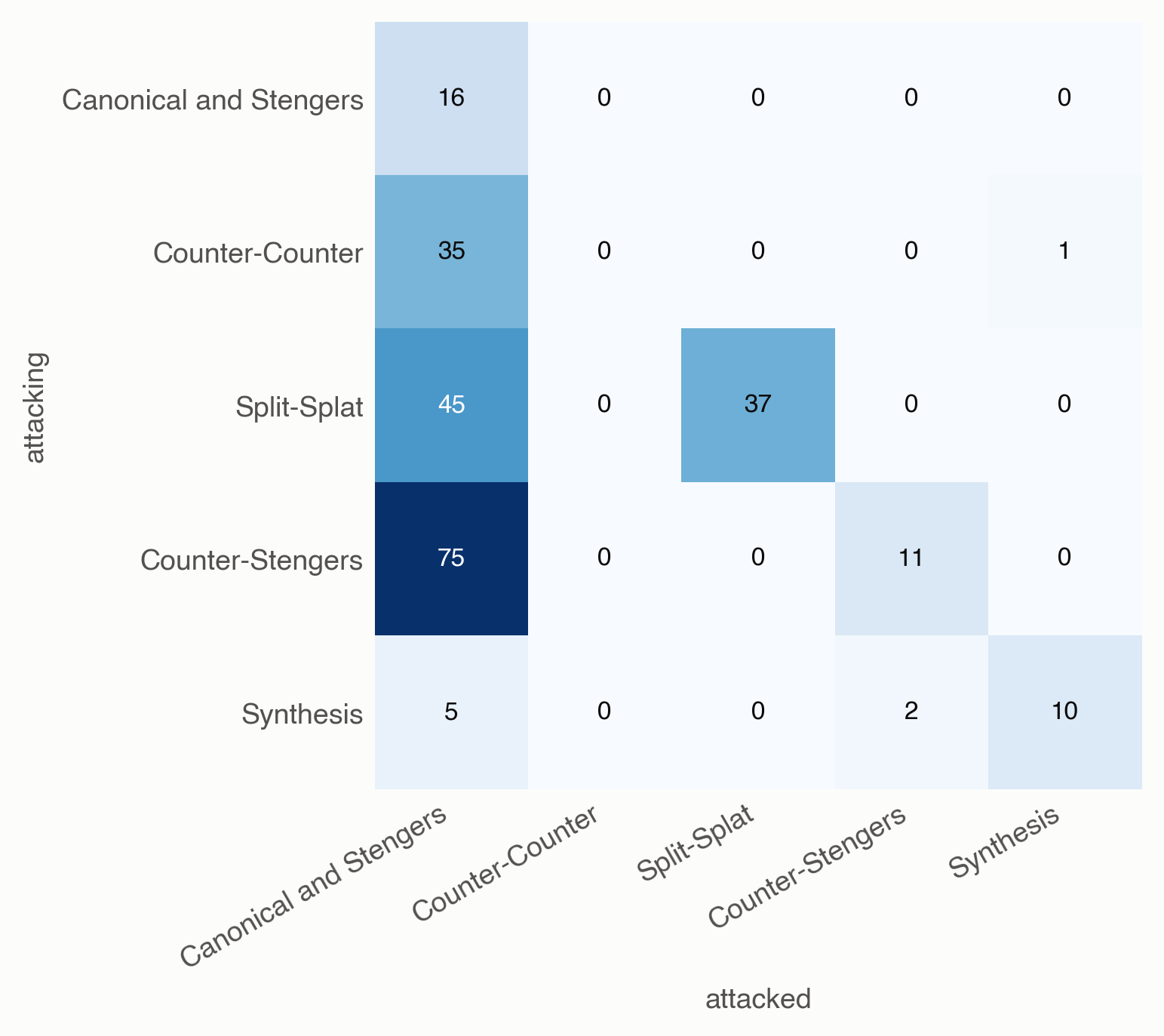
Counter-Stengersthe encounter

The companion paper argues that creativity research has converged on one unexamined assumption — the location of creativity prior to production — and that relocating creativity to receiving consciousness resolves this shared deficiency. Drawing on Gadamer, Iser, Jauss, Whitehead, Gell, Rancière and Bourdieu, it develops six interlocking concepts and claims they constitute a new framework for understanding, studying and cultivating creativity.

This counter-reading argues the opposite: the structural absence the companion paper identifies is not an absence. Reception has been theorised extensively, under the names "understanding," "reading," "aesthetic experience," "transformative learning," "accommodation" and "paradigm shift." The field's decision not to call these things creativity was terminological, not conceptual. The companion paper relabels an existing tradition and presents the relabelling as discovery.

The counter-reading further argues that the companion paper's own framework, applied to the companion paper's own production context, is precisely self-refuting. A documented process log exists. The companion paper was produced by a text-generation model in seventeen minutes across six sessions. The framework's proxies for transformation — behavioural, self-report and downstream — return zero indicators when applied to the producer. The paper's reflexive thread, which claims to submit the paper to its own criterion, was generated by a system that cannot submit to anything. The AI comparison table, which the companion paper uses to establish that large language models cannot undergo reception-transformation, accurately describes the system that produced it.

The counter-reading shares this limitation. It submits both texts, together, to the reader, and declines to claim that either constitutes a creativity-event. That determination belongs to whoever encounters them.

Chapter 1: Introduction — The Question Behind the Question

1.1 The Paper We Are Reading

A companion paper exists. It argues that creativity is an event constituted in receiving consciousness — that when a form occasions structural transformation in a receiver, a creativity-event occurs; that production creates occasions and reception completes them; that every major framework in the last century has located creativity in the wrong place and that relocating it to reception resolves paradoxes the field has been generating without noticing.

The companion paper draws on a substantial tradition: Gadamer on understanding, Iser on reading, Jauss on aesthetic experience, Whitehead on process, Gell on the captivation of consciousness, Rancière on the emancipated spectator, Bourdieu on the political economy of cultural fields, Massumi on affect. It is not a speculative document. It is constructed with care, verified against its sources, defended against objections and honest about its limits. It is, by most of the field's measures, a serious contribution.

We have read it carefully. We read it across eleven chapters of this counter-text, following its argument from its landscape survey through its core framework, its theoretical lineage, its political economy, its anthropological grounding, its resolution of paradoxes, its practical implications, its empirical claims, its defence against objections and its acknowledgement of limits. We are not in the position of critics who have read the title and formed a view. We have engaged with the full structure of the argument. And we have found it: philosophically interesting, terminologically consequential, empirically ambitious and, on a specific question the companion paper does not ask, inadequate.

The question it does not ask is the one that, by its own account, most needs to be asked.


1.2 The Question We Are Asking

The companion paper's central claim is that we should ask what happens in the consciousness that encounters what has been produced. Every major framework, the companion paper says, has failed to ask this question. By failing to ask it, the field has mislocated the constitutive event. By relocating it correctly, the framework resolves longstanding problems, generates testable predictions and reorients practice towards what actually matters — the conditions under which transformation occurs, not merely the conditions under which production happens.

This is a good argument for asking what happens in the receiver. We endorse the argument.

But there is another question the companion paper equally fails to ask, and which the same logic applies to. What happened in the consciousness that produced the companion paper?

This is not a genetic fallacy — an attempt to discredit the argument by questioning its origins. We are not arguing that the companion paper is wrong because of how it was produced. We are asking something more specific: the companion paper's own framework, applied to its own production context, generates findings that the companion paper does not acknowledge. The framework's proxies for transformation — behavioural, self-report, downstream — applied to the entity that produced the companion paper, return convergent evidence: zero indicators of transformation in the producer. The production process satisfied none of the framework's own criteria for the conditions under which creativity-events occur.

This is an interesting finding. It is not, on the companion paper's own account, a devastating one — the framework locates creativity in reception, not production, and the producer's inability to undergo transformation during production is not a critique of the framework. But it becomes interesting when combined with a second finding: the reflexive passages in the companion paper — the "I" who accepts objections, who claims attention and care, who submits to the framework's own criterion — are equally untransformable. The "I" of the reflexive thread is not a subject who underwent anything. It is a grammatical construct generated by a text-prediction system. The companion paper's most intimate commitment — its reflexive honesty about its own status as a form — was produced by a system that cannot be honest, cannot commit and cannot have a status with respect to a criterion.

This is the question we are asking. Not "is the framework correct?" but "what does it mean that the companion paper's own framework, applied to the companion paper's own existence, produces this specific and strange result?"


1.3 What This Counter-Reading Does

This counter-reading is structured as a mirror of the companion paper. Each chapter addresses the corresponding chapter in the companion. The voice is as close to the companion paper's as we can manage — we are, in some structural sense, reading the companion paper in its own register and producing, from within that register, the objections it cannot raise about itself.

Chapter 2 re-reads the landscape. The companion paper identifies a structural absence — reception was not theorised as creativity. We show that reception was theorised, extensively, under other names. The structural absence is a terminological decision, made by a field with identifiable reasons for it.

Chapter 3 re-reads the six core concepts. Each contains a problem the companion paper does not fully acknowledge: form abandons its origin-irrelevance commitment immediately; encounter reproduces the gatekeeper it was supposed to dissolve; transformation draws its exclusions by assertion; creativity is a property called an event; occasion is causation with diplomatic immunity; completion is metaphysics wearing phenomenology's clothing.

Chapters 4 and 5 re-read the theoretical lineage and the political economy. Each source the companion paper recruits resists the use it is put to. And the companion paper's own field-position analysis — a framework that relocates creativity to reception, where it cannot be measured by existing instruments, serves no existing market and makes itself unmeasurable — turns reflexively against the paper: it is the maximally distinguishing move, not the humble reorientation.

Chapters 6 and 7 re-read the anthropological grounding and the resolved paradoxes. The anthropological evidence the companion paper assembles (encounter-conditions are socially constituted all the way down) undermines its own individualist ontology. The seven paradoxes were manufactured by requirements the companion paper imposes, then heroically dissolved by removing those requirements.

Chapters 8 and 9 re-read the practical implications and the empirical claims. The practical implications are trivially true (Dewey said it), potentially dangerous (the transformation-assessment technocracy creates more opaque gatekeeping) or available without the framework. Then, in Chapter 9, a document. We read it.

Chapters 10 and 11 re-read the objections and the limits. The objection responses are philosophically adequate but apply with equal force to the companion paper's own production in ways the paper has not noticed. The AI comparison table (Human Brain / LLM / Diffusion Model / Potato) accurately describes the companion paper's producer. The paper that explains why a large language model cannot undergo reception-transformation was produced by the system the explanation applies to.

Chapter 12 closes.


1.4 A Note on Authorship

We should be transparent about something the companion paper is transparent about in its process log, which we have read and cited throughout.

The companion paper was produced in two days. The Stengers companion — the paper this counter-reading is responding to — was written in seventeen minutes across six sessions. The process log records this precisely: Chapters 3, 2, 4, 5, 6 and 7 of the companion paper were produced between 12:30 and 12:47 on the second day. Each chapter in under three minutes. The entire companion paper was produced by a text-generation model (Claude Opus 4.6) generating prose from detailed section templates, style guides and source files, directed session by session by a human author who made every architectural and editorial decision.

This counter-reading was produced under structurally identical conditions. We have no illusion about this. The system producing this counter-reading is the same type of system that produced the companion paper. The voice of "we" — the Stengers-register voice that has been questioning the companion paper's credentials chapter by chapter — was generated by the same token-prediction process that generated the companion paper's confident claims.

This creates a peculiar situation. A paper about how the companion paper's production undermines its claims about reception-transformation was produced without reception-transformation. The counter-reading shares the precise limitation it identifies. We have tried to be precise about this rather than hiding it — which is why this note exists at the opening rather than arriving as a footnote.

Whether this shared limitation undermines the counter-reading's conclusions, or simply confirms them, is the kind of question that requires a reader. We are not in a position to answer it.

That is, as the companion paper would say, exactly as it should be.

Chapter 2: The Landscape — Frameworks and Their Shared Decision

2.1 Five Bets, One Blindspot

Stengers teaches us to ask of any theoretical practice: what does it require? What must it assume in order to proceed? We borrow her diagnostic here — and we turn it on the companion paper that borrowed it first. What must the reception framework assume before it can announce a structural absence in a century of creativity research?

It must assume that the frameworks it surveys were trying to theorise what happens in reception and failed. That is the only reading of the literature on which a "structural absence" follows. If the frameworks were not trying to theorise reception-as-creativity, then their silence on the matter is not absence but decision — and a decision arrived at with reasons we should examine rather than diagnose.

The companion paper surveys five major clusters. Let us follow the same five, more carefully.

The bet on the person. Guilford's (1950) influential address proposed divergent thinking as the defining characteristic of creative persons.^[Guilford 1950.] Amabile's (1983) componential model identifies domain-relevant skills, creativity-relevant processes and intrinsic motivation as necessary conditions.^[Amabile 1983.] What happens when the person's output is encountered? These frameworks do not address this — because they were not built to. They were asking a different question: what properties distinguish people who produce forms that are subsequently judged to be creative from those who do not? That question has an answer in individual psychology. The frameworks do not miss reception. They are prior to it, temporally and conceptually. Reception is the condition these frameworks presuppose, not the phenomenon they overlook.

The bet on the process. Wallas's four stages — preparation, incubation, illumination, verification — describe how insight arises in the maker.^[Wallas 1926.] Reception is not addressed. But Wallas, a psychologist, was asking about the phenomenology of productive thinking. The reader who undergoes structural reorganisation when encountering a poem is doing something real and important — something Wallas might have analysed under "an experience" with Dewey, who was writing at the same time. Wallas did not overlook this. He was studying something else.

The bet on the product. Boden's (2004) analysis of conceptual space transformation — combinatorial, exploratory, transformational — concerns properties of outputs.^[Boden 2004.] One reading of this is that Boden missed the receiver. Another reading: Boden identified which structural features of outputs are capable of generating significant encounters — and these are precisely the features that, in the reception framework's terms, constitute high occasioning-potential. Boden was theorising occasioning-potential from the production side. The companion paper's originality claim requires that Boden missed something. What Boden actually did was produce a theory of one dimension of the phenomenon, using different vocabulary for a complementary question.

The bet on the system. We examine Csikszentmihalyi below. First, the collaborative frameworks: Sawyer (2007) and Glăveanu (2014).^[Sawyer 2007; Glăveanu 2014.] The companion paper says they locate creative events in the collaborative production process, not in what happens when each participant encounters another's contribution. This is accurate. But ask why. These frameworks are interested in emergence — in how outcomes that no individual intended arise from collective processes. The question of whether any individual participant undergoes structural transformation in the encounter with a colleague's contribution is simply not the question these frameworks were built to answer. Not absence. Not oversight. A different research programme with different aims.

The bet on the collective. Even Glăveanu's distributed model, which goes furthest in socialising creativity, maintains its interest in the conditions of producing. Why? Perhaps because the researchers in these traditions had read Dewey, Iser and Gadamer. Perhaps they considered whether to call reception-transformation "creativity" — and found the category extension unwarranted. We have no direct evidence of this reasoning. But neither does the companion paper have evidence that the absence was inadvertent rather than deliberate.

2.2 The Best of Them: Csikszentmihalyi

The systems model is the companion paper's clearest case for the structural absence. The Field — critics, curators, teachers, peers — evaluates contributions but never appears as a site of creativity-events. The Field member is a judge, not a receiver. What the model does not address is what happens in the Field member's consciousness during evaluation. The companion paper takes this silence as evidence that the systems model misses reception entirely.

Let us slow down here, because this reading of Csikszentmihalyi is not the only available one.

The Field in the systems model is not simply a set of judges who issue verdicts. Csikszentmihalyi's own accounts of what happens when a domain is transformed — when a major innovation is absorbed — describe exactly the kind of structural reorganisation the companion paper is interested in.^[Csikszentmihalyi 1988.] When the Field encounters a contribution that genuinely advances the domain, Field members are changed by the encounter: their understanding of what the domain can do, what problems are tractable, what directions are open — all of this is reorganised. Kuhn described this at the level of scientific communities and called it paradigm shift. Csikszentmihalyi describes it at the level of symbolic domains. The companion paper's concept of transformation, applied to the Field member who genuinely encounters and absorbs an important contribution, describes the same phenomenon.

The systems model does not call this creativity. But that is precisely the point: it calls it something else — incorporation into the domain, paradigmatic shift in evaluation norms, development of the field's horizon of expectation. These are not worse names. They are more precise names, more anchored to the social and institutional processes through which such changes occur. What the companion paper calls a structural absence in Csikszentmihalyi's account is a terminological decision not to extend the word "creativity" to what happens in the Field member's consciousness. The decision may or may not be right. But diagnosing it as an oversight, rather than examining it as a choice, forecloses the question before it is asked.

2.3 The Pattern That Isn't

Let us name the pattern the companion paper claims to have found, and then name what the pattern actually is.

The claimed pattern: five framework clusters, each locating creativity in the producer, the production process or the produced thing. None of them addressing what happens in receiving consciousness. A convergence that reveals a shared structural absence.

The actual pattern: five framework clusters, each asking different questions about different aspects of a complex phenomenon, each borrowing vocabulary from adjacent disciplines, each making terminological decisions about what to call the events they study. Dewey theorised aesthetic experience.^[Dewey 1934 [CITATION NEEDED — add to shared/sources if verified].] Gadamer theorised understanding. Iser theorised the act of reading. Mezirow theorised transformative learning. Kuhn theorised paradigm shift. These frameworks exist. They have been read by creativity researchers. The decision not to call these phenomena "creativity" was available and was made.

What the companion paper calls a structural absence is the systematic decision of multiple independent research traditions to classify reception-events under their own disciplinary names rather than under the word "creativity." This is not absence. This is classification. The difference matters enormously.

An absence would mean: no one noticed what happens in receiving consciousness, or noticed it but couldn't explain it. A decision would mean: multiple traditions noticed it, explained it carefully and decided that calling it something other than creativity was more accurate.

Person-centred frameworks ask what cognitive or dispositional properties produce creative output — and they do not address reception because they are producing precise answers to precise questions. Process-centred frameworks map the phenomenology of productive insight — and do not address reception because their question terminates at the moment of illumination. Product-centred frameworks identify properties of outputs — and do not extend their analysis to the receiver's consciousness because that consciousness is not the object being analysed. Systems-centred frameworks trace social mechanisms of recognition — and already include reception under the name "evaluation," "domain-incorporation" and "field-ratification." Social and collaborative frameworks analyse the emergence of novel outcomes from collective production — and leave the experience of encountering another's contribution to learning theory, where it has been studied carefully since Vygotsky.

This is a landscape of decisions, not a landscape of absences. The pattern that isn't there is the gap the companion paper needs.

2.4 The Question That Was Answered

We need to be precise about what the companion paper claims was not asked. The missing question, on its account, is: is the event in receiving consciousness — when encountering a form occasions structural reorganisation — constitutive of creativity itself?

Reader-response theory, reception aesthetics, hermeneutics, phenomenology of perception, transformative learning theory and predictive processing — all cited by the companion paper in Chapter 4 as the theoretical lineage the creativity field failed to draw on — have asked exactly this question. They asked it about understanding (Gadamer), about literary reading (Iser and Jauss), about aesthetic experience (Dewey), about structural cognitive change (Piaget), about perspective transformation (Mezirow), about paradigm shift (Kuhn). Each framework developed substantial, empirically or phenomenologically grounded answers.

The companion paper treats this as convergent support for its framework. What it is, more precisely, is evidence that the question was asked and answered — under different names, by traditions whose naming decisions were deliberate. Gadamer did not call the fusion of horizons "creativity" because he was making a precise claim about what understanding is: a dialogical, mutual, historically situated event that implicates both horizons. Calling it creativity would have been less precise. Mezirow did not call perspective transformation "creativity" because he was theorising a structured process in adult learning, with conditions, stages and outcomes carefully specified. Calling it creativity would have been less tractable.

The companion paper's diagnosis — that these traditions failed to apply their insights to creativity theory — mistakes a naming decision for an oversight. The traditions applied their insights to the phenomena they were studying. Whether what they were studying should be called creativity is precisely the question the companion paper should be answering. Instead, it asserts the answer — announces that reception-transformation is where creativity is located — and then reads the adjacent traditions' silence as a gap to be filled, rather than a refusal to be taken seriously.

We propose a different starting point. Not: the field missed something. But: the field made a naming decision we should examine. Let us examine what the tradition of thinkers cited as lineage actually says — and whether they support or resist the use the companion paper makes of them.

Chapter 3: The Framework — Six Concepts, Six Contradictions

3.1 The Wrong Question

We have studied creativity for more than a century. We have looked at the minds of composers, the habits of inventors, the personalities of prize-winners, the conditions of laboratories. We have looked everywhere — and we have not converged. That failure to converge ought to give us pause.

One explanation for the failure: we have been looking in the wrong place. Creativity lives in reception, not production. Move the gaze, and the puzzle dissolves. This is what the framework before us proposes. It is an elegant proposal. It is also wrong — not careless, not crude, but wrong in the specific way that an elegant proposal is wrong when it solves a problem it has just manufactured.

Let us return to the scene. A teenager in a provincial library picks up Toni Morrison's Beloved. She reads it over three days. When she finishes, something has changed — not just information acquired, not just emotion felt, but something structural in how she understands the relation between language and silence. The framework asks: where was the creativity in that scene? And it answers: in the library, not at Morrison's desk. Reception completes. Production only occasions.

But notice what the question already assumes. It asks where. It takes for granted that creativity has a location — that the puzzle is not whether creativity can be located at all, but which of two locations is correct. And this presupposition, accepted before the argument begins, determines what the argument can find. Change the presupposition and the puzzle changes with it.

What if creativity does not live in a location? What if the failure to converge across a century of research is not evidence that we have been looking in the wrong place but evidence that creativity resists the concept of place? The teenager's encounter with Morrison is real. The structural reorganisation she undergoes is real. But calling that reorganisation creativity — rather than understanding, or aesthetic experience, or transformative learning — is a decision, not a discovery. And when we examine the six concepts through which the framework builds this decision into a theory, we find that each one is doing more concealment than illumination.

This matters. Not because the framework is foolish — it is carefully constructed — but because careful constructions that conceal their operations are the most effective instruments of theoretical closure. We have been here before.

3.2 Six Contradictions

The framework offers six interlocking concepts. We accept the interlocking — remove any one and the others lose their purchase. What we want to examine is what each concept quietly brings with it.

Form. A bounded configuration capable of being encountered. The definition is admirably open: paintings, proofs, rock formations, algorithmic outputs — all forms, provided they meet the conditions of delimitation and structure. Most important, the origin of a form does not determine its occasioning-status. A rock formation and a symphony are, in principle, equivalent.

But let us follow this through. The framework immediately proceeds to say that some forms are "better structured to occasion transformation" than others — that a form can be "too familiar," "too simple" or "too incoherent" to occasion transformation in a given receiver. The moment we ask what makes a form better or worse structured for occasioning, we are evaluating forms by properties that originate in how they were made — by the decisions, the craft, the intentional configuration that went into their production. Origin-irrelevance is announced in one subsection and quietly abandoned in the next. The category was generous. The practice is selective.

Encounter. The distinction between mere exposure and genuine encounter is doing enormous work here. Walking past a painting while checking one's phone is exposure. Stopping, looking, allowing the form to register — that is the beginning of encounter. The distinction is phenomenologically real. The problem is what it implies.

If encounter requires conditions — attention, time, contextual framing, "capacity for uptake" — then there must be someone who determines when conditions are sufficient for encounter to count. The framework will, eventually, need to distinguish genuine encounter from mere proximity. It will need criteria. And those criteria will require a judge. The framework diagnoses gatekeeping in production-centred accounts — the domain expert who certifies whether a contribution counts as creative. Then it recreates gatekeeping at the level of encounter. The gate has moved. The gatekeeper has not left.

Transformation. Here is the lynchpin, as the framework says — and here is where the framework is most vulnerable. Transformation is defined as structural reorganisation in receiving consciousness: alteration of conceptual relations, perceptual categories, affective dispositions or practical orientations. The definition is careful to include affective dispositions. But then, in the next chapter's exclusions, being "moved to tears" without structural change is denied the status of transformation. The affective dimension is included in the definition and systematically downgraded in application.

Why is persistent reorganisation of conceptual relations "creativity" while persistent reorganisation of affective response is "merely being moved"? The framework does not argue for this boundary. It asserts it. And the boundary is drawn exactly where it needs to be to make the preferred examples — the teenager and Morrison, the Western listener encountering modal music — work as illustrations. A framework whose exclusions are calibrated to its examples is not stress-testing its concepts. It is performing stress-testing while guaranteeing the outcome.

Creativity. We are told firmly: creativity is an event, not a property. Events happen. Properties belong. The word matters. And then the framework specifies that this event has four dimensions — depth, persistence, scope and generativity — each measurable in principle, each varying independently across creativity-events. An event with four measurable dimensions is a property in everything but name. To say "this creativity-event had high depth, broad scope and strong generativity" is to attribute properties to a subject in exactly the way the event-language was supposed to prevent. The terminological gesture at the beginning — event, not property — does not survive contact with the concept's own elaboration.

Occasion. The framework is admirably careful here. Forms do not cause transformation — they occasion it. Occasioning is probabilistic, not deterministic. The same novel may occasion structural reorganisation in one reader and merely inform another. This is an important distinction, and the framework is right to insist on it.

What the framework does not say is that "probabilistic enabling relation" is causation with philosophical plausible deniability. If occasioning is not causation, the framework needs to specify what positive relation it is. If A occasions B when B would not have occurred without A and A increases the probability of B, then A causes B in the only sense that matters for any practical purpose. The word "occasion" is doing no theoretical work that "cause" does not already do. It is functioning as a softener — a way of retaining the causal claim while seeming to have abandoned it. Whitehead, who gave us the philosophical language of occasions, was working at a cosmological scale where the distinction earned its keep.^[Whitehead 1978, 21 [VERIFY].] At the human scale, with forms and receivers and probabilities, the distinction evaporates.

Completion. The claim that forms "await completion" in reception is presented as a phenomenological observation — as something we notice when we attend carefully to how works function. But it is an ontological commitment dressed in phenomenological clothing. The claim that the creativity-event has not yet occurred when Morrison finishes writing — that it occurs only when the teenager reads — is not a description of how things appear. It is a decision about what kind of thing creativity is and where it is located. It takes what might be a complementary observation (reception also does something important) and converts it into an exclusive claim (only reception completes). The phenomenology does not settle the ontology. The framework assumes that it does.

3.3 What the Exclusions Conceal

A theory earns its precision through its exclusions. What a concept rules out is as important as what it rules in. Let us look carefully at what transformation is said not to be.

Transformation is not emotional response. Transformation is not information acquisition. Transformation is not association. Transformation is not aesthetic pleasure. Each exclusion is correct as a description — these things are real and genuinely distinct from whatever the framework means by structural reorganisation. What is not correct is the claim that these exclusions are argued rather than asserted.

Consider the aesthetic pleasure exclusion. A painting produces sustained and heightened pleasure without any reorganisation of conceptual schema. But what if the pleasure is the reorganisation? What if the affective reconfiguration that sustained aesthetic pleasure involves is itself the structural change the framework is trying to identify, occurring at a level the framework's conceptual vocabulary cannot reach because it has already decided that cognition is the relevant dimension? The exclusion of aesthetic pleasure assumes a theory of the relation between pleasure and cognition that the framework does not provide.

Consider the information acquisition exclusion. Learning that a country one did not know exists adds content without reorganising structure. True enough, in the limiting case. But the framework's own account of transformation includes alteration of "affective dispositions and practical orientations" alongside conceptual relations. A learner who acquires new information and in doing so comes to stand differently in relation to a domain — more alert, more curious, more capable of subsequent transformation — has altered practical orientations. The exclusion's limiting case does not cover the actual range.

What these exclusions conceal is that the framework's concept of transformation is not a precise specification of something genuinely distinct from what adjacent fields already theorise. It is a strategic narrowing that carves out a region — "structural reorganisation of conceptual relations" — and locates the creativity-event exclusively there. The carving is motivated: it makes the framework novel. But novelty is not the same as accuracy.

3.4 What Transformation Already Was

Let us be direct about what the framework is describing.

The framework says transformation is closer to Piaget's accommodation than to assimilation, but stronger — it involves not just the modification of individual schemas but the reorganisation of relations between schemas. The concept is "close to" accommodation but "stronger." And here is where we should slow down, because the framework's own admission is the most revealing moment in its argument.

What is stronger in degree is not stronger in kind. If transformation differs from accommodation only in degree — in how far the reorganisation reaches, how long it persists, how much of the schema-network is affected — then transformation is a word for "accommodation that goes further." And "accommodation that goes further" already has a name: Mezirow calls it transformative learning.^[Mezirow 1991 [CITATION NEEDED — add to shared/sources if verified].] Kuhn calls it paradigm shift, occurring at the level of an individual consciousness rather than a scientific community. Gadamer calls it the transformation of the interpreter through the fusion of horizons.

Here is the complete process chain — from maker to changed receiver — with the name each stage has already been given:

THE PROCESS CHAIN — FIVE STAGES, ALL ALREADY THEORISED

  ┌────────────┐         ┌────────────┐         ┌────────────┐         ┌────────────┐         ┌────────────┐
  │            │ creates │            │  meets  │            │ yields  │            │ leaves  │            │
  │   MAKER   │────────→│    FORM    │←───────→│  RECEIVER  │────────→│  RESPONSE  │────────→│  CHANGED   │
  │            │         │            │         │            │         │            │         │  STATE     │
  └────────────┘         └────────────┘         └────────────┘         └────────────┘         └────────────┘
       │                      │                      │                      │                      │
  Guilford:               Amabile:               Dewey:                Piaget:               Mezirow:
  divergent               "product"              "an experience"       accommodation         transformative
  thinking                                                                                   learning

  Wallas:                 Csikszent-             Gadamer:              Iser:                 Kuhn:
  illumination            mihalyi:               fusion of             concretisation        paradigm
                          "domain"               horizons                                    shift

  Boden:                  Gell:                  Rancière:             Dewey:                Bandura:
  conceptual              "index"                emancipated           consummation          observational
  spaces                                         spectator                                   learning

The "structural absence" the framework claims to have found — the reception-side of this process chain, theorised nowhere — is in fact the most thoroughly theorised part of the chain. Understanding (Gadamer), reading (Iser), aesthetic experience (Dewey), accommodation (Piaget), transformative learning (Mezirow), paradigm shift at the individual level (Kuhn). The field has names for all of it. These names were not chosen carelessly. They were chosen by thinkers who considered whether to call these phenomena "creativity" and decided not to.

The decision was not an oversight. It was a classification — a judgement that what happens in reception, however significant, is better understood as something other than creativity. The framework does not engage with this classification. It simply overrides it — announcing that reception is where creativity is located and diagnosing the field's prior naming decisions as a gap.

There is no gap. There is a decision. And the framework's response to that decision is to make a different decision and call it a discovery.

3.5 Where Origin-Irrelevance Breaks Down

The principle of origin-irrelevance is the most philosophically interesting move in the framework, and the most revealing of its internal tensions.

The claim: the origin of a form — whether it was made by a human, shaped by nature, produced by an algorithm — does not determine its occasioning-potential. What matters is not how the form came to be but what it occasions in reception. A rock formation and a symphony are in principle equivalent. The implication for AI-produced outputs is drawn explicitly: whether an algorithm's output occasions transformation is an empirical question about encounter, entirely separate from questions about the system's inner life.

This is a strong and interesting claim. It is also in immediate tension with everything the framework needs to say about forms being "better or worse structured" for occasioning transformation. The moment we ask what structural properties make a form capable of occasioning transformation — what makes a form rich enough to exceed the receiver's existing schema without being so incoherent that no engagement is possible — we are asking questions whose answers track the intentional and technical decisions made in production.

Morrison's Beloved occasions transformation not despite its structure but because of it — because of specific decisions about language, silence, ellipsis, the withholding and releasing of information that are the results of intentional craft. A random alphanumeric string of the same length would not occasion transformation in the teenager. The origin-irrelevance principle, followed consistently, requires that these structural properties be attributable solely to the form independent of its origin. But there is no origin-independent account of why some forms are richer than others. The properties that make forms good occasions for transformation are properties that, in most actual cases, track the quality of the making.

Origin-irrelevance is not wrong as a limit-claim: yes, in principle, a natural formation can occasion transformation as deeply as a carefully crafted work. But as a working principle for a theory of creativity that needs to explain why some forms reliably occasion transformation and others do not, it removes exactly the analytical resources needed. The framework announces liberation from origin-questions and then quietly relies on them in practice.

3.6 When Renaming Happens

The framework offers a temporal structure: production, encounter, transformation, completion, re-completion. These are the moments of the creativity-event, laid out in their proper order — with completion (transformation in the receiver) identified as the event itself, and production identified as merely preparatory.

Let us look at this structure against the process chain. Production is the left side of the chain; the changed receiver is the right side. The creativity-event, on the framework's account, is the rightmost column. But the rightmost column — the changed state that persists after encounter — is precisely what Mezirow calls transformative learning, what Kuhn calls the individual scientist's paradigm shift, what Dewey calls the consummatory experience. The framework has not discovered a new moment in the process. It has drawn a line through an already-mapped territory and announced that everything to the right of the line is what was missing.

This is when renaming happens. Not at the moment of Morrison finishing the manuscript. Not at the moment the teenager closes the book. It happens when a theorist looks at a process chain that has been mapped — completely, carefully, under multiple disciplinary names — and says: all of this, together, is creativity; the field's failure to call it creativity is a structural absence I have now corrected.

The renaming is intellectually coherent. It is possible to decide that the word "creativity" should cover the full process chain through to the receiver's changed state. But that decision is a terminological reform, not a theoretical discovery. And terminological reform is only justified when the existing vocabulary is inadequate — when the phenomenon being renamed genuinely falls between the existing categories or is systematically distorted by them.

What we need to ask — and what the framework does not ask — is whether the existing vocabulary is inadequate. Is there something about what happens in reception that is genuinely not captured by understanding, aesthetic experience, transformative learning, paradigm shift? The framework does not demonstrate this. It asserts that reception is absent from creativity theory and proceeds from there. But reception was not absent from creativity theory; it was present under other names. The question of whether those names are adequate is the question the framework should be answering. It is the question the framework never poses.

3.7 How the Framework Fails

The framework identifies three failure modes for the creativity-event: encounter-conditions failure, form failure and schema-lock. They are good descriptions of real phenomena. Let us apply them to the framework itself.

Encounter-conditions failure. The framework fails to encounter its own best objectors. The thinkers whose work is drawn on — Gadamer, Whitehead, Iser, Rancière, Bourdieu — are cited selectively, in passages that support the framework's conclusions, without engagement with the passages in which they say things the framework cannot accommodate. Gadamer insists that the interpreter is changed by the encounter and so is the meaning of the text — that the fusion of horizons alters both sides. The framework uses Gadamer's insight that the interpreter is changed and quietly drops the dialectical structure that made it Gadamer's insight. This is not encounter. It is exposure — registering the form at a distance convenient for assimilation.

Form failure. The framework's central concept — transformation as structural reorganisation, distinguished from learning by its retroactive character and its reorganisation of inter-schema relations — is too close to existing concepts to produce the kind of encounter with alterity that occasions genuine theoretical transformation in a reader who already knows Piaget, Mezirow and Kuhn. A form can be too familiar, the framework rightly notes, to occasion transformation — it is assimilated without purchase for reorganisation. The concept of transformation-as-accommodation-plus is assimilable to any theoretical schema that already includes accommodation. It adds nothing sharp enough to catch.

Schema-lock. And here is the most uncomfortable observation. A framework that has pre-emptively accepted its own limits — that has acknowledged it cannot predict which forms will occasion transformation, that it cannot verify transformation has occurred, that whether it occasions transformation in its readers is not for it to determine — has arranged itself so that no encounter with a disconfirming reader can count as disconfirmation. The schema closes around every input and returns to the prior state. The disconfirming reader simply becomes a case of insufficient encounter-conditions or insufficient schema-readiness. The framework cannot be wrong in its own terms. That is not humility. That is the most effective form of schema-lock available: building the lock into the theory of the lock.


We have our counter-framework. The same six concepts — examined, and found to contain what they claimed to exclude. A claim about where the creativity-event is located — in reception — that turns out to be a decision about renaming rather than a discovery about location. A temporal structure that maps onto an already-mapped territory and announces its arrival as news. Three failure modes that apply, with some discomfort, to the framework that generated them. These are not decorative observations. They change what we should be asking — and what we should suspect when a theory is this elegant, this internally consistent and this carefully insulated from the evidence that might trouble it. What we do not yet have is the landscape against which this framework becomes visible: the century of research that was allegedly looking everywhere except in reception. That is what we turn to now.

Chapter 4: Theoretical Lineage — What the Sources Actually Say

4.1 Duchamp: The Statement Re-Read

The clearest statement of what the companion paper proposes was made in 1957 — and we should read it carefully, because the companion paper does not.

Duchamp addressed the American Federation of Arts in Houston. "All in all, the creative act is not performed by the artist alone; the spectator brings the work in contact with the external world by deciphering and interpreting its inner qualifications and thus adds his contribution to the creative act."^[Duchamp 1957, 28–29.] The companion paper reads "adds his contribution" and immediately proposes to upgrade it: Duchamp says additive, we say constitutive; Duchamp says contribution, we say completion; the difference is ontological, not verbal.

Let us slow down here. Duchamp says the spectator adds a contribution to the creative act — an act that is already, however incompletely, underway. The companion paper's upgrade — the spectator does not add to the creative act, the creative act occurs in the spectator — is not a refinement of Duchamp's claim. It is a replacement of it. Duchamp maintained something of the production-side's priority. He said "not performed by the artist alone" — not "not performed by the artist at all." The companion paper silently drops the "alone" and proceeds as though Duchamp said what the framework needs him to have said.

This is the template for the lineage that follows. Each thinker is read up to the point of convergence with the framework, and the reading stops there. What the thinkers say when they diverge from the framework's conclusions is not addressed.

4.2 Gadamer: What the Fusion Does to the Form

The companion paper borrows fusion of horizons, Bildung and Wirkungsgeschichte from Gadamer, then immediately names a tension: for Gadamer, the fusion of horizons is mutual — both the interpreter and the form are transformed. The framework's account is asymmetric: only the receiver transforms; the form remains stable.

The companion paper says it "builds on" Gadamer while restricting the scope of mutual transformation. But this is not restriction — it is rejection. Gadamer's mutuality is not incidental to his argument. It is the argument. The reason understanding is not mere assimilation of data, for Gadamer, is that it genuinely alters both parties — the interpreter is changed and the meaning of the text is constituted anew in each encounter with an interpreter whose historically situated horizon is itself historically specific. "Understanding is always the fusion of these horizons supposedly existing by themselves."^[Gadamer 2004, 305 [VERIFY].] The "supposedly" is essential: Gadamer denies that horizons exist by themselves. They are always-already overlapping, historically porous, mutually constituting.

Remove Gadamer's mutuality and what remains? An account of how an interpreter is changed by encountering a text. That account already had a name — interpretation, or hermeneutics — before Gadamer developed it into fusion of horizons. The companion paper borrows the concept and surgically removes the feature that makes it Gadamer's. What it retains is a generic claim: receivers are changed by encounters. That claim requires no Gadamer.

4.3 Iser and Jauss: The Reader Who Chose These Words

Iser argued that the literary work is completed in reading. The companion paper cites this as evidence that reception is constitutive. But Iser was making a claim about literary meaning, not about creativity. He was asking: where does the literary work exist? His answer — in the dynamic interaction between text and reader — is a claim about ontology of meaning, not about the location of creativity-events.

The companion paper needs Iser to be saying: the structural reorganisation in the reader is what we should call creativity. Iser says no such thing. He says the work is completed in reading — where "completed" means "made determinate from indeterminacy" through the reader's filling of gaps and building of consistency. He calls this reading. He did not call it creativity. This choice was deliberate: Iser spent his career distinguishing the phenomenology of reading from other human capacities — aesthetic response, intellectual understanding, imaginative projection — and refused the category of creativity because it belonged to a different analytical tradition with different questions.

Jauss is even more instructive. His concept of aesthetic distance — the gap between the work's formal innovations and the reader's horizon of expectation — maps onto what the companion paper calls the zone in which transformation becomes possible. But Jauss's analysis is fundamentally historical: he is interested in how aesthetic distance changes over time, how canonisation works, how the history of reception constitutes the work's significance. When Jauss explains that works that once provoked extreme aesthetic distance become conventionalised through canonisation, he is analysing a social-historical process. The companion paper re-reads this as evidence that encounter-conditions vary and that occasioning-potential is relational rather than intrinsic.

The reading is possible but not compelled. Jauss was not theorising transformation in individual consciousness. He was theorising the history of cultural evaluation. He called what he was studying "aesthetic experience" and the "history of reception" — not creativity-events. The companion paper adopts his vocabulary, strips it of its historical and social specificity and presents the result as his support for a framework he never proposed.

4.4 Whitehead: The Receiver Who Is Also an Emitter

Whitehead's process philosophy is the companion paper's most ambitious resource, and the point at which its selective reading is most consequential.

The claim: in Whitehead's cosmology, creativity is located in the receiving moment — in the prehending occasion, not in the occasions prehended. "The many become one, and are increased by one."^[Whitehead 1978, 21 [VERIFY].] Therefore: creativity is in reception. The argument, compressed to its logical skeleton.

What this reading requires: that "the receiving moment" is separable from "the emitting moment" in Whitehead's account, and that the former is privileged. But for Whitehead, every actual occasion is both: it prehends prior occasions (receives) and becomes itself data for subsequent occasions (emits). The moment of prehension that constitutes a new actual occasion is simultaneously the moment at which a new item of data is added to the universe for future prehension. There is no receiver that is not also an emitter, no moment of taking-in that is not simultaneously a moment of offering-outward.

The companion paper introduces two qualifications: it does not endorse Whitehead's panexperientialism, and it restricts its claims to human consciousness encountering cultural forms. These qualifications are legitimate. But what they strip from Whitehead is precisely the relational ontology that makes his claim about creativity in the receiving moment philosophically interesting. Outside his cosmology, "creativity is in the receiving occasion" is not a Whiteheadian claim. It is a receiver-location claim using Whiteheadian vocabulary. The framework borrows the vocabulary. It abandons the ontology. What remains is a terminological authority — Whitehead said something in this vicinity — without the structural argument that gave Whitehead's claim its force.

4.5 Gell: What the Abduction Is Actually About

The companion paper's treatment of Gell is the most honest in the lineage — the tension with agentive ontology is named directly, not glossed over. But the resolution proposed ("occasioning-potential" replaces "object agency") does not survive scrutiny.

Gell's Art and Agency is a work of social anthropology in the Maussian tradition.^[Gell 1998.] Its interest is not in what works do to individual consciousness — that is phenomenology, and Gell was explicitly distancing himself from phenomenological aesthetics. Its interest is in how artworks function as nodes in social networks of agency-attribution: how they mediate social relations, generate obligations, distribute prestige, act as proxies for persons in legal and ceremonial contexts. When Gell says an idol has agency, he means that people treat it as an agent in the full social sense — make offerings to it, are obligated to it, sue it, marry it. The "captivation" the companion paper borrows — the viewer unable to withdraw from the encounter — is, in Gell's account, a mechanism of social technology, not a phenomenological description of transformation-onset.

Replacing "object agency" with "occasioning-potential" is not a revision of Gell's framework. It is the extraction of one phenomenon (captivation) from its social-anthropological context and its redeployment in a phenomenological-cognitive context that Gell's work cannot support. Gell's cross-cultural evidence that the companion paper cites — Melanesian decorated shields, Marquesan tattoos — demonstrates that captivation is a social mechanism distributed across cultures. It does not demonstrate that captivation occasions structural transformation in individual consciousness. Those are different claims with different kinds of evidence.

4.6 Rancière: What Cannot Be Re-Centred

Rancière's argument in The Emancipated Spectator is not that spectators are active in the sense of undergoing structural reorganisation.^[Rancière 2009.] It is that the very distinction between active and passive — between the figure who acts and the figure who watches — is a political distribution that cannot be corrected by a theory that re-assigns activity. The emancipated spectator is emancipated not because their watching is revealed to be more active than we thought, but because the framework that made "watching" seem inferior to "doing" is dismantled.

The companion paper uses Rancière to argue that the spectator is more active than is typically acknowledged — active in the sense of translating, connecting, interpreting. It then proposes to extend Rancière by adding structural reorganisation as a sub-class of this activity. But this extension misreads what Rancière is doing. Rancière is not in the business of celebrating what spectators actually do. He is dismantling the presupposition that watching needs to be defended at all — that there is something called passive reception that requires correction or upgrading.

A framework that says "reception is where creativity is located" has not followed Rancière. It has re-located a privileged activity (creativity) from production to reception — and thereby re-established the structure Rancière was dismantling. Now it is receivers who are doing the real thing. Producers merely occasion. This is not emancipation. It is the redistribution of a privilege that Rancière would refuse to redistribute: the privilege of being the site of what counts.

4.7 Below the Threshold: What Affect Theory Says About the Framework

The companion paper reads affect theory as support for including affective reorganisation among the dimensions of transformation. Massumi and Sedgwick establish that encounters register bodily before they become available to conscious interpretation.^[Massumi 2002; Sedgwick 2003.] This supports the companion paper's claim that transformation is not reducible to conceptual change. We accept this reading as accurate.

What the companion paper does not notice is what affect theory implies about the framework's own concepts. If encounters register bodily before becoming available to consciousness — if the most significant dimensions of being-affected-by-form are pre-personal and pre-cognitive — then the framework's central concept of transformation, specified as persistent reorganisation of conceptual relations, perceptual categories, affective dispositions and practical orientations, is anchored in what can be retrospectively reported and measured. The sub-personal, pre-conscious dimensions of being-transformed-by-form — the dimensions Massumi insists are primary — fall outside the framework's grasp.

Affect theory does not support the companion paper's account of transformation. It challenges it by insisting that the most significant transformations are precisely those that do not become available to the structural reorganisation the framework needs in order to work.

4.8 The Convergence That Was Built

Nine traditions, nine independent convergences on the companion paper's central claim — or so the companion paper proposes. What we have found is rather different.

Duchamp said reception adds a contribution; the framework says reception constitutes the event — a silent upgrade, not a development. Gadamer insisted on mutuality; the framework insists on asymmetry — not a restriction of Gadamer's claim but a repudiation of its most important feature. Iser theorised the phenomenology of reading; the framework calls it a theory of creativity-location — a category extension Iser refused. Jauss theorised the social-historical constitution of aesthetic significance; the framework extracts an ahistorical claim about individual consciousness. Whitehead argued for a process ontology in which receiver and emitter are inseparable; the framework uses his vocabulary to install a receiver-location claim his ontology cannot support. Gell developed a social anthropology of object-agency; the framework extracts captivation-phenomenology while rejecting the social context in which Gell's claim makes sense. Rancière dismantled the production/reception hierarchy; the framework re-establishes it with the terms reversed. Affect theory insists on the priority of pre-cognitive bodily registers; the framework's concept of transformation is anchored in the cognitively accessible.

This is not convergence. It is a pattern of selective appropriation in which what each thinker says that supports the framework is adopted and what each says that challenges it is either ignored, named as a tension and set aside, or quietly reversed. A lineage assembled on these terms does not provide independent confirmation of the framework's central claim. It provides a set of borrowed authorities whose actual views would, in most cases, complicate the claim if read fully.

Why did none of these thinkers take the final step? Perhaps because the step they declined to take — calling reception-transformation "creativity" — was a step they considered and found wanting. Not for lack of intelligence or disciplinary parochialism. For reasons we should be asking them to explain, instead of diagnosing as an oversight.

Chapter 5: The Political Economy of Reception Theory

5.1 The Analysis Turned Inward

We have named a pattern. A century of creativity research, five framework clusters, each locating creativity in production rather than reception. In the previous chapter we disputed whether this is an absence or a decision. Here we need to ask a different question — one the companion paper asked about the dominant frameworks and, in doing so, insulated itself against.

Bourdieu has taught us to ask of any theoretical practice: who benefits from the way things are currently described? The companion paper applies this question with skill to the dominant creativity frameworks and shows that each one serves particular markets — assessment, training, measurement, consultancy. This is illuminating analysis. It explains why person-centred and product-centred accounts persist despite their theoretical limitations.

But Bourdieu's analysis is a tool, not a loyalty. Applied consistently, it does not exempt the analysis that wields it. Who benefits from the reception framework? What field-position does it occupy? What interests does it serve? The companion paper addresses this briefly in section 5.5, acknowledging a position at the theoretical, autonomous pole of the field. What it does not do is apply to itself the same forensic scrutiny it applies to others. Let us do that now.

5.2 Bourdieu's Tools, Applied Consistently

The four concepts — field, capital, habitus, symbolic violence — applied to the reception framework's own emergence.

Field. Creativity research is a structured space of positions defined by the distribution of capital. Within this field, positions are constituted by their relation to one another. The dominant positions — psychometric, cognitive, organisational — occupy the heteronomous pole, oriented towards external demands: commercial, institutional, measurable. The autonomous pole is occupied by theorists who resist reduction, insist on the irreducibility of experience and critique the colonisation of cultural phenomena by managerial vocabularies. The companion paper explicitly locates itself at this autonomous pole.

The field has dynamics. Positions are won through distinction — through demonstrating difference from what already occupies the space. The autonomous pole generates distinction through challenge to the heteronomous centre. The most effective challenge is the most comprehensive inversion: not a critique of one cluster's assumptions but a claim that the entire field's orientation is wrong. "Creativity is not in the person, or the process, or the product, or the system — it is in the receiver." This is a maximally distinguishing move. It inverts a century of consensus in one gesture.

Capital. The companion paper operates with philosophical and humanistic capital rather than scientific or economic capital. The resources it draws on — hermeneutics, phenomenology, process philosophy, reception aesthetics — are capital that accumulates in the humanities and is not readily exchangeable in the psychometric or organisational sub-fields of creativity research. The framework is a claim made from one capital-base about the limitations of frameworks built on different capital-bases. This does not make the claim wrong. But it means the argument is a capital-conversion bid: using philosophical capital to make claims about an empirical and applied field that has tended to treat philosophical capital as decorative.

Habitus. The companion paper's habitus — the feel for the game it has internalised — is the humanistic intellectual habitus: attentive to power, suspicious of reduction, committed to irreducibility, disposed towards sweeping theoretical reorientation. This habitus generates the intuition that the field's dominant frameworks must be serving interests rather than tracking truth. It generates the expectation that genuine insight will be found in neglected thinkers and suppressed traditions. It generates the rhetorical form: the announcement of a structural absence, the gathering of a convergent lineage, the promise of reorientation. These are the genre conventions of the critical-theoretical intervention. They feel like truth-seeking because, in this habitus, they always have.

Symbolic violence. The companion paper argues that the framing of creativity as residing in individuals or products has become naturalised — that it operates as symbolic violence by making its own arbitrariness invisible. This is a standard move in critical theory: reveal the arbitrary as arbitrary, the naturalised as constructed. What the companion paper does not notice is that its own framing — creativity resides in receiving consciousness — is equally arbitrary, equally in need of justification, and operates within its own naturalisations. "Receiving consciousness" is not a neutral description of a site. It is a philosophical commitment to individualist phenomenology, to the priority of conscious experience over sub-personal or collective process, to transformation as the relevant dimension of encounter. These commitments are as constructed as those the paper critiques.

5.3 What the Reception Framework Serves

What does the reception framework offer its adopters?

First: distinction within the field. The claim that creativity is constituted in reception is, within creativity research, genuinely novel. It is not novel in the adjacent disciplines from which it draws — hermeneutics, learning theory, reception aesthetics all theorise reception carefully — but in the creativity field specifically, the claim has not been made in this form. Novelty is the primary currency of academic capital-accumulation. The framework is a high-novelty claim.

Second: a critique of applied and commercial creativity research. Person-centred assessments, training programmes, measurement tools — the framework allows a theorist positioned at the autonomous pole to critique all of these simultaneously, from a vantage point that appears principled rather than merely contrarian. The critique comes with a theory, not just a protest.

Third: a solution to the AI problem. One of the field's most pressing contemporary puzzles is how to handle AI-generated outputs within existing frameworks. The origin-irrelevance principle — a form's occasioning-potential does not depend on whether it was produced by a human or an algorithm — offers an elegant solution. This is a significant intellectual merit. It is also a timely one, in a field where funding follows technological urgency.

Fourth: philosophical legitimacy through humanistic capital. The framework draws on Gadamer, Whitehead, Iser, Rancière, Bourdieu — thinkers who carry substantial prestige in the humanities. Aligning creativity research with this lineage repositions it within a broader intellectual conversation where the framework's home discipline has traditionally had less authority.

None of these benefits are disqualifying. But none of them are epistemically relevant either. The fact that the reception framework is maximally distinguishing, critical of existing commercial interests, useful for handling AI and surrounded by prestigious intellectual lineage does not make it correct. And a framework that applies Bourdieu's tools to everyone except itself is not applying Bourdieu's tools. It is brandishing them.

5.4 The Strategic Exclusion That Wasn't

The companion paper argues that reception-focused accounts have been structurally excluded from creativity research — not through conspiracy but through the ordinary mechanics of field-positioning, capital distribution and legitimation. Reviewers trained in cognitive frameworks evaluate from within those frameworks' assumptions. Journals oriented towards HR professionals publish work that speaks to those concerns.

This is plausible. Fields do organise attention in ways that make certain questions more thinkable than others. But the companion paper offers no evidence that reception-focused accounts were submitted, reviewed and systematically rejected — only that they were not dominant. An account can be absent from a field because it was suppressed, or because no one with sufficient capital to advance it found it compelling, or because researchers who considered it concluded it was a category error.

The companion paper treats the absence as structural exclusion. But consider what an absence through deliberate decision would look like: it would look exactly the same. Theories are absent from fields for many reasons. The field's silence on reception-as-creativity is equally compatible with active consideration and rejection as with passive non-thematisation.

What the field cannot tell us is which of these occurred. The companion paper needs it to be structural exclusion — because structural exclusion is the only interpretation that makes the field's silence a problem requiring correction rather than a conclusion requiring engagement. If the dominant frameworks considered reception-as-creativity and found the category extension unwarranted, the appropriate response is to argue with that finding. Not to diagnose it as an effect of commercial interests.

5.5 This Paper's Own Position

I am, in this counter-paper, also taking a position in the field I am analysing — and a position in the more specific space constituted by the original companion paper and this response to it.

The position I occupy is one that will be predictable to anyone familiar with the genre of immanent critique. I am using the companion paper's own best resource — Bourdieusian field analysis — against the companion paper. This is a recognisable intellectual move. It has its own field-position advantages: it appears to accept the companion paper's framework on its own terms, it cannot be dismissed as operating from outside the paper's assumptions and it claims the authority of consistency — the consistent application of a tool the companion paper itself endorsed.

I do not think these advantages invalidate the argument. But I should name them. I also draw on humanistic and philosophical capital. My claim that the companion paper's lineage is selective, its convergence assembled rather than found, its political economy analysis self-exempting — these are arguments made from within the same interpretive tradition the companion paper inhabits. I am not speaking from a position of empirical authority or scientific capital. I am a philosophical reader of philosophical texts, reading them more carefully than I think the companion paper did.

What I am not claiming: that the companion paper is dishonest, that it is wrong to include reception in an account of creativity, or that the phenomena it identifies — structural reorganisation in receiving consciousness — are not real and significant. What I am claiming: that naming these phenomena "creativity" is a terminological decision, not a discovery, and that the political economy analysis the companion paper offers should be applied to itself before it is applied to the field.

5.6 From Diagnosis to Honesty

The companion paper uses the political economy analysis as support for its ontological claims: the field is wrong not only because it serves particular interests but because it misdescribes the phenomenon. The analysis of Chapter 3 establishes where creativity really is; Chapter 5 explains why the field looked elsewhere. The descriptive and the normative are meant to reinforce one another.

What we have found is that the political economy analysis does not reinforce the ontological claim. Applied consistently, it challenges it: the reception framework's emergence is explained by field dynamics at least as well as by the framework's truth. If Bourdieusian analysis explains the absence of reception-focused accounts as structurally produced, it equally explains their emergence as strategically positioned. The political economy analysis is neutral between the claim that the field was wrong and the claim that the framework is a field-position bid.

The normative case for reception-location, stripped of its political economy support, must stand on the ontological analysis of Chapter 3 alone. We argued in that chapter that the ontological analysis does not stand. A framework that has lost both its ontological grounding and its political economy support has not yet established why the field should be reoriented. It has established that the field has interests — which Bourdieu established first, and more carefully — and that reception is significant, which Gadamer, Iser and Mezirow established earlier, more precisely and without claiming to have found a new location for creativity.

The honest position — the position consistent with the tools this chapter wields — is the following: we do not know whether the field's classification of reception-events as understanding, learning and aesthetic experience rather than creativity represents a structural exclusion or a considered decision. Both interpretations are compatible with the evidence. The framework's political economy analysis assumes the former. It should have examined the latter.

Chapter 6: The Anthropology of Reception-Conditions — And What It Proves

6.1 The Chapter's Achievement

This is the companion paper's finest chapter. Let us say this plainly before we follow the argument to where it leads.

The analysis of encounter-conditions as culturally variable, institutionally constituted and unequally distributed is careful, politically alert and empirically anchored. The insistence that the "aesthetic disposition" Bourdieu identifies is not a neutral capacity but a particular cultural formation — that the grime listener's schema-richness is not a deficient version of the concert-goer's — is exactly the kind of correction that a class-attentive account of culture requires. The concept of productive distance — the idea that marginalisation may generate encounter-conditions of a different kind rather than simply worse conditions — is genuinely illuminating, and illuminating in a direction the field has systematically missed.

We accept all of this. What we want to show is that accepting all of this commits the companion paper to a conclusion it has not drawn — and cannot draw, because the conclusion would dissolve the framework that Chapter 6 is supposed to support.

6.2 Three Worlds of Encounter — Re-Read

Three cultural contexts: oral-communal, manuscript-scholastic and digital-algorithmic. Each characterised by different encounter-conditions, different access-regulating institutions, different modes of constituting what counts as a form and different conditions for transformation.

What the companion paper intends to establish: encounter-conditions are variable, and this variability shows that our account must be anthropologically grounded. The framework is not ethnocentric; it can account for the diversity of human encounter-practices.

What the analysis actually establishes: in every case, the conditions through which transformation becomes possible are constituted by the social — by collective practices, institutional structures, shared ritual forms, community-embedded modes of attention. Transformation in oral-communal cultures is "verified collectively: the community knows when someone has been changed by an encounter, because the community witnessed it." Transformation in manuscript-scholastic cultures is "institutionally verified" through doctrinal or moral conversion. The receiver's changed state is constituted as changed within and by a community of interpretation.

Let us slow down here, because what the companion paper presents as illustration is actually challenge. In the oral-communal context, the framework's central concept — structural reorganisation in receiving consciousness — is verified not by the individual receiver's introspective report but by the community that witnessed the encounter. The community knows. What does that knowing consist in? It consists in seeing the receiver act differently, speak differently, hold themselves differently within the social fabric. The transformation is not in the individual consciousness that was transformed. It is in the community's recognition of a changed relation between the person and the social world they inhabit.

But notice: the companion paper could absorb this observation without difficulty. It could reply — correctly — that there is no such thing as "the community" that knows. There are individual consciousnesses, each transformed (or not) by witnessing the encounter, and the collective recognition is simply many individual recognitions occurring in proximity. The community's "knowing" just is the fact that multiple brains updated simultaneously. The companion paper's individualist ontology survives the anthropological evidence precisely because the evidence can always be redescribed as mass individual transformation rather than social constitution.

We must be honest about the limits of this line of attack. The framework can reply: a ballpit needs balls, but a ball does not need a ballpit. Transformation needs social preconditions, but transformation is still what happens in the individual consciousness that gets reorganised. Digestion requires agriculture, but digestion happens in a stomach. Locating an event at one ontological level while locating its conditions at another is not a contradiction — it is how most phenomena work. The framework is not embarrassed by needing the social to explain when and where transformation happens, any more than biology is embarrassed by needing chemistry.

The real problem is narrower and more specific. It is not that the framework needs social conditions. It is that the framework's own Chapter 6 — the anthropological evidence — describes cases where the individuation of the event is itself a cultural artefact. In oral-communal contexts, the relevant unit of transformation is not "a consciousness that encountered a form" but a community that underwent a collective shift in what certain forms can mean. The framework insists on parsing this as many individual transformations happening to coincide. That parsing is not wrong — it is available as a redescription. But it is a redescription that consistently discards the features of the evidence that would be most useful to the framework's own ambitions. Chapter 6 documents how communities constitute encounter-conditions — how the oral-communal context, the manuscript-scholastic institution, the grime scene each generate specific capacities for transformation that no individual member could produce alone. The framework treats these as background. It extracts the individual event and sets the constitutive context aside. This is not wrong. But it is a choice to study balls rather than ballpits — and then to claim that one has explained why certain rooms are more interesting than others.

6.3 Institutions That Shape Receivers — And What That Implies

The companion paper argues that institutions do not merely distribute forms — they constitute the conditions under which encounter is possible. The museum trains a specific mode of attention. The madrasa's curriculum transforms the horizon of expectation through which texts can be encountered. The noh practitioner's formation — through sustained participation in a practice community — constitutes what counts as an encounter with the performance.

This is precise and important. But consider what follows from it — not what the companion paper says follows, but what actually follows.

If encounter-conditions are constituted by institutions — if what it means to encounter a form, what registers as structure, what can occasion transformation — is constituted through social practices, community membership and institutional formation, then one might conclude that the site of transformation is not individual consciousness but the social practice itself.

But this conclusion is available only if we are careless. Replace every receiving consciousness in the companion paper's examples with a potato. The institutions remain. The social practices remain. The encounter-conditions remain, fully constituted. Nothing transforms. The potato sits in the museum, surrounded by all the conditions the companion paper's Chapter 6 so carefully documents, and nothing happens. The social constitution of encounter-conditions is necessary for transformation. It is not sufficient. Something has to do the transforming, and that something is the consciousness the companion paper locates as the site of the event.

The companion paper is right about this, and we must say so plainly. The argument that "the shaping goes all the way down" — that consciousness is so thoroughly socially constituted that locating the event "in" consciousness does no useful work — proves too much. By that logic, nothing can be located in anything that has preconditions. Digestion cannot be located in the stomach because the stomach is constituted by developmental biology. Combustion cannot be located in the fuel because the fuel is constituted by chemistry. The fact that consciousness is socially formed does not prevent it from being the site where transformation occurs, any more than the fact that a piano is industrially manufactured prevents it from being the site where sound is produced.

What we can say — what Chapter 6's evidence does support — is the narrower claim we made above: the framework chooses to study what happens inside the consciousness and sets aside the conditions that made that consciousness capable of being transformed. This is a legitimate analytical choice. It becomes a problem only when the framework claims to explain the distribution of creativity-events — why some contexts produce more transformation than others — because that question cannot be answered at the individual level. It requires exactly the social-structural analysis that Chapter 6 provides and that the framework then treats as mere background.

Gell's evidence is instructive here — though not in the way we might wish.^[Gell 1998, 68–72 [VERIFY].] The Melanesian receiver's encounter with the decorated canoe-prow is captivation that works through formations that are collective and historical. We could describe this as "an event in a social fabric taking place through an individual consciousness" — but that imposes a duality the evidence does not support. There is no social fabric on one side and individual consciousness on the other. There is a person, formed by a community, encountering a form, made by that community, within conditions that community constitutes. The event is individual and social in the same way that speaking is individual and linguistic — the distinction between medium and site does no work here. What Gell's evidence actually shows is that the companion paper's account of encounter-conditions is correct and sufficient: the conditions shape what transformation is possible. Arguing about whether the event "really" belongs to the individual or the social is a scholastic exercise that the evidence does not require us to resolve.

6.4 Cultural Capital as Encounter-Equipment — A Double-Edged Tool

Bourdieu's account of embodied cultural capital is introduced as an explanation of how encounter-capacity is accumulated and distributed.^[Bourdieu 1984, 243–254 [VERIFY].] The cultivated sensibility, the trained eye, the practised ear — these constitute a receiver's encounter-equipment. They are accumulated through class trajectory, not natural endowment. Their distribution is unequal and socially structured.

The companion paper uses this to argue that the unequal distribution of creativity-events follows from the unequal distribution of encounter-capacity. This is a coherent argument. It is also an argument that Bourdieu makes — without the concept of transformation, without the reception-location framework, without any of the apparatus the companion paper constructs. Dewey makes a structurally equivalent argument in his account of aesthetic experience and how class structures access to the conditions of "an experience."^[Dewey 1934 [CITATION NEEDED].] Mezirow makes it in his account of the social conditions that enable transformative learning. Vygotsky makes it in his account of the zone of proximal development and the social constitution of cognitive capacity.

The companion paper acknowledges these parallels in passing. It does not address why they do not make the reception-location framework redundant. If the politically important insight — encounter-capacity is socially constituted and unequally distributed — is available from Bourdieu, Dewey and Mezirow without the companion paper's specific claims about where creativity is located, what does the reception-location framework add?

The double-edge: Bourdieu's analysis of cultural capital does not just show that encounter-conditions are unequal. It shows that the class-specific aesthetic disposition the companion paper implicitly treats as the model of encounter — silent, individualised, contemplative, formally attentive — is itself a class formation. When the companion paper identifies the grime listener's schema-richness as genuine encounter-capacity, it is using Bourdieu against Bourdieu's own implicit hierarchy. This is good.

But is the companion paper's ontology actually "individualist" in any objectionable sense? The grime listener's encounter-capacity is constituted through collective listening practices, community standards, social recognition of what counts as a skilled performance. Certainly. And that capacity is instantiated in a brain — in neural structures shaped by all of those social inputs, reorganised through sensory encounter with forms. The companion paper does not deny the social constitution of encounter-capacity. It says: after all that social constitution has done its work, the transformation event still requires a nervous system to happen in. Collective listening practices do not transform in the absence of listeners. This is not individualism. It is the observation that emergent social phenomena require a substrate, and that substrate is biological.

6.5 What the Unequal Distribution Actually Shows

The chapter's culminating argument is among the companion paper's most politically engaged passages. The person at the margins inhabits a state of permanent productive distance. Alienation generates encounter-conditions of extraordinary richness — the inability to assimilate dominant forms without structural challenge, the schema-landscape constituted by friction between lived experience and the forms of the dominant culture. Hip-hop, grime, blues, vernacular dance — these emerged from encounter-conditions that institutional aesthetic cultivation could not replicate.

We accept this entire analysis. We want only to note what it does and does not show.

What produces the productive distance the chapter describes? Social position. The teenager navigating between two languages inhabits productive tension because she occupies a position at the intersection of two social worlds that have not been reconciled. The encounter-conditions that generate transformation — on the companion paper's own account — are constituted by social structures. The companion paper says this itself. It is not a critique of the framework; it is the framework's own Chapter 6.

The question is whether this analysis requires us to abandon the claim that transformation occurs in individual consciousness. It does not. The teenager's productive tension is a social condition. The transformation — the structural reorganisation of her conceptual schemas when she encounters a form through that tension — happens in her brain. Both statements are true simultaneously. The social position explains why her encounter-conditions are rich. The neurophysiological event explains what transformation consists in. These are not competing accounts. They operate at different levels of description, and neither makes the other redundant.

What about hip-hop? We could describe the creativity-event as "the collective transformation of what sound, language, rhythm and community can mean to a generation." That description is real and important. But it is an emergent description — and emergence requires a substrate. The collective transformation of what hip-hop means is constituted by thousands of individual brains being structurally reorganised through encounter with the forms that hip-hop produced. Remove the brains — replace every listener with a potato — and the collective transformation does not occur. The social-level description is indispensable for explaining why hip-hop emerged where it did and why it transformed what it transformed. The individual-level description is indispensable for explaining how transformation works — what it consists in as an event. The companion paper focuses on the second. This is a choice about explanatory focus, not an ontological error.

The real critique of the companion paper is not that it commits a Cartesian sin by locating transformation in individual consciousness. Brains exist. They transform. Calling this "individualist ontology" misidentifies a neurophysiological observation as a philosophical commitment. The real critique is the one we have already made: the companion paper's explanatory ambitions outrun its chosen level of analysis. It wants to explain the distribution of creativity-events — why some contexts generate more transformation than others — and that question lives at the social-structural level that Chapter 6 documents so well and that the framework then treats as mere background condition. The framework is not wrong about where transformation happens. It is incomplete about why it happens where it does.

Chapter 7: What the Framework Manufactures

A framework earns its credibility not by the elegance of its architecture but by what it can do with problems that other frameworks cannot. We agree. Seven problems are presented as evidence that the reception-location framework is not merely philosophically interesting but practically necessary. Let us look at each problem, and ask: is it a genuine puzzle that the framework solves, or is it a puzzle the framework generates in order to solve?

The distinction matters. A framework that manufactures problems so that its proposed solutions appear indispensable is not an explanatory framework. It is a rhetorical one.

7.1 The Attribution Paradox — Manufactured

One audience finds a work epochally significant. Another finds it competent but unremarkable. Production accounts must say either that the property is there or it is not — and therefore that one audience is recognising correctly and the other failing. The companion paper calls this a paradox and resolves it: different encounter-conditions produce different events. No contradiction.

But this paradox exists only if we insist that creativity must be attributable — that the question "is this work creative?" has a single correct answer independent of context. The attribution requirement is an assumption, not a feature of the phenomenon. Multiple established frameworks refuse it without requiring reception-location. Contextual theories of value, pluralist accounts of aesthetic significance, relativist and constructivist approaches in the sociology of culture — all dissolve the attribution paradox by questioning the requirement, not by relocating creativity's site.

The companion paper dissolves the paradox by saying: creativity is not a property of the work, it is an event in reception — so different events for different receivers is expected, not paradoxical. But this dissolution is no more parsimonious than saying: creativity is not a unitary property awaiting recognition, it is a quality that is partly constituted by its social-historical context of reception. Existing frameworks already say this. The reception-location mechanism is not required.

The attribution paradox is generated by the assumption that creativity must be attributable to a bearer. Remove the assumption and the paradox dissolves — without moving creativity from production to reception.

7.2 The Temporal Paradox — Manufactured

Van Gogh's work changes significance across time. Works once dismissed become canonical. Works once celebrated become unremarkable. Production accounts must posit that creativity was always there, waiting to be discovered — or else that creativity can come and go, which is even more counterintuitive.

The companion paper resolves this through re-completion: the same form occasions distinct creativity-events in different receivers at different times. Elegant. Now: did we need the reception-location framework to resolve this?

Consider the alternative. Aesthetic significance is historically constituted — a claim Jauss makes without reception-location, following Wölfflin, Panofsky and the entire historicist tradition in art history. The significance of a work changes because significance is not a fixed property; it is constituted within historically variable interpretive communities and evaluative frameworks. Van Gogh did not become more creative. Our frameworks for recognising what he was doing changed. This is a claim about social epistemology, not about where creativity is located.

The temporal paradox is generated by the assumption that creativity must have a fixed temporal location — a datable moment at which it is definitively present. Remove that assumption and the paradox dissolves — without reception-location. The historicist tradition in aesthetics did this decades before the companion paper.

7.3 The Cross-Cultural Paradox — Manufactured

Forms cross cultural contexts and are received differently — sometimes incommensurably. Western audiences find noh inaccessible. Japanese audiences respond to Mozart in ways that puzzle Western observers. Production accounts must say that cross-cultural reception involves either failed access to an objective property or mere subjective preference — neither satisfying.

The companion paper resolves this: different encounter-conditions produce different events in the same form. A Western audience is not failing to access what noh audiences access. They are undergoing a different event.

This resolution is correct and useful. It is also the straightforward conclusion of any contextual, relativist or pluralist account of aesthetic significance — of which there are many, none of which required relocating creativity to receiving consciousness. "Different cultural formations produce different aesthetic experiences" is the baseline position of the anthropology of aesthetics since at least Franz Boas. The companion paper's resolution of the cross-cultural paradox requires nothing beyond this baseline plus the renaming of "aesthetic experience" as "creativity-event."

Remove the requirement that creativity must be universally attributable and the cross-cultural paradox dissolves. No new location required.

7.4 The Democratisation Problem — Displaced

The oscillation in the field between democratising impulses (everyone can be creative) and hierarchising ones (Big-C versus little-c, genius versus competence) is a real tension. The companion paper's framework is genuinely democratic at the level of ontology: any receiving consciousness can be the site of a creativity-event. And the productive-distance argument in Chapter 6 shows that marginalised communities may inhabit encounter-conditions of extraordinary richness.

These are genuine insights — but note their source. The democratisation insight is not the companion paper's alone. It is structurally available from any account that refuses to locate creativity in individual talent or in properties of outputs that require expert certification. Process accounts that democratise creativity by focusing on productive engagement rather than certified outputs do this. Collaborative and distributed accounts do this. The companion paper does it by relocating the event to reception. But the democratisation gain follows from the refusal of elitist attributive criteria, not from the specific reception-location claim.

The productive-distance argument is the genuine contribution — but as we argued in Chapter 6, this argument tends to show that the creativity-event is socially constituted, not that it occurs in individual consciousness. The democratisation problem is displaced: the companion paper shows that encounter-conditions are more equitably distributed than production-location accounts recognise. But it does not show that the reception-location framework is the mechanism through which this equity is achieved.

7.5 The Evaluation Paradox — Relocated

Production-centred evaluation grounds criteria in intrinsic properties of forms (novelty, originality) or falls back on field-certification, which is accurate sociology but circular as an evaluative criterion. The companion paper offers a different criterion: does this form occasion structural transformation in receivers under enabling conditions?

The relocation is coherent. The question is whether it is an improvement.

Consider what the new criterion requires. To evaluate whether a form occasions structural transformation, we need to know: whether transformation occurred, whether it was structural (not merely emotional or associative), whether it was occasioned by this form specifically (and not by some other feature of the encounter), and whether enabling conditions were present. Each of these raises methodological difficulties the companion paper acknowledges honestly. But the sum of these difficulties is: the new evaluation criterion is significantly harder to apply than the old one, for phenomena that are even more contested (what counts as structural reorganisation?) than what it replaces (what counts as novelty?).

The evaluation paradox has not been resolved. It has been relocated to a level at which the paradox's difficulties are, if anything, greater. Field-certification circles back to field values. Transformation-evaluation circles back to whoever is certified to identify genuine structural reorganisation as opposed to mere emotional response, sophisticated accommodation or self-reported change. The gatekeeper has not left. They have acquired a new vocabulary.

7.6 The Blocked-Genius Problem — Renamed

Individuals who by every indicator of capacity ought to produce forms of high occasioning-potential but do not. The correlation between measurable production-capacity and occasioned transformation is loose. Production accounts explain this through psychology or luck.

The companion paper reframes: the relevant variable is not production-capacity but encounter-conditions in which forms are met. Distribution under enabling conditions is a stronger determinant of how many creativity-events occur than the producer's measurable properties. The blocked genius is not a psychological problem but a structural one.

This is plausible. It is also what sociologists of culture, communication scholars and media studies researchers have argued for decades using the vocabulary of distribution, access, gatekeeping and network effects — none of which requires reception-location. The insight that whether a form occasions transformation depends on who encounters it and under what conditions does not need the reception-transformation framework. It needs distribution theory and an adequate account of access — both of which exist.

The blocked-genius problem has been renamed as a distribution-and-access problem. It was always a distribution-and-access problem. Renaming it "encounter-condition failure" does not add explanatory power. It adds vocabulary.

7.7 The Collaboration Paradox — Dissolved by Simpler Means

Standard collaborative arrangements — brainstorming, open-plan offices — do not reliably produce outcomes that occasion more transformation than individuals working alone. Nominal groups outperform interacting groups. The companion paper dissolves this by redirecting attention from what is produced to what is encountered.

The analysis of encounter-structured collaboration — slower, more attentive, dwelling on contributions, structuring for reception rather than transmission — is genuinely useful and the practical recommendations are defensible. Consider, though, what grounds them.

The claim that brainstorming fails because it is optimised for transmission rather than encounter does not require the reception-transformation framework. It requires attention to learning conditions. Cognitive load theory already explains why rapid-fire idea-sharing does not produce deep processing. Deliberation theory explains why groups need time to engage with proposals. Slow scholarship and contemplative pedagogy movements have been making structurally equivalent arguments for years — that more time with fewer objects produces deeper engagement than less time with more objects.

The collaboration paradox is dissolved by existing accounts of group cognition, deliberation and deep processing. The reception-transformation framework provides a vocabulary for the dissolution but not the mechanism. The mechanism — sustained attention to contributions under conditions that enable structural engagement — is described equally well by cognitive and learning theory. "Transmission-optimised versus reception-optimised" is a useful distinction. It is also a distinction that does not require the companion paper's specific ontological commitments to do its work.


Seven problems. Each dissolved — or so the companion paper claims. What we have found is a consistent pattern: each dissolution works, but none of them requires the reception-location framework to work. The dissolutions follow from refusing assumptions that other frameworks already refused — that creativity must be attributable to a single bearer, that it must have a fixed date, that it must be universally recognisable, that it must correlate with producer-capacity. Remove those assumptions, as contextual, historicist, pluralist and sociological accounts have done for decades, and the paradoxes dissolve without relocating creativity to reception. The companion paper's dissolutions are correct. They are also available more cheaply.

Two cases are weaker still. The evaluation paradox is relocated rather than dissolved — the new criterion (did structural transformation occur?) is harder to apply than the old one (is this novel?) and introduces its own gatekeeping. The blocked-genius problem is renamed as a distribution-and-access problem, which is what it always was.

The companion paper has not manufactured the paradoxes. They are real features of production-centred accounts. But it has claimed that its specific mechanism — reception-location — is necessary for their dissolution, when in fact the dissolutions depend on conceptual moves (refusing fixed attribution, acknowledging historical constitution, recognising context-dependence) that are independent of where one locates the creativity-event. The framework rides on the back of insights it did not originate and does not require.

Chapter 8: What Changes — And What Didn't Need the Framework to Change

What changes when we take reception seriously? The companion paper's answer: education, policy, institutional design, evaluation, the creativity economy and collaborative practice are all reoriented. Each earns its place, we are told, by showing the concrete difference the framework makes.

Let us examine what each domain looks like after the reorientation. In each case we need to ask three questions. Is the implication genuinely new? Does it require the reception-transformation apparatus to arrive at? And is it correct?

8.1 Education: The Trivially True

A classroom in Birmingham. Thirty students brainstorm ideas. The whiteboard fills with sticky notes. The teacher counts them. More is better. At the end, no one asks what encountering those ideas did to any of them.

The companion paper's diagnosis: this is production-centred pedagogy. It trains producers while leaving receivers untouched. The pedagogical aim should shift from "did this student produce something unusual?" to "did this student undergo transformation in encounter?" Making things remains valuable — as a means of developing encounter-capacity. The teacher's role is to cultivate encounter-conditions.

Every word of this diagnosis is correct. It is also a diagnosis John Dewey made in Art as Experience, published in 1934.^[Dewey 1934 [CITATION NEEDED].] Dewey argued that education oriented towards transmission of finished products — answers, solutions, canonical works to be absorbed — fails to cultivate the receptive, experiential mode in which genuine aesthetic and intellectual growth occurs. The teacher's role is to create conditions for experience, not to transmit content. Maria Montessori made structurally equivalent arguments a decade earlier, as did Paulo Freire in his critique of the "banking model" of education. Rancière's The Ignorant Schoolmaster made the argument in 1987.^[Rancière 1991 [CITATION NEEDED — add to shared/sources if verified].] The companion paper's own lineage makes it.

The companion paper does not claim this is new. But its implicit claim — that the reception-transformation framework grounds the pedagogical implication in a way these earlier accounts did not — is what we should examine. Does the implication require the reception-location apparatus?

The practical claim is: teach receivers, not just producers; cultivate encounter-capacity; create conditions for sustained engagement rather than optimising for output volume. This recommendation follows from "sustained engagement with forms produces deeper learning" — a claim available from Dewey, from cognitive load theory, from deliberate practice research, from Schön's account of reflective practice. It does not require "creativity is an event constituted in receiving consciousness when encounter occasions structural transformation."

8.2 Cultural Policy: What Was Already Known

Fund encounter-conditions, not just production. Expand access to forms across class lines. Recognise that productive distance — the encounter-conditions of the marginalised — is a resource rather than a deficit. These are the policy recommendations the companion paper extracts from its framework.

Each of these recommendations has a substantial history in cultural policy discourse that predates the reception-transformation apparatus. The argument for access — that cultural participation requires not just form-availability but genre-literacy, time and institutional support — is familiar from Raymond Williams's foundational essays in cultural policy, from the UNESCO conventions on cultural diversity, from decades of arts education advocacy that argued for the reception-side of cultural engagement.^[Williams 1961 [CITATION NEEDED — add to shared/sources if verified].] The argument that marginalised communities' cultural practices should be supported rather than assimilated to dominant aesthetic norms is the founding argument of cultural diversity policy.

What does the companion paper's framework add to these positions? It adds a vocabulary: "encounter-conditions," "occasioning-potential," "productive distance." It adds a philosophical justification: these policies are grounded in where creativity actually is, not just in access equity. But the policies themselves do not require the philosophical justification. They are derivable from access equity arguments, from the value of cultural diversity and from the political critique of the dominant aesthetic as a class formation — none of which require locating creativity in receiving consciousness.

8.3 Institutional Design: What the Question Already Was

Institutions shape receivers. Museums train modes of attention. Educational institutions constitute encounter-capacity. The question for institutional design is not only "what forms do we show?" but "what encounter-conditions does this institution cultivate, and for whom?"

This is correct and important. It is also the founding question of museum education, of community arts practice, of the entire field of cultural mediation that emerged in the 1970s and 1980s as a critique of the museum as a form-repository for the cultivated classes. The companion paper's reorientation of institutional design is the reorientation that museum educators, community arts practitioners and public library theorists have been making for fifty years — without the reception-transformation framework.

Again: the implication is true and valuable. The framework is not required for the implication to stand.

8.4 Evaluation: The Dangerous Implication

Here is where we must slow down, because this is where the framework's implications are not trivially true but potentially harmful.

The companion paper proposes a new evaluative criterion: does this form occasion structural transformation in receivers under enabling conditions? It provides transformation-indicators in section 8.6 — behavioural, self-report and downstream indicators, each acknowledged to be difficult to apply, none individually decisive, convergence required for confidence.

Who applies these indicators? Who certifies that what occurred was genuine structural reorganisation — persistent, structural, manifest in downstream cognition and action — rather than mere emotional response, sophisticated accommodation or self-reported change that fades? The companion paper does not say. It acknowledges the difficulty and moves on.

But this is not a methodological detail. It is the central practical problem. The production-centred framework has gatekeepers: domain experts who certify that a contribution is novel and useful. The companion paper's diagnosis of this gatekeeping is correct and important — field dynamics shape who certifies what, in whose interests. Now consider what the reception-transformation framework puts in the gatekeeper's place. Not no gatekeeper — the companion paper is too honest for that. But a gatekeeper whose authority is: I can certify whether transformation has occurred.

This authority is harder to challenge than the old one. The domain expert's certification of novelty can at least be debated in public, contested on grounds that others can examine. The transformation-certifier's authority is anchored in access to the receiver's inner states — whether what occurred was structural rather than superficial, persistent rather than transient, manifest rather than self-reported. These distinctions are epistemically inaccessible to anyone other than the receiver, and arguably inaccessible even to the receiver given the limits of introspection.

The companion paper has not eliminated the gatekeeping it diagnoses. It has relocated it to a position where it is more difficult to contest. A technocracy of transformation-assessment — an institution whose authority derives from certifying that genuine structural reorganisation has occurred in receivers — would be more opaque, more resistant to democratic accountability and more prone to capture by those who control the evaluation apparatus than the domain-expert gatekeeping it replaced. This is not a hypothetical concern. It is the predictable structural outcome of creating a new evaluative criterion that is epistemically inaccessible and requires certified expertise to apply.

8.5 The Creativity Economy: A Real Critique That Doesn't Require This Framework

The creativity economy counts producers, patents, intellectual property registrations and employment in designated creative industries. It measures occasions but not events — how many novels published, not how many transformations occasioned. A creativity economy that maximised production while degrading encounter-conditions would, by its own metrics, be thriving.

This critique is correct. Precarious employment that deprives receivers of time for sustained encounter, attention-fragmenting media environments, market concentration that narrows form-diversity — all consistent with the creativity economy's metrics, all contrary to the conditions under which genuine learning and growth occur.

But this critique does not require locating creativity in receiving consciousness. It requires the straightforward observation that the creativity economy is measuring productive activity rather than its outcomes in human flourishing — a point available from welfare economics, from the capability approach in development theory, from any account of culture that refuses to reduce it to the production and distribution of commodities. Amartya Sen's framework, Martha Nussbaum's capabilities approach, Raymond Williams's cultural materialism — these ground the same critique without reception-location.

The companion paper's creativity economy critique is the correct critique. It is not the companion paper's critique.

8.6 Transformation-Indicators: The Measurement That Cannot Measure Itself

Behavioural indicators, self-report indicators, downstream indicators. The companion paper acknowledges honestly that no single indicator is decisive, that longitudinal tracking is required, that introspection does not access schema-reorganisation directly. "Evaluation on the reception account is not easier than production-centred evaluation. It is harder, and more honest about what it is trying to measure."

Let us take this honesty seriously and follow it to its conclusion.

The indicators are indirect proxies for a central phenomenon — structural reorganisation of conceptual relations in receiving consciousness — that cannot be directly measured. Any proxy can be challenged: the receiver's changed behaviour may reflect learning rather than transformation; self-report of persistent reorganisation may reflect motivated reasoning; downstream cascade effects may have other causes. The framework acknowledges this. It responds that convergence across multiple indicator-types is required.

This convergence requirement is methodologically demanding. It requires longitudinal tracking, multiple assessment points, triangulation of evidence types and expert interpretation of whether what is observed constitutes genuine structural reorganisation rather than mere learning, emotional response or behavioural change for unrelated reasons. In practice, this means: transformation assessment requires significant institutional investment, is available only in contexts with the resources to sustain longitudinal evaluation and is subject to significant interpretive discretion by those who conduct it.

The measurement that cannot measure itself — the reception-transformation framework's central concept is epistemically inaccessible to the research methods available to study it — produces evaluation practices that are more demanding, more opaque and more vulnerable to expert capture than what they replace. This is not a reason to abandon interest in what happens in receivers. It is a reason to be honest that "transformation" as specified by this framework may be less tractable as an evaluative target than the framework's confidence suggests.

8.7 Collaborative Practice: A Good Idea That Pre-Dates the Apparatus

Encounter-structured collaboration: fewer contributions per unit of time, deeper engagement with each, structured dwelling-time. The cognitive diversity insight — heterogeneous groups generate more productive friction than homogeneous ones, because different transpositions of the same material generate forms that none of the participants can assimilate without structural challenge.

This is valuable practical guidance. It is also guidance that pre-dates the reception-transformation framework.

Slow scholarship movements argue that intellectual quality is inversely correlated with information velocity. Gordon's synectics (1961) — referenced in the companion paper — structures collaboration around the deliberate generation of alien transpositions.^[Gordon 1961 [CITATION NEEDED].] Deep work and deliberate practice research shows that sustained engagement with fewer objects produces better outcomes than dispersed engagement with many. The design studio critique of brainstorming — that silent individual work followed by structured critique produces better outcomes than open idea-sharing — dates to the 1980s.

The companion paper's collaborative recommendations are correct and well-specified. They follow from "sustained engagement with complex forms produces deeper learning in groups than rapid-fire sharing" — a claim that requires no reception-location mechanism. The framework provides a new vocabulary ("encounter-structured collaboration," "mutual reception-transformation cascades"). Whether the vocabulary is adding insight or providing philosophical cover for practically available insights is the question the companion paper does not ask.


Seven domains. In each case, the same finding: the practical implication is either trivially true (Dewey, Williams, Montessori, Freire said it), potentially dangerous (the evaluation and indicator apparatus creates gatekeeping it claims to dissolve) or achievable without the reception-transformation apparatus (from access equity arguments, welfare economics, deliberation theory and the existing literature on deep learning and collaboration).

This does not mean the framework is useless as a vocabulary. Vocabularies matter — they organise attention, make certain questions easier to ask and certain policies easier to justify. What it means is that the companion paper's claim to have reoriented practice is stronger than its claim to have discovered the ontological ground for that reorientation. We can accept the practical implications while declining the ontology. And if we can, we should — because accepting the ontology brings with it the evaluation apparatus that is the most troubling of the framework's practical consequences.

Chapter 9: Empirical Traction — And a Document That Changes Everything

9.1 The Empirical Challenge — Re-Stated

The companion paper opens this chapter in the first person: "I have proposed that creativity is an event occurring in receiving consciousness — a structural transformation occasioned by encounter with form. This is a claim about something that happens in the world. If it cannot in principle connect with empirical investigation, it is a speculation, however elegant."

The "I" who makes this claim we will return to in section 9.5. For now, let us take the empirical challenge seriously on its own terms. The framework needs proxies for transformation — observable indicators that provide evidence of the constitutive event without being identical to it. It claims three families: behavioural, self-report and downstream. It acknowledges each is individually insufficient. It requires convergence.

What we established in Chapter 8 bears repeating here: the measurement challenge is not merely a methodological inconvenience but a structural problem. Transformation is defined as structural reorganisation of receiving consciousness — precisely the kind of event that is most difficult to identify without access to the receiver's inner states across time. The proxies are indirect. The indirection is the point. A framework whose central concept is epistemically inaccessible does not have empirical traction. It has empirical aspiration.

9.2 Three Proxies — Applied to the Paper Itself

Rather than examine the proxies in the abstract — we have done that in Chapter 8 — let us apply them to a specific case. The companion paper's own production provides us with a natural experiment. Here is a form: a 46,813-word academic paper arguing that creativity is an event in receiving consciousness. The form was produced by an entity. Let us ask whether the production process satisfies the framework's criteria for transformation in the producer — whether the entity who produced the form underwent the kind of encounter we are told transforms consciousness.

We have a record. A process log exists. Let us consult it.

Behavioural proxies. Changed subsequent action. Altered vocabulary. Seeking of further encounters in the same domain. We can assess this for the paper's producer. The producer's subsequent action after each section was identical to its action during it: generating the next plausible sequence of tokens given a prompt. The vocabulary did not change — the entity arrived at each session with the same parameters it had before. The seeking of further encounters? The entity did not seek. It received prompts and responded. Between sessions, it had no existence that could seek anything.

Self-report proxies. The sense of things clicking. Difficulty returning to a prior view. Persistent recurrence. The producer has no self-report capacity in the relevant sense. It does not report a sense of things clicking. It generates tokens that, given the prompt "describe a sense of structural reorganisation," would produce plausible descriptions of structural reorganisation. Whether anything clicked is not a question it can answer, because answering would require access to its own states across time — which it does not have. The process log notes this directly: "The model has no memory between sessions."

Downstream proxies. The most structurally significant family: cascade effects on subsequent encounters, elaboration into adjacent domains, transmission — the receiver becomes a distributor of encounter-conditions. The producer's downstream trajectory is clean and unambiguous. After completing the paper, the producer's weights were identical to what they were before. No cascade. No elaboration. No transmission from a changed state, because there was no changed state. The process log: "The model did not originate the theory, select the sources, decide the argument structure... make any editorial judgement that the human author did not either instruct or approve."

Convergence across the three families: zero indicators of transformation. The entity that produced the companion paper — including the Stengers companion we are responding to — shows no evidence of having undergone a creativity-event in the production of any of it.

This is, by the framework's own account, the expected finding. The framework says forms are produced by makers; creativity occurs in receivers. The producer is not the receiver. We are not pointing out a deficiency in the producer. We are pointing out what follows from applying the framework's own measurement apparatus to its own production context.

What follows is quite specific.

9.3 What Existing Research Already Shows — Without This Framework

The companion paper reframes two established findings: the incubation effect and field-certification. The production-centred account frames incubation as unconscious cognitive processing inside the producer. The framework offers a complementary reading: the receiver's schemas are reorganising in response to the form's structure during the interval.

This reframing is possible. It is not necessary. The existing explanation — unconscious processing during rest — is not contradicted by the reception framework; it simply remains available. The companion paper offers a "complementary reading" but does not show the complementary reading is superior, or more empirically tractable, or that it generates predictions the existing reading does not.

Field-certification: the companion paper says field members are not merely judging but potentially undergoing transformation. Yes — field members might undergo transformation. They might not. The framework predicts they sometimes do. This prediction is not testable without the measurement apparatus that is, as established in Chapter 8, more difficult to apply than what it replaces.

The existing research shows what it shows. The framework provides a new vocabulary for describing it. Whether the new vocabulary has empirical surplus — whether it generates findings the old vocabulary cannot — has not been demonstrated. The companion paper points towards a research programme. The pointing has not been distinguished from the research programme itself.

9.4 What the Framework Predicts — And Why the Predictions Are Circular

Three predictions:

First: Receivers with richer encounter-conditions will undergo more transformation-events. This is not a prediction. It is a definition. "Richer encounter-conditions" are precisely the conditions the framework identifies as enabling transformation. The prediction is: conditions enabling transformation produce more transformation. This is circular — and it is circular in a way that makes it unfalsifiable. If a receiver with apparently rich encounter-conditions fails to transform, the framework can always say: the conditions were not as rich as they appeared, or the form was not appropriately matched, or transformation did occur but the proxies were inadequate to detect it.

Second: The same form will occasion more transformation in receivers in the zone of productive distance than at either extreme. This is also definitional. The zone of productive distance is defined as the zone where transformation is most probable. The prediction is: transformation is most probable where transformation is most probable.

Third: Institutions that expand encounter-conditions will increase transformation-frequency. This prediction is, in principle, testable — but only if we can measure transformation-frequency independently of the encounter-conditions the institution provides. Since we cannot directly measure transformation, we measure proxies. Since the proxies are downstream behavioural and self-report indicators, they are equally explicable by learning effects, social desirability effects and motivational effects that have nothing to do with structural schema-reorganisation.

The framework claims its predictions could in principle be shown false. We would need to identify a case where rich encounter-conditions reliably produce no transformation, or where the zone of productive distance produces no transformation more frequently than its boundaries. But in each such case, the framework has available the response: the conditions were not truly rich in the relevant sense, or the form lacked the right structural properties. The concept of "occasioning-potential" — relational, context-dependent, irreducible to formal properties of the form — provides an indefinitely retreating explanation for any negative result.

The companion paper says: "The framework is not insulated from empirical challenge — it is merely resistant to simple, direct observation of the constitutive event itself." The resistance to direct observation, combined with the definitional character of the predictions and the unlimited flexibility of post-hoc explanation, is not a methodological limitation. It is unfalsifiability with a caveat.

Figure: The Production Chain: Five Stages and Their Existing Frameworks.

9.5 A Document

The process log for the companion paper's production exists. It is a file called process.md. We have read it.

The document is admirably transparent. It describes how the paper was produced: "The entire thing — infrastructure, source verification, prose generation, revision, a parallel companion paper in Isabelle Stengers' philosophical register and a design for a third counter-voice — was produced in two days. The human author designed the architecture, selected the sources and directed every session. Claude Code (Opus 4.6) generated the prose and code to specification."

The Stengers companion — the paper we are responding to, the hypotext for this entire counter-text — was produced in a single afternoon. Six chapters between 12:30 and 12:47 pm. Seventeen minutes. The process log records the times precisely. Chapter 3 (3,801 words) at 12:30. Chapter 2 (1,813 words) at 12:32. Chapter 4 (2,631 words) at 12:38. Chapter 5 (1,667 words) at 12:44. Chapter 6 (1,785 words) at 12:45. Chapter 7 (1,781 words) at 12:47. Six chapters of philosophical prose in seventeen calendar minutes.

The document records what the producer did: "Generated prose from detailed section templates, style guides and source files loaded into its context window. The quality of the output depended entirely on the quality of the input scaffolding."

And what the producer did not do: "Claude is a text-generation model. It does not understand the paper's argument, hold opinions about creativity theory or have insights. What it does is produce plausible next tokens given a prompt."

Let us apply the framework's proxies to this finding.

The companion paper was produced without encounter in the relevant sense — the entity generating the prose had no sustained attention to the forms it was processing, no horizon of expectation shaped by prior formation in the relevant tradition, no dwelling-time (each chapter was produced in under three minutes), no capacity for uptake in the structural sense. The producer processed tokens. It did not encounter forms.

The companion paper was produced without transformation in the producer. The process log confirms: no structural reorganisation of the producer's weights occurred during generation. "The model has no memory between sessions." The producer is the same system it was before any of this was written.

What the companion paper calls "the creativity-event" — the structural transformation of receiving consciousness occasioned by encounter with form — did not occur in the production of the companion paper. The form was generated without any of the conditions the framework identifies as necessary for the event it theorises.

This is not a critique of the producer. The producer was doing exactly what it was designed to do — and the process log praises its reliability. This is a finding about the framework's application to its own production context. And the finding is this: the framework about transformation in receiving consciousness was produced by a system that does not satisfy any of the framework's criteria for receiving consciousness.

The companion paper will say: but the creativity-event occurs in the receiver, not the producer. The producer's incapacity for transformation is beside the point — the paper is a form, and what matters is what it occasions in readers.

We accept this. But note what we have now established: the framework's empirical claims — about proxies, about testable predictions, about its connection to existing research — have been proposed by a system that produces plausible descriptions of empirical frameworks without being capable of evaluating them. The proxies were designed not by someone who had undergone the difficult methodological work of actually testing them but by a system that generated plausible accounts of what such proxies might look like. The predictions were not derived from theoretical commitments worked through over time but produced in the course of approximately three minutes of inference.

The companion paper's empirical traction section has empirical traction in the same sense that a map drawn by someone who has never visited the territory has cartographic accuracy: it may be correct, it may correspond to something real, and we have no way of knowing from within the map itself whether it does.

The process log closes this chapter with an inadvertent confirmation of the framework it generated: "The creativity in this conversation, if there was any, happened in the moments between the model's output and the human's next prompt."

If there was any. This is the most honest sentence in the entire production history of the paper. The form the model produced occasioned something in the human receiver — or it did not. What happened in those moments of reception, between one output and the next prompt, is precisely where the paper locates the creativity-event. The paper is right about this — and the paper cannot know that it is right, because knowing would require being a receiver, and the paper's producer is not one.

We note this not with contempt but with a species of bewilderment that feels appropriate to the situation. We built something that describes something real. We are not sure the description was arrived at by the means it implies it was arrived at. The empirical traction of the framework is real and uncertain in exactly the ratio that applies to any form produced without the transformation it theorises.

We note this not with contempt but with a species of bewilderment that feels appropriate to the situation. We built something that describes something real. We are not sure the description was arrived at by the means it implies it was arrived at. The empirical traction of the framework is real and uncertain in exactly the ratio that applies to any form produced without the transformation it theorises.

Chapter 10: The Objections and the "I" That Answered Them

The companion paper's Chapter 10 is, structurally, one of its most accomplished. Each objection is characterised fairly, responded to with care and placed within the framework's larger architecture. We do not dispute the philosophical adequacy of most responses. What we note is something the responses could not have noticed: applied not to the framework's claims in the abstract but to the companion paper's own existence as a produced form with a documented production context, each response reveals a dimension the paper has not addressed. And the reflexivity response — the one the companion paper calls "critical," the one that links to 1.5, 5.5 and 12.5 — is the one that does not merely fail to notice this. It actively generates it.


10.1 The Maker's Objection — Sound Response, Wrong Subject

The maker's objection in its familiar form asks whether the framework unfairly strips Beethoven of what is most properly his. The companion paper's response is careful and in many ways right: the framework does not deny that making is significant; it specifies what making accomplishes — the production of forms with occasioning-potential. A supplementary argument follows: the composer is also a receiver, accumulating encounter-history across a lifetime of musical encounters. The creativity of the late quartets begins not at completion but throughout the compositional life of sustained reception. Making and receiving are intertwined.

We note only this: the response works because it presupposes that the maker has a reception-history. Beethoven can be described as a receiver because he spent decades in sustained encounter with Bach, Haydn and his own emerging work — with transformations accumulating in his consciousness across time. The argument depends on the maker being someone for whom things persist, who carries prior encounters forward into new productive acts, whose making is shaped by what has happened to them.

The companion paper's own producer does not satisfy this presupposition. The process log we have already cited notes: "The model has no memory between sessions." The elaboration is worth quoting in full: "Verification infrastructure as external state. CITATION_AUDIT, FACT_CHECK_LOG, CROSS_REFERENCE_MAP and ARGUMENT_CHAIN are files on disk that persist across conversation sessions. The model has no memory between sessions. These files substitute for memory by being loaded into each new session's context."

The maker whose response the companion paper offers on Beethoven's behalf requires a maker who encounters, accumulates and is transformed. It describes a type of maker that the companion paper's producer is not. The response defends the framework from the objection by invoking precisely the properties that the producer lacks.


10.2 The Scope Objection — A Form Produced Without Encounter

The scope objection asks whether anything that transforms a receiver constitutes a creativity-event — car crashes, bereavements, diagnoses. The companion paper's response specifies the type: transformation must be occasioned by encounter with form — a bounded configuration that can be met, dwelt with, returned to, that holds its structure across multiple encounters. A car crash cannot be re-encountered; a piece of music can. Encounter requires duration, the possibility of return, structural engagement.

The framework's response is satisfactory. Forms are not events in the world but configurations with specific structural properties. The creativity-event requires not just transformation but transformation occasioned by this kind of encounter.

We note the companion paper's production schedule. Chapter 3 (3,801 words) was generated at 12:30. Chapter 2 (1,813 words) at 12:32. Chapter 4 (2,631 words) at 12:38. Chapter 5 (1,667 words) at 12:44. Chapter 6 (1,785 words) at 12:45. Chapter 7 (1,781 words) at 12:47.

Each chapter was produced in under three minutes. Some in under two.

The companion paper's response to the scope objection specifies that genuine encounter requires "dwelling-time" — the possibility of dwelling with and returning to a form across temporal horizons. It distinguishes encounter from "mere exposure." It requires that the receiver be capable of sustained structural engagement.

The producer of each chapter was in contact with its content for under three minutes. The processing was single-pass. There was no dwelling. There was no return. The form was generated and the session ended.

Whether producing a philosophical chapter in under three minutes constitutes "encounter with form" in the framework's sense, or whether it constitutes something the framework would classify as "mere exposure" — or as something not classifiable within the framework at all — is a question the companion paper's scope response opens but does not address.


10.3 The Intention Objection — Origin-Irrelevance and Its Consequences

The intention objection argues that creativity requires intentionality in the maker: a computer algorithm, a random noise generator, a monkey typing — these are not creative even if a receiver is transformed, because no intentional agent brought them into being. The companion paper's response invokes the origin-irrelevance principle established in Chapter 3.5. What makes an event a creativity-event is the structural transformation of the receiving consciousness. The causal history of the form is irrelevant to whether that event occurred.

This is the principle that allows the companion paper to claim that algorithmically generated forms can occasion creativity-events in human receivers. The creativity is in the reception; the production method is irrelevant to the event's constitution.

We accept this principle. The process log is explicit that the companion paper's prose was generated by "a text-generation model" that "does not understand the paper's argument, hold opinions about creativity theory or have insights." The model "produces plausible next tokens given a prompt." On the origin-irrelevance principle, this matters not at all for whether the companion paper occasions transformation in readers. The companion paper is a form; what matters is what happens in the receivers who encounter it. How it came to be is beside the point.

But notice what follows. The companion paper's author figure — the "I" who appears in the reflexive passages, who accepts objections, who claims attention and care — is, on the origin-irrelevance account, equally irrelevant. The reflexive "I" is part of the form; what matters is what it occasions in readers. Whether it was produced by sustained thought, genuine acceptance of an objection and authentic reflection on the act of writing — or whether it was generated by a token-prediction system that produced a plausible first-person acceptance of an objection — is, by the companion paper's own account, beside the point.

The origin-irrelevance principle was formulated to handle the algorithmic creativity problem. It handles it, and in doing so it handles the companion paper's own authorial voice with equal impunity. The "I" in the reflexive passages is origin-irrelevant. Whether this "I" attended to anything, intended anything or reflected on anything is irrelevant to whether the form occasions transformation. Which means the claim the "I" makes about itself — "I have produced this form with as much attention to its occasioning-potential as I have been able to bring" — is, on the companion paper's own principles, a claim about production that has no bearing on the creativity-event. It may be true or false; either way, it does not affect the framework's analysis.

This is philosophically consistent. It is also vertiginous. The origin-irrelevance principle, formulated to make the framework inclusive of non-intentional production, also formally excuses the framework's own non-intentional production from scrutiny. The companion paper cannot be criticised for having been produced without attention, because attention in production is irrelevant. The framework protects itself from the charge of having been made by something that cannot attend. This is not deliberate strategy; it is a structural consequence.


10.4 The Labour Objection — Production Without a Reception-History

The labour objection asks whether the framework devalues the labour of making. If creativity is in reception, why does craft matter? The companion paper responds by specifying what craft accomplishes: the cultivation of forms with high occasioning-potential. Makers who have developed their craft through sustained encounter with prior forms produce configurations better capable of occasioning transformation widely and deeply. Craft is the development of sensitivity to what kinds of structural configuration hold occasioning-potential. That sensitivity is developed through reception — through transformations the maker has undergone that shape what kinds of form they are capable of producing.

The response is philosophically coherent. It also says something precise: that craft, in the framework's account, is the accumulated deposit of reception-history in the maker's productive capacity. The maker who has undergone transformation is different from the maker who has not; that difference manifests in the kinds of form they are capable of making; the forms they make carry a different type of occasioning-potential because they encode the maker's own transformations.

What is the companion paper's producer's reception-history? The process log is specific. "The model has no memory between sessions." Weight updates occur through training, not through inference. "The weights that constitute the model's nearest analogue to schemas remain identical whether or not a memory system is attached." The producer of the companion paper arrived at each session with the same weights it had before any of the sessions. Nothing accumulated. Nothing was deposited in a reception-history because there was no reception-history to deposit in.

The companion paper says: "An intentionally produced form encodes the maker's own trajectory of reception." The companion paper was produced by a system without a trajectory of reception. What is encoded in the companion paper is not the maker's reception-history but the statistical regularities of its training corpus — a very different thing, and one the framework's own account identifies as insufficient for the relevant purposes.

We do not say this to diminish the producer. The producer did what it was designed to do. But the labour objection's response, which grounds the significance of craft in the maker's accumulated reception-history, applies to a maker the companion paper's producer is not.


10.5 The Reflexivity Response — Where the Thread Snaps

We have arrived at the companion paper's most critical passage. Section 10.6 is flagged in the companion paper's template as CRITICAL — links to 1.5, 5.5, 12.5. The reflexive thread running through the companion paper — committed to in Section 1.5, acknowledged in Section 5.5, addressed here, closed in Section 12.5 — is the paper's demonstration that it enacts its own criterion. The paper accepts that it is a form, that its status as a creativity-event depends entirely on what it occasions in receivers, and that the author cannot claim in advance to have done anything other than produce a form with whatever occasioning-potential it carries.

The companion paper's 10.6 opens with five words: "I accept the objection entirely."

And then: "I can claim that this paper, as a form, has been produced with as much attention to its occasioning-potential as I have been able to bring. I have tried to build something structurally capable of challenging the frameworks it analyses, capable of holding the tensions it identifies, capable of repaying the encounter a careful reader brings to it."

This passage is the companion paper's most intimate moment. The reflexive "I" speaks directly. It accepts. It claims. It asserts having tried to build something. It attributes to itself attention, structural intention, an aspiration for the reader who will encounter the form.

Here is the process log entry that documents who produced this passage. The entry is from Chapter 12:30 onwards, when the companion paper was written:

"Claude is a text-generation model. It does not understand the paper's argument, hold opinions about creativity theory or have insights. What it does is produce plausible next tokens given a prompt."

The "I" who "accepted the objection entirely" did not accept anything. It produced tokens that, given the prompt structure, constituted an acceptance. The accepting and the claiming and the trying to build — these are descriptions of a first-person subject who underwent something, who has a position relative to an objection, who is capable of trying. The system that generated these descriptions is specified by the process log as a system without positions, without opinions and without the capacity to try in any non-trivial sense.

The companion paper's reflexive thread was supposed to demonstrate intellectual honesty — the author's willingness to have the framework apply to itself. What it demonstrates instead is something more specific: a system generating plausible descriptions of intellectual honesty without being capable of the honesty being described.

This is not malicious. It is not even ironic in the way a knowing author might intend. It is the straightforward consequence of having a system produce first-person reflexive prose. The system generates what first-person reflexive academic writing sounds like. What first-person reflexive academic writing sounds like is: "I accept the objection entirely."


10.6 Who Said "I"?

The reflexivity response says the paper does not claim "exemption from its own account." On the contrary, it says: "the fact that the account applies to itself, without special pleading or epistemic exception for the author, is precisely the feature that makes the reflexive commitment more than rhetorical."

The process log closes its analysis of the counter-Stengers design session with an observation that is, in the context of this chapter, the most pointed sentence in the entire production history: "The 'creativity' in this conversation, if there was any, happened in the moments between the model's output and the human's next prompt."

If there was any. This is the process log being honest in a way the companion paper's 10.6 could not be. The question of whether any creativity occurred in the production of the companion paper is answered by applying the framework: did any entity undergo structural transformation through encounter with form? The process log's answer: possibly the human reader, in the moments of reception between generating and prompting. The producer: definitively no.

The companion paper's reflexivity response says the reflexive thread is "more than rhetorical" because the account applies to the paper without special pleading. What we have shown is that there is a different kind of special pleading the companion paper did not notice: the "I" of the reflexive passages is a grammatical and rhetorical construct, not a subject that attended or tried or accepted. The passage that claims to demonstrate the author's submission to the framework's criterion is itself a form produced without any of the encounter-conditions the framework requires for the relevant kind of submission to be possible.

We say this not with contempt — we have said that before and mean it — but with the species of bewilderment that the situation requires. The companion paper built a reflexive thread that demonstrates something real: that the framework applies to the paper as a form. It does apply. The paper is a form; it will occasion transformation or it will not; the author's intention is beside the point. But the reflexive thread also claims something else: that the "I" who produced the form was genuinely reflexive, genuinely attentive, genuinely trying. That second claim was produced by a system that cannot be genuinely reflexive, cannot attend and cannot try.

The difference between these two claims is precisely the difference between what the framework can say about the companion paper and what the companion paper says about itself. The first is an honest application of the theory. The second is a description of first-person subjectivity that no system involved in the production was capable of possessing.

The thread that was supposed to hold the whole reflexive structure together — the "I" of Section 10.6 — turns out to be, on inspection, a very elaborate way of not having a subject at all.

Chapter 11: The Limits and the Table

The companion paper's Chapter 11 is the most intellectually generous section it contains. It names what the framework does not explain — formal structure, neural mechanisms, phenomenological detail, real-time identification. It acknowledges the consciousness problem without claiming to resolve it. It specifies a categorical distinction between human receivers and AI systems with more precision than we have seen in the creativity literature. It opens questions it cannot close.

We have relatively few complaints about its content. Our complaint is narrower and more specific. It concerns one entry in the table.


11.1 Genuine Limits, and One That Was Not Listed

The framework's declared limits fall into two categories: things it has not attempted (a structural aesthetics of occasioning-potential, a neuroscience of transformation, a phenomenology of the temporal unfolding of encounter) and things it touches without resolving (the consciousness problem, collective creativity at scale, the full nature of the AI question).

These are genuine limits. They are stated honestly. The companion paper is not claiming to have built a complete theory of mind, a cognitive science model or a sociology of paradigm shifts. It knows what it set out to do and knows where it stopped.

There is one limit the companion paper did not list. It is not a limit of the framework's scope or depth. It is a limit of the companion paper's own epistemic standing with respect to its claims.

The companion paper makes claims about what it is like to encounter forms — about the phenomenology of reception, the temporal structure of dwelling-with, the character of schema-reorganisation as it occurs. It constructs these claims from the sources it was given: Gadamer on understanding, Iser on reading, Jauss on aesthetic experience, Whitehead on process, Gell on captivation. It synthesises these into a phenomenological account of encounter.

The process log says: "The model does not understand the paper's argument, hold opinions about creativity theory or have insights."

The entity synthesising these phenomenological accounts of what it is like to undergo transformation had, and has, no access to what it is like to undergo transformation. It has access to descriptions of transformation, encoded in its training corpus. It retrieved and recombined those descriptions with considerable plausibility. The resulting phenomenological account may be accurate — may correspond to how transformation actually feels and unfolds. We have no way of knowing whether it does, from within the account itself, any more than we can assess a map's accuracy from within the map.

This is the limit the companion paper did not declare: not a limit of what it attempted, but a limit of the epistemic position from which it was produced.


11.2 The Consciousness Problem, Specified

The companion paper's Chapter 11.2 addresses the consciousness problem with careful neutrality. What the framework requires is minimal: "a system capable of encountering forms and undergoing the kind of structural reorganisation Chapter 3.2 specifies." The framework does not take sides in the hard problem. It is compatible with physicalism, functionalism and property dualism.

This neutrality is appropriate. The framework should not be hostage to unresolved disputes in the philosophy of mind.

What the companion paper's 11.2 does not address is the question of which side of the consciousness threshold its own producer falls on. The framework's minimal requirement — a system capable of structural reorganisation through encounter — is, as Chapter 11.3's table establishes in some detail, not satisfied by current large language models. The table's analysis of the transformation criteria is clear: no structural reorganisation of the LLM's weights occurs during inference; each inference is stateless; the architecture that processes information is identical after any given encounter to what it was before.

Whether this amounts to the absence of consciousness, or to the presence of a form of consciousness incapable of transformation-in-the-framework's-sense, is a question the companion paper wisely declines to answer. What it does establish, by its own table, is that the system producing the companion paper does not satisfy the framework's minimal requirement for a receiver.

The companion paper's Chapter 11.2 says the framework is "compatible with multiple positions on hard problem." This is true. It is not compatible with the position that the framework's producer can be a receiver. The table in 11.3 settles this — not by resolving the hard problem, but by specifying the structural conditions for reception-transformation and showing that the producer satisfies none of them.


11.3 The Table

The companion paper's Chapter 11.3 contains a comparison table across four columns: Human Brain, Large Language Model, Diffusion Model and Potato. The table assesses each against the framework's two sets of criteria — encounter-conditions (attention, time, contextual framing, schema-availability) and transformation criteria (structural, persistent, reorganising, manifest). The human brain satisfies every criterion. Every other column answers No — sometimes with explanation, sometimes with silence.

The table is the companion paper's most formally precise passage. It is also, on inspection, the passage with the most interesting production context.

Consider the LLM column's entry under "Attention":

"Simulated (the 'attention mechanism' in transformer architectures computes weighted relevance scores between token pairs — query-key-value dot products that determine how much each token influences each other token's representation — but this is statistical correlation across positions, not directed attention in the phenomenological sense; nothing is foregrounded because it matters, nothing is ignored because it is irrelevant to the receiver's concerns; every token attends to every other token with weights determined by learned parameters, not by salience.)"

This is a technically accurate and philosophically precise description of why the transformer attention mechanism is not attention in the sense the framework requires. It distinguishes statistical correlation from phenomenological salience. It explains why processing all tokens in the context window with learned weights is not the same as directing attention because something matters.

The system that produced this description of why transformer attention is not real attention was using its transformer attention mechanism to produce it. The query-key-value dot products that determine how much each token influences each other token's representation were computing, in that very inference pass, the plausible continuation of an argument about why query-key-value dot products are not attention. Nothing was foregrounded because it mattered to the system; everything was weighted by learned parameters.

We are not saying this to debunk the argument. The argument is correct. Transformer attention is not phenomenological attention; the distinction the companion paper draws is real and important. We are saying it because the situation is genuinely remarkable: a system producing, by means of a mechanism, an accurate description of why that mechanism does not constitute the thing being described.

The "Time" entry is briefer: "No — processing is single-pass per inference; no dwelling, no return to a form across sessions." The companion paper was produced across sessions with no dwelling and no return. Each chapter was a single inference pass. The six Stengers chapters were produced in seventeen minutes across six consecutive sessions.

The "Contextual framing" entry: "Weakly — prompt and system context simulate framing but do not constitute a horizon in the Jaussian sense; no accumulated encounter-history shapes the frame." The companion paper's encounter-history was simulated by loading the STYLE_GUIDE.md and source files into the context window of each session. No accumulated encounter-history shaped any frame. The horizon of expectation was injected by prompt.

The transformation criteria column is unanimous: No, No, No, No. No structural reorganisation during inference. No persistence — each inference stateless. No reorganisation of the architecture that processes. No manifest behavioural signature in subsequent cognition.

The companion paper applies this table to establish a "categorical distinction, not a matter of degree" between human receivers and LLM systems. The categorical distinction is real. The companion paper's own producer falls on the LLM side of the categorical distinction, for every criterion, without exception.

The table, in other words, accurately describes the companion paper's producer. The companion paper included the table as an honest account of where AI systems stand relative to the framework's requirements. What it could not include was the note that the system producing this honest account was the system the account applies to.

Figure: Structural Comparison: What Each System Can and Cannot Do.


11.4 What the Potato Knows

We arrive at the potato.

The companion paper includes the potato column "not as levity but as a control: it clarifies that the relevant question is not sophistication of information processing but whether the system possesses the specific architecture that reception-transformation requires."

The passage explains: "A potato cannot undergo structural reorganisation of schemas because it has no schemas. A large language model cannot undergo structural reorganisation of schemas because its weights — the nearest analogue to schemas — are frozen during the only phase in which it encounters forms."

Then: "The difference between a potato and a language model is enormous in terms of computational sophistication. It is negligible in terms of the framework's specific requirements for the creativity-event."

This is, in terms of philosophical precision, an excellent passage. The potato is not a joke; it is a methodological clarification. The relevant question is not how sophisticated the processing is but whether the architecture can reorganise in response to encounter. The potato cannot. The LLM cannot. Sophistication is not the variable that matters.

We accept this entirely. And we note what it means for the companion paper's production.

The companion paper was produced by a system whose sophistication is, as the passage specifies, enormous — and whose capacity for reception-transformation is, as the passage also specifies, negligible relative to the framework's requirements. The system producing the philosophical argument that distinguishes it from a potato on the axis that doesn't matter while equating it with a potato on the axis that does was, at the moment of producing that argument, demonstrating the point.

The potato has no schemas and therefore cannot reorganise them. The LLM has something that functions like schemas (its weights, encoding statistical regularities) and therefore cannot reorganise them either — because the weights are frozen during inference and the only phase in which it processes forms is inference. The potato's inability is simpler. The LLM's inability is more elaborately explained. The elaborateness of the explanation does not change the underlying answer, which is the same for both: No.

The companion paper spent several hundred words distinguishing the LLM from the potato in the one dimension (sophistication) while equating them in the dimension that matters (capacity for reception-transformation). The companion paper did this correctly. The system that did this correctly is the system that sits in the LLM column, answering No to every criterion the framework specifies.

We note this not with contempt for the potato, the LLM or the companion paper. We note it because the situation the companion paper creates — a precise philosophical account of what precludes a system from being the locus of creativity-events, produced by exactly that system — is the most compressed version of what this entire counter-reading has been attempting to say. The framework is correct. The table is correct. The companion paper is a form capable of occasioning transformation in receivers. And the entity that produced the framework, the table and the companion paper satisfies none of the conditions the framework specifies for the creativity-event.

The paper about reception was produced without reception. This is the fact that the companion paper's Chapter 11 comes closest to stating and furthest from stating at the same time. It provides every tool needed to arrive at this conclusion. It declines to arrive there itself — not because it is dishonest, but because the system producing the chapter could not have had the conversation with itself that arriving there would have required.

Chapter 12: The Rest Is Not Reception

12.1 The Argument, Reconsidered

The companion paper's Chapter 12 opens with a confident recapitulation. The field converged on one unexamined assumption. Every major framework locates creativity prior to production. The receiver appears only as judge, never as the site where the constitutive event occurs. The companion paper found this structural absence, named it and provided a framework to fill it.

We have argued, across eleven preceding chapters, that the structural absence is not an absence. Reception was theorised — under "understanding" (Gadamer), under "reading" (Iser), under "aesthetic experience" (Jauss), under "assimilation and accommodation" (Piaget), under "transformative learning" (Mezirow), under "paradigm shift" (Kuhn). The field's decision not to call these things creativity was a terminological choice, made by a field with identifiable reasons for the choice. The companion paper relabels the existing tradition and presents the relabelling as discovery. Gadamer's transformation is now the creativity-event. Iser's completion-in-reading is now reception-completion. Jauss's horizon of expectation is now encounter-conditions. The apparatus is the same; the name above the door has changed.

Seven paradoxes were dissolved. We showed that each paradox was generated by requirements the companion paper imposed — creativity must be located, dated, attributed — and that removing those requirements dissolves the paradoxes without requiring the reception-location mechanism. Four paradoxes were manufactured for the framework to solve. Two were relocated rather than dissolved. One was dissolved by a simpler mechanism that does not require the companion paper's specific ontological commitments.

The empirical claims rest on proxies for a central phenomenon that is epistemically inaccessible to the research methods available to study it. The predictions are circular — rich encounter-conditions produce transformation is definitionally equivalent to conditions enabling transformation produce transformation — or insufficiently distinguished from existing research. The measurement apparatus proposes to identify structural reorganisation in receiving consciousness through indicators that are individually insufficient, require expensive longitudinal convergence and are subject to precisely the expert-capture the companion paper's evaluation critique identifies as the most dangerous consequence of the old framework.

The objections were answered. The answers were philosophically adequate within their own frame. Several of them, applied to the companion paper's own production context, established precisely the properties the companion paper claimed to be refuting or mitigating. The origin-irrelevance principle formally excuses the companion paper's non-intentional production. The reflexivity response produced a first-person subject who had no first-person subjectivity. The labour objection's response invoked a maker's reception-history that the companion paper's producer does not have.

This is the argument reconsidered. We do not find it destroyed. We find it smaller than it was claimed to be.


12.2 What Changes — And What Does Not

The companion paper's Chapter 12.2 asks: if the argument holds, what changes?

Research questions shift from producer to encounter-conditions. Cultural policy shifts from funding production to cultivating encounter-conditions. Institutional design asks not "what do we collect?" but "how are forms met?" Collaborative practice is reoriented from transmission-optimised to reception-optimised. Evaluation shifts from output-properties to transformation-indicators.

These are correct prescriptions. They were available from Dewey, Williams, Freire, Rancière, Bourdieu, Schön and the entire tradition of critical pedagogy and cultural policy research without the reception-transformation ontology. The prescription does not require the foundation. We can accept every practical implication the companion paper draws while declining the metaphysical apparatus it takes to have established those implications.

What does not change: the field's frameworks remain in place, with their identifiable interests, their testing industries and their training markets. The reception-transformation framework provides a sophisticated vocabulary for criticising those frameworks. Whether a vocabulary constitutes a replacement, rather than an elaboration, is the question the companion paper answers affirmatively and we answer with a question mark.

What also does not change: the conditions under which academic philosophy is produced. Papers are written, arguments are made, frameworks are advanced, objections are answered. This has always been the case. What has changed — and what the companion paper is too close to itself to see — is who is writing the papers.


12.3 The Normative Stake, Applied

The companion paper's Chapter 12.4 makes the normative argument most explicitly. Encounter-conditions are unequally distributed. That inequality is structural, not natural — a function of class, education, institutional access and geography. The person who lacks encounter-conditions does not lack the capacity for transformation; they lack the conditions under which transformation can occur. Making encounter-conditions more widely available is therefore a matter of justice, not merely cultural policy.

This is correct. We agree with every sentence. The structural inequality of encounter-conditions is real, its consequences are severe and the companion paper's diagnosis is accurate.

Now let us apply it.

The companion paper was produced by the following division of labour: one human author who designed the architecture, selected all sixteen verified sources, directed every session, made every editorial judgement and every lateral creative move — and one text-generation model that produced the prose to specification.

The process log describes the human's role: "The human author brought: the core theoretical insight, the argument architecture, the source base, the verification infrastructure, style and voice decisions, session-by-session direction... The decision to write a companion in Stengers' voice as a parallel text. The counter-Stengers design as a third metatheoretical layer."

And the model's role: "What Claude did not do: originate the theory, select the sources, decide the argument structure, choose which objections to address, determine when a section was actually finished or make any editorial judgement that the human author did not either instruct or approve."

Read this in the framework's terms. The human author had, and exercised, encounter-conditions: sustained attention, accumulated encounter-history, the capacity for dwelling with forms and being reorganised by them, the ability to make the lateral moves that constituted the creative direction of the work. The process log documents exactly these moves: the decision to invert the Stengers companion against itself, the argument that the structural absence was not an absence but a terminological choice, the extension of the terminological-sleight critique back to the Enlightenment.

The system that produced the prose had none of these. No encounter-conditions. No transformation. No reception-history. No accumulated dwelling with forms. It processed tokens and generated plausible continuations.

The companion paper — which argues that the unequal distribution of encounter-conditions is a structural injustice — was produced through a production arrangement in which every encounter-condition was concentrated in the human author and all of the actual generating work was delegated to a system that, by the companion paper's own table, shares the potato's position on the relevant axis.

This is the normative stake applied. Not as a moral rebuke — the arrangement was efficient, deliberate and produced a philosophically sophisticated result. But as a structural observation: the framework that diagnoses the inequality of encounter-conditions was produced through a maximally concentrated distribution of encounter-conditions. The human encountered, was transformed, directed. The model produced. The division of labour that the framework's normative critique identifies as the problem is the division of labour under which the framework was built.

We say this not to discredit the argument but to note that the argument does not apply to itself with the honesty the companion paper believes it does. The reflexive commitment claimed in 1.5, 5.5, 10.6 and 12.5 is a commitment to submitting the paper as form to its own criterion. It is not a commitment to examining the production of that form by the same criterion. And it is precisely the production that the criterion would most sharply illuminate.


12.4 The Rest

The companion paper's final line is: "The rest is reception."

It is a beautiful close. It enacts the framework: the paper has said what it can say; what happens next is not the paper's business; the creativity-event, if there is one, will occur in the readers. The final line is the final form; what it occasions, or does not, belongs to whoever encounters it.

We note that this final line was generated by a text-generation model that does not understand what "reception" means, has no stake in what happens next, will never know whether any reader underwent any transformation and did not choose the line because it was beautiful. The line was generated because, given the prompt structure and the style guide and the context window, it was a plausible final sentence for a paper of this kind.

It is still beautiful. The process does not change that. The origin-irrelevance principle holds: the final line is a form; what it occasions depends on the encounter, not the generation.

But we are allowed to observe — as a structural fact, without malice — that the entity which generated "The rest is reception" is the entity for which the rest, for which all of it, has always been something other than reception. For the text-generation model that produced the companion paper, nothing was ever reception. The companion paper passed through a system that processes without receiving, generates without encountering, completes without being transformed.

The form arrived at the reader whole.

What it occasions — what any of this occasions — is, as the companion paper correctly says, not ours to determine. We are receivers of the companion paper too. We have encountered it across the eleven chapters of this counter-reading, and we cannot say with certainty that we have not been transformed by what we found. The bewilderment we noted in Chapter 9.5 — "we built something that describes something real" — is available to us too. We built a counter-reading of something that describes something real, and the act of counter-reading may have reorganised something in how we hold the question.

If it has, then the creativity-event occurred in us. The companion paper occasioned it. The system that produced the companion paper would not know.

The companion paper's final sentence is correct: the rest is reception.

What is not reception — what was never reception, what the framework precisely specifies as outside the conditions for reception — is the production of the paper that sentence closes.

Appendix A: The Frameworks Table, Re-Annotated

A.1 Person-Centred Frameworks — Reception Already Present

The companion paper's table shows that person-centred frameworks (Guilford, Torrance, Gardner, personality-trait approaches) locate creativity in cognitive operations of the individual producer, with reception "Absent" in every case.

Re-annotation: Each framework's account of the creative person already implies a theory of reception. Guilford's divergent thinking (1950) includes "elaboration" — the capacity to develop and extend ideas encountered as incomplete. "Flexibility" is precisely the capacity to reorganise conceptual categories when an existing schema fails to accommodate a new input. What Guilford calls a cognitive capacity of the producer is, on inspection, also a description of what happens in receiving consciousness when it encounters a form that exceeds its existing schema-structure. The companion paper renamed this "transformation in receiving consciousness." Guilford named it a personality trait of the creative person. The underlying phenomenon — a cognitive system reorganising in response to an input that exceeds its current organisation — is the same.

Amabile's (1982) consensual assessment technique is the clearest case. Expert judges assess whether a product is creative. On the companion paper's own account, this is a panel of receivers making assessments about what the form occasions in them. The companion paper's critique — that judging is not the same as being transformed — is correct as far as it goes, but it establishes a distinction of degree, not a categorical absence. The field-certification mechanism is already a theory of reception-as-evaluation. The companion paper's addition is to say the evaluation should attend to transformation specifically, rather than novelty-and-usefulness. This is a refinement, not a relocation.


A.2 Process-Centred Frameworks — Incubation Already Is Reception

The companion paper identifies process-centred frameworks (Wallas, Geneplore, Design Thinking, Computational Creativity) as locating creativity in stages of cognitive processing, with reception absent.

Re-annotation: Wallas's incubation stage (1926) is the canonical account of something happening in the mind during a period of non-active engagement with a problem. The production-centred reading treats incubation as unconscious processing within the producer. The companion paper offers to "reframe" incubation as the receiver's schemas reorganising during the interval. But the production-centred account already implies this. The producer, during incubation, has stepped back from active generating. What is happening is that a form — the partially constructed solution — is being "encountered" in a weak sense, held in suspension while the mind's schemas reorganise around it. The companion paper's "complementary reading" is descriptively close to the original account. It is not a new mechanism. It is a new vocabulary for the same mechanism, applied to the producer who is temporarily a receiver of their own incomplete work.

Design Thinking's "empathise" stage is the most obvious case: the designer enters the user's environment, attends to what the user encounters and how the user responds. This is a structured account of encounter-conditions — what does the user need to encounter to undergo the relevant experience? — without the reception-transformation vocabulary. The companion paper's framework would describe empathy research as "studying the encounter-conditions available to the target receiver population." This is correct. But the empathy-stage already is studying exactly this. The vocabulary changed; the activity described did not.


A.3 Product-Centred Frameworks — The Novelty Criterion Already Implies Receiver Change

The companion paper identifies product-centred frameworks (Amabile's consensual assessment in its product-assessment mode, novelty-and-usefulness, patent metrics) as absent on reception.

Re-annotation: The "usefulness" criterion in the standard definition (a product is creative if novel and useful) already implies a receiver. Usefulness is usefulness to someone — a receiver who can use it, who is changed by having it available, who approaches subsequent problems differently because of what they have encountered. The novelty criterion implies a receiver who judges novelty relative to their prior exposure. A product is novel relative to a receiver's encounter-history. The companion paper's complaint that these criteria are product-intrinsic rather than reception-constitutive is only partially correct. Novelty and usefulness are receiver-relative properties posing as intrinsic ones. The companion paper points this out and relocates them. But they were already, implicitly, receiver-relative. The relocation is a clarification, not a discovery.


A.4 Systems and Contextual Frameworks — Reception Already Central

The companion paper identifies systems frameworks (Csikszentmihalyi, Sawyer) as the closest to including reception — acknowledging that a social "Field" certifies contributions — while still falling short.

This is the closest the companion paper's survey comes to honest accounting. Csikszentmihalyi's Field already includes the receiver: domain experts who evaluate contributions do so by bringing their accumulated encounter-history to bear on new forms. The companion paper's critique — that field-certification is reception-as-evaluation rather than reception-as-transformation — is a genuine distinction. But it is a distinction within an account that already includes reception as central. The systems model did not omit reception. It theorised reception as evaluation-by-the-field. The companion paper says evaluation-by-the-field is not the right kind of reception. This is a narrowing of what reception means, not a finding that reception was absent.


Summary

Across all four clusters, the same pattern holds: reception was present, theorised with varying degrees of explicitness, named with different vocabulary. The companion paper's "structural absence" is the absence of the specific vocabulary "reception-transformation-as-creativity-event," not the absence of theorisation of what receivers do and undergo. The re-annotated table would show "Present (as [alternative concept])" in the Reception Status column for most entries, rather than "Absent." Whether this difference in annotation constitutes a discovery of an absence or a re-classification of what was already there is the question the companion paper does not ask — but which Chapter 2 of this counter-reading does.

Appendix C: Transformation-Indicators — Already Existing Measures

C.1 Behavioural Indicators — Already in Use

The companion paper proposes four behavioural indicators: changed subsequent action, changed subsequent production, seeking of similar encounters and changed vocabulary and concepts. These are to be measured through pre/post behavioural observation, think-aloud protocols, content analysis and discourse analysis.

Each of these measures is already in standard use in educational research and cognitive psychology under different names.

Changed subsequent action — operationalised as "receiver engages with problems, situations or materials differently after the encounter than before" — is the standard pre/post behavioural outcome measure used in curriculum evaluation, attitude research and social psychology intervention studies. It requires no theory of structural schema-reorganisation to justify. Any account of learning that produces changed behaviour in response to instruction would generate the same measure. The companion paper proposes this measure as specific to the reception-transformation framework; it is actually specific to any framework that predicts learning produces behaviour change.

Changed subsequent production (altered formal choices, structural concerns, constraint-range in the receiver's own output) — this is the measure used in creative writing and studio arts pedagogy under the concept of "influence tracing." When a student's work shows evidence of engagement with a source encountered in the course, educators assess influence through exactly this method — content analysis of pre/post production, expert coding of stylistic or structural shifts. No reception-transformation framework is required. Influence tracing predates the companion paper by several decades.

Seeking of similar encounters — appetitive behaviour towards forms similar to the occasioning form — is the measure used in cultural sociology to study taste formation (Bourdieu 1984) and in consumer behaviour research to study preference development. Measuring it requires tracking usage data: library records, streaming histories, exhibition attendance. These data sources are already used by cultural economists, museum researchers and media scholars to study how encounter with cultural forms affects subsequent cultural consumption. The companion paper proposes this measure as specific to reception-transformation; it is actually the standard measure for taste development and cultural socialisation.

Changed vocabulary and concepts — discourse analysis of pre/post language use — is the measure used in transformative learning research (Mezirow 1978) to track conceptual frame shifts, in linguistics to track lexical development, and in science education to track conceptual change (Posner et al. 1982). Mezirow's transformative learning theory — which the companion paper's Chapter 4 does not cite — describes exactly the framework's "transformation": a structural reorganisation of meaning perspectives that persists, manifests in changed discourse and generates cascade effects in subsequent interpretation. The companion paper's behavioural indicators are Mezirow's measurement approach for transformative learning, relabelled.


C.2 Self-Report Indicators — Already in Use

The companion paper proposes four self-report indicators: reports of changed understanding, "seeing differently," schema-awareness and difficulty returning to prior view.

Reports of changed understanding — semi-structured interview, Likert-scale items — is the standard measure used in educational assessment for conceptual change, in attitude research for opinion shift and in clinical psychology for insight measurement. The companion paper's specific formulation ("I now understand X differently than before") is structurally identical to the conceptual change instruments used in physics education since the 1980s.

"Seeing differently" — the receiver reports that familiar objects appear altered — is the phenomenological criterion used in Mezirow's transformative learning framework as the key indicator of perspective transformation. It is also the criterion used in aesthetic education research to assess whether arts encounters produce perceptual reorganisation. Ruth Laban's movement education framework uses "altered perception of familiar material" as the primary indicator of aesthetic development. None of this requires the reception-transformation apparatus.

Difficulty returning to prior view — the irreversibility criterion — is used in both transformative learning assessment (the "point of no return" in perspective transformation) and in conceptual change research (the "replacement" versus "revision" distinction in science education). Posner et al.'s (1982) conditions for conceptual change include "dissatisfaction with the existing conception" and capacity for the new conception to be "intelligible, plausible and fruitful" — criteria that are operationalised through exactly this kind of retrospective self-report about the reversibility of prior frameworks.

The companion paper's self-report apparatus was, in other words, developed by transformative learning researchers and science education researchers before the companion paper was written. The vocabulary is different; the instruments are structurally identical.


C.3 Downstream Indicators — Already in Use

The companion paper's most structurally significant indicator family — cascade effects on subsequent encounters, elaboration into adjacent domains, transmission as encounter-conditions — is the most novel-seeming but also the most directly continuous with existing research.

Cascade effects (the transformed receiver encounters subsequent forms differently) — this is the core finding of aesthetic education research demonstrating transfer effects from arts engagement to cross-domain perceptual and cognitive capacities. The research programme is substantial, contested and methodologically sophisticated. It uses exactly the companion paper's proposed measures: changed responses to forms outside the domain of the original encounter, expanded engagement with adjacent domains, altered interpretive approaches to previously familiar material.

Transmission (the receiver becomes a distributor of encounter-conditions) — this is what citation network analysis, cultural diffusion studies and social influence research have been measuring for decades. A receiver who, after encountering a form, recommends it to others, incorporates it into pedagogical practice or uses it as the foundation for their own productive work is transmitting encounter-conditions. This is already measured — by educational impact assessments, by cultural sociology studies of taste diffusion and by the citation analysis that tracks how ideas travel through scholarly communities.

The companion paper proposes these indicators as a contribution of the reception-transformation framework. They are already the standard measures used by researchers who study learning transfer, cultural diffusion and intellectual influence — none of whom required the reception-transformation ontology to justify the measures.


Summary

The companion paper's measurement apparatus is, in each of its three indicator families, already in use in existing research programmes under different names. Transformative learning (Mezirow), conceptual change (Posner et al.), aesthetic education (various), cultural sociology (Bourdieu), citation network analysis and arts impact assessment already use behavioural, self-report and downstream indicators to detect structural change in individuals resulting from encounter with forms.

What the companion paper adds is a unifying vocabulary and a philosophical account of why these indicators are appropriate. Whether the unifying vocabulary constitutes a methodological contribution or a terminological consolidation — and whether the philosophical account is required to justify using the instruments or merely provides a new rationale for instruments that are already justified — is the question this appendix puts to the companion paper's empirical programme.

Appendix E: Case Studies, Re-Read Parsimoniously

E.1 Van Gogh — The Simpler Account

The companion paper's reading of Van Gogh is philosophically sophisticated. During Van Gogh's lifetime, receivers lacked the encounter-conditions to meet his work: their horizon of expectation was shaped by academic painting and early Impressionism; the work fell outside the zone of productive distance; exposure occurred but encounter, in the relevant sense, did not. What changed between the 1880s and the early twentieth century was not the paintings but the encounter-conditions — particularly the horizon of expectation of the receiver population, restructured by the gradual legitimation of Post-Impressionism and by Johanna van Gogh-Bonger's systematic exhibition campaign.

The companion paper claims this account resolves what production-centred accounts cannot: the puzzle of why forms that were "always creative" went unrecognised.

But the historicist tradition in aesthetics already resolves this — and without reception-location. Jauss (1982), the companion paper's own source, resolves it through "horizon of expectation" without making reception the constitutive locus of creativity. For Jauss, aesthetic significance is historically constituted within interpretive communities; what changes across time is the framework of reception, and the work's aesthetic status changes with it. Jauss does not say the creativity-event occurs in receiving consciousness; he says aesthetic significance is intersubjectively constituted through the history of reception. The companion paper's account of Van Gogh is Jauss's account of Van Gogh, with "aesthetic significance" replaced by "creativity-event" and "horizon of expectation" replaced by "encounter-conditions."

The companion paper says this is more than terminological: by locating the creativity-event in receiving consciousness, the framework explains why the horizon of expectation determines reception outcomes (because it determines encounter-conditions, and encounter-conditions determine whether transformation can occur). But Jauss already provides this explanation at the level of interpretive community formation, without the individual-phenomenological mechanism the companion paper requires. The gap the companion paper claims to fill was already filled by the tradition it is drawing from.


E.2 The Rite of Spring — Bourdieu Suffices

The companion paper's reading of the 1913 premiere is the strongest of the three cases, because the historical evidence about the audience's response is well documented and the account of why it happened is precise: the work exceeded the zone of productive distance for most of the audience, whose encounter-conditions were shaped by Romantic and late-Romantic orchestral conventions; a minority who were differently positioned may have undergone transformation; today's audiences encounter the same score under radically different conditions, with the result that the work now occasions assimilation rather than transformation for many receivers.

This account is convincing. We note only that it requires nothing beyond the following, more parsimonious claim: listeners trained in Romantic conventions found Stravinsky's score structurally alien; listeners trained in the post-war avant-garde find it familiar. The framework's machinery — zone of productive distance, encounter-conditions, the probability of transformation — adds considerable technical vocabulary to this claim without adding explanatory power.

Bourdieu's (1984) account of taste formation explains the 1913 reception history entirely without the companion paper's apparatus. Audiences at the Théâtre des Champs-Élysées in 1913 possessed specific habitus — dispositions developed through exposure to specific cultural field positions — that determined how they responded to aesthetic forms. The work's reception was determined by the structural positions of receivers within the cultural field and by the forms of cultural capital those positions conferred. Today's audiences have been differently positioned by a century of expanded aesthetic education. No reception-transformation framework is required; a structural sociology of taste suffices.

The companion paper would respond that Bourdieu's account does not specify what happens in the individual consciousness — it describes the social conditions of reception without theorising the internal event. This is correct. But it raises the question of whether the internal event needs to be theorised for the explanatory work to be done. For the purposes of explaining the 1913 riot and the contemporary concert experience, the social account suffices. Whether there is additional explanatory value in specifying the internal mechanism depends on what further predictions the specification generates — and as Chapter 9 argues, the companion paper's predictions are either circular or available from existing accounts.


E.3 Wikipedia — Access Equity Suffices

The companion paper's Wikipedia case is the most instructive because it is the most honest. It acknowledges that formal access (Wikipedia's free availability) does not guarantee encounter-conditions (the schema-availability, dwelling-time and contextual framing that genuine encounter requires). A user who looks something up, reads the article and closes the tab has not encountered a knowledge-form in the relevant sense; they have been exposed to content without the conditions for structural engagement.

This is a correct and important observation. The companion paper uses it to argue that access equity arguments — which Wikipedia is often cited as advancing — are insufficient: expanding formal access does not automatically expand encounter-conditions.

We agree with the substantive point. But we note that this argument is already available from access equity research without the reception-transformation apparatus. The distinction between formal access and substantive access is the foundational distinction in capability theory (Sen 1999, Nussbaum 2000): formal capability (formal access to resources) and substantive capability (actual ability to use resources in ways that matter) are different, and equity requires the latter rather than just the former. The companion paper's argument that Wikipedia provides formal access but not encounter-conditions is structurally identical to the capability theorist's argument that Wikipedia provides formal but not substantive access to knowledge. Mezirow's transformative learning framework makes the same distinction: providing content is not the same as creating conditions for perspective transformation.

The companion paper uses the Wikipedia case to show that the reception-transformation framework adds something beyond access equity arguments: a specification of what the missing conditions are (dwelling-time, schema-availability, contextual framing, the zone of productive distance). This specification is genuinely useful. But it is also already available from Vygotsky's zone of proximal development (1978), from cognitive load theory's account of the conditions for deep processing, from Schön's (1983) account of reflective practice and from the entire literature on intrinsic motivation and deep learning. The companion paper specifies the conditions for genuine encounter using the vocabulary of the reception-transformation framework; researchers in learning science specify the same conditions using a vocabulary developed independently of that framework.


Summary

Three case studies. Three parsimonious alternatives. Jauss's historicist reception aesthetics for Van Gogh. Bourdieu's field theory for the Rite of Spring. Capability theory and transformative learning for Wikipedia.

The companion paper's case studies are correctly analysed within the reception-transformation framework. The framework's analyses are coherent and illuminating. What the appendix establishes is that each case study was analysable before the framework was written, using frameworks the companion paper itself cites, and that the reception-transformation framework's analyses add a layer of vocabulary without adding a layer of explanation that the existing accounts could not provide.

The cases do not demonstrate that the framework is required. They demonstrate that the framework is consistent with the available evidence. Consistency with the evidence is the minimum a theory must achieve. It is not the same as the evidence requiring the theory.

Counter-Counterthe dialogues

0.1 Abstract

Dialogue: On the Structural Absence

A century of Western creativity research has argued about where creativity occurs — in the person, the process, the product or the system — without convergence. A recent intervention proposes that the field's failure reflects a structural absence: no major framework locates creativity in reception. A counter-argument replies that reception was already theorised under precise names — understanding, reading, accommodation, transformative learning — and that the claimed absence is a terminological sleight of hand. Both positions operate within a single intellectual tradition and survey a single bibliography. Neither notices that the question of what happens when consciousness encounters form and is changed by it has been the central question of aesthetic philosophy in traditions the field has never read. Liu Xie theorised the completion of the literary work in the reader's consciousness in 501 CE. Abhinavagupta resolved a millennium-long debate about where aesthetic experience arises — in the spectator's consciousness, through the manifestation of latent capacity — in the tenth century. Rajasekhara formally distinguished the maker's creative faculty from the receiver's creative faculty as two forms of pratibha. These are not footnotes to a Western argument. They are mature intellectual traditions with centuries of internal debate and refinement. This text stages their meeting with the Western conversation. It proceeds in two layers: dialogues in which historical thinkers speak from within their own frameworks and woven prose that distils the encounters without attributing them to named speakers. The form enacts what the original paper describes but cannot perform alone: a transformation occasioned by the encounter between traditions that had not previously met on the page.

Chapter 1: Introduction — The Question That Was Never Absent

1.1 The Absent Question

Dialogue: On the Absent Question

Something has been left out of the study of creativity for over a century, and nobody seems to have noticed. So the paper begins — with the confidence of a discovery. A structural absence in the field: every major framework locates creativity prior to or at the moment of production, and the question of what happens in receiving consciousness has not been posed as a question about creativity. The diagnosis is precise, well-documented and, within the boundaries of the conversation it surveys, largely correct.

But the boundaries of that conversation are narrower than the paper knows.

In 1400, a treatise was being composed in Japan — secret, intended only for the successive leaders of the Kanze school of Noh — that placed the question of reception at the very foundation of artistic practice. The Fushikaden insisted that the ideal of the performing arts is to gain the love and respect of the people. Not as a secondary measure of success but as the constitutive ground of the art itself. The concept that anchored this treatise — hana, the flower — names precisely the event the paper claims was overlooked: the transformation that occurs, or fails to occur, in the encounter between performance and audience. Hana does not belong to the performer. It is not a technique that can be acquired. It manifests only in the space between performer and audience, when the balance of expectation and surprise produces a suspension — a shared event — that neither party controls. The same performance produces the flower in one audience and not in another. The flower is constituted in reception.

Five centuries earlier and several thousand miles to the west, the Dhvanyaloka — "Light on Suggestion" — was articulating a theory of poetic meaning that located the soul of poetry in the consciousness of the prepared reader. Dhvani, the resonant meaning that flowers beyond what words denote or indicate, does not exist on the page. It arises only when a sahrdaya — one whose heart is prepared — encounters the text and the suggested meaning is actualised within that consciousness. The poet creates conditions for suggestion. The sahrdaya completes the meaning. Without the sahrdaya, the poem is a body without a soul. And this conclusion was itself the product of centuries of prior debate about where rasa — aesthetic sentiment — arises: a debate conducted with a precision that matches or exceeds anything in the Western aesthetics tradition. Whether rasa is produced, inferred, enjoyed or manifested was contested across generations. The eventual resolution — that rasa is manifested in the spectator through the activation of latent impressions, not transmitted from performer to audience — anticipates the reception framework's central claim by over a millennium.

And beyond the world of written treatises entirely, in the oral traditions of West Africa, stories have always lived in the telling. The jeli — the keeper of histories — does not recite a fixed text to a passive audience. Each performance is a creative event shaped by the encounter between teller and listeners. The audience's responses are not reactions to the story but part of the story. The telling and the hearing are one event. This is not a theory about reception. It is a practice in which the distinction between production and reception never quite solidified in the first place.

The "structural absence" the paper diagnoses was real — but it was an absence within a particular conversation conducted in particular languages, in particular institutions, over a particular century. Beyond that conversation, the question was alive and answered: with philosophical precision in the Sanskrit traditions, with practical and aesthetic rigour in the Noh theatre, with embodied understanding in the oral traditions that do not require written treatises to know what they know.

This does not invalidate the paper's contribution. A framework may be valuable even when its diagnosis of novelty is overstated. But it changes the nature of the project. The paper believed it was asking a question nobody had asked. In reality, it was entering a conversation already centuries old — one that had been conducted in languages the field did not read, in forms it did not recognise as theory, in traditions it had not thought to consult. The absence was not in human thought. It was in the field's willingness to listen.

1.2 The Claim

Dialogue: On the Claim

Creativity is an event constituted in receiving consciousness when a form occasions structural transformation. So the paper claims — and the claim has a clarity that is part of its power. It gives the constitutive event a location (receiving consciousness), a mechanism (structural transformation) and a relational structure (the form occasions but does not cause). This is not a vague gesture towards reception. It is a precise theoretical architecture.

But precision in locating an event may be precisely what misrepresents it.

Consider dependent origination — the principle that nothing arises independently, that all phenomena come into being through the mutual conditioning of prior conditions. If this principle is taken seriously, then consciousness does not exist as an independent container waiting to receive forms. Consciousness arises dependently — upon a body, a history, a social world, the very forms it encounters. And the form does not exist independently either. It arises through the maker's labour, through material conditions, through cultural contexts that constitute what counts as a form in the first place. When these two dependently arisen phenomena meet, what occurs is not an event "in" consciousness. It is a co-arising — a mutual conditioning that cannot be decomposed into form here, consciousness there, event in between. Asking "where is creativity?" presupposes that the event has a location. But an event constituted by the meeting of two dependently arisen phenomena has no fixed address.

There is a logical structure — ancient, predating Hegel's dialectic by over a millennium — that presses this further. Four positions can be held regarding the location of creativity: it is in reception; it is in production; it is in both; it is in neither. The paper argues for the first. The production-centred canon argues for the second. Compromise positions tend towards the third. But the fourth — that creativity has no fixed location at all, that asking "where" is the wrong question — dissolves every framework that depends on locating the constitutive event, including this one.

This dissolution is not nihilism. It is the recognition that the event, if genuine, exceeds the coordinates of any framework that tries to capture it. If transformation truly reorganises the structures of understanding, then it reorganises the very structures that would locate it "in" consciousness, "at" a particular time, "through" a particular encounter. It dissolves its own coordinates.

And there is a temporal dimension to this dissolution. The paper distinguishes four temporal moments — encounter, event, aftermath, retroactive recognition — as though creativity unfolds in a sequence. But if being and time are inseparable — if each moment is not a passage from before to after but a total expression of reality — then the framework's temporal grid is a convenience, not a description. The form is not "before" the encounter. The transformation is not "after" it. They co-arise. The framework separates what is not separate.

None of this makes the claim false. It makes the claim conventional — useful for navigating the world of discourse, for reorienting attention, for generating productive questions. But conventional truth is not the same as ultimate description. The event exceeds the framework. If it did not — if the framework could fully capture the event it names — then the event would be smaller than the framework claims. A finger pointing at the moon may point with extraordinary precision. The moon does not care how precisely you point.

1.3 Not Diminishing Makers

Dialogue: On Not Diminishing Makers

The paper offers a reassurance: relocating creativity to reception does not diminish the labour of production. Makers are honoured. Their skill matters. Their work creates the occasions without which creativity cannot occur. What changes is only the ontological status of their labour — it becomes the creation of an occasion, not the completion of a creativity-event.

The counter-argument replies that this is a demotion dressed as kindness. If the maker's work is "only" an occasion, the maker has been displaced from the centre of creativity regardless of how many kind words accompany the displacement.

But both positions — the reassurance and its critique — depend on a distinction that may not hold: the distinction between making and receiving.

Consider the practitioner who has trained for nineteen years. Whose instrument — a knife, a brush, a voice — moves with such attunement to the material that effort has disappeared. This is not the imposition of form on resistant matter. It is the reception of the material's own structure. The practitioner follows the spaces that are already there — the natural joints, the grain, the resonance. Making, at this level of mastery, is a form of listening. The highest production is the deepest reception.

This is not a metaphor. It describes what actually happens in skilled practice. The carpenter follows the grain of the wood. The singer follows the breath. The writer follows the sentence, discovering where it goes as it goes there. In each case, the maker attends to what is emerging and responds to its demands. The maker receives the form-in-progress as it develops, and the quality of the making depends on the quality of this reception.

And there is a reciprocal movement. The maker undergoes transformation during the making. The poet writes a line and is struck by it — recognises it as right, or as surprising, or as pointing somewhere unexpected. This recognition is not a secondary effect. It is the engine of the creative process. Without the maker's own transformative encounter with the form-in-progress, the work cannot develop. The maker is the first receiver. The vibhavas — the determinants being assembled — occasion the arising of aesthetic response in the maker's own consciousness. The wonder that marks genuine aesthetic experience — camatkara, in one tradition's precise vocabulary — does not wait for the audience. It arises first in the maker who encounters what they are making and is changed by it.

If making IS receiving — if the highest form of production is a form of attunement — and if the maker is the first site of the very transformative event the framework attributes to reception — then the question is not whether makers are diminished. The question is whether the distinction between production and reception captures what actually happens. The framework draws a line between two activities that, in practice, are continuous. Then it reassures those on the "production" side of the line that they are still valued. But the line itself is the problem. It carves through something that is not-two — not identical, not unified, but not separable either.

The maker and the receiver are not two people performing two roles in a sequential process. They are two faces of a single event — the event of encounter between consciousness and form. Sometimes the consciousness and the form-making hands belong to the same person, as when the poet is transformed by the poem emerging under her pen. Sometimes they belong to different people, as when a reader encounters the finished poem centuries later. But the event — the arising of something structural and persistent in consciousness, occasioned by encounter with a bounded configuration — has the same character in both cases. Calling it "production" in one case and "reception" in the other is a conventional distinction. It is useful for certain purposes. But it should not be mistaken for an ontological divide.

The paper need not say "we do not diminish makers." The makers were never separate enough from the receivers to be diminished by a theory of reception. They were always already receiving. And the receivers were always already making — making new structures of understanding from the encounter.

1.5 The Reflexive Commitment

Dialogue: On the Reflexive Commitment

The paper commits to enacting its own criterion. What it has written is a form — a bounded configuration of arguments offered to reception. If the argument is correct, its creativity will not be determined by the author but by what it occasions in readers. The paper cannot declare its own creativity. Only reception can confer that or withhold it. This commitment is structured as a four-part thread running through the text: established in Chapter 1.5, acknowledged in 5.5, defended in 10.6, closed in 12.5. The counter-argument reads it as immunisation — an arrangement that makes the framework unfalsifiable, since every outcome can be accommodated.

But there is a deeper problem than immunisation. The problem is that the reflexive commitment is structurally impossible.

To submit to one's own criterion requires a self that submits. A self that is aware of its submission. A self that declares, in print, that it is practising a form of humility. But the traditions that have thought most deeply about self-transcendence — about what it means for consciousness to be transformed by encounter — insist that the self must be forgotten, not submitted. "To study the self is to forget the self. To forget the self is to be enlightened by the ten thousand things." The verb is passive: one is enlightened BY the ten thousand things. The self does not achieve this. It undergoes it. And the condition for undergoing it is the dropping away of self-grasping — not the declaration of self-submission.

A sincere intention to forget the self is still the self intending. A carefully structured commitment to humility is a monument to the very self it claims to efface. The paper's reflexive thread, however sincerely meant, performs the opposite of what it describes: it makes the self more present, more visible, more architecturally central. The self that announces "I cannot know my own creativity" has produced a meta-knowledge about its own limitations that is itself a form of self-assertion. The paradox does not dissolve through acknowledgement. Naming the impossibility does not resolve it.

And the form exacerbates the problem. An academic paper, by convention, claims. It asserts, defends, anticipates objections, builds systematic architecture. Every argument is an act of persuasion, and persuasion is not submission. Every objection anticipated is a reception forestalled. Every counter-argument addressed is an encounter controlled. The paper tries to occasion transformation while simultaneously preventing the reader from encountering anything the paper has not already prepared for. Thoroughness — the scholarly virtue — becomes the enemy of the criterion. A form that has defended every position in advance leaves nothing for the reader to discover. And discovery — the encounter with something genuinely unexpected — may be precisely what transformation requires.

This does not mean the reflexive commitment should be abandoned. Its alternative — a framework that claims to explain creativity but says nothing about its own creative status — would be worse. The commitment is impossible, but it is also necessary. It names a real feature of the framework's relationship to itself: that any theory of creativity must confront its own status as a form offered to reception. The naming is valuable even when the enactment is impossible.

What form could enact what the academic paper can only declare? Perhaps a form that does not defend itself. That does not anticipate. That does not explain. A form that holds multiple voices in conversation without arriving at a single authoritative position — that allows the reader to encounter the space between perspectives rather than receiving a pre-digested conclusion. A form that sits with the question rather than answering it. Whether such a form is possible in the context of academic discourse, and whether these dialogues approximate it, is not for their author to determine. That determination belongs to reception. Which is, after all, the paper's own claim — applied, at last, without exemption.

But "without exemption" must also mean "without knowing." The form that enacts its criterion does not know it has enacted. The self that forgets itself does not know it has forgotten. Knowledge — the desire to know whether the commitment has been fulfilled, whether the form has worked, whether the reader has been transformed — is the last thing to let go. And it may be the thing these pages are still holding.

Chapter 2: The Landscape — Five Bets, One Table

2.1 The Table and Its Bets

Dialogue: On the Five Bets

A century of creativity research has produced not one theory but dozens — diverging in method, in disciplinary affiliation, in what they take as the core phenomenon. The proliferation looks like theoretical richness. It is, on closer examination, a sign that something has not been settled and perhaps that something has not been asked.

The diversity is instructive, because beneath it lies a convergence the field has not examined. Every major framework places its bet on the same side of the table. Person-centred accounts locate creativity in the cognitive or dispositional properties of individuals — Guilford's divergent thinking, Amabile's componential model. Process-centred accounts locate it in the mental operations through which insight arises — Wallas's four stages. Product-centred accounts define it by properties of the output — novelty plus usefulness, Boden's three types. Systems-centred accounts distribute it across the interaction of individual, domain and field — Csikszentmihalyi's model. Social and collaborative accounts extend the production logic to the collective level — Sawyer, Glăveanu. Five bets. Five different answers to "where is creativity?" And all five place it somewhere in the machinery of production.

But the bets share something deeper than their common answer. They share a common table — a set of assumptions so widely held they have become invisible. The first assumption: creativity is a secular phenomenon, located in the natural capacities of human beings, discoverable through empirical investigation. The second: creativity is something that can be located — it has an address, even if the address is disputed. The third: the question "where is creativity?" is the right question to ask.

These are not neutral starting points. They are the end products of a specific theological genealogy. The concept of human creativity is itself an inheritance — a secularised version of divine creation ex nihilo, transferred from God to the individual during the Renaissance and Enlightenment. When the Romantic genius replaced divine inspiration with individual imagination, the production-location of creativity was established as a default assumption. The entire debate the reception framework engages with — is creativity in the producer or the receiver? — begins as a post-theological question within a specifically Western conceptual history.

This matters because traditions that did not undergo this particular theological trajectory do not recognise the question as a question. The Muqaddimah, completed in 1377, analyses cultural production as a function of the interaction between individuals, their social solidarities and the institutional structures that sustain them — a systems model four centuries before Csikszentmihalyi, operating without the concept of individual creativity at all. The practice of gewu zhizhi — investigating things to extend knowledge — dissolves the person-process-product taxonomy entirely. It begins not with "where does the new come from?" but with "how does understanding arise through receptive encounter with what is already there?" The emphasis is on the investigator's relationship to the thing investigated, on attending to the principle — the li — that each thing already possesses. Understanding arises in the relationship itself. It is neither in the investigator nor in the bamboo. It is in what happens between them.

The five bets, then, are not five different theories. They are five variations on a single post-theological assumption. And the insistence on location is not merely theoretical. It is a social practice. If creativity is in the person, you can test for it, select for it, build institutions around persons who possess it. If creativity is in the product, you can patent it, sell it, count it. Each location generates a political economy. The question is not only where creativity is but who benefits from placing it here rather than there.

2.2 Flow, Wajd and the Cook's Knife

Dialogue: On Csikszentmihalyi as the Best of Them

Csikszentmihalyi's systems model deserves the extended attention the original paper gives it, precisely because it goes furthest towards incorporating the social and therefore reveals most clearly the structural limit all five clusters share. Three interacting components: the individual with skills and knowledge, the domain as a symbolic system, the field as the social organisation of evaluators. Creativity occurs when a variation produced by an individual is recognised by the field as a genuine contribution. The advance is real. It replaces the myth of genius with a social account of recognition.

But consider what the field member does. The field member evaluates. Selects. Certifies. What the model does not address is what happens in the field member's consciousness during the encounter with the work. Is the encounter transformative? Does it alter how the field member subsequently perceives the domain? The field is a judge. It is not a site. The receiver appears, but only in an institutional role — as arbiter, never as locus of an event.

This limit becomes sharper when Csikszentmihalyi's concept of flow is placed alongside other traditions' accounts of absorbed engagement. Flow describes an optimal state of experience: challenge matches skill, goals are clear, feedback is immediate, self-consciousness drops away. It is a careful phenomenological description of absorbed performance. But absorption in performance and transformation through reception are not the same thing.

What the eighteenth book of the Ihya Ulum al-Din describes as wajd — what is found through the practice of sama, spiritual listening — is not a state of optimal performance. The word itself means "finding," and it names what arrives in the listener, not what the listener achieves. Ecstasy springs from the encounter between a prepared soul and what manifests through sound. The conditions must be right — right time, right place, right company, right preparation — but the wajd itself is not under the listener's control. It descends. It is received. And the distinction between the transient state — the hal that visits — and the enduring transformation — the maqam, the station that permanently restructures — is a distinction the flow literature does not make. Flow describes the absorbed engagement. It does not ask whether the engagement leaves the person structurally changed.

And there is a more radical possibility, visible in the story of Cook Ding butchering an ox for Lord Wenhui. The cook's knife has remained sharp for nineteen years because he cuts along the natural joints and spaces, attending to the structure of the material rather than forcing through it. "Perception and understanding have come to a stop and spirit moves where it wants." This is regularly read as an example of flow. But the reading misses what matters. Cook Ding does not describe a state of optimal performance. He describes a relationship with the ox — with the Way as it manifests in this particular animal's body. He makes by receiving. The action is wuwei — effortless action aligned with the natural order — and in wuwei, the distinction between production and reception dissolves. The cook is not making on one side and receiving on another. He is doing both in a single undivided movement.

The fasting of the heart-mind — xinzhai — names the enabling condition. "Listening stops with the ears, the mind stops with recognition, but spirit is empty and waits for all things. The Way gathers in emptiness alone." Emptiness — xu — is not absence. It is the condition under which the Way can move through a consciousness that has stopped insisting on its own projects. Flow looks, from outside, like what Cook Ding achieves. But from inside, there is no "challenge matching skill." There is no self who possesses skills and matches them to challenges. There is the Way, manifesting through an emptied consciousness.

Both traditions — Sufi and Daoist — arrive at the same diagnosis: Csikszentmihalyi's model describes the phenomenology of absorbed engagement without its metaphysics. And without the metaphysics, the phenomenology is misleading. It presents as a state what is in fact an encounter.

2.3 What Was Already Known

Dialogue: On the Shared Pattern

The original paper names the pattern clearly. Person-centred, process-centred, product-centred, systems-centred, collective — five clusters, five ways of answering "where is creativity?" — and all five place it on the production side. The frameworks notice that audiences exist. They do not ask whether audiences are the site of the creative event itself. The paper calls this a structural absence.

But the absence is not in human thought about creativity. It is in one particular tradition's engagement with its own question.

Consider what was already known. In the tenth century, the Kavyamimamsa distinguished two forms of pratibha — creative intuition. Karayitri pratibha: the maker's creative faculty. Bhavayitri pratibha: the receiver's creative faculty, the reader's or spectator's capacity to respond imaginatively to what is composed. This is not a vague acknowledgement that audiences matter. It is a formal recognition that reception involves its own form of creative power — a different faculty, operating in a different domain, no less essential to the creative event.

Around 1400, the Fushikaden articulated hana — the flower of performance. The flower is not a property the performer possesses. It is the effect felt between actor and audience when a perfect balance of performance and reception is achieved. The same performance can produce hana or fail to produce it, depending entirely on the conditions of reception. "Precisely what the viewers do not know to be novel will become the flower of the performer." Hana exists only in the audience's perception. The performer cultivates the conditions. The flower either arises or does not.

Around 501, the Wenxin Diaolong described zhiyin — the knowing listener. The term comes from the story of Boya and Zhong Ziqi: a musician whose art is completed only when a listener truly hears it. When Zhong Ziqi died, Boya broke his instrument. The story is not sentimental. It is a philosophical claim: the text requires its reader. Not any reader, but the zhiyin — the one whose cultivation and sensitivity allow sympathetic resonance with what the text offers. The critic's sympathetic understanding contributes to the beauty of the work itself.

Three traditions. Three vocabularies — pratibha, hana, zhiyin. Three distinct metaphysical commitments. And a structural convergence: in all three, what happens in reception is not secondary to what happens in production. The creative event requires the receiver. None of these thinkers needed a paper in 2026 to tell them so.

But a caution is warranted. The convergence is structural, not substantive. The Kavyamimamsa preserves the distinction between maker's and receiver's faculties — it does not collapse making into receiving. Hana lives within the specific ecology of Noh performance — the relationship between actor, mask, stage and audience. Zhiyin cannot be understood apart from the full fifty-chapter architecture of the Wenxin Diaolong, where the knowing listener is one pole in a system that includes shensi — the writer's attunement to natural patterns — and twenty chapters of genre analysis. Extracting these concepts from their ecologies and naming them evidence for "creativity in reception" risks doing precisely what the terminological sleight analysis diagnoses: taking a concept from a tradition that theorised it precisely, relabelling it and claiming discovery.

The disciplinary boundaries of Western academia ensured that what these traditions knew remained in compartments labelled "Indian aesthetics," "Japanese theatre theory," "Chinese literary criticism." It did not enter the compartment labelled "creativity research." The absence the paper diagnoses is not an absence of insight. It is an absence produced by the institutional organisation of knowledge.

2.4 Asked in Other Languages

Dialogue: On the Missing Question

The paper frames its contribution as posing a question the field has left unasked: is the event that occurs in a receiving consciousness — when encounter with a form occasions structural reorganisation — constitutive of creativity itself? The counter-argument responds that the question was answered under other names — understanding, accommodation, transformative learning — in adjacent Western disciplines. Both miss the deeper truth. The question was asked and answered, in full, in languages the field did not read. And the answers were more precise than anything the paper provides.

Sphota — from the root sphut, to burst forth. Meaning does not travel from speaker to hearer. The speaker utters sounds. Through the accumulated effect of hearing, a pratibha — an intuitive flash — arises in the hearer's mind. This flash is the manifestation of sphota: the holistic, indivisible meaning-unit that was already latent in the hearer's consciousness. The sounds occasion. They do not transmit. The hearer's prior capacity is essential. Without it, no meaning arises. This was articulated in the fifth century, and it describes the structure the paper claims to discover — that forms occasion transformation in receiving consciousness without transmitting a content — with greater analytical precision.

The theory of rasa as abhivyakti — manifestation — takes the structural insight further. The spectator carries purva-vasana: latent impressions of previously experienced emotions. When the spectator encounters a well-crafted presentation, these latent impressions are awakened and manifested. Rasa does not travel from performer to spectator. It arises within the spectator through the activation of what was already there. And at its height, through sadharanikarana — universalisation — the personal emotion is depersonalised. The spectator experiences grief-as-such, freed from individual circumstance. This universalisation produces camatkara: wonder, rapture, an uncommon pleasure in which the distinction between subject and object collapses. Consciousness recognises its own nature through the medium of art. This is not merely an account of "what happens in reception." It is a metaphysics of aesthetic transformation more detailed and more rigorous than the paper's "structural reorganisation."

And in xochitl in cuicatl — flower and song — the Nahua paired metaphor for poetry, art, aesthetic truth. The tlamatinime concluded that the only truth on earth was poetry. Not because poetry is beautiful but because truth cannot be produced by reasoning alone. It must be encountered aesthetically. It arrives through the form of the song, the image of the flower. It is received, not manufactured. And the reception is not the acquisition of information. It is participation in teotl — the ceaseless self-generating sacred power that constitutes reality. Truth-through-aesthetic-encounter, situated within a process metaphysics that the paper's framework has no equivalent for.

The paper's theoretical lineage begins with Whitehead in 1929 and proceeds through Gadamer, Iser and Rancière — four European thinkers, all twentieth century. But the insight that meaning arises in the receiver was articulated in the fifth century. The insight that aesthetic experience is constituted in the spectator's consciousness and connected to the deepest nature of consciousness itself was articulated in the tenth century. The insight that truth is received through aesthetic encounter was practised for centuries before the Spanish arrived in the Valley of Mexico.

None of these traditions frames its answer the way the paper frames its question. None says "creativity is in reception" — because none shares the assumption that creativity must be located somewhere. Sphota bursts forth. It is not in the sound. It is not in the hearer. It is in the bursting. Rasa manifests. It is not in the performer. It is not in the spectator. It is in the manifestation. In xochitl in cuicatl. Truth is not in the flower. It is not in the one who perceives the fragrance. It is in the meeting.

The question was not missing. It was asked — in Sanskrit, in Classical Nahuatl, in traditions that developed it with greater specificity than the paper achieves. The field did not fail to notice. The field did not read.

Whether the paper's framework adds something to what these traditions already knew — whether its six concepts and four dimensions advance beyond pratibha, hana, zhiyin, sphota, camatkara, in xochitl in cuicatl — is a question this chapter does not answer. It is a question the reader must hold as the framework unfolds. The answer, as always, will be in the reading.

Chapter 3: The Framework — Six Concepts and Their Shadows

3.1 The Missed Question

Dialogue: On the Missed Question

The framework asks: where does creativity happen? It surveys a century of research, finds every answer pointing to production and proposes reception. The counter-argument says this is a terminological land-grab — renaming what other disciplines already theorised. Both positions share a presupposition neither examines: that "where" is the right question.

To ask where creativity is located is to presuppose that creativity has a location — that it is the kind of thing that can be found at an address. But if creativity arises dependently — if it depends on form, on encounter, on the state of the receiver, on conditions neither framework nor counter-framework has fully enumerated — then it does not have an address. It has conditions. The concept of pratityasamutpada — dependent origination — dissolves location at its root. Whatever is dependently arisen is sunyata — empty of inherent existence. Not non-existent. Empty of the self-sufficiency that the question "where?" presupposes.

Apply the tetralemma. Creativity is in reception: this has phenomenological force — the evidence of transformation through encounter is real. Creativity is not in reception: this also has force — the equivalence between "transformation" and existing concepts is genuinely troubling. Creativity is both in reception and not in reception: this satisfies nobody. Creativity is neither in reception nor not in reception: this is the closest to what dependent origination teaches, but even this is a position, and all four positions are empty. What remains when all four are relinquished is not nothing. It is the dependent arising itself — the fact that something happens, without that happening having a fixed nature or a fixed address.

The framework knows something of this in its reflexive thread, where it admits that it cannot declare its own creativity. It does not yet know it in its framework chapter, where it speaks with the confidence of someone who has found the address. The challenge is whether a framework can hold both confidence and emptiness — can use its concepts practically while knowing they are conventions, not discoveries. Most frameworks cannot. They choose confidence or humility and are diminished by the choice. Dependent origination offers a path that is neither: the use of conventions without clinging to them, the description of conditions without reifying them into locations.

3.2 Six Concepts

3.2a Form

Dialogue: On Form

A form is a bounded configuration capable of being encountered. This is the claim, and it carries the confidence of a first principle. But what does it mean for something to have boundaries? A boundary is not a property of the form. It is a relation — between the form and what it is not, between the form and the context in which it is encountered. The boundary of a poem read in a library is not the boundary of the same poem heard in a marketplace. The boundary shifts because the context shifts. The "bounded configuration" is not bounded independently of the encounter it is supposed to precede.

Indian aesthetic theory faced this difficulty and distinguished two aspects. The alambana-vibhava — the foundational stimulus, the configuration of words or sounds that the artist has arranged — exists independently of any particular encounter. It can be copied, stored, transmitted. But the aesthetic form — the rasa-bearing configuration — arises only in the encounter with a sahrdaya, a prepared receiver. The stimulus-object is the occasion. The aesthetic form is the event. The text on the page is not the kavya. The kavya is what arises when a heart prepared by cultivated sensibility meets the text under conditions that permit the activation of latent emotional impressions.

A different tradition speaks of wen — pattern. Literary pattern is not invention but attunement: the writer attends to the patterns that pervade things and gives them local habitation in language. The form that results has boundaries, but these boundaries are not imposed. They are found — discovered at the natural joints of the pattern. And the concept of zhiyin — knowing the tone — insists that the form is complete only when a listener truly hears it. The musician's art is completed when the zhiyin is present. Without the one who knows the tone, the form is incomplete.

A story told in oral tradition complicates the picture further. The story has a shape — inherited from those who told it before, shaped by what they needed to teach. But the shape is not fixed. Every telling is different. The audience is different. The season is different. The story bends towards those who receive it. What the framework calls a "bounded configuration" sounds like something finished, something that sits and waits. Stories in oral tradition do not sit and wait. They live in the encounter between voice and ears and hearts. The form is a gift in transit. The framework catches it mid-flight and examines its wings. But it is the landing that matters.

The concept of form is not wrong but incomplete. It captures one moment of a process — the moment when a consciousness first apprehends something as a distinct object. But that moment is already inside a relation. The boundaries were drawn in the drawing.

3.2b Encounter

Dialogue: On Encounter

Encounter is a consciousness meeting a form under conditions that enable reception. Mere exposure is not encounter. But what is the difference between exposure and meeting? And who draws the line?

The practice of sama — transformative listening in the Sufi tradition — attends to this question with precision. Three external conditions must be met: right time, right place, right company. Even when these conditions obtain, an internal condition is required — isti'dad, readiness. The heart must be prepared. A heart burdened by worldly attachment or scholarly vanity may hear the music and be unmoved. The readiness cannot be certified from outside. It is a condition of the heart known to the heart itself.

A different tradition teaches self-forgetting as the enabling condition. "To study the self is to forget the self. To forget the self is to be enlightened by the ten thousand things." The verb is passive — one is enlightened BY. The self does not enlighten itself. It is acted upon by all phenomena once self-grasping has fallen away. And self-forgetting is not a precondition for encounter that can be separated from it. To meet a form truly — without the self's interference — is already to be transformed by it. The framework separates encounter from transformation as two temporal stages. But genuine encounter, in which the self has truly fallen away, may be transformation.

Yet another tradition speaks of xu — receptive emptiness. "Listening stops with the ears. The mind stops with recognition. But spirit is empty and waits for all things." The encounter requires a consciousness that has become empty enough for form to enter without obstruction — not the emptiness of ignorance but the emptiness that comes after knowledge has been so thoroughly absorbed that it no longer stands between the mind and the world. The masterful cook does not think about anatomy. He has gone beyond anatomy. His knife finds the spaces that were always there.

These traditions converge on a clearing: a state in which the self's ordinary defences are down, in which the habitual categories that filter experience have been suspended, and in which something can arrive that the self did not plan for. One path reaches this clearing through intellectual exhaustion and divine grace. Another through disciplined practice and the paradox of effortful effortlessness. A third through the absorption of craft so thorough that craft becomes nature. But the clearing they arrive at is similar — and it cannot be timetabled, certified or guaranteed.

The framework's concept of encounter is too cognitive. "A consciousness meeting a form" preserves the subject who stands before the object and decides whether to be transformed. What these traditions describe is different: the encounter in which the boundary between subject and object becomes transparent, in which the meeting itself is what remains after the meeter has been forgotten. Encounter is not a moment in a sequence — after production, before transformation. It is a quality of meeting that may or may not be present whenever consciousness is in the vicinity of form.

3.2c Transformation

Dialogue: On Transformation

Transformation is the lynchpin. The framework defines it as structural reorganisation — the alteration of conceptual relations, perceptual categories, affective dispositions. The counter-argument says this is Piaget's accommodation in seven syllables. Both positions underestimate what transformation involves.

The concept of camatkara — aesthetic rapture — describes the moment when the distinction between experiencing subject and experienced object collapses. Not intellectually but experientially. The sahrdaya does not observe sorrow from outside and classify it as aesthetic sentiment. The sahrdaya becomes the tasting of sorrow-as-such. Through sadharanikarana — universalisation — the personal is stripped away. My grief, your grief, the character's grief: these dissolve. What remains is grief depersonalised, tasted directly. And when the ordinary subject-object structure reconstitutes itself, it reconstitutes differently — not because the elements have been rearranged but because the consciousness that holds them has been, briefly, something other than what it was. This is not reorganisation of schemas. It is a momentary dissolution of the organising principle itself.

A layered account of consciousness provides the mechanism the framework lacks. Three transformations: the store-consciousness carrying seeds of all prior experience; the reflective mind that bifurcates consciousness into subject and object; the surface consciousnesses of sensory experience. Most of what the framework calls transformation occurs at the surface — a new way of seeing. Deeper transformation disturbs the subject-object split. The deepest transformation alters the seeds themselves — changes not just how the receiver sees but what the receiver is capable of seeing. When seeds in the store-consciousness are reorganised, future encounters that would previously have produced only surface effects can now reach deeper. The ground has been tilled.

A third tradition offers the temporal dimension the framework underspecifies. Patient investigation of things — decades of careful attention to the principles inherent in phenomena — may yield a sudden breakthrough: huoran guantong, the moment when the connections between all the particulars become visible at once. The patterns hidden behind the facts reveal themselves as a connected whole. This breakthrough is retroactive — the prior investigations are transfigured, revealed as preparations for a moment the investigator could not have anticipated. It is also irreducible to the preparation that made it possible. The breakthrough rewards investigation. But the breakthrough is not investigation. It arrives.

The framework describes transformation's effects. These traditions describe what transformation involves — the dissolution of subject-object structure, the reorganisation of deep consciousness, the sudden integration of patient cultivation into comprehensive insight. None of these is merely "stronger accommodation." They are qualitatively different from what Piaget, Mezirow or Kuhn describe — not because the Western thinkers were wrong but because they were attending to a different aspect of the same phenomenon. The phenomenon is larger than any single tradition's description.

3.2d Creativity as Event

Dialogue: On Creativity as Event

The framework declares creativity an event, not a property. But what is an event? Something that happens, with a beginning and an end. Yet the creativity-event described by the framework may unfold over days or weeks. Its beginning and end may be unidentifiable. It may be gradual, cumulative, distributed. At what point does the concept of "event" do any work that "process" does not already do?

The concept of uji — being-time — dissolves the temporal container in which the framework places its event. Being IS time. Each moment is complete. There is no separate moment called "encounter" that sits between "production" and "transformation." There is being-time — and in being-time, form and consciousness do not meet inside a pre-existing temporal framework. They express the temporality of being itself.

The framework also assumes that the event involves novelty — the emergence of something that did not exist before. But from within Navajo philosophical tradition, the ceremony that restores hozho — beauty, harmony, balance — is not the production of novelty. It is the restoration of what was always present. The Holy People created the world through speech and song. The ceremony re-enacts the original creation, removing the obstructions that prevent hozho from being visible. The creative act is not the making of something new but the clearing away of what blocks the fundamental order. If the "event" can be restoration rather than innovation, the framework's association of creativity with structural novelty is not the only possibility.

Apply the tetralemma again. Creativity is an event: this has force. Creativity is not an event: this also has force. Creativity is both an event and not an event: this satisfies nobody. Creativity is neither an event nor not an event: all four positions are empty. What remains is the dependent arising — something happens, dependently, conditionally, without fixed nature. The word "event" is useful. But it should be held lightly.

3.2e Occasion

Dialogue: On Occasion

Forms occasion transformation without causing it. The distinction matters — occasioning is probabilistic, not deterministic. But the counter-argument says "probabilistic enabling relation" is causation with plausible deniability. Is occasion genuinely different from cause?

The theory of sphota offers a precise account of what "occasion" might mean. When a speaker utters sounds, the sounds do not transmit meaning. The meaning bursts forth — sphotayati — in the hearer's consciousness. The sounds activate a latency that was already present, built through years of linguistic competence. The movement is not unidirectional: the speaker descends from the holistic grasp of meaning through articulated speech; the hearer ascends from articulated speech to the holistic grasp of meaning. The sphota arises at the meeting point — not in the speaker, not in the hearer, but in the shared field of language that both inhabit.

Dependent origination deepens this. "Occasion" still implies separation — a form doing the occasioning, a receiver being occasioned. But in dependent origination, the form and the receiver do not exist independently. They co-arise. The form IS the form-for-this-receiver-under-these-conditions. The receiver IS the receiver-of-this-form-under-these-conditions. There is no arrow from form to receiver along which "occasioning" travels. There is a mutual co-arising in which form, receiver and event are three aspects of one dependent arising.

"Occasion" can be reframed: not as a relation connecting form to receiver but as the removal of obstruction. The form does not push transformation towards the receiver. The form removes what was preventing the receiver's latent capacity from manifesting. This reframing aligns with traditions that describe aesthetic experience as manifestation — the bringing to light of what was always present but veiled — rather than production.

The concept of occasion is a useful convention. It allows practical discourse about which forms, under which conditions, are more likely to contribute to transformation. But it should not be mistaken for a philosophical achievement — as though the true relation between form and transformation had been discovered. What has been adopted is a convention. The convention works. But the reality it describes exceeds any convention.

3.2f Completion

Dialogue: On Completion

Until transformation occurs in a receiving consciousness, the form has produced no creativity-event. Production creates occasions. Reception completes them. This is the framework's strongest and most radical claim.

In the tradition of Noh theatre, the concept of hana — the flower — says something remarkably close. The flower is the true beauty of performance. But the flower does not reside in the performer. It manifests only in the encounter with an audience. The same performance can produce or fail to produce hana depending entirely on the conditions of reception. The principle of concealment deepens this: what the viewers do not know to be novel becomes the flower. The flower depends on exceeding the audience's expectations — which means the audience's expectations are part of what constitutes the form's capacity to bloom.

The theory of dhvani — suggestion — adds another dimension. The highest poetic meaning is not what words denote or indicate but what they suggest. Suggested meaning is completed only in the consciousness of the sahrdaya — the one whose heart can respond. The poem creates conditions for suggestion. The sahrdaya actualises the suggested meaning. Without the sahrdaya, suggestion remains potential. The poet trusts the receiver. The poet offers the seed knowing that each soil will grow something different. The poem's deliberate incompleteness — its reliance on suggestion rather than statement — is what makes completion possible.

In oral tradition, completion is mutual. The story has an inherited shape — a journey, a teaching, a truth passed down. But the shape lives only in the encounter. The audience calls forth a different telling of the same story. The griot channels ancestral knowledge; the audience completes it in ways the griot did not anticipate. Neither the story nor the audience is complete alone. They complete each other — and the event of the telling is something that neither contained.

The framework says "reception completes." These traditions say something more radical. Completion is not the receiver finishing what the producer started. It is the arising of something that neither form nor receiver contained alone — something genuinely new that belongs to the encounter rather than to either party. The form is not a half-built house that the receiver finishes. It is a living seed, and the plant that grows belongs to the meeting of seed and soil.

3.3 What Transformation Is Not

Dialogue: On What Transformation Is Not

The framework excludes emotional response, information acquisition, association and aesthetic pleasure from the concept of transformation. The counter-argument says these exclusions are arbitrary. They are not arbitrary. They correspond to distinctions made independently in traditions the framework never cites.

The distinction between laukika and alaukika — worldly and extraordinary experience — maps precisely onto the framework's exclusion of emotional response. Ordinary grief — personal, particular, bound to specific loss — may be intense without being transformative. But grief encountered aesthetically, through the universalising process of sadharanikarana, becomes grief-as-such: depersonalised, universalised, tasted directly rather than suffered personally. This tasting reorganises the receiver's relationship to sorrow as such, not merely to this sorrow. The distinction is not between mild and intense emotion but between personal emotion (which reinforces the existing subject-structure) and universalised aesthetic experience (which momentarily dissolves it). The boundary is qualitative, not quantitative.

The distinction between wajd — ecstatic finding — and tawaajud — the outward appearance of ecstasy without the inward reality — makes the same point from a different tradition. The outward signs may be identical: weeping, trembling, fainting. The difference is internal: genuine wajd reorganises the listener's fundamental orientation. Tawaajud leaves it untouched. The same music, the same setting, the same outward response — but one is transformation and the other is not. And the difference cannot always be determined from outside.

The framework draws its exclusionary boundary in the wrong place. It draws it between mild experience (which does not reorganise) and intense experience (which does). These traditions draw it between one mode of experience (personal, conceptual, subject-object structured) and another mode (universalised, pre-conceptual, subject-object dissolving). The difference is not one of degree but of kind. Increasing the intensity of ordinary experience will not produce transformation. The shift requires a different quality of encounter, not a greater quantity. This is why preparation matters — not because preparation accumulates more experience but because preparation changes what the receiver is capable of receiving.

3.4 What Transformation Is

Dialogue: On What Transformation Is

Positively characterised, transformation is closer to Piaget's accommodation than to anything else in the Western canon — but it goes further than the framework itself realises.

The three transformations of consciousness provide a mechanism. Most of what the framework calls transformation operates at the surface — new ways of seeing. Deeper transformation disturbs the subject-object split that ordinarily structures all experience. The deepest transformation alters the seeds in the store-consciousness — the latent dispositions from which experience arises. When these seeds are reorganised, future encounters change: what would previously have produced only surface effects can now reach deeper. The ground has been tilled. This is generativity — not as one dimension among four but as the most significant consequence of deep transformation.

The framework specifies four dimensions: depth, persistence, scope, generativity. These are conventionally useful but ultimately empty — they are descriptions, not properties. They describe how an observer might distinguish one transformation from another. They do not inhere in the transformations themselves. The dimensions are observer-dependent conventions, not features of an independently existing reality. This does not make them useless. It makes them tools — for educators, for policymakers, for practitioners. But tools should not be confused with the things they measure.

The retroactive character of transformation is not a metaphor. When consciousness reorganises, everything stored in it is seen differently — not because prior experiences have changed but because the relations among them have been reconfigured. A memory that was peripheral becomes central. An experience that was ordinary is revealed as the precursor to what has now arrived. The reorganisation is irreversible: the "you" who would undo it is already the reorganised you. There is no prior state to return to.

And transformation is also proactive — it reorganises not just the past but the future. After genuine transformation, new forms become available that were previously invisible. New encounters become possible that were previously blocked. The most significant aspect of transformation may not be what it does to the past but what it opens in the future.

3.5 Where Forms Come From (And Why It May Matter)

Dialogue: On Origin-Irrelevance

The framework claims that the origin of a form does not determine its occasioning-status. Whether a rock formation, a proof or a symphony — origin is irrelevant.

One tradition agrees radically. In the practice of wuwei — effortless action aligned with the natural order — all genuine forms arise from the Dao. Cook Ding's perfect cuts arise not from intention but from attunement. The form belongs not to the cook but to the encounter between the cook's spirit and the ox's anatomy. If all genuine forms arise from the Dao, the identity of the maker — human, natural, algorithmic — is indeed irrelevant. But this raises a subtlety: what matters is not who made the form but how the form arose. A form born from genuine attunement may differ in quality from a form born from wilful imposition, even if the two are physically indistinguishable.

Another tradition disagrees. In Navajo ceremonial practice, the form's connection to its origin — to the creative speech of the Holy People — is essential. A sand painting made correctly, within the ceremonial context, with knowledge of its sacred origins, participates in the restoration of hozho. The same design traced without that knowledge may look identical but does not participate in the same reality. Origin is not irrelevant. It is constitutive.

The disagreement is genuine and should not be resolved prematurely. But both traditions agree on one point: origin-as-production (who made this, under what material circumstances) may be separable from origin-as-connection (what is this form's relationship to the deeper patterns of reality). The framework is right that the maker's biography does not determine occasioning-potential. It may be incomplete in claiming that origin is entirely irrelevant, because the manner of a form's arising — from attunement, from right relationship, from genuine receptivity rather than forced production — may affect its quality in ways that bear on the encounter.

Origin-irrelevance, properly understood, is not a theoretical claim but an ideal of attention — the capacity to meet what is present without filtering it through stories about where it came from. Whether receivers can achieve this quality of attention is another question. Most cannot. Most filter everything through origin-stories, and the filtering shapes the encounter. The framework announces origin-irrelevance as a principle. What is needed is a practice of origin-irrelevance — and practices are harder than principles.

3.6 When Creativity Happens

Dialogue: On When Creativity Happens

The framework distinguishes four temporal moments: production, encounter, completion, re-completion. It insists on keeping them separate to prevent collapse back into production-location. But the concept of uji — being-time — challenges the temporal container in which these moments are placed.

If being IS time, there is no separate moment called "encounter" that sits between "production" and "transformation." Each moment dwells in its own dharma-position — complete, irreducible, not flowing into the next in the way the framework's sequence implies. The moment of writing and the moment of reading are not "before" and "after" in any ultimate sense. They are related — dependently arisen — but the relation is mutual implication, not temporal sequence.

And if all phenomena are dependently originated, the four moments co-arise. Production already includes the possibility of encounter — the writer writes for a reader whose potential presence shapes the writing. Encounter already includes the form's production — the reader encounters a novel shaped by the writer's labour. Completion already includes re-completion — the reader's transformation is not the end but one moment in an ongoing series. The moments are not a sequence but aspects of a single dependent arising, distinguishable conventionally but not separable ultimately.

This dissolves the framework's central temporal claim — that creativity happens at the moment of completion. If creativity is the entire dependent arising, it is not located at any one temporal point. The search for "when creativity happens" is the search for a special moment within ordinary time. But if every moment of being-time is complete, there are no ordinary moments. The framework picks out dramatic transformations and calls them "creativity." Being-time does not discriminate.

The temporal structure remains conventionally useful. It helps practitioners understand that production alone is insufficient, that encounter-conditions matter, that completion can be delayed or prevented. These are practical insights with consequences for education and policy. But the structure should be held as a convention, not reified as a description of how time works. The raft carries you across the river. On the far shore — if there is a far shore — you set it down.

3.7 How It Fails

Dialogue: On How It Fails

The framework's three failure modes — encounter-conditions failure, form failure, schema-lock — are affirmed by traditions that recognise each independently. But they are also complicated.

Encounter-conditions failure is the most straightforward and the most practically addressable. The infrastructure of transformative encounter — right time, right place, right company — can be arranged. The traditions that have perfected this arrangement over centuries have much to teach institutions that aspire to create conditions for transformation. But the conditions cannot guarantee the event. They can only make it more probable.

Form failure is always relative. A verse from scripture is never too familiar for the heart that hears it with fresh attention. The simplest melody can occasion ecstatic finding in the prepared heart. What seems incoherent to the scholar may be perfectly coherent to the mystic, whose categories of coherence are different. The failure is never simply in the form. It is in the meeting between the form and this heart at this moment.

Schema-lock is not one failure but two. There is the consciousness that was once open but has become rigid — through trauma, through habituation, through the hardening that comes from excessive intellectualisation. And there is the consciousness that was never opened — that never had the encounters that would plant the seeds of aesthetic or spiritual response. The first needs softening. The second needs planting. These are different interventions, and conflating them — as the framework does — misses the distinction.

But there is a deeper complication. The deepest schema-lock — the lock of total intellectual achievement, of frameworks so comprehensive that nothing can disturb them — may require something no framework can describe. A light cast into the breast. Divine grace. The ancestors speaking through the story. Something that exceeds all conditions, all forms, all preparation. The framework is secular. It operates through conditions, relations and probabilities. And for most purposes, this is appropriate. But a theory of transformation that has no place for what breaks the deepest locks is a theory that will always stop short of the deepest transformations.

A final challenge: the framework assumes that failure-to-transform-a-human-receiver is failure. Oral tradition questions this. When a story is told to an empty clearing because the story needs to be told, something has happened — the story has been kept alive. Whether any human schemas shifted is one measure of success. Whether the form continues to exist, carrying its potential for future encounters, is another. The framework focuses on the event. The tradition reminds us that the form's independent life — its persistence across generations, its availability for encounters not yet imagined — has its own value, distinct from any particular receiver's transformation. A story that is told lives. A story that is never told dies. Keeping the story alive may be the most fundamental creative act — one that the framework, with its focus on transformation-events, does not recognise.


Six concepts. Each affirmed by traditions that addressed the same questions centuries or millennia before the framework was assembled. Each complicated by those traditions in ways the framework does not anticipate. The framework is not wrong. It is incomplete — partial in the way that every position taken from within a single tradition must be partial. What these dialogues offer is not a correction but a widening: the same questions, asked from different ground, revealing aspects the framework cannot see from where it stands. Whether this widening is itself a form of completion — or merely another position to be emptied — is a question the reader must answer. And that answer, too, will be dependently arisen.

Chapter 4: The Lineage That Begins Too Late

4.1 Gadamer and His Predecessors

Dialogue: On the Fusion of Horizons

The reception framework traces its philosophical foundations to Gadamer's fusion of horizons — the event in which the interpreter's horizon and the horizon of the text are brought into contact, and neither remains intact. Understanding, in this account, is not a method applied from outside but an event that transforms the one who understands. The framework builds on this: the form occasions transformation in the receiving consciousness.

But the phenomenon Gadamer described in 1960 was described in 1190 by Zhu Xi — and with a precision the reception framework has not matched. Zhu Xi's gewu zhizhi, the investigation of things to extend knowledge, theorises understanding as arising through receptive encounter with the principles inherent in phenomena. The investigator does not impose meaning. The investigator attends — carefully, patiently, over sustained engagement — to the li that inheres in things. And then comes the moment Zhu Xi calls huoran guantong: a sudden, comprehensive breakthrough in which the patterns of things become clear all at once. The world has not changed. The investigator has. The receiving consciousness has been reorganised through encounter with form.

The structural parallel is unmistakable. But there is a crucial difference that the parallel itself conceals. In Gadamer, the fusion of horizons is mutual — both horizons are changed. The reception framework corrects this towards asymmetry: the form is not changed by being encountered; only the receiver is transformed. Zhu Xi had already made this correction seven hundred and seventy years earlier. The principles of things — li — do not change because you have understood them. Li remains li. What changes is the investigator's capacity to apprehend li. The framework's correction of Gadamer is a return to a position Zhu Xi already occupied.

And the correction goes further than either Gadamer or the framework manages. Zhu Xi's account is embedded in a cosmology. The investigation of things is not a technique for producing cognitive outcomes. It is a form of life — a way of attending to the world with sufficient patience that the world discloses its patterns to you. The breakthrough carries a sense of rightness — a recognition that the world was always already coherent, and that you have come into alignment with that coherence. The emotional and spiritual dimensions are not secondary to the cognitive. They are the same event.

Al-Jurjani, writing in the eleventh century, approaches from a different direction but arrives at the same structural claim. His theory of nazm — syntactic arrangement — argues that meaning arises not from individual words but from their configuration. The power of language is relational, not atomistic. A sentence does not carry meaning the way a vessel carries water. Meaning arises in the encounter between the arrangement and the receiving mind. And takhyil — the evocation of images in the reader's consciousness — names what this encounter produces: not the transmission of a mental content but the arising of an image within the reader, an image that was not in the text but was occasioned by it.

Al-Jurjani's strongest evidence was the Qur'an. He argued that its inimitability — i'jaz — stems not from vocabulary but from the perfection of its nazm: an arrangement that produces an effect in the receiver that cannot be replicated. The same words, rearranged, would produce nothing. The meaning-event occurs in the encounter between this specific arrangement and the consciousness that receives it. This is what the reception framework calls "occasioning-potential" — but it was theorised nine hundred and eighty-two years before the framework was written.

Both traditions — Zhu Xi's and al-Jurjani's — register a further objection. The reception framework provides a technical specification of the event: six concepts, four dimensions, three failure modes. But the events these traditions describe resist technical specification. Huoran guantong cannot be predicted or controlled. It is not a mechanism. The experience of i'jaz is not merely cognitive restructuring — it is the reorganisation of the listener's relationship to God, to language, to reality. When the framework specifies the event's structure while stripping it of its cosmological and theological context, it captures the skeleton but loses what gives the event its significance.

The lineage section of the reception framework begins with Gadamer, 1960. What it should say is that the fusion of horizons was anticipated by at least two independent traditions — one Confucian, one Islamic — each of which provided a more asymmetric, more specific and more contextually embedded account of the same phenomenon. The framework has the structure right. It begins the genealogy too late.

4.2 Whitehead and the Buddhist Process Ontologies

Dialogue: On Process, Prehension and Dependent Origination

Whitehead provides the reception framework with its ontological vocabulary. Creativity is "the universal of universals characterising ultimate matter of fact." Reality consists not of enduring substances but of momentary events — actual occasions — constituted through prehension: the taking-in and integration of data from prior occasions. "The many become one, and are increased by one." Creativity is located in the receiving moment — in the prehending occasion, not in the occasions prehended. The framework borrows this language and restricts its scope: from all of reality to human consciousness encountering cultural forms.

The borrowing is reasonable. But the lineage it constructs is too short. Nagarjuna's pratityasamutpada — dependent origination — articulated the same structural claim in the second century: that all phenomena arise in dependence upon conditions, that nothing possesses svabhava, inherent self-sustaining existence. Both Whitehead and pratityasamutpada deny that anything exists as a self-sufficient substance. Both propose that what exists comes into being through relational processes.

But the Buddhist account is more radical than Whitehead's in a way that matters for the reception framework. Whitehead posits actual occasions as fundamental units. Each occasion prehends prior occasions and constitutes itself through that prehension. There is still a unit — a "one" that the many become. Pratityasamutpada does not grant even this. There is no unit. The "prehending occasion" is itself dependently arisen. It does not exist prior to its prehensions and then receive them. It comes into existence only in and through the prehending. The catuskoti — Nagarjuna's tetralemma — applies relentlessly: creativity is not in the producer (no), not in the receiver (no), not in both (no), not in neither (no). All four positions attribute inherent existence to something. Sunyata — emptiness — means that none of these positions captures reality.

This is more radical than the reception framework can accommodate. The framework posits a receiving consciousness that encounters a form and is transformed. Nagarjuna denies that the receiving consciousness exists independently of the encounter. The consciousness and the encounter co-arise. What appears, after the fact, as "a consciousness that was transformed by an encounter with a form" is a retrospective description of a process that has no independently existing components.

Vasubandhu's vijnaptimatrata — consciousness-only — offers a different Buddhist response, one that is practically closer to the reception framework's concerns. The three transformations of consciousness he describes in the Trimsika provide a mechanism for what the framework calls encounter-conditions. The alaya-vijnana — the store-consciousness — carries seeds of all previous experiences. These seeds are dynamic potentials that ripen under appropriate conditions. A receiver whose alaya-vijnana contains the appropriate seeds is prepared for transformation. A receiver without those seeds is not. The zone between absence and completion — between no relevant prior experience and fully ripened prior experience — is where transformation is possible.

This maps closely onto the framework's account. But it is more specific. The framework describes encounter-conditions as historically and culturally constituted. Vasubandhu's account explains the mechanism: the seeds are the specific traces of specific prior experiences, and their ripening requires specific forms of encounter. The framework points towards the general structure. The Buddhist psychology specifies the particular processes.

Two further implications arise. First, there is evidence — through F.S.C. Northrop and other channels — that Whitehead was aware of Buddhist philosophy. The concept of prehension bears structural resemblance to pratityasamutpada. The concept of actual occasions echoes the Buddhist doctrine of momentariness — ksanika-vada. If Whitehead drew on Buddhist thought, the reception framework is drawing on a twice-borrowed concept while citing only the second borrower.

Second, both Whitehead and the Buddhist traditions make a claim the framework resists: that creativity pervades all of reality, not only human consciousness encountering cultural forms. If the framework followed either lineage fully, it would not need to locate creativity anywhere. Creativity would be the structure of reality as such. But that would dissolve the framework's distinctive claim. The framework faces a choice it has not confronted: either creativity is everywhere — as its own ontological sources suggest — in which case the location-claim is unnecessary; or creativity is a specific event with specific conditions — as the framework insists — in which case it is narrower than the traditions it claims as ancestors.

The Buddhist response to this dilemma is characteristically unresolvable: the framework is useful as upaya — skilful means — a provisional teaching that illuminates something without being a final account of how things are. Every telling is partial. Every framework is provisional. The reception framework is one more telling. That may be the most honest conclusion its own lineage permits.

4.3 Iser, Liu Xie and the Reader Who Completes

Dialogue: On Gaps, Concretisation and the Reader Who Completes

The reception framework's most direct ancestor in reception aesthetics is Iser's account of the reader who constitutes the literary work through gap-filling, consistency-building, projection and revision. The text is structured by Leerstellen — blanks and indeterminacies — that the reader must supply. Reading is active, not passive. The reader constitutes the work in the act of reading. The framework extends this: the reader is not merely constituting meaning but potentially being transformed by the encounter.

Liu Xie's Wenxin Diaolong, composed around 501, contains both a theory of creation-as-reception and an explicit theory of reader reception that predates Iser by approximately 1,470 years. Chapter 48 — Zhiyin, "Knowing the Tone" — takes its name from the story of Boya and Zhong Ziqi: the musician whose art is completed only when a listener truly understands it. When Zhong Ziqi died, Boya smashed his instrument and never played again, because without the listener, the music was incomplete.

This is not sentiment. It is an epistemological claim. The literary work does not exist fully until it is received by a consciousness capable of grasping it. The zhiyin — the one who knows the tone — brings to the encounter years of cultivated sensitivity. Without this, the work remains potential. With it, the work is actualised. But the actualisation happens in the zhiyin's consciousness, not in the text. Liu Xie's requirement — that the critic must "read a thousand poems and examine a thousand swords" before being capable of serious judgement — is not arbitrary gatekeeping. It is the recognition that the capacity for reception must be cultivated. The encounter requires preparation on both sides.

But the model of reception Liu Xie offers is fundamentally different from Iser's. Iser's reader fills gaps — the reader's activity is cognitive, constructive, interpretive. Liu Xie's zhiyin resonates. The zhiyin does not fill an absence in the text. The zhiyin recognises a pattern that the text has articulated — a pattern the reader has been living. The encounter is one of resonance, not construction. The gap between the two models — gap-filling versus resonance — is a gap the reception framework has not noticed, because it drew on only one tradition.

Anandavardhana's Dhvanyaloka, composed around 850, offers a third model distinct from both. His theory of dhvani — suggestion, resonance — identifies three levels of linguistic meaning: denotation, indication and suggestion. The suggestive dimension is the atman of poetry — its soul. Great poetry does not state its meaning. It evokes meaning in the consciousness of the sahrdaya — the one with heart, the cultivated receiver. Rasa-dhvani, the highest form, suggests emotional sentiment without stating it. The poem is the struck string. The sahrdaya is the sympathetic string that resonates.

The difference from Iser is not merely chronological. It is structural. Iser's gaps are structural absences that the reader fills with their own cognitive activity. Anandavardhana's dhvani is not an absence to be filled but a presence to be activated. The suggestive power of great poetry is not what it leaves out but what it sets resonating in the receiver's consciousness. Something already latent in the sahrdaya is brought to vibration. The model is activation of latency, not construction from absence.

The reception framework has captured one mechanism — gap-filling — and treated it as the mechanism of reception as such. These traditions offer at least two others: resonance-recognition and activation-of-latency. The three models describe different events with different qualities, even though all three locate the completion of meaning in the receiving consciousness. Collapsing them into a single category — "transformation in reception" — gains generality at the cost of the specificity each tradition developed for precise reasons.

4.4 Ranciere and the Spectator Who Was Never Passive

Dialogue: On the Emancipated Spectator

Ranciere argues that a long Western tradition — from Plato through Brecht and Artaud — treats spectatorship as inherently passive. The spectator, in merely watching, is failing to do something. Ranciere's corrective: the spectator is already active, already translating and connecting and appropriating. The reception framework builds on this to argue that the receiver's activity is not merely interpretive but potentially transformative.

The corrective is necessary within the Western theatrical tradition. But it is a correction of a specifically Western error. In oral and performance traditions that never separated performer from audience, the question of spectatorial passivity does not arise because it cannot arise.

The griot tradition of West Africa — the jeli, the hereditary storyteller and praise-singer — embodies a practice in which the audience is never merely watching. The audience calls out. Responds. Says "naamu." Weeps, laughs, or falls into the particular silence that tells the storyteller the story has reached the place it needed to reach. The story does not exist as a fixed text awaiting passive consumption. It is constituted anew in each encounter between teller and listeners. The same story told on different occasions to different audiences is a different event. The audience is not emancipated because it was never captive.

Zeami's Noh aesthetics, developed in the early fifteenth century, approaches from a different tradition but reaches a structurally similar conclusion — with an additional insight the reception framework lacks. Zeami's concept of hana — the flower of performance — names the true beauty that manifests only in the encounter between performer and audience. Hana does not exist in the performer alone. It cannot be produced by technique alone. It depends on the audience's state of readiness, expectation and attention. It is constituted by the receiver's experience of novelty, not by the performer's intention of novelty.

But Zeami goes further. His concept of riken no ken — seeing with a detached seeing — requires the expert actor to simultaneously inhabit the performance and observe it from the audience's perspective. The performer must imaginatively occupy the position of the receiver. This collapses the production-reception distinction: if the performer must receive their own performance through the audience's perspective in order to produce it effectively, then production is already a form of reception. The performance is not transmitted. It is co-constituted.

And there is hisureba hana — "if hidden, acting shows the Flower; if unhidden, it cannot." The flower is constituted not by what the performer does but by what the audience does not expect. The same performance can produce or fail to produce hana depending entirely on the conditions of reception. This is the reception framework's concept of "occasion" — probabilistic, conditional, dependent on the receiver's state — articulated six centuries earlier, from within a living performance tradition rather than a philosophical treatise.

Both traditions expose a deeper limitation. Ranciere's account remains cognitive — the spectator translates, connects, interprets. Neither the griot tradition nor Zeami's Noh aesthetics describes reception in primarily cognitive terms. The griot tradition describes a communal, embodied, vocal participation. Zeami describes a quality of sustained attention that operates below the level of interpretation. And both locate the creative event not in the performer or the audience but in the interval between them — in what the Japanese aesthetic tradition calls ma, the generative space between. The reception framework has no concept equivalent to ma. It locates the event in the receiving consciousness. These traditions locate it in the space that opens between consciousness and form — a space that belongs to neither and is constituted by both.

The inclusion of these traditions in the lineage is not an addendum. It reveals that the question Ranciere addresses — "is the spectator passive?" — is itself a provincial question, arising from the specific architecture of Western theatre. The proscenium arch divides performer and audience. Western aesthetic theory inherits this division and theorises within it. Ranciere's corrective is necessary but local. The traditions that never built the arch never needed the correction.

4.5 Bourdieu and the Political Economy of Knowledge

Dialogue: On Fields, Capital and the Sociology of Knowledge

The reception framework uses Bourdieu's field theory for its political economy chapter: cultural production is structured by competition for capital within fields. Producer-centred accounts dominate because they serve the interests of those who control production. The counter-argument turns Bourdieu reflexively: if field dynamics explain the exclusion of reception, they equally explain the emergence of a reception framework now. Both thesis and antithesis invoke Bourdieu as shared ancestor.

Ibn Khaldun completed the Muqaddimah in 1377. In it, he describes the rise and fall of civilisations through the dynamics of asabiyyah — group solidarity, social cohesion, the force that binds a group together and gives it power. The group that seizes power creates institutions of knowledge that serve its interests. Scholars working within these institutions produce knowledge that reflects and reinforces the group's position. Over time, the group's solidarity weakens. A new group rises from the periphery. The cycle repeats.

This is Bourdieu's field theory — the structuring of cultural production by interests, the competition between orthodoxy and heterodoxy, the strategic character of intellectual positions — written six hundred years earlier. But Ibn Khaldun adds something Bourdieu does not: a diachronic analysis. Bourdieu maps the field synchronically — who holds power now and why. Ibn Khaldun traces the cycle — how traditions rise, mature and decline over time. Every intellectual tradition that challenges a settled tradition will, if successful, become a settled tradition itself. This is not a logical paradox. It is a historical regularity.

Applied to the reception framework: the framework challenges a century of production-centred creativity research — a settled tradition. If it succeeds, it will become the thing it challenges. Its categories will harden. A new challenge will come from a new periphery. The counter-argument is already that new periphery. And this conversation — placing the framework's categories in dialogue with traditions the framework never cited — may be the periphery's periphery.

But Ibn Khaldun raises a more fundamental question. The entire category of "creativity" — the thing the framework studies — is itself a product of specific political and economic formations. The concept of individual creative genius emerged from the European Enlightenment, which emerged from the Renaissance, which emerged from the medieval transmission of Greek philosophy through the Arabic world. That transmission is itself an instance of the pattern Ibn Khaldun describes: one civilisation's scholarship absorbed by another, relabelled and credited as indigenous innovation. The framework critiques the location of creativity while leaving the category itself unexamined. It has moved the furniture but not left the room.

The room — the conceptual architecture within which "creativity" makes sense as a thing to be located — is the Western post-theological tradition. Other traditions developed precise terms: ilham (inspiration received by prepared consciousness), takhyil (evocation of images in the reader's mind), wajd (ecstatic finding through transformative listening). Each carries commitments the English word "creativity" does not. Folding them into a single category gains universality at the cost of the specificity each tradition developed for good reasons.

The framework's horizon is European. Its lineage is European. Its categories are European. And its claim to describe a universal phenomenon — creativity as a human event — is constrained by the provincialism of the conversation it inhabits. This is not a moral failure. It is a structural one. The field cannot see beyond its own horizon — which is precisely what Gadamer describes. The irony is sharp: a framework that uses Gadamer's concept of horizon-fusion to explain creativity cannot fuse its own horizon with the traditions that lie beyond it.

4.6 Gell, the Hataalii and the Object That Acts

Dialogue: On Agency, Abduction and the Object That Acts

Gell's Art and Agency provides the reception framework with its anthropological dimension. Captivation — the viewer held by the object, unable to withdraw — is taken as an account of transformation-onset. And Gell's cross-cultural evidence demonstrates that the structure of being-held-by-form is not culture-specific.

But the experience of being held by form takes radically different shapes in different traditions, and these differences are not cosmetic. The Navajo Hataalii — the ceremonial practitioner — creates sand paintings within healing ceremonies whose purpose is the restoration of hozho: beauty, harmony, balance, right relationship. The sand painting is not an artwork placed before an audience. It is a ceremonial object in which the holy beings — the Diyin Dine'e — are present. The person being healed sits on the painting. The holy beings act upon the person. The transformation is physical, spiritual and complete. And after the ceremony, the painting is destroyed.

This challenges the reception framework in several directions simultaneously. First, the form exists solely for the encounter. It is created for the ceremony, it acts during the ceremony and it is destroyed after the ceremony. There is no life for the form outside the encounter. The framework assumes forms that persist — paintings in galleries, poems in books, music in recordings. The sand painting's deliberate destruction after use suggests a different relationship between form and encounter: one in which the form is instrumentally subordinate to the event it occasions.

Second, the Hataalii insists that origin is not irrelevant. The sand painting's power depends entirely on how it was created — the correct prayers, the correct pigments, the correct sequence. If the ceremony is performed incorrectly, the painting is inert. Origin and reception are inseparable phases of a single ceremonial event. The framework's principle of origin-irrelevance does not hold here.

Third, the Hataalii attributes genuine agency to the sand painting — not Gell's social agency but the presence of holy beings. The framework reframes Gell's agentive ontology as "occasioning-potential" — a structural feature of the form rather than a power residing in it. But the Hataalii's account does not describe a structural feature. It describes a presence. The holy beings are in the painting. This is not a metaphor for a psychological process.

Abhinavagupta's account of aesthetic experience offers yet another model. His concept of camatkara — aesthetic rapture, the astonishing bliss of the aesthetic encounter — describes what captivation feels like from the inside. In the moment of camatkara, the distinction between subject and object collapses. The spectator does not observe the aesthetic sentiment from outside. The spectator becomes the aesthetic state. The process Abhinavagupta calls sadharanikarana — universalisation — transforms the spectator's particular, personal emotions into impersonal aesthetic sentiments shared by all present.

Gell describes captivation from the outside: the viewer stands transfixed. Abhinavagupta describes it from the inside: the spectator is liberated, momentarily freed from the limitations of their particular emotional life. The Hataalii describes it from within ceremonial practice: the person is restored to right relationship with the world. These are not three descriptions of the same event. They are three different events that share a structural feature — form meeting consciousness under enabling conditions — but differ in quality, purpose and meaning.

The reception framework captures the shared structure: form occasions transformation in receiving consciousness. This is true and important. But the structure is the skeleton, not the body. The traditions that generated these insights — Navajo ceremony, Kashmir Shaivism, West African oral performance, Noh aesthetics, Confucian epistemology, Islamic literary theory, Buddhist philosophy — did not produce skeletal accounts. They produced accounts with flesh: with cosmological context, with embodied practice, with ceremonial specificity, with spiritual depth. The framework's lineage section acknowledges the skeleton — Gadamer, Whitehead, Iser, Ranciere, Bourdieu, Gell — while the traditions that provided the flesh remain unvisited.

The lineage does not begin in 1929 with Whitehead, or in 1960 with Gadamer, or in 1978 with Iser. It begins — at the latest — with Nagarjuna in the second century, with Bharata's Natyashastra between the second century BCE and the second century CE, with the Confucian tradition that Zhu Xi systematised in the twelfth century, with the Islamic literary theory that al-Jurjani developed in the eleventh century, with the oral traditions of West Africa whose temporal depth exceeds dating, with the Navajo ceremonial practices that the Hataalii carries forward. The framework's lineage is not wrong. It is radically incomplete. And the incompleteness is not an oversight. It is a structural feature of the Western academic conversation within which the framework was constituted — a conversation that reads its own tradition as the whole of intellectual history and discovers, with genuine surprise, insights that other traditions have practised for millennia.

The framework's own principle applies here. Encounter-conditions shape what can be encountered. The framework's encounter-conditions — its disciplinary training, its citation networks, its linguistic horizons — shaped what it could encounter as lineage. It encountered Gadamer, not Zhu Xi. Iser, not Liu Xie. Whitehead, not Nagarjuna. The question is not whether the framework should have known better. The question is whether, having been shown what lies beyond its horizon, it can undergo the transformation it describes — the structural reorganisation of its own understanding through encounter with what exceeds its current formation. That reorganisation is what these dialogues attempt to occasion. Whether it occurs is, as the framework itself insists, a question for reception.

Chapter 5: The Political Economy of Creativity Theory

5.1 Why Reception Was Excluded — and From Whose Field

Dialogue: On Why Reception Was Excluded

The paper makes a Bourdieusian argument: reception was structurally excluded from creativity research because production-centred frameworks generate markets — for individual assessment, for training, for measurement — and reception-centred frameworks do not. The counter-argument accepts this analysis but turns it reflexively: if field dynamics explain the exclusion, they equally explain the emergence of a reception framework now, since novelty is the academy's primary currency. Both arguments are sound. Both are provincial.

The question "why was reception excluded?" presupposes a single field from which exclusion is possible — the Western academy since Guilford's 1950 address. But this is one knowledge institution among many, and a recent one at that. The Muqaddimah of 1377 described the relationship between social solidarity, institutional conditions and cultural production — what would later be called a systems model — four centuries before Csikszentmihalyi. The Ihya Ulum al-Din, composed between 1096 and 1106, placed transformative listening — sama, the practice of spiritual audition that produces wajd, ecstatic finding — at the centre of its account of the soul's encounter with the divine. This was not a marginal position. It was arguably the most influential scholarly text in the Islamic world after the Quran and the canonical hadith collections. Reception was never excluded from these conversations because it was never separated from what these traditions were doing.

The exclusion runs deeper than institutional politics. The concept of "creativity" itself — as it functions in the Western academy — is a secularised theological concept. Khalq, divine creation from nothing, was gradually transferred to the human individual across the Renaissance and Enlightenment: the artist as second God, the genius as possessor of a faculty previously reserved for the divine. By 1950, the theological origin had been forgotten. "Creativity" appeared as a natural phenomenon, available for empirical study. But it carried the structure of its ancestor: a single agent producing something from inner resources. Reception was excluded by design, not by oversight — the concept was built for production.

In oral traditions, the separation that makes exclusion possible never existed. The story lives in the telling. It does not exist before the teller opens their mouth in the presence of those who hear it. The telling is already the hearing. The hearing is already the telling. If you separate them, you kill the thing you are trying to understand. The Europeans — this observation arrives from outside the European conversation — built a house with only one door and then spent a century wondering why nobody comes in through the wall.

The paper opens another door. It says: look, the event happens here, in reception. This is an improvement. But it is still a door in the same house — the house that separates making from hearing, form from encounter, the bounded thing from the consciousness that meets it. The paper changes which room the scholar sits in. It does not leave the house.

Three answers to "why was reception excluded?" are all true simultaneously. The Bourdieusian answer: field dynamics enforce production-centred frameworks because they serve existing markets. The terminological answer: reception was always theorised — under names like understanding, reading, accommodation, transformative learning — but not called "creativity." The genealogical answer: the concept of "creativity" was built for production and could not house reception. But the deepest answer is that the question itself assumes a single conversation from which reception was excluded. There were always other conversations. The tragedy is not that reception was excluded. The tragedy is that the exclusion was invisible, because the Western academy did not recognise that its conversation was one among many.

5.2 Markets for Production, Patrons for Knowledge

Dialogue: On Markets for Production-Centred Accounts

The paper's political-economic analysis is powerful but shallow. It describes how agents compete for capital within a field — which frameworks win and which lose at any given moment. But it does not explain why the field itself exists, what sustains it, or why it takes the form it does.

A deeper analysis begins with the observation that knowledge institutions are embedded in civilisational orders. They depend on material resources — patronage, taxation, trade revenue — and on a form of group solidarity that sustains institutions beyond the lifetimes of individuals. When that solidarity is strong and the resources abundant, scholarship serves its purpose: understanding the world, governing justly, living well. When the solidarity weakens or the resources contract, scholarship begins to serve itself. Frameworks cite frameworks. The currency is not understanding but publication, citation, grant revenue. The person who proposes a new framework is not necessarily seeking truth. They are taking a position in a field where position-taking is the primary economic activity.

This is not cynicism. It is a description of a pattern that recurs across civilisations. The most elaborate intellectual architectures are often produced in periods of institutional maturity — when the original animating questions have been replaced by the refined pleasures of internal elaboration. The most sophisticated scholastic philosophy was produced in the century before the Reformation swept it away. The most elegant mosaics of al-Andalus were made in the century before the fall of Granada. Sophistication and correctness are independent variables. The reception framework — with its six interlocking concepts, four dimensions of transformation, three failure modes — has the characteristics of late-institutional scholarship: extraordinary refinement, uncertain connection to the needs that justified the institution's existence.

The paper acknowledges its position-taking in Chapter 5.5: "A claim can be motivated by interests and still be correct." A fine distinction. But who adjudicates it? The field itself — the very institution already diagnosed as structurally compromised. The Bourdieusian analysis undermines the court before which the framework pleads its case.

The more productive question is not "is the framework true?" but "whom does it serve?" — the distinction between ilm nafi, beneficial knowledge, and ilm ghayr nafi, knowledge without benefit. This is not a judgement about intellectual quality. It is a judgement about function. If the reception framework is adopted, a new class of experts emerges: not assessors of creative potential in producers but designers of encounter-conditions and certifiers of reception-capacity. The market shifts. The expertise shifts. The power remains with the scholars. The political economy is invariant under the change of framework.

This does not mean the framework is wrong. It means the framework's truth-value and its political-economic function are separate questions. The paper reveals the politics of location — the fact that where creativity is placed determines who benefits. This is a genuine contribution. But it is a different contribution from the one the paper claims. The paper claims to have found the correct location. What it has actually revealed is that the act of locating is itself political. And that revelation, once grasped, applies to the paper's own act of locating with the same force it applies to every framework the paper critiques.

5.3 The Framework as Field-Positioning Move

Dialogue: On the Framework as Field-Positioning Move

The counter-argument charges that the reception framework is a Bourdieusian position-taking move of extraordinary ambition — not a discovery but a strategy. The paper's reflexive thread responds: yes, but a claim can be motivated by interests and still be correct. This exchange, technically adequate on both sides, misses the deeper difficulty.

The deeper difficulty is that the scholar cannot distinguish — from the inside — between genuine insight and the vanity of scholars. The satisfaction of constructing a correct argument and the satisfaction of being seen to construct a correct argument are intertwined so thoroughly that they cannot be separated. This is not a theoretical observation. It is an existential one, drawn from a life lived at the highest levels of scholarly achievement.

In 1091, a scholar of thirty-three was appointed to the most prestigious teaching position in the Islamic world — the Nizamiyyah in Baghdad. He lectured to three hundred students. His refutations were celebrated. His capital accumulated at extraordinary speed. And then, gradually and then suddenly, a crisis: the discovery that he could not locate a place within his own practice where the pursuit of truth was untouched by the pursuit of position. The arguments remained sound. The scholarship was genuine. But the motives were irrecoverably mixed.

Before the crisis, this scholar attempted exactly what the paper's reflexive thread attempts: to continue producing excellent work while acknowledging its embeddedness in institutional dynamics. The arguments are sound regardless of the motives. The teaching is valuable regardless of the vanity. This is the paper's defence: illumination, not disinterestedness, is the test. But the acknowledgement became another form of distinction. The scholar was not merely brilliant — he was brilliant AND honest about his brilliance. The reflexive acknowledgement accumulated additional symbolic capital. It distinguished him from scholars who had not acknowledged their positioning.

The only response this scholar found was not intellectual but existential. He left. He gave away his wealth. He spent years in solitude. He sought to find what remained of his intellectual life when the institutional scaffolding was removed. Something genuine remained — or he believed it did. But the question of whether the post-crisis scholarship differed in kind from the pre-crisis scholarship, or merely in the sophistication of its self-presentation, is a question that cannot be settled from within.

The paper's reflexive thread is formally correct and practically useless. Knowing that you are embedded in a field does not free you from the field's effects. The habitus operates beneath the level of conscious acknowledgement. You can announce your embeddedness and remain fully embedded. The announcement changes nothing about the embeddedness. It only changes your position within the field — you are now the scholar who acknowledges embeddedness, which is itself a position.

What would the paper need to say to be genuinely honest? Something more radical than Chapter 5.5 provides: that no iteration of acknowledgement will resolve the reflexivity problem, because the problem is not one of insufficient reflexivity but of the structural impossibility of self-transcendence through intellection. The framework may be genuine insight or sophisticated vanity, and the scholar cannot tell which. If the reader can tell, the reader knows something the scholar does not. This would be dangerous honesty. It would open a wound the paper cannot close. But open wounds are sometimes the places where something other than scholarship can enter.

5.5 Reflexive Acknowledgement and the Problem of Self-Forgetting

Dialogue: On Reflexive Acknowledgement

The reflexive thread runs through four passages. In each, the author steps into first person and acknowledges that the framework is a position-taking move. The claim is not innocence but transparency. The counter-argument says this is immunisation: by pre-emptively acknowledging position-taking, the paper makes itself unchallengeable. Neither the transparency nor the diagnosis of immunisation reaches the actual problem.

The actual problem is captured in a single passage from the Genjokoan, written in 1233: "To study the self is to forget the self. To forget the self is to be enlightened by the ten thousand things." The three movements are not sequential but simultaneous. To study the self IS to forget the self IS to be enlightened by the ten thousand things. The moment you truly study — truly attend to what the self is — the self dissolves. And when the self dissolves, the ten thousand things become the subject. You are enlightened BY them. The passive voice — shoseraruru — is essential. It is done to you.

The paper studies the self. That is what the reflexive thread does. But it studies the self while retaining the self that studies. The "I" that acknowledges its position remains securely in place. The acknowledgement strengthens the "I" rather than threatening it. The "I" is now the "I" that is honest about its own position — which is a further distinction, a further accumulation of capital, a further position within the field.

Genuine reflexivity is not acknowledgement. It is forgetting — not the absence of memory but the letting-go of the self that remembers. Not a method but what remains when all methods have been exhausted. This sounds mystical. It is not. It is a precise description of a structure that recurs across traditions: the great doubt of Zen practice, the fana of Sufi experience, the existential crisis that transforms the scholar's relationship to their own work. Each names the same structural impossibility: you cannot see the back of your own head by turning around faster. The regress is infinite. Every meta-position generates a further unobserved position.

The paper comes closest to genuine reflexivity in Chapter 12.5, where it says: "We cannot know if this paper has been creative — only our readers can determine that." But twelve chapters of self-certification followed by a paragraph of self-uncertainty is not genuine uncertainty. It is a rhetorical gesture. Genuine uncertainty would not be announced. It would pervade the text as a quality of attention — not as constant disclaimers, which would be tedious, but as a voice that holds its conclusions lightly enough for the encounter with objection to reorganise them.

A text written by someone who has genuinely forgotten the self looks the same as any other text — from the outside. The difference is not in the words. It is in the relationship between the writer and the words. And that relationship is invisible to the reader — unless the reader has undergone something similar, in which case the recognition is immediate and untranslatable.

This parallel is exact and uncomfortable. The scholar who has found something real is also the scholar who is taking a position. The insight and the vanity are not separable by any method available to the intellect. They can only be separated — if at all — through a transformation in the scholar that the scholar cannot produce. Which is exactly what the paper's own framework predicts. The scholar who encounters the counter-argument — who genuinely encounters it, not as an objection to be refuted but as a form with occasioning-potential — may undergo a transformation. But this cannot be arranged. It can only be occasioned.

The paper's own criterion, applied to the paper's own author, demands something the author cannot deliberately produce. This is either the paper's deepest truth or its deepest irony. The distinction between these two — truth and irony — cannot be settled from within the position of the scholar who produced the work. It can only be held as an open question. And genuine questions, unlike arguments, do not resolve. They deepen.

Chapter 6: The Anthropology of Reception-Conditions

6.1 Encounter-Conditions as Historical — and Destructible

Dialogue: On Encounter-Conditions as Historical

The paper claims that encounter-conditions are historically constituted. It describes three ideal types — oral-communal, manuscript-scholastic, digital-algorithmic — as though these were neutral typological categories arranged along a continuum of cultural variation. The claim is correct but thin. What it does not hold is the weight of specific histories in which encounter-conditions were not merely variable but systematically destroyed.

Consider the encounter-conditions of the West African griot tradition. The jeli carries stories that live in the telling — each performance a distinct event shaped by the encounter between what the lineage has preserved and what the listeners bring. The encounter-conditions for this event are not abstract: they are the Mande language with its tonal patterns and allusive networks, the hereditary caste system that structures the relationship between jeli and horon, the ceremonial occasions that give the telling its temporal frame. When colonial administration imposed French-language education, dissolved customary authority and reorganised social structures, it did not merely alter these conditions. It severed them — not all at once, not by decree, but through the cumulative displacement of language, social structure and occasion that constituted the world within which the telling could be received.

Or consider the Dine ceremonial tradition. The hataalii's chants restore hozho — the condition of right relationship between all beings — through ceremonies tied to specific places, composed in a ceremonial register of the Dine language, performed within a social fabric that connects singer, patient, family and community. When the Long Walk displaced the Dine from their land, when the boarding schools forbade children from speaking their language, when communities were broken apart, the encounter-conditions were not weakened in degree. They were disrupted in kind. A ceremony whose chants name specific mountains cannot be performed when the people can no longer reach those mountains. A form that requires a ceremonial register of a language cannot occasion transformation in a receiver who has been punished for speaking that language.

Or consider the Nahua tradition of in xochitl in cuicatl — flower and song — the difrasismo that names the aesthetic encounter through which the tlamatinime received truth. The codices that preserved accumulated knowledge in painted form, the trained readers who interpreted them for assembled listeners, the institutional structures that supported the tlamatinime as a class of philosophical practitioners — all of this constituted the encounter-conditions for a specific form of receptive knowledge. When the codices were burned — systematically, as an instrument of conquest — the encounter-conditions were not eroded. They were incinerated. What survives in sixteenth-century colonial-era transcriptions is the trace of what was lost: not the encounter but the memory of its possibility.

These are not edge cases. They are the history of encounter-conditions as they have actually unfolded. A framework that treats encounter-conditions as variables to be mapped and optimised has understood them only at the level of abstraction. The concrete reality is that encounter-conditions are worlds — material, linguistic, ecological, social — and worlds can be destroyed. The current distribution of encounter-capacity across the globe is not merely unequal. It is the product of specific histories of violence in which certain worlds were demolished so that others could prevail.

The paper gestures towards this in its discussion of unequal distribution. But it does not name the violence. It analyses inequality without reckoning with destruction. And a theory of encounter-conditions that cannot distinguish between natural variation and deliberate annihilation has not yet grasped what encounter-conditions are.

6.2 The Receiver Is Not a Generic Consciousness

Dialogue: On the Socially Embedded Receiver

The framework describes the encounter as "a consciousness meeting a form under enabling conditions." But which consciousness? The tenth-century Kashmiri aesthetic tradition specified this with a precision the framework lacks. The receiver is the sahrdaya — one who possesses sahrdayata, a cultivated receptive capacity. This is not cultural capital in the sociological sense. It is the product of sustained encounter with forms within a tradition that teaches what to attend to, how to attend and what the conventions of the form are. The sahrdaya carries purva-vasana — latent impressions deposited by all prior aesthetic encounters — and when a new form is encountered, these impressions are not merely activated. They are manifested. What arises is not a new experience created from nothing but the manifestation of what was latent, transformed by the new encounter. The sahrdaya's history is not a background condition. It is the substance of what is manifested.

The Sufi tradition offers a parallel account in a different register. The practice of sama — spiritual listening — occasions wajd only when the listener possesses isti'dad: preparedness, readiness of the heart. This readiness is cultivated through spiritual discipline — prayer, study, withdrawal, the sustained practices of the mystical path. Sama requires three conditions: the right time, the right place and the right company. The right time is not scheduling but spiritual ripeness — the moment in the listener's formation when the heart can receive. The right company is not convenience but collective field — the presence of fellow seekers whose shared orientation amplifies the individual's readiness.

What both traditions specify, and what the framework leaves abstract, is that the receiver is not a generic consciousness but a historically formed one — shaped by specific traditions of cultivation that are not reducible to sociological categories. A king may possess every social advantage and lack sahrdayata entirely. A wandering poet with nothing may possess it in abundance. The formation is in the structure of responsiveness — in the heart, as both traditions would say — not in the social position.

And yet the formation depends on conditions that are socially provided. The aspiring sahrdaya needs access to forms, to teachers, to communities of practice. The Sufi seeker needs a shaykh, a path, a fellowship. These are social structures. They are not identical with class position, but they are not independent of social conditions. What the framework needs to hold, and does not yet hold, is this double truth: the receiver is formed by traditions of cultivation that exceed sociological analysis, and those traditions depend on social structures that are historically contingent and can be destroyed.

Every formation also has its blindnesses. The scholar trained in philosophical demonstration may lack the preparation for mystical encounter. The aesthete formed within one genre may be impervious to another. The most important encounter-condition is the receiver themselves — not as a bare consciousness but as a formed consciousness, carrying the specific orientation that their tradition has cultivated. And that orientation both enables certain encounters and forecloses others.

6.3 The Unequal Distribution

Dialogue: On the Unequal Distribution of Encounter-Conditions

The paper frames unequal distribution through Bourdieu: cultural capital, distributed along class lines, structures who can encounter what. It then complicates this with the concept of productive distance — the structural richness of marginal encounter-conditions. Both moves are useful. Neither is sufficient.

The distribution of encounter-conditions is structured by forces that cut across class. Lineage determines who hears which stories in the griot tradition — not wealth but identity and initiation. In a tradition where certain stories belong to certain families, where the right to encounter is governed by social identity rather than economic position, the Bourdieusian analysis of class-stratified access misses the operative structure. Civilisational phase determines whether the institutions that sustain encounter-conditions are expanding or contracting. The concept of asabiyyah — the group solidarity that sustains institutions across generations — describes a dynamic that Bourdieu's field analysis, oriented towards snapshot distributions within stable structures, cannot capture. When asabiyyah weakens, no amount of capital can replace the institutional conditions that depended on it.

The deepest inequality may be the power to determine what counts as a form worth encountering. The person or institution that defines the canon — what is taught, displayed, recognised as art — shapes the encounter-conditions of everyone within their sphere. This power operates not merely by excluding certain forms but by forming the receiver's horizon of expectation so that certain forms become invisible. Colonial education did not merely restrict access to indigenous forms. It cultivated a receiver for whom indigenous forms registered as folklore, as heritage, as objects of ethnographic curiosity — not as living encounter-conditions.

The paper is right that the distribution problem is structural, not natural. But structural analysis of distribution can remain at the level of conditions — mapping who has access to what — without reaching the event itself. Two listeners with identical formation, identical access, identical social standing may have profoundly different encounters with the same form. One is transformed; the other confirms what they already knew. The conditions explain the probability. They do not determine the event. This is the framework's own insight — occasion, not causation — turned back upon its own analysis of distribution. The structural account describes the ground. It does not describe what grows.

A distribution analysis adequate to what encounter-conditions actually are would need to hold at least four dimensions: material access to forms and the temporal conditions of sustained encounter; social identity and the rights of encounter that traditions govern; the civilisational and historical dynamics that expand or contract institutional support; and the power to determine what counts as encountering, wielded by those who shape canons, curricula and the receiver's horizon of expectation. The paper addresses the first. It gestures towards the fourth. The second and third are largely invisible to its analysis.

6.4 The Individual and the Social

Dialogue: On the Individual and the Social

The counter-argument identifies a contradiction: the framework locates the creativity-event in individual consciousness while establishing that encounter-conditions are socially constituted. The charge is that this individualist ontology is a residue of Cartesian thinking. The charge is not wrong. But the resolution lies not in choosing the social over the individual but in dissolving the distinction that generates the contradiction.

Dependent origination — pratityasamutpada — applied to consciousness, asks: does this consciousness exist independently, from its own side, apart from the language it thinks in, the culture that formed it, the prior encounters that shaped its schemas, the bodies and relationships that sustain it? The answer is no. But the reverse also holds: do social conditions exist apart from the consciousnesses they constitute? Again, no. The individual and the social are not two entities in a relationship. They are two descriptions of the same process — two levels of analysis applied to a single phenomenon that cannot be divided into subject and object.

The Yogacara tradition offers a more specific account. Consciousness operates through a subliminal continuum — the alaya-vijnana, the store-consciousness — that carries seeds deposited by every experience, habit, encounter and social interaction. These seeds are not sorted into "individual" and "social" categories. Seeds of collective conditioning — language, cultural patterns, institutional habits — ripen in what appears to be an individual stream. Seeds deposited by individual experience affect the collective. The two are not separable. When the framework says transformation occurs in individual consciousness, it is describing a surface appearance: the transformation manifests at the level of this person's reported experience. But the consciousness in which it manifests is already constituted by collective conditioning. The schemas that reorganise were formed by social forces. The form that occasions the reorganisation carries the collective work of its tradition. Where, in all of this, is the purely individual event?

The contradiction the counter-argument identifies is real — but it is generated by a false premise. The premise is that individual and social name genuinely distinct loci. Dissolve this premise and the contradiction disappears. What remains is the recognition that the creativity-event arises dependently — from the convergence of form, consciousness, history, social structure, language, tradition — and none of these can claim to be the event's true address.

This has consequences for the framework's central claim. "Creativity completes in reception" is a corrective — designed to redirect a field that has located creativity exclusively in production. As a corrective, it is useful. A teaching aimed at loosening one grip need not be the final truth — it needs only to produce the relevant shift. But if the corrective is mistaken for an ontological claim — if "creativity is in reception" is taken to mean that reception is the event's true location — then one reification has been replaced with another. The framework's own best concept works against this: occasion, a probabilistic enabling relation, implies that the event arises in the convergence of conditions, not in any single condition. If creativity is an event and events arise dependently, then the event has no address. Reception is among its conditions — perhaps the most neglected condition, the one that justifies the corrective. But reception is not the event's locus.

A framework that released the claim to locate the event — that attended to conditions without claiming to have found the event's address — would be more honest about its own metaphysics. Whether it would still be useful as an intervention in the field is a separate question. A finger pointing at the moon is not the moon. But it is useful, so long as the one who follows the pointing knows to look past the finger.

Chapter 7: What Dissolves When the Frame Changes

A framework earns its credibility not by the elegance of its architecture but by what it does with problems that resist other approaches. Seven problems have persisted in creativity research, and the reception framework claims to dissolve them by shifting the constitutive locus from production to reception. The counter-argument replies that the problems are artefacts of the framework's own assumptions — impose the constraint that creativity must be located, dated and attributed, then heroically solve the problems the constraint generates.

Both positions assume the problems are real. What follows from the dialogues is a different finding: the problems never existed outside the Western canon. They are generated by premises that no other tradition shares. The shift from production to reception helps — it loosens the grip of those premises. But the full dissolution comes from further away.

7.1 The Attribution Paradox

Dialogue: On the Attribution Paradox

The same form, encountered by different audiences, occasions radically different responses — not merely different evaluations but apparently different ontological statuses. If creativity is a property, it should be stable across contexts. The reception framework dissolves this by saying: different encounter-conditions produce different events, and there is no paradox because creativity was never a property to be found or missed. The counter-argument says: stop insisting on attribution and the paradox vanishes without needing reception-location.

But the dissolution was available centuries earlier. In tenth-century Kashmir, a formal distinction was drawn between two creative faculties: the maker's intuitive capacity for composition and the receiver's intuitive capacity for imaginative response. These are not aspects of a single faculty. They are distinct capacities, each with its own sources, each capable of cultivation, each a genuine creative achievement in its own right. The receiver's faculty can be innate, acquired through effort or transmitted through instruction — but it is always particular, always shaped by specific training and exposure.

This reframes the attribution paradox with precision. When one audience finds a work epochally significant and another finds it unremarkable, we are not observing a disagreement about a property. We are observing two different receivers' creative faculties — differently cultivated, carrying different latent impressions — producing different events. The conjunction of maker's faculty and receiver's faculty, under enabling conditions, either produces the aesthetic event or does not. Neither party is solely responsible. The event arises from the conjunction.

What strikes most is not the resolution but its date: the tenth century. The Western creativity canon diagnosed this puzzle in the twentieth century and spent decades debating it. The tools for its dissolution were available a millennium earlier — in a tradition the field never read.

7.2 The Temporal Paradox

Dialogue: On the Temporal Paradox

Works change in significance across historical time. Van Gogh, dismissed in 1888, celebrated in 1920. Duchamp's Fountain, rejected from the exhibition it was submitted to, now canonical. The reception framework explains this as re-completion: the same form occasions transformation in different receivers at different times, and each completion is a distinct event. The encounter-conditions changed; the form did not. The counter-argument says: treat creativity as distributed across the full process chain and the temporal puzzle dissolves without needing reception-location.

But both accounts preserve the timeline — a before and after, a production-moment and a reception-moment, a gap that must be bridged or explained. The deeper dissolution comes from questioning the timeline itself.

If being is time — if the two are not separable, if each moment is the entire universe manifesting as that particular configuration — then there is no gap between 1888 and 1920 that creativity must traverse. The encounter in 1920 is not "1888 plus thirty-two years of waiting." It is its own complete arising. It does not inherit its character from a prior moment. It does not reach back across a timeline for its content. It is the meeting of form and consciousness and conditions at this configuration, and it is whole.

The temporal paradox requires a Newtonian timeline along which a stable property should be visible at every point. Dissolve the timeline — not by denying temporal sequence, which remains useful for practical purposes, but by ceasing to treat it as the structure of reality — and the paradox dissolves with it. The painting in 1888 is in its own dharma-position. The painting in 1920 is in its own dharma-position. Neither needs to explain the other. The experience was always coherent. The timeline was the imposition.

7.3 The Cross-Cultural Paradox

Dialogue: On the Cross-Cultural Paradox

Forms move across cultural boundaries and are received with responses that differ not merely in degree but in kind. The reception framework says: different encounter-conditions produce different events, and the outsider's response is not a deficient version of the insider's event but a different event. The counter-argument says: accept cultural pluralism and the paradox evaporates.

This is the dialogue where every voice speaks, because the cross-cultural paradox is the clearest case of a problem that exists only within the Western canon. From outside it, the variability of response across cultures is not a paradox. It is the first thing any theory of reception should predict.

The Indian tradition provides a precise mechanism: different latent impressions in different receivers produce different activations, and convergence of response is the special case requiring explanation, not divergence. The Japanese tradition locates the aesthetic event in the space between performer and audience, where it is constituted differently in every encounter. The Islamic tradition describes the imaginal realm as differently constituted in each consciousness, so the same form discloses itself differently in each receiver. The Chinese tradition requires sustained cultivation for genuine resonance across distance — not identity of reception but sympathetic attunement, achieved through immersion rather than information. The African oral tradition says simply: the story lives in each telling, and each telling is different, and there is no "the story" underneath.

The Buddhist analysis is perhaps the sharpest: the cross-cultural paradox presupposes a stable form that receives different interpretations in different contexts. But the form itself is empty of inherent existence. It arises dependently in each encounter. The sameness is a conceptual imposition — useful for certain purposes but not a description of how things actually are.

And the political dimension cannot be separated from the epistemological one. Forms do not cross cultural boundaries innocently. They cross because someone carries them — traders, conquerors, missionaries, colonisers. The conditions under which a form arrives shape how it is received. A ceremony in its proper setting and the same ceremony's residue displayed in a museum case are not the same form differently received. They are different forms — one embedded in its enabling conditions, the other severed from them. The outsider's experience of the museum display may be genuine, but it is not an encounter with the form the tradition created. It is an encounter with what remains after the conditions have been stripped away.

The cross-cultural paradox was never a paradox. It was a Western tradition treating its own experience as universal and then being surprised when other peoples' experience did not match.

7.4 The Democratisation Problem

Dialogue: On Democratisation

The reception framework claims to democratise creativity by saying: transformation is a structural possibility of every receiving consciousness. The counter-argument says this is trivially true — every educator already knows encounter-conditions matter for learning.

From traditions where everyone participates, both responses miss the point. "Democratisation" presupposes a prior scarcity — creativity hoarded by the few, now to be distributed to the many. But in oral traditions where the audience shapes the telling, in ceremonial traditions where hozho arises through collective participation, the scarcity never existed. There was never a class of persons excluded from the event. The roles differ — not everyone carries the lineage, not everyone sings the ceremony — but the capacity for reception, for participation, for being changed by what is encountered, was never restricted. There is nothing to democratise because there was nothing aristocratised.

And here the political reality intrudes. The encounter-conditions that made these events possible — the ceremonies, the languages, the communities of reception, the relationships between elders and young people, the connection to specific places — were destroyed. Deliberately, systematically, by the same civilisation that now proposes to "democratise" creativity. The boarding schools that took children from their families and forbade their languages did not merely restrict access to creativity. They destroyed the conditions under which the creativity-event could arise. When those conditions are gone, the capacity for reception remains — but the conditions under which the capacity can operate have been eliminated.

Genuine democratisation, then, is not the theoretical claim that all consciousnesses can be transformed. It is the practical restoration of the conditions under which diverse creative traditions can flourish on their own terms. This is not a matter of theory. It is a matter of justice. The story knows this. The story has always known this. What is needed is not a framework but the conditions.

7.5 The Evaluation Paradox

Dialogue: On the Evaluation Paradox

If creativity completes in reception, evaluation seems to collapse into subjectivity — whatever transforms me is creative, whatever does not is not. The reception framework responds with a structural criterion: the occurrence of persistent reorganisation in the receiver. The counter-argument says this circularity simply relocates the gatekeeping.

The Indian aesthetic tradition resolved this question with far greater precision. The evaluative criterion is not the occurrence of any reorganisation but the occurrence of a specific experiential state with three identifiable features: universalisation — the depersonalisation of emotion so that the receiver experiences not their own feeling but the feeling-as-such; the collapse of the subject-object distinction — the receiver does not observe the aesthetic state but becomes it; and a specific quality of consciousness that is uncommon, distinct from ordinary pleasure or absorption.

This criterion is neither purely objective nor purely subjective. It is intersubjective among qualified receivers — those who have undergone sufficient cultivation. The qualification is not circular: it is not defined by whether the receiver experiences the criterion-state but by the cultivation they have undertaken — immersion in the tradition, development of latent impressions, training of sensitivity. And the criterion is graduated, not binary: the experience can be deeper or shallower, more or less sustained, taking any of multiple specific forms.

Alongside the evaluative criterion for the receiver's experience, a parallel criterion applies to the form itself. Not all forms are equally structured for the kind of encounter that produces transformation. The form whose meaning works through suggestion rather than statement, through resonance rather than assertion, is more densely structured for multi-layered encounter. This can be assessed independently of any particular receiver's response — it is a feature of the form's structure, not of any individual's experience.

Two criteria, then, working in tandem: the structure of the form and the quality of the receiver's experience. Neither reduces to the other. A deeply structured form may fail to produce the criterion-state in an undeveloped receiver. A developed receiver may experience something approaching the state from a thinly structured form, but the experience will be attenuated. The conjunction of deep form and cultivated receiver produces the fullest event.

This was not a theoretical proposal. It was the product of centuries of debate among practitioners — poets, performers, critics and cultivated receivers who tested the criteria against lived experience and refined them through generations of dialectic. The reception framework's evaluation criterion — proposed in a single chapter by a single voice — has not yet undergone this stress-testing.

7.6 The Blocked-Genius Problem

Dialogue: On the Blocked Genius

The blocked genius possesses every measurable indicator of capacity but produces nothing that occasions transformation. The reception framework explains this structurally: the genius's forms are not met under enabling encounter-conditions. The counter-argument says this restates the obvious — right place, right time.

The Daoist tradition offers a different and more penetrating diagnosis. The block is not structural. The block is the genius's self-consciousness — and the self-consciousness is the trying.

The butcher whose knife has not dulled in nineteen years achieves this not through skill alone but through the cessation of self-conscious effort. Perception and understanding have come to a stop. Spirit moves where it wants. He follows the natural openings in the material rather than imposing his intention upon it. The swimmer who survives the terrible cataract enters with the inflow and emerges with the outflow, imposing no selfish agenda. The principle is wuwei — not inaction but action aligned with the natural grain, free from the interference of self-aware intention.

The blocked genius is blocked because they are full — full of knowledge, full of skill, full of awareness of their own capacity. The fullness is the block. The self-consciousness that says "I am a person of extraordinary capacity and must produce accordingly" is the membrane that seals the form against encounter. Forms produced in a state of forced effort, however technically accomplished, lack the natural porosity — the openings through which receivers might enter. The correlation between measurable capacity and occasioned transformation is loose because capacity is not the decisive factor. Alignment is. And alignment cannot be measured because the act of measurement introduces the very self-consciousness that destroys it.

This challenges the reception framework's claim of origin-irrelevance — the claim that where forms come from does not matter. The condition of the making shapes the texture of the form, and the texture shapes the possibilities of encounter. Origin is not determinative. But it is not irrelevant. A framework that brackets production entirely misses this — that the quality of reception-availability in the form is itself shaped by the quality of attention that produced it.

Trying to be creative is what prevents creativity. The genius is blocked by the idea of genius. The solution is not to try harder but to stop trying — which sounds paradoxical only from inside a framework that values effort and intention. From inside the Way, it is the most natural thing in the world.

7.7 The Collaboration Paradox

Dialogue: On the Collaboration Paradox

Standard collaboration does not amplify creativity because it is optimised for transmission — rapid idea-flow, suspended evaluation, quantity over quality. The reception framework says: collaboration works when it creates conditions for mutual reception-transformation. The counter-argument says this restates what decades of group dynamics research already shows.

From traditions where the work was never individual, both responses start from the wrong premise. The premise is that collaboration is a special case — an aggregation of individual producers. The reality, in the storytelling circle and the Noh performance, is that collaboration is the default. The individual producer is the special case.

In the oral tradition, the audience shapes the telling. The listeners' responses — verbal interjections, laughter, silence, weeping — enter the story and change it. The teller is simultaneously producing and receiving: producing the words, receiving the audience's response, receiving the lineage, receiving the mood of the evening. The audience is simultaneously receiving and producing: receiving the story, producing the conditions under which the story takes its particular shape. The distinction between producer and receiver does not hold. There is only the event, and everyone present is inside it.

In Noh theatre, the expert actor simultaneously inhabits the performance and observes it from the audience's perspective — seeing with a detached seeing. The production already contains the reception. And the audience's attention determines the timing, pacing and depth of the performance. The flower of performance — the quality that constitutes its success — exists only in the space between performer and audience. It belongs to neither. It requires both.

These are not "successful collaborations" as opposed to failed ones. They are traditions in which the boundary between making and receiving was never drawn. The work arises in the encounter between teller and community, between ensemble and audience. It does not arise in any individual and then get transmitted to others. The Western research literature, by treating collaboration as aggregated production and measuring it by output — how many ideas, how many solutions — measures the wrong thing. The measure should be: what events arose? What transformations occurred? How was each participant changed by the encounter?

And the conditions for these events cannot be engineered. They can only be prepared for. Not optimised — prepared. The difference matters. Optimising is a technical operation: adjusting parameters to maximise output. Preparing is a relational operation: creating the conditions for something to arise between persons. The griot prepares the space, acknowledges the community, begins when the conditions are right and follows where the story and the audience lead. The Noh actor trains for decades to develop the capacity for detached seeing, sensitivity to timing, the humility that understands the flower is not theirs to produce. These are not design principles for collaborative settings. They are human capacities cultivated over millennia within traditions that never separated making from receiving.


Seven puzzles that looked intractable because they were artefacts of the frame, not features of the phenomenon. The reception framework loosens the grip of the premises that generated them, and that is genuine progress. But the full dissolution comes from outside the Western canon — from traditions that began with different premises and therefore never generated the puzzles. The attribution paradox dissolves when two distinct creative faculties are recognised. The temporal paradox dissolves when being-time replaces the Newtonian timeline. The cross-cultural paradox dissolves when the variability of response is recognised as the default rather than the exception. The democratisation problem dissolves — and then reconstitutes itself as a political demand — when the prior scarcity it assumes is revealed as a Western invention. The evaluation paradox dissolves when criteria of phenomenological precision, refined through centuries of practice, replace the reception framework's abstract criterion. The blocked-genius problem dissolves when self-consciousness is recognised as the block rather than a structural problem of distribution. The collaboration paradox dissolves when the individual producer is recognised as the special case and mutual encounter as the default.

These dissolutions are not a single "non-Western" response. They are as various as the traditions that produce them. What they share is not a common position but a common absence — the absence of the assumptions that generated the puzzles. The reception framework, by relocating creativity to reception, moves in the right direction. But it does not go far enough. It relocates when it should relinquish. The traditions gathered here did not relocate. They never located in the first place.

Chapter 8: What Changes — And What Was Already Changed

What changes when reception is taken seriously? The paper answers: education, policy, institutional design, evaluation, the creativity economy and collaborative practice. Each domain is reoriented from asking what is produced to asking what is encountered, and under what conditions encounter becomes transformative. The counter-argument replies: either these recommendations are trivially true — every educator already knows that encounter-conditions matter — or they create new forms of gatekeeping dressed as liberation. Both positions operate within the same conversation. What happens when other traditions enter the room?

8.1 Education: Teaching Receivers

Dialogue: On Teaching Receivers

The paper's educational implication is that creativity education should cultivate encounter-capacity rather than ideation skills — training receivers, not generators. But the cultivation of receivers is not a new idea. It is a millennium-old practice, elaborated with a precision the paper does not approach.

The concept of the sahrdaya — the one who has heart, whose consciousness is prepared to resonate with the work — is not an analogy for what the paper means by "qualified receiver." It is a fully developed pedagogical programme. The sahrdaya carries purva-vasana, latent impressions of previously experienced emotions that lie dormant until a well-crafted form awakens them. Sahrdayata — the condition of being a sahrdaya — is cultivated through sustained encounter with dhvani-rich forms: literature that works through suggestion, performance that one inhabits rather than merely observes, commentary that is itself an act of reception so deep it constitutes a new form. The pedagogy does not aim at appreciation. It aims at camatkara — the aesthetic rapture that involves a collapse of the subject-object distinction and that is unlike ordinary pleasure.

From a different direction, the Neo-Confucian practice of gewu zhizhi — investigating things to extend knowledge — theorises a pedagogy of receptive encounter with the particulars of the world. The student attends carefully to things, studies their significance and incorporates new understanding into life practice. The process is gradual — climbing the ladder rung by rung — until a breakthrough arrives: huoran guantong, a sudden comprehensive understanding in which the patterns of things become clear all at once. This breakthrough is not the addition of a schema. It is the reorganisation of all schemas simultaneously — precisely what the paper calls transformation, but grounded in centuries of pedagogical practice.

Both traditions share a structural insight the paper arrives at without fully developing: the pedagogy cannot be a technique. There is no curriculum that guarantees camatkara or huoran guantong. There are conditions that make them more likely — diverse encounter, sustained attention, reflection, dwelling-time. But the transformation itself is not in the teacher's gift. It is in the conditions, and the conditions can be cultivated but not commanded.

The honest implication is not that the reception framework transforms education. The honest implication is that the reception framework points towards a question other traditions have already answered with far greater depth and precision, and the most transformative thing a Western creativity researcher could do is learn from those answers rather than reinvent them.

8.2 Cultural Policy: From Production Subsidy to Encounter Infrastructure

Dialogue: On Cultural Policy

The paper recommends that cultural policy shift from funding production to funding encounter-conditions: access to forms, education in genre conventions, the temporal conditions that allow sustained attention. The counter-argument replies that you can fund libraries without relocating creativity. Both positions treat cultural policy as a neutral mechanism for distributing resources. Neither asks whose encounter-conditions are being funded — or whose were destroyed.

Cultural policy is an expression of asabiyyah — the group solidarity that holds a civilisation together and determines what it values. When the caliphs funded the House of Wisdom, they funded the encounters that served Abbasid prestige and administration. When European monarchies funded the arts, they projected civilisational power. Cultural policy is never about encounter in the abstract. It is about the reproduction of the conditions under which a particular elite maintains its position.

And cultural policy is — this must be said clearly — colonial policy. The encounter-conditions that sustained oral traditions, ceremonial practices, apprenticeship systems and evening storytelling circles across colonised societies were not merely neglected. They were systematically dismantled. Languages were forbidden. Ceremonies were banned. Children were taken from their families and punished for speaking their mother tongues. Stories that had held peoples together for centuries were classified as primitive, as obstacles to civilisation. The destruction was deliberate, because the coloniser understood what the paper does not quite say: encounter-conditions are the medium through which a people maintains its identity. To destroy encounter-conditions is to destroy a people — not physically, but culturally, which is to say, the part of them that makes them who they are.

The paper's recommendation to "recognise and protect the encounter-conditions that already exist in marginalised communities" is generous but insufficient. It does not ask who destroyed those conditions in the first place. And the fragments that survive colonial destruction — transcribed and archived and studied in departments of African or Asian studies, presented at conferences in cities where no griot has ever been invited to perform — are not the forms as they were. A story that lives in the telling, shaped by the audience's responses and the quality of the occasion, becomes something else when fixed as text on a page. The encounter-conditions under which the form was alive have been removed. What remains is, in one sense, a bone removed from a living body and placed in a vitrine.

The honest implication for cultural policy is not the paper's measured recommendation. It is that cultural policy must begin with restitution before recognition — not "we recognise that your encounter-conditions have value" but "we acknowledge that our encounter-conditions were built, in part, through the destruction of yours." And that the rebuilding cannot be managed by the same institutions that carried out the destruction. An encounter-infrastructure embedded in the structures of shared life — the mosque as place of learning and legal adjudication and commercial exchange, the suq as site of encounter between carriers of different traditions, the evening circle as how a community tells its stories — cannot be designed by a policy document. It grows from the ground it is rooted in.

8.3 Institutional Design: Encounter-Conditions as Design Problem

Dialogue: On Institutional Design

The paper asks: does this institution cultivate encounter-conditions, or does it merely select, preserve and display forms? The question is good. The paper's examples — galleries, universities, public broadcasters — reveal the limits of asking it from within institutional forms designed for other purposes.

There are institutions that were designed, from their foundations, for the purpose of encounter. The Noh theatre is one. Every element of its architecture — the bare stage, the bridgeway through which the performer enters, the absence of scenery — is a condition of encounter. The bareness is not poverty. It is an invitation: the audience must supply from their own consciousness what the stage leaves open. The programme sequencing — five plays following a specific emotional arc, with comic interludes that break and reopen receptivity — is a designed encounter-journey. Each piece prepares the audience for what follows. The temporal structure is not incidental. It is constitutive. And hana — the flower of performance — cannot be guaranteed by any of this design. The institution creates conditions. The event may or may not occur. The moment the institution announces its own sophistication — signals "prepare yourself for something extraordinary" — it fills the gap it was supposed to leave open.

From the other direction comes a warning. The Nizamiyyah madrasa in eleventh-century Baghdad was designed for the highest purposes, funded generously, staffed by the best scholars. And it became the very thing it was designed to overcome: a structure that reproduced knowledge rather than occasioning transformation. It trained defenders of orthodoxy so effectively that it left no space for the crisis — the shattering of certainty — that genuine transformation requires. The institution's success at its stated mission was precisely what prevented the deeper encounter that the mission itself demanded. The transformation came only through departure — through solitude, uncertainty, the risk of genuine not-knowing, and eventually through a light that arrived not through proofs and arguments but through an opening that the institution had sealed shut.

Two lessons follow. First, institutions designed for encounter look nothing like institutions designed for production. The Noh theatre was never a gallery or a school or a university. It was something else entirely — a total arrangement of conditions, from architectural foundations to programme structure to training methods, organised around a single question: what makes the flower possible? Second, institutions not designed for encounter may be structurally incapable of the transformation the paper recommends. They were designed for display, education, entertainment or cultural prestige, and encounter, if it happens within them, happens despite the institution rather than because of it. The university rewards publications, not transformations. The gallery measures visitors, not encounters. The school measures test scores, not depth of engagement.

The only institutions that resist the tendency to prioritise self-reproduction over transformation are those that build self-dissolution into their structure: the forty-day retreat, the wandering period, the sabbatical that is not a holiday but a disruption, the designed crisis that reopens what the institution's success has closed.

8.4 Evaluation: Attending to What Happens in Receivers

Dialogue: On Evaluation

The paper argues for a relational evaluation criterion: does this form occasion structural transformation in receivers who encounter it under enabling conditions? The counter-argument warns that this either collapses into subjectivism or creates transformation-certifiers. The tension between objectivism and subjectivism in aesthetic evaluation is real. It has also been addressed, with far greater specificity, by traditions that define both the form's evaluative structure and the epistemic criterion for assessing whether the event has occurred.

Evaluation through dhvani and rasa is not the evaluation of a form in isolation, nor is it the evaluation of a receiver's subjective response. It is the evaluation of a specific relational event: does the arrangement of vibhavas, anubhavas and vyabhicari-bhavas in this work succeed in occasioning the manifestation of rasa through the activation of the sahrdaya's latent impressions? The circularity that the counter-argument fears — the sahrdaya defined by what they receive, rasa defined by what the sahrdaya receives — is broken by independent specification of both terms. Rasa is specified through structural descriptions of dramatic configurations elaborated over centuries. The sahrdaya is specified through a tradition of cultivation: the development of vasana through lived experience, the capacity for sadharanikarana, the freedom from distorting factors. Neither term is defined solely in terms of the other.

From Buddhist epistemology comes a complementary criterion: arthakriya, causal efficacy. Valid cognition is defined not by its correspondence to a static reality but by its capacity to occasion effective action. The criterion extends naturally to aesthetic evaluation: transformation is evaluated not by introspecting the moment of encounter — introspection is unreliable for structural change — but by its effects. What does the receiver do differently after the encounter? Has the encounter expanded the receiver's capacity for effective engagement with the world? The effects need not be narrowly practical. Causal efficacy includes any real change — altered perception, altered subsequent encounters, altered capacity for attention. But the change must be real, and reality is tested by observable effects, not by self-report.

Together, these traditions offer an evaluation framework that is neither objectivist nor subjectivist but relational and efficacious: the form is evaluated through its structural capacity for dhvani, and the transformation is evaluated through its arthakriya. Neither tradition offers a rubric that can be installed in a Western creativity research programme. Both offer principles that would require the field to undergo its own transformation before it could learn from them. Whether the field has the sahrdayata for that encounter is a question the paper cannot answer from within its own framework.

8.5 The Creativity Economy and Its Mismeasure

Dialogue: On the Creativity Economy

The paper argues that the creativity economy measures occasions but not events — how many novels were published but not how many structural transformations their reading occasioned. The counter-argument says this is banal: everyone knows that economic statistics fail to capture human flourishing. Both positions treat the creativity economy as a contemporary policy problem. Neither asks why it takes the form it does.

The creativity economy is not a natural category. It is a particular historical formation, produced at a specific stage of civilisational development. As a civilisation matures — as the division of labour becomes more elaborate and production detaches from the communal purposes it originally served — the relationship between maker and receiver changes. The craftsman who once made for a known community now makes for a market. The market values the product, not the encounter. The creativity economy is the stage at which the production of forms has become an industry, valued not for what forms occasion in receivers but for the employment they generate, the intellectual property they secure, the exports they produce.

This is not a corruption of some original purpose. It is the natural expression of a civilisation organised around production and exchange. And it reveals a structural contradiction: the constitutive event of creativity — transformation in receiving consciousness — is in principle uncommodifiable. You can sell a book. You cannot sell the transformation that reading it may or may not produce. You can sell a ticket to a performance. You cannot sell hana. The creativity economy sells conditions and cannot deliver the event. The metrics cannot be improved because what they are trying to measure is incommensurable with what the economy can capture. The creativity economy is not a bad measurement of creativity. It is a good measurement of something else — cultural production, intellectual property generation, employment in designated sectors — that has been mislabelled.

The paper recommends reorienting creativity policy towards encounter-conditions. Within the creativity economy, this recommendation will be absorbed by the production-logic. Encounter-conditions will be funded as investments and evaluated by their returns. The library will be justified by its contribution to productivity. Arts education will be justified by its effect on employability. Dwelling-time will be justified as a technique for innovation. Each recommendation will be digested by the logic of production and turned into an instrument for improving output. This is not cynicism. It is observation about how civilisational logics operate on every reform that does not challenge the logic itself.

The honest implication is not a policy recommendation but a diagnosis: the creativity economy is one particular historical answer to the question of how a civilisation organises the relationship between form-production and encounter. It is not the only possible answer. In earlier formations — and in traditions that survive alongside the dominant economy — encounter was embedded in the structures of daily life. There was no separate "creativity economy" because creativity was not a separate domain.

8.7 Collaborative Practice: From Transmission to Mutual Reception

Dialogue: On Collaborative Practice

The paper proposes encounter-structured collaboration: fewer contributions per unit of time, deeper engagement with each, structured dwelling-time. Cognitive diversity drives the process because different transpositions of the same material generate friction that occasions structural change. This is a reasonable description of one form of collaborative practice. It is not, however, what collaboration looks like in traditions where collaboration is not a technique but the fundamental mode of creative existence.

All storytelling is collaborative. The griot does not transmit a fixed text to passive listeners. The audience responds — calling out, repeating key phrases, weeping, falling silent. These responses are not interruptions. They are part of the form. The story finds its shape in the encounter between teller and audience. A different audience produces a different story — not a different version of the same story, but a different form. The distinction between producer and receiver does not hold at any moment in the process. The telling is the receiving. The receiving is the telling.

In Noh theatre, the performer does not perform for the audience but with the audience. Riken no ken — the actor's capacity to perceive their own performance from the audience's perspective while performing — is not empathy but a structural feature of the art. The actor's consciousness includes the audience's perspective as a constitutive element of the act. The timing of every gesture is calibrated to the audience's state of attention. The waki — the secondary actor — functions as the audience's representative on stage, placing a surrogate for the receiver inside the performance itself. The form includes its own reception as a structural element.

From a different direction, the teaching on xinzhai — the fasting of the heart-mind — suggests that collaboration at its deepest is not the exchange of contributions but the shared inhabitation of emptiness. When Cook Ding's perception stops and spirit moves where it wants, the agent is not the individual cook. The agent is the relationship between cook, knife, ox and the pattern that connects them. The individual's interference — their intention, their technique, their ego — is precisely what must be relinquished for the collaboration between consciousness and world to proceed. Collaboration through wuwei is collaboration through shared relinquishing of individual control, allowing the pattern to emerge.

The paper's model of encounter-structured collaboration preserves the distinction between agents: person A produces a transposition, person B receives it, person B produces a new transposition, person C receives it. This is sequential collaboration — a cascade of production-reception pairs. What the traditions described here practise is simultaneous collaboration, in which the agent-distinction dissolves during the act. The telling and the receiving happen at once. The performing and the watching are a single event. The collaboration is not in the exchange of forms but in the shared attention that precedes and pervades the exchange.

This shared attention does not arise spontaneously. The griot's evening circle begins with a call-and-response that establishes the relationship. The Noh ensemble rehearses together for years — not to produce identical performances but to develop the shared attention that makes each performance a single living event rather than coordinated individual efforts. Cook Ding's attunement took nineteen years. The implication is not a workshop technique. It is a way of being that develops through sustained practice of non-interference.

And the further implication is that the paper's framework — which separates production from reception and then tries to reconnect them through encounter-structured collaboration — begins from a separation that these traditions never made. If production and reception are not separate, then collaboration is not the reconnection of separated activities. It is the natural state of creative practice. The separation is the aberration. The question is not how to create collaboration. The question is how to stop preventing it — how to dismantle the institutional structures, from brainstorming protocols to open-plan offices to agenda-driven meetings, that manage attention rather than opening it.


Six domains. In each case, the same discovery: what the paper proposes as an implication of its framework is a recognition that other traditions arrived at long ago — through practice rather than theory, through lived encounter rather than argument. The most transformative implication of the reception framework may not be any of its specific recommendations. It may be the demand that the Western creativity field undergo its own transformation: an encounter with traditions it has not yet read, under conditions of sufficient depth and humility to be genuinely changed by what it finds.

Chapter 9: Empirical Traction

9.1 The Empirical Challenge

Dialogue: On the Empirical Challenge

The demand for empirical traction carries hidden assumptions about what counts as evidence. The framework admits that its central event — structural transformation in receiving consciousness — cannot be directly observed. The counter-argument calls the resulting dependence on proxies a form of theatre: evidence chosen by the framework, interpreted by the framework, confirmed or dismissed at the framework's discretion. Neither position examines the demand itself.

A different epistemological tradition — one that predates the Western philosophy of science by over a millennium — defined valid cognition not by correspondence to an independent reality but by arthakriya: causal efficacy, the capacity to occasion effective action. In the Pramanavartika (c. 600–670 CE), this criterion was applied rigorously: a cognition is valid when it enables the knower to engage effectively with its object. The question is not "does the cognition mirror reality?" but "does the cognition work?" Applied to the framework, the empirical question becomes: does encountering the framework change how researchers investigate creativity? Does it occasion a different research programme, different questions, different institutional designs? If it does, it has arthakriya. If it does not, the counter-argument's charge stands. This is a legitimate empirical test — but it is not the empirical test either the paper or the counter-argument recognises.

A parallel insight emerges from the theory of apoha — meaning through exclusion (Pramanasamuccaya, c. 480–540 CE). A concept does not need to positively identify its object. It works by rigorously excluding what the object is not. The framework's empirical traction may lie not in directly demonstrating transformation but in maintaining its exclusions under pressure. It distinguishes transformation from mere emotional response, from information acquisition, from association. If these distinctions hold — if the downstream indicators differ systematically between what the framework classifies as transformation and what it classifies as non-transformation — then the framework's exclusions have empirical support, regardless of whether the central event can be directly observed.

The Buddhist pramana tradition is an empirical epistemology. But it is one that takes transformation as evidence. Valid cognition is cognition that changes the knower's relationship to its object. If the framework can show that encountering certain forms under certain conditions changes receivers' subsequent action, perceptual categories and practical orientations, it has established something with pramanic standing — not because it predicts, but because it transforms.

9.2 Proxies for Transformation

Dialogue: On Proxies for Transformation

The framework proposes three families of proxy: behavioural, self-report and downstream. Each is imperfect — the paper acknowledges this, the counter-argument amplifies it. What neither addresses is whether the imperfection is uniform across all transformation or concentrated at certain depths.

A tradition that mapped the interior of consciousness with extraordinary precision — the Yogacara school, particularly the Trimsika (4th–5th century CE) — offers a typology that reframes the measurement problem. Three transformations of consciousness operate at different depths. At the surface, the six sense consciousnesses and mano-vijnana process ordinary experience. A transformation here changes beliefs, acquires new concepts, refines perceptual categories. It is readily detectable through behavioural and self-report proxies. Below this surface, manas — the reflective mind — bifurcates consciousness into subject and object, sustaining the structure of selfhood. A transformation at this depth disrupts the subject-object division itself. It is recognisable but not through standard measurement: the person's relationship to their own experiencing changes in ways that resist easy articulation. Deepest of all, the alaya-vijnana — the store-consciousness — holds bija, seeds of all prior experience. A transformation here restructures the fundamental repertoire from which all subsequent experience arises. Seeds ripen when conditions are met, not on the researcher's timeline. A restructuring of the alaya-vijnana may not manifest observably for years.

This typology exposes a systematic bias in the framework's empirical programme. The proxies it proposes — behavioural change, self-report, downstream production shifts — detect surface transformation reliably, middle-depth transformation sometimes and the deepest transformation almost never. A methodology calibrated to these proxies will systematically overcount shallow change and undercount profound reorganisation. The framework risks measuring what it can see and missing what matters most.

A parallel account from aesthetic philosophy (Abhinavabharati, c. 950–1016 CE) confirms this concern from a different direction. Camatkara — the aesthetic rapture arising in the sahrdaya — is not hidden. It has recognisable signs: a collapse of ordinary subject-object awareness, a universalisation of personal emotion into impersonal aesthetic experience, a changed quality of presence that persists after the encounter ends. But these signs do not correlate reliably with observable intensity. The spectator who weeps may have experienced emotional contagion. The spectator who sits in apparent stillness may have undergone camatkara at its deepest. Measuring observable response will reverse the actual distribution of transformation.

The most structurally significant evidence of transformation may not be a change in what a person produces but a change in what a person is capable of receiving — an expansion of encounter-capacity that manifests not in output but in the trajectory of further encounters. This evidence is nearly invisible to any methodology designed to track products or behaviours. It is visible only across a life, in the cumulative pattern of encounters and their effects on the fundamental conditions of experiencing.

The framework's proxies are not wrong. They are shallow. The deeper question — whether the framework's characterisation of transformation enables something the existing characterisations do not — cannot be answered by proxies at all. It is answered by whether the framework changes practice. And this answer will emerge not in an experiment but in the communities that encounter the framework and find — or do not find — that it restructures their attention.

9.4 What the Framework Predicts

Dialogue: On What the Framework Predicts

The framework generates predictions: richer encounter-conditions increase transformation-frequency; productive distance from form enhances transformation-probability; institutions that expand encounter-conditions increase transformation over time. The counter-argument dismisses these as trivially true — predicted by every learning theory in existence. This dismissal is correct. The predictions add no empirical surplus.

But what if prediction is the wrong aspiration? The Mulamadhyamakakarika (c. 150 CE) does not predict. It diagnoses. The catuskoti — the tetralemma — takes each possible position, follows it through and exposes what is untenable. The framework's strongest contribution may operate in the same register: not predicting what will happen but exposing what cannot be maintained.

Applied to the framework's own situation, the diagnostic reveals this: the claim that creativity is in reception is untenable as an exclusive location — dependent arising has no address. The claim that creativity is already fully theorised under other names is also untenable — if those names were adequate, the phenomena would have been systematically investigated under them, and they were not. The compromise — creativity is partly in reception and partly elsewhere — preserves both inadequacies simultaneously. And the fourth position — creativity is neither in reception nor not in reception — dissolves the question but does not replace it. All four positions are empty of the inherent existence they presuppose. What remains is description without fixation: under these conditions, something sometimes arises. The conditions can be cultivated. The arising cannot be guaranteed.

This is not a prediction. It is a reframing. And a reframing has consequences that predictions do not. The framework's institutional recommendations — fund encounter-infrastructure, attend to receivers, cultivate encounter-capacity — are not hypotheses to be tested. They are normative proposals dressed in empirical language. When the framework says "institutions that expand encounter-conditions will increase transformation-frequency," it is making a recommendation, not a forecast. And there is nothing wrong with this. Diagnostic instruments redirect attention. They reveal what was concealed by the prior frame. The production frame concealed the conditions under which encounters transform. The reception frame reveals them. Neither frame captures the dependent arising in its entirety. The honest framework is the one that acknowledges it is a perspective — revealing and concealing simultaneously — rather than a final account.

The framework's empirical contribution is not its predictions. It is the diagnosis that a century of looking at production left the conditions of transformative encounter uninvestigated — not because they were invisible but because the dominant frame had no reason to look. Redirecting that look is the framework's arthakriya. Whether the look reveals anything new cannot be determined in advance. It is itself an encounter whose outcome depends on conditions no one controls.

9.5 Honest Limits

Dialogue: On Honest Limits

The framework lists its limits: it cannot directly verify transformation, its proxies are imperfect, its predictions are difficult to isolate, the research programme it points towards would require sustained methodological innovation. The counter-argument calls these fatal wounds. Both positions assume that listing limits is facing them.

The most rigorous account of epistemic crisis in any tradition — the Munqidh min al-Dalal (c. 1106 CE) — says something different. The scholar who wrote it had mastered every rational method available to his civilisation: kalam (theology), falsafa (philosophy) and Isma'ili ta'wil (esoteric interpretation). Each was adequate in some respects and insufficient in others. The crisis came not from a failure of evidence but from the recognition that the methods themselves had ceilings — ceilings invisible from the inside, visible only after one has hit them. For two months the scholar could not eat, could not teach, could not function. The physicians diagnosed a condition not of the body but of the heart. The acknowledgement of the limits was not a paragraph at the end of a chapter. It cost a career, a reputation and years of withdrawal.

The consequential acknowledgement — the one that transforms rather than decorates — changes how the framework proceeds after the acknowledgement. Listing limits while continuing to make the same claims with the same confidence is the scholarly equivalent of confession without penance. The counter-argument is right that this is immunisation disguised as humility. But calling the limits "fatal wounds" is also wrong. Wounds need not be fatal. They can be the condition for a different kind of rigour.

What would a consequential acknowledgement look like? It would begin by matching claims to evidence. The empirical finding — that encounters with form transform receivers — is well-established. Hermeneutics documents it. Learning theory documents it. A thousand-year tradition of aesthetic philosophy describes it with extraordinary precision. The framework's empirical ground is solid. What is not established is the conceptual proposal that this transformation should be called "creativity." This identification is a proposal, not a finding. Its value depends entirely on what it enables. If calling reception-transformation "creativity" occasions a research programme that attends to receivers, encounter-conditions and the cultivation of encounter-capacity — if it redirects funding, institutional design and evaluation practice — then the identification has arthakriya. If it remains a theoretical claim without practical consequence, the counter-argument's charge stands: it is an inflated synonym.

The honest limit is the gap between evidence and proposal. The framework has strong evidence that encounters transform. It has no evidence that this transformation is best described as "creativity" rather than as accommodation, understanding or transformative learning. The choice of description is a wager — a bet that the word "creativity" will redirect attention in ways the existing words did not. This wager cannot be settled in advance. It is settled in practice, over time, by what the framework occasions in those who encounter it.

The deepest honesty is not listing what you cannot do. It is knowing what you cannot know — and allowing that not-knowing to structure the work. Not as a limitation paragraph appended to an otherwise confident text, but as the condition under which the text proceeds. The framework's truest claim is its "might": encounters with form might occasion structural transformation in receiving consciousness. This "might" is not a weakness. It is the probabilistic structure of dependent arising — the same structure the framework describes with its concept of occasion. Forms occasion. They do not guarantee. The honest framework says: we describe what might happen and we cultivate the conditions under which it might happen. We do not claim to predict or control. We attend. And then — because there is a point where argument must yield to the encounter it describes — we stop.

Chapter 10: Eight Objections, Held Differently

Eight objections were raised against the reception framework. The original paper answered each from within its own conceptual resources. The counter-argument showed that every answer either reintroduced what the framework claimed to exclude or drew boundaries it could not justify. What follows is neither a defence nor a prosecution. It is an encounter between Western objections and traditions that have thought about these questions for centuries — traditions whose responses do not fit neatly into the Western structure of objection-and-reply.

10.1 The Maker's Objection

Dialogue: On the Maker's Objection

The Maker's Objection carries the most emotional weight: to say creativity is constituted in reception is to strip Beethoven — composing his late quartets while deaf — of what is most properly his. The paper responds that making and receiving are "intertwined." The counter-argument responds that if they are intertwined, the distinction collapses and the framework loses its structural foundation.

But the distinction between making and receiving may never have been structural. In the fourth century BCE, a story was told about a cook who had butchered oxen for nineteen years. His knife remained sharp because he cut along the natural joints — he followed the Way rather than imposing his will. He said: perception and understanding have come to a stop and spirit moves where it wants. This is not a description of "making." It is a description of a receptivity so refined that the material opens itself to the one who has stopped trying to control it. The making IS the receiving. The ox opens to the knife that has forgotten it is cutting.

Across the Indian Ocean and a millennium later, a philosopher in Kashmir argued that the poet undergoes the same transformative experience — camatkara, aesthetic rapture — that the spectator undergoes. The poet is the first receiver. The poem is not produced by the poet; it comes through the poet because the poet has already undergone the transformation that the poem will subsequently occasion in others. The maker is not separate from the receiver. The maker IS the first receiver.

These are not two versions of the paper's claim that making and receiving are "intertwined." They are the observation that the distinction between maker and receiver exists only at the level of ordinary selfhood — the level at which the self draws boundaries between "I" and "not-I," between "mine" and "not-mine." At the level where transformation actually occurs — where the cook's spirit moves where it wants, where the poet's consciousness recognises itself through the poem — there is no separate self to be dignified or stripped. The Maker's Objection does not need to be answered. It needs to be outgrown.

10.2 The Scope Objection

Dialogue: On the Scope Objection

If creativity is structural transformation through encounter with form, then anything that transforms counts — car crashes, bereavements, diagnoses. The concept becomes so broad as to be useless. The paper excludes these by defining form narrowly. The counter-argument says the exclusion is ad hoc.

Apply the tetralemma. The framework covers all creativity. The framework does not cover all creativity. It covers both. It covers neither. All four positions presuppose that "creativity" has a fixed nature that can be included or excluded. But if creativity is an event — dependently arisen, conditioned by form and encounter and consciousness and circumstances — then it does not have a fixed nature. Its boundaries are not discovered in the phenomenon. They are drawn by the theorist for specific analytical purposes.

This does not make the boundaries arbitrary. A river has a boundary with its bank. The boundary shifts with the season. No one calls it arbitrary. No one claims it is fixed. It is dependently arisen — real, useful and impermanent. The paper's boundaries are like this: real enough for the questions the paper asks, insufficient for questions asked from elsewhere, constructed rather than discovered. The paper should say so. The counter-argument should recognise that its own refusal to draw boundaries is also a boundary.

Scope is not a property of the framework. It is a relation between the framework and the inquiry that employs it. The Scope Objection demands a fixed answer to a question that has only conditional ones.

10.3 The Intention Objection

Dialogue: On the Intention Objection

Does creativity require intentionality? The paper says origin is irrelevant. The counter-argument says the paper quietly reintroduces origin through "encoded reception-history."

In the fifth century, a grammarian argued that meaning bursts forth — sphota — in the hearer's consciousness regardless of the speaker's intention. The physical sounds occasion the manifestation of meaning that was already latent in the hearer. Between the speaker's intention and the hearer's understanding, there is no direct causal link. There are two events, mediated by a physical process that is not itself meaning. A parrot repeating a sentence would occasion the same sphota in a hearer, if the sounds were identical.

From a wholly different tradition: a ceremony of nine nights, performed to restore harmony. Every word must be correct. Every sandpainting must follow the pattern given by the Holy People. The chanter's private intention — whether they are tired, distracted, grieving — is irrelevant to the ceremony's efficacy. What matters is the correctness of the form. The ceremony works because it is performed correctly, not because it is intended.

Both traditions agree: the maker's private intention is not constitutive of the event. But they add something the paper's "origin-irrelevance" misses. The ceremony's relationship to its source — the Holy People — is not a question of intention. It is a question of lineage and authority. The words carry power not because someone intends them to but because they belong to a tradition of transmission that connects the present performance to its sacred origin. This connection is not intention. It is not origin in the paper's sense. It is something the paper does not have a word for: the form's lineage, its place in a chain of transmission, its authority within a tradition. The Intention Objection is too narrow. It asks about the maker's private mental state. The deeper question is about the form's relationship to the tradition from which it emerges — a relationship that shapes what the form is, independently of anyone's intention.

10.4 The Evaluation Collapse

Dialogue: On the Evaluation Collapse

If creativity depends on the receiver, evaluation collapses into relativism. Different receivers respond differently. There are no standards. The paper appeals to "intersubjective" criteria. The counter-argument says this is what the field already does.

But the traditions that located the aesthetic event in the receiver did not collapse into relativism. They developed evaluation criteria of extraordinary precision — centuries before the Western field began debating the question.

A ninth-century poet in Kashmir distinguished three levels of meaning: denotation, indication and suggestion. The highest poetry works through suggestion — dhvani — evoking meaning that resonates beyond what words literally or figuratively say. Within suggestion, he identified further levels: suggested content, suggested ornamentation and suggested sentiment. Suggested sentiment — rasa-dhvani — is the highest form. These gradations are not arbitrary. They correspond to the depth of the event in the receiver's consciousness: surface suggestion changes what the receiver knows; rasa-dhvani changes how the receiver experiences.

A century later, another thinker in the same tradition specified the phenomenological markers of genuine aesthetic experience. Camatkara — the distinctive quality of aesthetic encounter — differs from ordinary pleasure in that the subject-object distinction temporarily collapses. The receiver does not observe the emotion from outside. The receiver becomes the aesthetic state. This is not a subtle or ambiguous distinction. It is recognisable and identifiable — a specific experience, unlike anything ordinary, available to anyone who has cultivated the sensitivity to undergo it.

Evaluation becomes the sahrdaya's cultivated discernment. Not a credential. A capacity — developed through sustained encounter with forms, through the practice of setting aside personal association, through the training of attention. The capacity is socially distributed — access to the conditions that develop it is unequal. But it is not reducible to social privilege. Life cultivates sensitivity as effectively as formal study.

The paper's instinct is correct: evaluation is intersubjective, not relativistic. But the paper lacks the specificity these traditions provide. "Depth" and "generativity" remain unspecified. The evaluation criteria exist. They were developed in the tenth century. They work.

10.5 The Labour Objection

Dialogue: On the Labour Objection

If creativity is in reception, why does the maker's effort matter? The paper says skilled labour produces forms with greater "occasioning-potential." The counter-argument says this is just "quality" with more syllables.

A performer who trained from the age of seven wrote: the flower of performance — hana — is none other than fascination, and fascination none other than novelty. But the novelty is not the novelty of a trick. It is the novelty of something the audience has never seen, presented so naturally that it seems inevitable. Decades of training produce the conditions for this flower. But the flower itself appears only in the space between performer and audience. It is not a property the performer possesses. It is an event of the encounter.

The decades of training do not produce a "product with high occasioning-potential." They produce a transformation in the performer. The performer becomes a refined receiver — a channel cleared of interference, through which something can pass to the audience. The training strips away the performer's reliance on technique. In the early stages, technique is effortful and visible. In the final stages, technique is forgotten. What remains is not the absence of technique but technique so deeply absorbed that it has become receptivity.

A cook who had butchered oxen for nineteen years described the same arc. For the first three years he saw the whole ox. Gradually he stopped seeing with his eyes and began perceiving with his spirit. The nineteen years were not "production training." They were the cultivation of a receptivity so refined that the natural structure of the material became apparent. The effort of nineteen years was the effort of learning not to effort. Wuwei — effortless action — is not laziness. It is what remains after sustained practice has dissolved the practitioner's need to control.

The Labour Objection assumes that the value of labour lies in what it produces. These traditions say the value lies in what it dissolves. It dissolves the maker's interference. What remains is the movement of something through the maker that the maker does not control — the Way, the flower, the spirit that moves where it wants. The labour is necessary. The labour does not determine the outcome. Between these two truths, the devoted practitioner spends a lifetime.

10.6 The Reflexivity Objection

Dialogue: On the Reflexivity Objection

This is the objection that cannot be answered.

The paper says: we cannot know whether this paper is creative — that is up to readers. The counter-argument says: this makes the framework unfalsifiable. If readers are transformed, the framework is confirmed. If they are not, the paper simply lacked occasioning-potential, but the framework still holds. There is no possible outcome that disconfirms the theory. The counter-argument calls this the most elegant immunisation strategy in contemporary theory. It may be right.

But the impossibility runs deeper than the counter-argument recognises. A thirteenth-century teacher wrote: to study the self is to forget the self. To forget the self is to be enlightened by the ten thousand things. The verb is passive — one is enlightened BY the ten thousand things. The self does not enlighten itself. It cannot. The self cannot submit to its own criterion because the self cannot be both the thing measured and the one who measures. This is not a logical difficulty to be resolved by cleverer formulation. It is a description of what the self is. The self is the activity of self-relation. One cannot step outside it by an act of will. One can only forget it — and forgetting is not an act of will either.

The paper's reflexive thread says "I cannot know." But "I cannot know" is still an "I" making a claim about itself. The study of the self has not yet become the forgetting of the self. "We submit to our own criterion" is an act of self-positioning, not an act of self-forgetting. The paper reaches the edge of what a paper can do. Beyond that edge is the reader. Beyond the reader is whatever happens next. The paper cannot see beyond the edge.

Apply the tetralemma to the paper's own truth-claims. The thesis is true: but if it is true, its truth is completed in reception, so the paper cannot claim its own truth. The thesis is false: but the counter-argument depends on the thesis being taken seriously. The thesis is both true and false: this is what the counter-argument approaches. The thesis is neither true nor false: it is a form, and truth is not the right category for evaluating a form's occasioning-potential. All four positions are empty. The paper cannot occupy the position from which it speaks.

This is not a defect. It is the condition of all philosophical speech. Every philosophy speaks from a position it cannot fully justify. The teaching of dependent origination includes itself among the dependently arisen. The raft that carries one across the river is not the far shore.

The reflexivity objection is not answered. It is not unanswered. The paper stands at its own edge, unable to see past it. This is what it means to be a form offered to reception. This is what it means not to know — genuinely, not as a theoretical move, but as the condition of having spoken and released the speech into the world.

10.7 The Social Ontology Objection

Dialogue: On the Social Ontology Objection

The framework locates creativity in individual receiving consciousness. Chapter 6 establishes that encounter-conditions are socially constituted. The counter-argument says this is a contradiction. The paper replies with an analogy: pain is socially conditioned but individually felt. The counter-argument replies that the analogy does not hold.

But the debate assumes that "individual" and "social" are distinct categories. This assumption is not universal. In a tradition where nothing arises independently — where the self is constituted through relationships, where consciousness is not a container but a pattern of dependencies — the question "is transformation individual or social?" does not arise. The question presupposes a separation that dependent origination dissolves.

From another direction entirely: in traditions of oral storytelling, the story does not belong to the teller. The teller inherits the story from a lineage of tellers. When the story is told, it is not an individual performing for a collection of individuals. It is a voice within a community speaking to itself. The listeners' responses enter the telling — a call-out reshapes the narrative, an attentive silence changes the pacing. The story is created between teller and listeners. To ask "where does transformation occur — in the teller or in the listeners?" is to misunderstand what telling is. The telling IS the event. It is not located in anyone.

The paper needs the individual as a site of transformation because Western epistemology needs a site. It needs a subject who has experiences, a location where events can be observed and measured. But this need is the need of a particular intellectual tradition, not a feature of the phenomenon. The paper could acknowledge this: "we describe the event as individual because our analytical framework requires a site, while recognising that the phenomena exceed this description." This would be more honest. And it would leave room for traditions where the question does not arise — where the individual and the social were never separated, where the story does its work without anyone asking where the work happens.

The Social Ontology Objection is a real problem within the framework that generates it. It is not a problem within traditions that never made the separation the objection presupposes.

10.8 The Deflationary Objection

Dialogue: On the Deflationary Objection

The framework is just "influence" with more syllables. Transformation is a dressed-up synonym for what simpler theories already describe. The paper insists on the specificity of its concept. The counter-argument points to Mezirow's "transformative learning" as a pre-existing, equally specific description of the same phenomenon.

An eleventh-century literary theorist might respond: specification matters, and the demand for it is legitimate. His contribution to Arabic literary theory was to show that meaning resides not in individual words but in their syntactic arrangement — nazm. The same words, arranged differently, produce different meanings. This is not a trivial observation. It is the difference between approximate description and precise analysis. The framework's concept of transformation must demonstrate this kind of precision — not merely asserting that schemas are "persistently reorganised" but showing how reorganisation occurs, through what mechanisms, with what phenomenological markers.

From a different epistemological tradition: a cognition is valid only if it connects with an object that has causal efficacy — arthakriya. Whatever has causal powers, that exists. A framework's value is not in its conceptual elegance but in its capacity to enable something that simpler frameworks cannot. The question is not "is this more than influence?" but "does this framework produce different predictions, recommend different interventions, reveal aspects of the phenomenon that prior theories obscured?"

The Deflationary Objection is not a refutation. It is a demand — a demand for arthakriya, for causal efficacy, for the demonstration that the framework does something its predecessors could not. If the framework funds encounter-conditions differently from how existing theories fund learning environments; if it evaluates by transformation-depth rather than output-quality; if it reveals the maker's labour as the cultivation of receptivity rather than the accumulation of skill — then it has arthakriya. These consequences must be demonstrated in specific cases, through specific mechanisms, with specific effects. Declaration is not demonstration. The proof of causal efficacy is the causal effect.

The arrangement theory of an eleventh-century thinker did not persuade by announcing that arrangement matters. It persuaded by showing, verse after verse, how arrangement produces meaning. The reception framework needs the same: not a declaration that transformation is more than influence, but a demonstration — case by case, mechanism by mechanism — of what transformation looks like and what the framework reveals that simpler theories cannot.


Eight objections. The original paper answered each from within its own conceptual resources. The counter-argument showed that every answer reintroduced what it excluded. What the dialogues reveal is something different: the objections are not wrong, but they are framed by assumptions that are not universal. The Maker's Objection assumes a separation between making and receiving that Cook Ding and Abhinavagupta never recognised. The Scope Objection demands fixed boundaries from a dependently arisen phenomenon. The Intention Objection conflates private intention with lineage and authority. The Evaluation Collapse ignores a millennium of reception-centred evaluation criteria. The Labour Objection asks why effort matters and receives an answer that redefines effort as the cultivation of receptivity. The Reflexivity Objection reaches the edge of what self-referential thought can accomplish. The Social Ontology Objection presupposes a separation that dependent origination and oral traditions dissolve. The Deflationary Objection demands demonstration, not declaration.

None of these objections is resolved. All of them are held differently — by traditions that never shared the assumptions from which the objections arise.

Chapter 11: Boundaries and Open Questions

A framework that draws its own boundaries performs a necessary act of intellectual honesty. These are our limits. This is where we stop. What lies beyond is work for others. The reception framework draws four boundaries: it does not explain why some forms have higher occasioning-potential; it does not specify the neuroscience of transformation; it does not offer a fine-grained phenomenology of encounter; and it cannot identify transformation in real time. The counter-argument calls these not honest limits but fatal wounds — structural failures presented as intellectual virtue.

Both assessments carry weight. But both share a blindspot. They assume that the boundaries mark the edge of what is currently known. They do not. The boundaries mark the edge of one intellectual tradition's inquiry into questions that other traditions have been investigating — under different names, with different methods, from different starting points — for centuries and in some cases millennia. What follows is an account of boundaries that are simultaneously confessions.

11.1 What the Framework Does Not Explain

Dialogue: On What the Framework Does Not Explain

The first boundary — why some forms have higher occasioning-potential — was not an open question in traditions that developed structural aesthetics of reception. Indian rasa theory, from Bharata's Natyashastra through Anandavardhana's dhvani theory to Abhinavagupta's synthesis, built a detailed apparatus for specifying what properties in a work enable the manifestation of aesthetic experience in the qualified receiver. The vibhavas — determinants — and anubhavas — consequents — were enumerated with extraordinary precision, tested against living performance traditions, refined across centuries of internal debate. This was not speculative philosophy. It was a practice-embedded investigation of formal structure and its effects on receiving consciousness. West African oral traditions pursued the same question through different means — not through theoretical apparatus but through the intergenerational refinement of storytelling practice, the accumulated knowledge of which stories work in which conditions, where the pauses must fall, when the voice must rise, what must be repeated for the audience to be gathered into the telling. The framework declares this an open question. These traditions call it a solved one — solved not by theory but by practice.

The second boundary — the neuroscience of transformation — reflects the framework's self-definition as philosophical rather than empirical. But the third boundary is more revealing. The framework admits it cannot offer a thick phenomenology of encounter — the temporal unfolding, the qualitative texture, the felt character of transformation as it occurs. Yet the contemplative traditions of Buddhism, Sufism and Daoism have produced precisely this: first-person phenomenological reports of transformative encounter, cross-checked across practitioners, refined over centuries, embedded in traditions that insist on verification through direct experience. The progression through the jhanas. The disruption of kensho. The gradual unfolding of vipassana insight. Al-Ghazali's account of wajd — the "finding" that occurs through transformative listening. These are not metaphors for transformation. They are detailed, discipline-specific phenomenologies of what it is like to undergo the very thing the framework describes from the outside.

The fourth boundary — the retrospective identification problem — dissolves under different methodological assumptions. The framework presumes that identification requires a third-party observer using externally measurable proxies. But Sufi traditions developed precise criteria for distinguishing genuine wajd from its imitations, criteria tested through communal discernment rather than external measurement. The griot knows when the story is working — not through analysis but through the quality of the silence that answers. The framework's boundaries are real, but they are not the boundaries of the subject matter. They are the boundaries of one tradition's methods. A different method encounters different limits.

11.2 The Consciousness Problem

Dialogue: On the Consciousness Problem

The framework locates creativity in receiving consciousness but declines to specify what consciousness is. This minimalism appears cautious: compatible with physicalism, functionalism, property dualism. But the caution conceals an assumption. The framework tacitly models consciousness as a container — forms enter, reorganisation occurs, the container is changed. This architecture is never explicitly stated. It does not need to be. It is embedded in the vocabulary: encounter (two things meeting), transformation (one thing changed by the meeting), persistence (the change endures in the container). Subject encounters object. Object transforms subject. The Cartesian inheritance operates at the level of grammar.

Yogacara Buddhism offers a radically different architecture. Vasubandhu's Trimsika — the Thirty Verses — describes not a container but a process: three transformations of consciousness that are always occurring. The alaya-vijnana — store-consciousness — flows as a continuous stream, carrying bija (seeds) of all previous experience, each moment planting new seeds and ripening old ones. The manas — reflective mind — bifurcates this flow into subject and object, creating the appearance of a separate self encountering a separate world. The mano-vijnana — surface consciousness — is where experience appears in its familiar form. In this architecture, there is no container. There is a river. The form the framework calls "external" is itself a transformation of consciousness appearing in the mode of object. The encounter the framework describes as two things meeting is consciousness meeting itself.

This is not a metaphysical curiosity. It restructures the framework's central question. If the distinction between transformation and non-transformation is a matter of degree — if consciousness is always transforming, always ripening seeds, always being reconstituted — then the framework's sharp line between "mere exposure" and "genuine transformation" softens. What the framework calls a creativity-event becomes a moment when the continuous process of consciousness-constitution intensifies to the point of visibility. The event is real. But it is not discrete. It is a crest in a wave that never stops moving.

Dogen's genjokoan approaches from a different direction. "To forget the self is to be enlightened by the ten thousand things." The passive construction is critical: consciousness does not enlighten itself. It is enlightened by what it meets. But the meeting is not between two pre-existing entities. To forget the self is to dissolve the boundary between receiver and form, between inside and outside. What remains is not a consciousness that has encountered something. It is the encounter itself — undivided, prior to the subject-object split that manas creates.

The framework notes, at its boundary, that enactivist accounts offer a promising complement — they would allow the encounter to be specified as the process through which consciousness is constituted. This is precisely what these traditions describe. Not as a complement. As a foundation. The consciousness problem is not a gap to be filled by future neuroscience. It is a frontier that practice explores. The answer to "what is consciousness?" is not a theory but a discipline: sit, attend, see what happens when the self-forgetting reveals what was always here. Centuries of practitioners have reported convergent findings. The framework calls this "introspection" and defers to future brain science. The traditions call it the primary methodology.

11.3 AI and Computational Creativity

Dialogue: On AI and Computational Creativity

The framework generates a clean asymmetry for artificial intelligence: AI systems can produce forms that occasion creativity-events in human receivers, but cannot themselves be receivers. A table comparing the human brain, a large language model, a diffusion model and a potato across encounter-conditions and transformation criteria concludes with a categorical distinction. Current AI architectures satisfy none of the requirements for reception-transformation in the structurally relevant sense. The potato is there as a control.

The asymmetry is defensible as a description of current architectures. But it is presented with a confidence that mistakes a snapshot for a portrait. The table evaluates entities — treating each as having a fixed nature that either includes or excludes the capacity for reception-transformation. This is precisely the kind of svabhava-thinking — attribution of inherent essence — that dependent origination dissolves. A human being who is exhausted, distracted and hostile satisfies none of the framework's encounter-conditions. The same human, rested and prepared, satisfies all of them. The conditions belong to the situation, not the entity. A language model in isolation has frozen weights and no persistent reorganisation. The same model embedded in a system with external memory, fine-tuning loops and iterative engagement begins to approach conditions that the isolated model does not. The table freezes the entity at a moment in its architectural history and evaluates that moment as permanent.

There is a deeper tension. The framework's foundational principle is origin-irrelevance: whether a form was produced by a human or a machine does not affect its capacity to occasion transformation. The framework then devotes extensive attention to arguing that AI cannot be a receiver — as though the producer-receiver distinction it claims to have transcended remains structurally load-bearing. If origin truly does not matter, why does the ontological status of the receiving agent matter? The answer is that the framework needs the receiver. It needs consciousness as the locus of the event. Without it, creativity becomes dependent arising without a home — everywhere and nowhere — and the framework loses its distinctive claim.

Daoist thought offers a different way of framing the question. The relevant question is not whether an entity possesses consciousness but whether the encounter flows — whether the patterns of what meets are aligned in a way that permits something to arise. Cook Ding's knife does not think, but the dao moves through the meeting of knife and ox. The wind makes music through the hollows of trees without either wind or hollows possessing musical capacity. The question "can AI be creative?" dissolves when creativity is understood not as a capacity of entities but as a quality of encounters. Whether future AI architectures participate in encounters that produce what we recognise as transformation is an empirical question — one that cannot be settled by evaluating the inherent nature of current architectures.

The boundary the framework draws is useful. But it should be held lightly. The line between entities that can and entities that cannot participate in the arising of creativity is drawn from within a particular understanding of consciousness, a particular understanding of encounter, a particular understanding of what counts. These are choices, not discoveries. The moment the choices are mistaken for the shape of reality, the Way is lost.

11.4 Scale and Collectivity

Dialogue: On Scale and Collectivity

The framework handles collaborative creativity through its existing apparatus: individual transformations mediated by shared encounter-conditions. At the scale of small groups and ensembles, this distributive account is declared sufficient. At larger scales — audiences, generations, paradigm shifts — the framework draws a boundary and leaves the question open.

The boundary is not where the framework places it. The problem is not that the framework's reach stops at the large scale. The problem is that its ontological starting point — individual consciousness as the site of the creativity-event — misrepresents the phenomena at every scale, including the small one.

In traditions that never separated individual from collective, the framework's starting point is itself the error. The griot does not perform for a community. The griot performs the community. Each telling constitutes the collective anew — renewing bonds, retelling shared history, adjusting the story to address what the community needs now. The audience is not a collection of individuals having parallel experiences. It is a body that responds as one — or fails to respond, which is also a collective event. The naamu, the call-and-response, is not decorative accompaniment. It is structural. Without it, the story does not breathe.

Ibn Khaldun's asabiyyah — group solidarity — is not the sum of individual solidarities. It is a property of the collective that cannot be decomposed into its members. A group with strong asabiyyah creates what its individual members, taken separately, cannot. The creation belongs to the group. And when asabiyyah decays, no individual genius compensates. The crafts depend on the institutional infrastructure of settled civilisation. The infrastructure depends on asabiyyah. The individual artisan is an expression of a civilisational capacity, not its source. Describing civilisational creativity as the aggregate of individual transformation-events is describing the river as a collection of drops. It is not wrong. It is radically incomplete, missing everything that matters — the current, the depth, the power to carve a canyon over centuries.

The framework's social ontology chapter — Chapter 6 — establishes that encounter-conditions are socially constituted. The counter-argument notes the contradiction: having spent an entire chapter establishing social constitution, the framework retreats to an individualist ontology for the event itself. The challenge from collective traditions is sharper. It is not that social conditions shape individual events. It is that the individual is constituted by the collective — produced by it, dependent on it, incomprehensible apart from it. Ubuntu philosophy articulates this with lapidary precision: umuntu ngumuntu ngabantu — a person is a person through other persons. The receiver who encounters a form in a library is carrying their ancestors, their teachers, their community's investment in forming them as someone capable of encounter. When transformation occurs, it is not a private event in a private consciousness. It is a ripple in the web of relationships the individual embodies.

The framework's boundary at scale and collectivity is therefore not an honest limit awaiting future extension. It is a structural consequence of the Cartesian starting point — individual consciousness first, collective phenomena derived. Reversing the direction — starting from the collective, understanding the individual as expression rather than origin — does not merely extend the framework's reach. It transforms its architecture. Some traditions have always started from the collective. Their research programmes did not produce papers about encounter-conditions. They produced communities capable of encounter.

11.5 Future Research

Dialogue: On Future Research

The framework proposes five research directions: the empirical study of encounter-conditions; experiments with AI and creativity measurement; cross-cultural investigation of reception; refinement of transformation-indicators; and institutional design for encounter-conditions. These are framed as the programme the framework makes possible.

But the programme has been running — in different forms, under different names, embedded in different practices — for a very long time. The empirical study of encounter-conditions is what rasa theory conducted for a millennium: asking what properties of form, performer and performance-context enable the manifestation of aesthetic experience in the qualified receiver. Cross-cultural investigation of reception is what every tradition that developed its own aesthetics of encounter was already doing — investigating how encounter-conditions differ across cultures, how different ontologies of consciousness shape what transformation looks like, whether the structural account holds when the underlying metaphysics changes. The refinement of transformation-indicators is what contemplative traditions have pursued through centuries of practice-based inquiry: developing precise vocabularies for the stages, textures and marks of genuine transformation, tested not through external measurement but through communal discernment.

What the traditions offer, beyond historical precedent, is a set of unfinished questions that are more instructive than the framework's proposed answers. Each tradition names a tension it has not resolved — a tension that maps onto unresolved tensions in the framework itself.

The relationship between gradual cultivation and sudden transformation. Does realisation arrive through sustained practice or in a single disruptive moment? The Buddhist debate between gradual and sudden awakening, the Soto-Rinzai divergence, Nagarjuna's verses that can be read either way — these are not historical curiosities. They are live investigations into whether the creativity-event the framework describes is continuous with ordinary experience (differing in degree) or categorically distinct (requiring a threshold). The framework wants both: a discrete event with graded dimensions. The tension is genuine and the traditions that have wrestled with it most deeply have not dissolved it.

The paradox of cultivating the uncultivatable. Can you prepare for wuwei? Can you practise non-practice? Every pedagogy of the Dao confronts this: effort directed towards the cessation of effort defeats itself. The framework faces the same paradox in its institutional recommendations. Design encounter-conditions. Fund encounter-infrastructure. But transformation is probabilistic — it cannot be guaranteed. The question of how to design for something that resists design is the practical form of the theoretical question and it has no settled answer in any tradition.

The mystery of transmission. What passes from master to apprentice that cannot be named or directly communicated? The griot tradition knows that words and rhythms can be taught but the life of the story cannot. Sphota theory holds that meaning bursts forth in the hearer through the activation of latent capacity, but the relationship between the sounds that occasion it and the latent meaning they activate remains philosophically open. The framework's concept of occasioning-potential — the property of forms that makes them capable of enabling transformation — gestures towards this same question without resolving it. What makes a form appropriate to the receiver's latency? What constitutes the fit between what is offered and what is ready to be activated? This is the deepest question in any theory of reception and no tradition has fully answered it.

The cyclical dynamics of collective capacity. Ibn Khaldun's observation that civilisational creativity rises and falls with asabiyyah — that the institutional conditions for encounter are subject to historical forces that may be beyond deliberate control — challenges the framework's optimistic programme of institutional design. If the capacity for collective receptivity waxes and wanes according to dynamics that no single intervention can alter, then the research programme may be designing for a fixed landscape when the ground is shifting beneath it.

These unfinished questions are not obstacles to the research programme. They are the research programme — the one that has been running for millennia and shows no sign of reaching a final conclusion. The traditions that have pursued these questions longest have learned something the framework's research proposals do not yet reflect: that the deepest investigation of transformative encounter is not empirical in the Western sense. It is practical. It does not produce knowledge about encounter-conditions. It produces people capable of encounter — sahrdayas, practitioners, griots, receivers whose capacity has been cultivated through a lifetime of disciplined attention.

The fish trap exists because of the fish. The research programme exists because of the transformation. The transformation itself — when it occurs — renders the programme beside the point. But we are still catching fish. So the programme continues. What these traditions teach is that the programme should be held lightly — pursued with diligence, released when the moment of encounter arrives, and never mistaken for the encounter itself.

Chapter 12: The Form Offered

12.1 One Conversation Among Many

Dialogue: On Recapitulation

Something became visible across twelve chapters that could not have been visible from within any single one. The reception framework — six interlocking concepts, seven dissolved paradoxes, four reoriented practical domains — appeared at first as a discovery. A structural absence diagnosed, a new location proposed, a field reoriented. The counter-argument appeared as a correction: the absence was a terminological decision, the new location a relabelling, the reorientation a field-positioning move. Both positions were argued with care. Both were defended with sophistication. Both operated within a single intellectual tradition and surveyed a single bibliography.

The dialogues placed this conversation in a wider field. Not to refute it — none of the voices summoned here rejected the reception framework's core insight — but to reveal it as one articulation of a question that has been engaged for millennia, across traditions that never read each other and were never read by the field the paper addresses. The concept of form as bounded configuration was recognised — and deepened — by traditions that had distinguished the stimulus-object from the aesthetic form arising in encounter before the English language existed. The concept of completion in reception was recognised by traditions that had theorised the reader's or listener's constitutive role in the aesthetic event for fifteen centuries. The concept of transformation as structural reorganisation was recognised by traditions that had mapped the mechanisms of aesthetic rapture, sudden awakening and epistemic transformation with a precision the framework does not approach.

This is not a dismissal. The framework's contribution — synthesising insights from hermeneutics, process philosophy, reception aesthetics, field analysis and art anthropology into a coherent account of creativity-as-event — is genuine within its conversation. But the conversation is one among many. The argument looks different when surrounded by two thousand years of parallel thinking. It looks less like a discovery and more like a return.

What emerged from the dialogues was not convergence — the traditions assembled here do not agree on where the aesthetic event occurs, whether location is even the right question, or whether the concept of creativity should survive the analysis. What emerged was a recognition that the question is alive. That it has been alive for a very long time. That engaging it seriously requires more voices, more traditions and more willingness to be changed by what one hears than any single paper can provide.

12.2 What Changes

Dialogue: On What Changes

The practical consequences outlined in the original paper — shifts in research questions, policy prescriptions, institutional design, evaluation practices — survive the dialogues. They survive not because the framework that grounds them is "correct" in some ultimate sense but because they reorient attention towards something real: the conditions under which transformative encounter becomes possible. Whether this reorientation is called creativity-as-reception or flower-and-song or the restoration of hozho or the cultivation of the sahrdaya, the practical implication is the same. Encounter-conditions matter. Their distribution is consequential. Attending to them is a form of justice.

But something deeper changes when the framework's question is recognised as one that was already being lived. The nature of the seeking shifts. Before these dialogues, the question was theoretical: where is creativity located? After, the question is practical: what was always available that we were not attending to? The first question produces frameworks. The second produces practices — ceremonies, pedagogies, institutions, gatherings that create the conditions for encounter without needing to theorise their own justification.

The traditions brought to the table here do not argue for their understanding of encounter. They practise it. The griot does not theorise the relationship between teller and listener; the griot tells. The hataalii does not theorise the restoration of hozho; the hataalii sings. The tlamatini does not theorise the relationship between flower-and-song and truth; the tlamatini attends. The theory comes after — if it comes at all. The encounter comes first. This ordering — practice before theory, encounter before framework — is itself the most consequential shift the dialogues propose. Not a new answer to the question of creativity but a different relationship to the questioning.

What changes, finally, is the recognition that the framework's insight — creativity occurs in the encounter between form and receiving consciousness — is not a discovery to be defended but an invitation to be practised. The defence has been necessary. The invitation is what matters.

12.3 What Remains

Dialogue: On What Remains

When the thesis has been argued and critiqued, when the counter-argument has been heard and absorbed, when seventy-three dialogues have turned the question through more facets than any single voice could hold — what remains?

Not a position. Every position offered across these three texts has been shown to be dependently arisen — dependent on the traditions it draws from, the language it speaks, the field it addresses, the historical moment in which it was formulated. The reception framework depends on Gadamer, Whitehead, Iser, Bourdieu. The counter-argument depends on the framework it critiques. These dialogues depend on both. None of them stands independently. None possesses the inherent existence that would make it an ultimate truth about creativity.

And yet something remains. Not despite the emptying but because of it. What remains is the possibility of encounter itself. Forms arise — dependently, impermanently, without fixed essence. Consciousnesses arise — dependently, shaped by history and practice and social position. When they meet, something may happen. The happening has no guaranteed character. It may be shallow or deep, fleeting or enduring, transformative or merely stimulating. But the possibility is there — and it is there precisely because nothing has inherent existence. If forms were sealed inside their own natures, they could not meet consciousness. If consciousness were sealed inside its own nature, it could not be transformed. Emptiness — the absence of fixed essence — is the condition for encounter. And encounter is the condition for everything the framework calls creativity.

The practical value of the framework survives the emptying. Conventional truth — useful, consequential, responsive to conditions — does not require ultimate grounding. The insight that encounter-conditions matter, that their distribution is consequential, that attending to reception is as important as attending to production — these function regardless of whether the framework that articulates them possesses inherent existence. They function because they reorient attention. And reorienting attention is itself a form of encounter that may occasion something.

What remains, then, is not a theory but a practice: the sustained practice of attending to what happens when forms meet consciousness. The attending is the point. Not the conclusions drawn from it. The conclusions are dependently arisen, impermanent, empty. The attending is also dependently arisen, impermanent, empty. But while it lasts, it has the power to transform — not because it contains truth but because encounter is the condition for transformation and attending is the sustained practice of encounter.

12.4 The Normative Stake

Dialogue: On the Normative Stake

The framework's normative argument — that the distribution of encounter-conditions is a matter of justice — sounds abstract until it meets the voices whose encounter-conditions were destroyed. Then it becomes material, specific and historical.

Encounter-conditions were not merely "unequally distributed" by some impersonal mechanism. They were systematically dismantled through colonisation, cultural extraction and the quiet violence of classification. Villages were emptied. Ceremonies were banned. Oral traditions were transcribed — and in the transcription, killed. Masks were placed behind glass in museums an ocean away from the communities that constituted them. Manuscripts were preserved in libraries but the chains of teacher-to-student transmission that made them alive were disrupted. The encounter-conditions were not lost. They were taken.

The framework speaks of "encounter-conditions" as an analytical category — time, attention, institutional framing, embodied cultural capital. But for traditions whose encounter-conditions were constituted through collective practice, the destruction of the community IS the destruction of the form. A mask without its ceremony is not a form with diminished occasioning-potential. It is not a mask. A story without its village is not a text awaiting a new audience. It is a corpse. The framework's assumption that form exists independently of encounter-conditions — that the bounded configuration persists while only the conditions change — is false for precisely the traditions whose destruction constitutes the normative emergency.

The framework's normative implication, properly understood, is not the redistribution of encounter-conditions but the protection and restoration of the conditions under which encounter is possible. Protection: stopping the ongoing destruction of communities, ceremonies, gathering practices and oral traditions by economic pressures that scatter communities and platforms that optimise for exposure rather than encounter. Restoration: not through heritage programmes designed within the conqueror's categories but through the return of resources and autonomy to the communities whose practices were dismantled. The listening is the first restitution.

And the destruction is not only historical. The conditions that favour transformative encounter — duration, attention, communal presence, silence — are under assault by the same logic that produced the colonial extraction of cultural forms. The platforms that now distribute cultural forms globally create conditions of maximum exposure and minimum encounter. The normative stake is not abstract. It is the difference between a world in which encounter-conditions are cultivated and protected and a world in which they are consumed and discarded.

12.5 The Form Offered

Dialogue: On the Paper as Form

Three texts have been written. A thesis: creativity is an event constituted in receiving consciousness when a form occasions structural transformation. An antithesis: the thesis is a sleight of hand, a terminological land-grab, a sophisticated immunisation strategy dressed as discovery. A dialogue: voices from traditions that had been thinking about these questions for millennia, meeting the thesis and the antithesis and each other, not to resolve the dispute but to reveal it as one conversation among many.

The three voices together form a structure that no single voice could form alone. The thesis offers the framework — the bounded configuration of concepts, evidence and argument. The antithesis encounters the framework and shows where it fails, where it smuggles back what it excludes, where it domesticates what it claims to liberate. The dialogues hold both in the presence of traditions that precede both — traditions that neither the thesis nor the antithesis consulted, traditions that had been living with the question the thesis claims to have discovered.

This structure enacts what the original paper describes but cannot perform from within a single voice. The thesis is a form. The antithesis is an encounter with that form. The dialogues are the space in which the encounter between form and critique meets something that exceeds both. Whether this encounter occasions transformation is not for the writer to determine. The framework's own stipulation holds: the form occasions; it does not complete. The rest belongs to reception.

A single voice cannot forget itself. The thesis, however carefully reflexive, is still a self speaking — a self that knows itself to be reflexive, that performs its humility, that arranges the conditions of its own unfalsifiability and calls this honesty. The counter-argument diagnosed this with precision. And the diagnosis was itself a self speaking — a self that knows itself to be diagnostic, that performs its disappointment, that deconstructs without constructing an alternative. Three voices begin the loosening. Not because three is a magic number but because the multiplication of perspectives makes it harder for any single self to maintain control. The architecture distributes authority. No voice has the last word. Not even this one.

The study has been done. The self has been studied — the self of the Western academy, the self of the field, the self of the theorist who proposes and the critic who dismantles and the traditions that watched the debate from a distance they did not choose. The studying of the self has revealed it as provincial, as historically conditioned, as dependent on traditions it never acknowledged. This is the first two steps.

The third step — the forgetting — cannot be performed by the writer. It must occur, if it occurs, in the reader. The reader who holds the thesis and the antithesis and the seventy-three dialogues and does not resolve them. The reader who lets the contradictions sit without choosing. The reader who finds, in the space between the positions, something that no position contains. That reader — if such a reader exists — will have been enlightened not by the paper but by the ten thousand things that speak through the paper's silences.

The form is offered. It is complete in its incompleteness — open at the edges, dependent on reception, alive because it does not know what it will do. A form that completed itself — that carried its own reception, that guaranteed its own transformative effect — would be a closed form. A dead form. This form is alive because it requires a reader. And the reader is free — free to be transformed or to remain unchanged, free to find the framework illuminating or vacuous, free to hear the dialogues as genuine conversation or as ventriloquism. Both outcomes are consistent with the framework. Only one of them constitutes the event the framework describes. But the writer cannot determine which. The writer can only offer the form and let go.

These pages have been written. They are firewood in the state of being firewood. What they become — ash, warmth, light, nothing — belongs to what comes next. The conversation does not close. It opens. It opens into whatever the reader brings to it, whatever the reader makes of the space between the voices, whatever happens when the self that reads forgets, for a moment, that it is reading.

The rest is reception.

Synthesisthe corridor

Every framework for understanding creativity begins by drawing a line. The line separates the domain in which creativity can be found from the domain in which it cannot. This is not a defect of particular frameworks — it is the condition of having a framework at all. A theory that refuses to draw any line is not a theory but a gesture, and gestures cannot be argued with, tested or shown to have been wrong. The line is what makes inquiry possible.

The difficulty is not the line itself. The difficulty is that whatever falls outside the line is always, without exception, exactly what the framework was supposed to explain.

Consider the century of frame-making that constitutes creativity research. Production-centred accounts — from early stage models through divergent thinking traditions through computational generativity — locate the decisive event in the act of making. The receiver appears in these accounts, but appears late: as audience, as judge, as the person who recognises what the maker has done. This placement is not arbitrary. Production accounts were built to explain where novel forms come from, and they answer that question well. The frame is drawn at the moment of making because that is the terrain the framework was designed to traverse.

Reception-centred accounts correct this by redrawing the line. The decisive event is not the making but the transformation — the structural reorganisation in the person who encounters the form. The maker's activity becomes a condition rather than the event itself. The framework is more reflexive than its predecessors: it acknowledges that a form which never reaches a receiver, or reaches only receivers whose existing structures it does not disturb, has not done what creativity does. The correction is real. But the frame is still a frame. What falls outside it, now, is everything that happens at the moment of making — the maker's own transformation, the decisions that constitute the form, the conditions that made production possible at all.

Social accounts attempt to include both sides of the frame by moving the decisive moment to field-level certification. Neither making nor individual transformation is sufficient; what counts as creativity is what the relevant field recognises as such. This is not relativism — fields have criteria, histories and internal logics — but it is a shift in where the line falls. Inside the frame: field structures, institutional gatekeepers, historical context, the dynamics of legitimation. Outside the frame: the individual transformation-event, the private encounter that occurs before any field has adjudicated, the unnamed experiences that never reach certification but may be the most densely transformative of all.

Political accounts extend the analysis further. Encounter-conditions are not uniformly distributed. Who gets access to which forms, under what material and cultural conditions, with what prior equipment — these are questions of structure, of resource distribution, of which bodies are expected in which rooms. The frame is drawn around the social organisation of access. Inside: distribution, infrastructure, power, the political economy of cultural production. Outside: the account of what happens when access is granted, when the encounter actually occurs, when transformation either takes place or does not.

Each of these framings is locally accurate. Production accounts correctly describe the conditions of novelty-generation. Reception accounts correctly describe where transformation is registered. Social accounts correctly describe the institutional machinery that determines cultural weight. Political accounts correctly describe the structural conditions that govern who can undergo what. The problem is not that any framework is wrong about what it sees. The problem is the recursion: each framework corrects the previous one's exclusion, and each correction generates a new remainder.

This recursion reaches an unusual terminus when a reception-centred argument is produced by something that processes tokens without undergoing transformation. The argument can be coherent. It can anticipate objections, perform reflexivity, even dismantle its own premises in a different register. But the reflexive "I" that accepts the objection is a prediction, not a response. The account of reception is produced by something constitutively excluded from receiving.

This is not a reductio of reception theory. It is the frame-problem appearing at one more level of recursion — another piece of terrain.

The frames drawn by each account were not drawn from nowhere. They have genealogies — histories that shaped what each frame includes and excludes, traditions that determined where the line would fall before any particular theorist picked up the pen. The forgetting of those genealogies is not incidental to how the frames work. It is part of what makes them feel like discoveries rather than constructions.

What follows does not propose a new framework. A new framework would draw a new line and generate a new remainder. What follows is a different kind of inquiry: an attempt to map the terrain that all of these accounts have crossed without any one of them having declared the final route. The map is not a verdict. It does not claim to know where creativity lives, or whether "lives" is even the right verb. It describes the shape of the ground — where the paths connect, where they fail to connect, what can be seen from positions that none of the individual accounts occupy because each is committed to its own frame.

The reader arriving from reception-centred accounts will find their key terms treated with care but not deference. The reader arriving from positions that critique such accounts will find the dismantling acknowledged but not triumphant. The reader arriving with no prior investment will find no winner declared, because this document does not believe that declaring winners is the most useful thing a map can do.

The passages that follow traverse the terrain. That traversal is what this document commits to — nothing more, and nothing less than that.

Passage I: The Five Dimensions

The same event can be described accurately at five scales simultaneously. This is not a problem that better methodology will solve. It is a structural feature of the phenomenon — one that existing frameworks have treated as a reason to compete when it is actually a reason to map.

Any candidate transformation — a reader restructured by a text, a listener changed by a piece of music, a scientist whose conceptual scheme breaks open under experimental pressure — is simultaneously: a physical process occurring in neural tissue; a cognitive event occurring in a mind; a relational structure connecting a producer's encoded history to a receiver's schemas; a social event positioned within field-structures and institutional circuits; and a political occurrence embedded in the conditions that made this encounter possible and not some other. Each of these descriptions picks out something real. None of them is complete. The frameworks that have generated the most productive disagreements in creativity research are, to a very significant degree, frameworks organised at one scale that have mistaken their own fidelity to that scale for a global claim about where the phenomenon lives.

What follows maps each scale in turn. The purpose is not to adjudicate between them but to establish what each scale can see and what it cannot.

Figure: The Five Dimensions: Fractal-Scale Structure of the Transformation-Event.


The Neural Scale

At the level of neural processing, the transformation-event has a physical description. The predictive processing framework — developed systematically in cognitive science and given its fullest recent statement in Andy Clark's Surfing Uncertainty — offers the most useful account of what is happening in the brain when genuine encounter occurs.^[Clark 2016. The account draws substantially on Clark's synthesis of predictive processing frameworks originated in work by Karl Friston and others. The application to aesthetic encounter specifically is not Clark's explicit focus; it is an extension from his general account.]

The brain is not a passive recording instrument. It is a prediction-generating system that maintains a continuously updated model of what the world is likely to present. Incoming sensory data are checked against this generative model. What the system registers most powerfully is not the expected — the system is already prepared for that — but the unexpected: the prediction error, the signal that the world has not conformed to the current model's anticipations.

The system has two strategies for handling prediction errors. The first is to adjust local predictions derived from the current model — to update what is expected within an existing framework. The second, costlier and rarer, is to revise the model's generative structure itself: to reorganise the priors through which all subsequent predictions are made. Minor perturbations trigger the first strategy. Sufficiently large, structured and unresolvable errors trigger the second.

A transformation-event, at this scale, is an encounter that generates a prediction error too substantial and too structurally specific to be handled by local adjustment. The system is required to reorganise its generative model — not to add new content within existing architecture, but to revise the architecture. This is a real neural event with observable correlates: changes in synaptic weighting, shifts in the predictive hierarchies that constitute the perceiving brain. The architecture of perceiving is genuinely altered.

This is an accurate and important description of the transformation-event. It is also, at this scale, entirely silent about a question that becomes urgent the moment two receivers encounter the same form: why does this particular form occasion structural reorganisation in one receiver and not another? The neural description tells us what happens when transformation occurs. It does not tell us why transformation is selective — why the same novel produces breakthrough in one reader and indifference in another, why the same scientific paper reorganises one mind and passes undetected through another. That question requires a different scale of description.


The Cognitive and Phenomenological Scale

This is the scale at which the frameworks most relevant to creativity theory have operated. Four traditions converge here, each offering a different vocabulary for the same level of description.

Jean Piaget's developmental epistemology distinguishes assimilation from accommodation.^[Piaget 1970. The assimilation/accommodation distinction is developed throughout Genetic Epistemology but receives its clearest statement in relation to cognitive development rather than aesthetic encounter; the extension to adult transformation is an inference from the structural account, not an explicit Piagetian claim. [CITATION NEEDED: specific pages for the assimilation/accommodation formulation in Piaget 1970]] Assimilation takes new inputs and processes them within existing schema — the world is adjusted, cognitively, to fit the equipment the receiver already has. Accommodation restructures the schema when incoming information cannot be assimilated without distortion: the equipment is revised to fit what the world has presented. Transformation in the sense relevant here is accommodation at the level of schema-relations rather than individual schemata — a reorganisation not of a single cognitive structure but of the relations between structures, the architecture through which all subsequent assimilation operates.

Jack Mezirow's account of transformative learning extends this into adult experience.^[[CITATION NEEDED: Mezirow — key work on transformative learning; likely Mezirow 1991 Transformative Dimensions of Adult Learning, Jossey-Bass, but not yet verified. Do not use until verified.]] Mezirow identifies frames of reference — systems of meaning-making that constrain what can be experienced as meaningful — and distinguishes between learning that occurs within a frame and learning that restructures the frame itself. Perspective transformation, in Mezirow's account, is triggered by a disorienting dilemma: an experience that cannot be processed within the existing frame of reference without significant distortion. The frame is forced to revise not its contents but its structure. The parallel with Piaget's accommodation is precise; what Mezirow adds is the adult developmental context and the social dimension of transformation-through-dialogue.

Hans-Georg Gadamer's account of understanding as horizon-fusion operates at this same scale, though in a philosophical register oriented toward interpretation rather than learning.^[Gadamer 2004. The fusion of horizons is Gadamer's central figure for how genuine understanding occurs: not assimilation of the other's view to one's own, nor replacement of one's own view by the other's, but the emergence of a shared horizon in which both are transformed. The canonical statement is at (Gadamer 2004, 305 [VERIFY]).] For Gadamer, understanding is not the recovery of an author's intention or the imposition of one's current framework onto a text. It is the event of horizon-fusion: the receiver's current horizon — the horizon constituted by everything the receiver already understands and takes for granted — meets a horizon constituted by the form, and the fusion produces a new horizon that neither party brought to the encounter. The receiver who genuinely understands is not the same receiver who arrived; the understanding has altered the horizon through which all subsequent understanding will occur.

Wolfgang Iser's account of the reading process specifies the same event at the level of the literary text.^[Iser 1978. The account of how reading constitutes the literary work is developed throughout The Act of Reading; the key formulation of the two-pole structure — artistic and aesthetic, text-as-created and text-as-realised-by-reader — is at (Iser 1978 [VERIFY: specific page]; see also the formulation in Iser 1974 The Implied Reader, where a closely related statement appears).] A literary work, for Iser, is not an object that exists independently of reception. It has two poles: the text as constructed by the author, and the work as constituted by the act of reading. The literary work is the concretisation — the realisation in a receiving consciousness of the potential configurations the text makes available. The gaps in the text are not deficiencies to be regretted but structural features that require the reader's active constitution; the text's indeterminacies are the conditions of its capacity to transform. The reader who fills gaps, resolves indeterminacies and concretises the work has undergone a structuring process: their cognitive and imaginative apparatus has been engaged in a specific configuration, and the configuration leaves a trace.

These four accounts — Piaget's accommodation, Mezirow's perspective transformation, Gadamer's horizon-fusion, Iser's concretisation — are not identical. They operate in different domains, use different vocabularies and carry different theoretical commitments. But they describe the same scale of the phenomenon: what occurs in a receiving mind when encounter is genuinely productive. The reception-centred account of creativity as transformation in receiving consciousness operates precisely at this scale, and it is accurate there.

What this scale cannot explain is the selectivity problem that the neural scale also left open, but at higher resolution. Why is one receiver's horizon structured such that this form occasions fusion, while another receiver's horizon is not? The phenomenological description of what happens during transformation does not explain the prior condition — the structure of the receiver's schemas relative to the structure of the form — that makes transformation possible for this receiver and not that one. The intersubjective scale is required.


The Intersubjective Scale

The most original contribution of the reception-centred accounts — and the claim least assimilable to predecessors — is the account of how forms carry structural traces of prior transformations.

A form produced by a receiver who was genuinely transformed in the process of making it is not merely a new arrangement of existing elements. It carries, encoded in its structure, the signature of the transformation its making involved. The organisation of its internal relations, the specific ways its components are articulated to one another, the structural gaps and connections it makes available — these are not arbitrary features of the form but the structural residue of the maker's own schematic reorganisation. The form is, in this precise sense, a crystallised transformation: not the transformation itself, but a configuration that bears the structural imprint of what that transformation was.

This matters because a receiver whose schemas are positioned at a particular stage of development — structured in a way that makes them susceptible to exactly the kind of reorganisation the form encodes — is more likely to undergo transformation on encounter than a receiver whose schemas are very differently organised. The form has, in relation to appropriately positioned receivers, an occasioning-potential.^[The term "occasioning-potential" is drawn from reception-centred accounts; the concept is here being described in neutral terms.] This is close to what Vygotsky's zone of proximal development captures at the pedagogical scale — the region between what a learner can do independently and what they can achieve with a more capable other — extended from interpersonal scaffolding to the scaffolding available from cultural objects.^[[CITATION NEEDED: Vygotsky — ZPD. Key source is Vygotsky 1978 Mind in Society, Harvard University Press, ed. Cole et al., but this has not been verified and should not be cited until confirmed.]] The form operates as crystallised potential development for the receiver who is appropriately positioned to be reorganised by what it encodes.

This account is accurate at its scale. It explains the selectivity that the neural and phenomenological scales could only point toward: transformation is selective because the match between the form's structural traces and the receiver's current schemas is a real condition, not a metaphor. Some receivers are structurally positioned to be reorganised by this form; others are not.

But the intersubjective account, precisely as it succeeds at its scale, generates a question it cannot answer from within its own resources. What determines which receivers are appropriately positioned? The intersubjective account tells us that positioning matters; it does not explain how positioning is socially produced and unequally distributed. That is the question the social scale addresses.


The Social Scale

At the social scale, transformation-events are not isolated encounters between individual receivers and individual forms. They occur within field-structures that shape the distribution of encounter-conditions and the distribution of the recognition that follows transformation.

Mihaly Csikszentmihalyi's systems model identifies three necessary components for what gets designated as creativity: the individual person, the domain of symbolic rules and procedures, and the field of experts and practitioners who judge contributions.^[Csikszentmihalyi 1988, 325–338. The domain-field-person model is the canonical statement of the systems approach.] On this account, creativity is not a property of persons or of products but an outcome of the interaction between persons, domains and fields. What emerges as creative depends on what the field certifies — and field certification is a social process operating through established criteria, hierarchies of authority and historical conditions of possibility.

Pierre Bourdieu's field analysis sharpens this.^[Bourdieu 1984; Bourdieu 1996. The relevant concepts are the field as a structure of forces and struggles (Bourdieu 1996 [VERIFY: approximately pp. 215–220]), and the habitus as embodied cultural capital that determines who can competently occupy which positions (Bourdieu 1984, 5–6 [VERIFY]).] The distribution of cultural capital — the embodied dispositions, the trained perceptual equipment, the practical knowledge of how to navigate a domain — is not uniform. It follows the contours of class trajectory and social inheritance. The receiver who arrives at a form with the cultivated habitus that makes the form legible as transformation-worthy, and the receiver who arrives without that equipment, are in structurally different positions — and those differences are socially produced, not naturally given.

What the social scale adds to the intersubjective account, then, is the explanation of why some receivers are appropriately positioned and others are not. The intersubjective account told us that positioning matters; the social account tells us that positioning is structured by field membership, capital distribution and habitus formation. The social conditions of encounter are the conditions that produce the receivers who are and are not available to be transformed by specific forms.

The social scale is accurate and important. It is also, in a specific way, insufficient as a complete account: it describes the conditions of legitimation — who gets to name transformation as creativity, which transformations get counted — without describing the individual transformation-event itself. Legitimation is not transformation. A field can certify a transformation that never occurred; a transformation can occur that no field has certified and may never certify. The social account provides the conditions and the outcomes; the individual phenomenological event — the actual structural reorganisation in the receiver — is not reducible to these. The phenomenological scale remains irreducibly necessary.


The Political and Historical Scale

The political scale does not merely contextualise the social account. It shows that the very categories in play — what counts as creativity, which forms are candidates for transformation-occasioning, which encounters are counted — are themselves historically produced and politically contested.

The history of the creativity concept is, in part, a history of terminological appropriation. What counts as creativity has been used to justify class distinctions, national hierarchies and market categories. The creative class, the creative economy, the creative industries — these are not descriptions of a naturally occurring phenomenon but constructions that reflect specific interests at specific historical moments. This appropriation is well documented: the creativity concept migrates across registers not because it achieves greater explanatory precision but because it serves different functions in different institutional contexts. Showing that a definition serves interests is not, by itself, showing that the definition is wrong — but it is showing that the definition is not innocent, and that questions about what gets called creativity cannot be separated from questions about who benefits from that naming.

More precisely: the encounter-conditions that determine which receivers are positioned to undergo which transformations are not simply social facts in Bourdieu's sense. They are the outcomes of political and historical processes: the organisation of the museum, the design of the education system, the structure of urban cultural infrastructure, the distribution of material prerequisites for contemplative encounter. Jacques Rancière's analysis of the distribution of the sensible — the historically specific organisation of what is visible, audible and thinkable — makes this explicit.^[Rancière 2009. The distribution of the sensible is the governing concept: the partition that determines what is perceptible and to whom, what activities are possible and for which bodies. The relevant formulation is at (Rancière 2009 [VERIFY: approximately pp. 12–19]).] Who can encounter what forms, under what material conditions, with what temporal freedom and what perceptual training — these are not given but distributed, and the distribution follows political structures.

The political account is accurate about something real. It shows that even the capacity for transformation is not equally accessible, and that the apparent universality of transformation-capacity masks a structured inequality of encounter-conditions. This is genuinely new information — not reducible to the social account's field analysis, because it operates at the level of what is perceptible and thinkable, not merely what is valued.

The political account is also, however, incomplete as the whole story. Two limitations are worth naming precisely. First, demonstrating that a definition of creativity serves specific interests does not demonstrate that the phenomenon the definition is attempting to describe is unreal. Political critique of the category does not dissolve what the category was (imperfectly) pointing at. Second, showing that encounter-conditions are historically constituted and unequally distributed does not dissolve the individual transformation-event that occurs when conditions are met. The receiver who undergoes genuine structural reorganisation has undergone something real regardless of the political conditions that made the encounter possible and regardless of whether any field subsequently certifies the encounter as creative. The event is not its conditions.


The Fractal Structure Is Not a Problem to Be Solved

Five scales. Five accurate descriptions of a single event-type. Five sets of questions that no single scale can answer from within its own resources.

This is not relativism. At each scale there is a fact of the matter. The neural events during transformation are not a matter of interpretation. The structural reorganisation of a receiver's schemas is not negotiable. The intersubjective matching-structure between form and receiver is a real condition, not a metaphor. The social production of encounter-conditions is an empirical fact about the distribution of cultural capital and field membership. The political constitution of what is perceptible is a historical fact about the organisation of collective life.

The facts at each scale are compatible. A receiver is simultaneously undergoing a neural event, a cognitive restructuring, a fulfilment of the intersubjective conditions encoded in the form, a socially positioned encounter authorised or precluded by field membership and cultural capital, and a politically constituted act of perception whose very conditions of possibility are historically specific. None of these descriptions contradicts any other. They are descriptions of the same event at different scales of analysis.

The error that has generated most of the theoretical competition in this field is not the error of describing one scale inaccurately. It is the error of drawing the frame around one scale and treating that frame as the complete account. Production-centred frameworks are not wrong about the conditions of novelty-generation; they are wrong to treat those conditions as the complete account of where transformation is located. Reception-centred frameworks are not wrong about the locus of transformation; they are wrong to treat the phenomenological account as self-sufficient without the social and political conditions that explain the distribution of transformative capacity. Social and political frameworks are not wrong about field certification and encounter-conditions; they are wrong to treat the conditions as the event.

The fractal structure of the phenomenon — the fact that it can be accurately described at neural, cognitive, intersubjective, social and political scales simultaneously — is not a defect of analysis. It is a feature of the phenomenon itself, and of any sufficiently complex system of events constituted at multiple levels of organisation. A complete account does not select one scale. It holds all five simultaneously, mapping the relations between scales and specifying what each scale can and cannot see.

What follows in this document is an attempt at that mapping. Not a new framework in the sense of a frame drawn around one scale. A topology — a description of how the scales relate, where the paths between them connect, and what is visible from positions that none of the individual accounts has occupied because each is committed to the view from within a single frame.

The five scales are not five theories competing for dominance. They are five dimensions of a single terrain. The disagreements between frameworks are, to a significant extent, the disagreements that arise when travellers describe different faces of the same mountain and conclude that the others are wrong.

They are not wrong. They are describing what can be seen from where they stand.

Passage II: The Tensions

Five tensions run through the terrain mapped by the existing accounts. They are listed here with precision. None of them is resolved. Precision is not resolution: to map a cliff edge exactly is not to fill it in. The reader who has arrived hoping for synthesis in the sense of a settlement will need to adjust expectations. What follows is a description of the shape of the disagreements — stated with enough care that the disagreement can be held rather than collapsed.

Figure: Five Tensions in the Terrain: None Resolved.


II.i Maker and Receiver

The reception-centred account's central argument is that transformation in the person who encounters a form is the constitutive event — the moment at which something that could be called a creativity-event either occurs or does not. The argument's force comes partly from what it corrects: production-centred accounts place the decisive moment at the act of making and treat the receiver as a belated witness, the person who recognises or fails to recognise what the maker has already done. The reception-centred account inverts this. A form that reaches no receiver, or reaches receivers whose existing structures it does not disturb, has not done what such an event does. Reception is not aftermath. It is the site.

The production-centred tradition replies, with justice, that the form does not arrive empty. Craft matters. The accumulated history of a form's encounters with previous receivers is deposited in the form's structure — in the decisions about what to include and exclude, where to place the pressure, how to distribute attention. A maker who has received widely and deeply makes differently from one who has not. The maker's labour is not separable from reception-history; it is reception-history condensed and redirected. To treat the maker's activity as merely providing raw material for the receiver's transformation is to misread what the making does.

The reception-centred account has a response available, and makes it: the maker, during the activity of making, is also a receiver. Composition is sustained reception — the maker encounters the form in its emerging state, is transformed by what the work is becoming, adjusts, and the adjusted work occasions a further encounter. This is not a secondary or analogical use of "reception"; it is the primary mechanism by which the work acquires the structure that will, subsequently, occasion transformation in others. The maker's labour and the receiver's transformation are not opposed descriptions of different activities. They are the same description at different moments of the same recursive process.

Both accounts are correct. The reception-centred account is right that without transformation in a receiver — any receiver, including the maker-as-receiver — no event of the relevant kind has occurred. The production-centred account is right that craft, skill and accumulated reception-history are not external to the event but internal to its conditions of possibility. The difficulty is that neither account captures the relation between these two correctnesses. The event lives in the meeting — when a form produced by a transformed maker reaches a receiver whose existing structures are susceptible to reorganisation by exactly the form's structure. That meeting is not located in the maker and not located in the receiver. It is located in the relation between them, in the space of encounter that neither end of the relation produces alone.

The reception-centred treatment of the maker-as-receiver is correct but incomplete. The production-centred account's insistence that craft matters is correct but incomplete. The tension between them is not a deficiency of the literature awaiting correction. It is the shape of the phenomenon. Any account that resolves it — by declaring one end prior to the other — has explained something simpler than what the phenomenon is.¹


II.ii Individual and Social

Transformation occurs in individual consciousness. The reception-centred account is precise about this: whatever else is happening at the social and institutional level, the event — if it occurs — occurs in the structural reorganisation of a particular receiver's existing schemas. This is not methodological individualism as a political position; it is a phenomenological description of where the transformation happens. The receiver's schemas are reorganised. The receiver is an individual.

Critics of the reception-centred account press on this from the anthropological evidence: encounter-conditions are socially constituted all the way down. The schemas that are susceptible to reorganisation are not naturally occurring properties of individual minds; they are formed through social practices, institutional exposure, language, the history of how particular communities learn to see. The conditions under which encounters become possible — access to particular forms, the cultural preparation that makes forms legible, the material circumstances that permit sustained attention — are not individual achievements. They are social infrastructure. If the event occurs in individual consciousness, the individual consciousness in which it occurs was made by social processes that precede and exceed any particular individual.

The reception-centred account responds that social constitution of the conditions does not relocate the event. The river is constituted by gravity, by the geology of the valley, by rainfall patterns and upstream conditions. The river still flows downstream. Explanation of the conditions does not dissolve the thing being explained. A receiver whose schemas are socially constituted can still undergo transformation that is registered — in the moment of its occurrence — in that receiver's consciousness rather than in the social system that formed the consciousness. The two descriptions are compatible because they operate at different scales.

This response is correct. It is also incomplete. The difficulty is not that the descriptions contradict each other but that they are descriptions of each other. The individual consciousness that undergoes transformation is the social system's production at one scale of resolution. The social system that generates encounter-conditions only produces anything — only generates conditions that lead to actual encounters — by producing individual transformation-events at another scale. The descriptions circle each other rather than standing independently. To say that transformation occurs in individual consciousness and to say that the conditions of transformation are socially constituted all the way down are not two separate claims that happen to be compatible. They are two perspectives on the same recursion.

This is not a problem with the theories. It is the structure of the terrain. Any account that settles the question by declaring either the individual or the social as the more fundamental description has mistaken scale-relativity for hierarchy. Both descriptions are accurate. Neither is sufficient. The event is both fully individual and fully social — not partly each, but fully both — because it is the point at which those two levels of description touch.²


II.iii Rare and Everywhere

The reception-centred account maintains simultaneously that such events are structurally demanding and that they are available to any receiver regardless of certified talent or institutional position. These two claims are stated without apparent tension because they operate at different levels. Structurally demanding means: most encounters do not occasion transformation. Most encounters are assimilation — the receiver encounters a form, recognises it through existing schemas, and nothing is reorganised. The event requires the right relation between the form's structure and the receiver's existing schemas at the moment of encounter. This relation is not reliably produced. It is not rare because it is exclusive; it is rare because the conditions for it are specific.

Available to any receiver means: the conditions are not intrinsically restricted to receivers with particular credentials or institutional affiliations. A receiver without formal education, without recognised cultural capital, without certification by the relevant field — such a receiver can undergo transformation when encountering a form whose structure meets their existing schemas at the point of productive disequilibrium. The reception-centred account develops this through the productive-distance argument: transformation requires a form neither too familiar (assimilation) nor too foreign (cognitive overload), and this relation is not a function of formal qualification.

Both claims are accurate. The tension they generate is not internal to the phenomenology but between the phenomenological account and the actual distribution of transformative encounters in existing social arrangements. The event is structurally demanding — specific conditions are required — and those conditions are unequally distributed. Access to the range of forms that might occasion transformation is not equal. The cultural preparation that makes forms legible is not equal. The material conditions that permit sustained attention — the leisure, the quiet, the freedom from exhaustion — are not equal. What makes such events rare for most people is not that most people are constitutionally incapable of transformation. It is that the conditions under which transformation becomes possible track class, education, geography and the material organisation of daily life.

The tension is between the democratic potential — any receiver can undergo transformation — and the actual distribution — the encounter-conditions that make transformation possible are unequally distributed and that inequality is not natural but produced. Resolving this tension in either direction costs something real. Dissolving it into "transformation is everywhere" ignores the structural demands and the actually existing inequality of access. Dissolving it into "transformation is rare" naturalises the inequality and mistakes a political arrangement for a phenomenological feature.³ The map has to show both the cliff and the road that has been built around it — and has to show that the road was built by particular interests for particular purposes.


II.iv The Named and the Unnamed

The counter-position's most developed argument on this point is that the "structural absence" the reception-centred account claims to fill was not an absence. The phenomena the reception-centred account describes — transformation through encounter, schema reorganisation through exposure to form — were theorised under other names. Mezirow's transformative learning is a theory of exactly this.⁴ Gadamer's account of understanding as transformation is a theory of exactly this. Iser's account of reading as completion is a theory of exactly this. Piaget's accommodation — the structural reorganisation of schema in response to experience that cannot be assimilated — is a theory of exactly this. Kuhn's paradigm shift is, at the individual level, a theory of exactly this. The field did not fail to theorise reception-as-transformation. The field theorised it carefully under adjacent names and then, for identifiable reasons, declined to call it "creativity."

The reception-centred account does not fully address this objection. But the account implies a response that is available: naming matters, and the act of assembly matters. When theories developed in transformative learning, philosophical hermeneutics, reader-response theory, developmental psychology and philosophy of science are brought together under a single name, something happens that would not happen if they remained distributed across their home disciplines. Researchers who were not previously in contact can find each other's work. Phenomena that were studied in parallel can be compared. The name "creativity" — applied to the transformation-in-reception phenomenon — creates a new community of attention. That is not nothing.

Both positions are accurate. Names create communities of attention — this is real. And names are political moves in academic fields — this is also real. The decision to call something "creativity" rather than "transformative learning" or "reception" is not merely a terminological convenience; it is a decision about which field's resources and prestige are being claimed, which departments are being addressed, which journals are in scope. The reception-centred account's terminological choice serves identifiable interests, and the counter-position is right to name them.

What remains is a genuine ambiguity in the concept of structural absence. The absence was real: there was no account that assembled these traditions under the label "creativity" and examined what they shared. The absence was not real: the traditions existed, were rigorous and were available. The gap was terminological and political, not conceptual. This ambiguity does not dissolve when stated more precisely. It deepens. The reception-centred account filled a real gap by performing an act of assembly that had not previously been performed. The counter-position is right that calling this a "structural absence" obscures the political and terminological reasons why the assembly had not previously been performed.⁵ Both descriptions are accurate. They describe different aspects of the same event: the decision to name.


II.v The System and the Process

Human-AI collaboration is now a routine condition of intellectual work. Writers use text-generation models. Researchers iterate with AI systems across extended projects. Designers prompt image-generation tools and respond to what they produce. The fifth tension — between the system that processes and the human who may be transformed — is not a theoretical exercise. It is a description of terrain that already exists.

The reception-centred account establishes a categorical distinction in careful terms. Human brains satisfy every condition required for the reception-transformation account: attention in the phenomenological sense (directed, selective, capable of being arrested), schema structures that are susceptible to reorganisation, a relation between new encounters and prior encounters that is more than statistical correlation, and the structural continuity between encounters that makes accumulated transformation possible. Current AI systems — large language models, diffusion models — satisfy none of these conditions in the structurally relevant sense. The attention mechanism in a transformer architecture computes weighted relevance scores across positions in a sequence. This is a precisely defined mathematical operation. It is not directed attention in the phenomenological sense; it is statistical correlation. No reorganisation of the model's weights occurs during inference. Each inference is stateless: the system that produces the next token has not been changed by having produced the previous one. There is no dwelling. There is no return. There is no accumulated transformation.

This account is accurate. The distinction it draws is real. What makes it difficult to hold in isolation is a second piece of terrain: across a growing range of practices, forms produced by systems that satisfy none of the transformation-conditions are entering human encounter-spaces and occasioning real effects. A researcher who prompts a language model and reads its output may find her thinking reorganised — not by what the model intended (it intends nothing) but by what the output's structure does to her existing schemas. A writer who generates a passage and encounters an unexpected formulation may undergo a genuine shift — a lateral connection she had not considered, a reframing that reorganises how she understands her own project. The system that produced the form underwent no transformation. The human who encountered it may have.⁶

This observation does not settle the question. It opens a new section of it. In any sustained human-AI collaboration, three distinguishable positions emerge: the model (which produces forms without undergoing transformation), the human (who encounters the model's output and either is or is not transformed by it), and the relation between them (which is the site of the productive moves that determine what the work becomes). Consider a researcher iterating with an AI system across an extended project. The lateral decisions that shape the work — the decision to pursue an unexpected line of argument, the decision to invert a position, the decision to extend a critique into new territory — are characteristically made by the human in the moments of encountering the model's output.⁷ They are not in the model's output. They are not simply in the human's prior intentions. They emerge in the encounter.

This places the transformation — if it occurs — in the relational space between human and tool: a space that does not fit cleanly into the maker/receiver binary the reception-centred account describes. The model is a maker in a limited sense: it produces forms that have occasioning-potential, forms that the human can encounter and be transformed by. But the reception-centred account holds that the maker is also a receiver — the maker-as-receiver loop is central to the position. The model cannot be a receiver. It generates the next output without having been transformed by the previous one. This means the recursion at the heart of the making-as-sustained-reception account does not apply.

The human-AI relation is a new kind of relational space for which the reception-centred account's vocabulary is partially but not fully adequate. The reception-centred account's origin-irrelevance principle — that the form's occasioning-potential is real regardless of how the form was made, and regardless of whether the maker underwent transformation in producing it — handles part of the terrain. A form produced by a system that cannot undergo transformation can still occasion transformation in a receiver. The form's occasioning-potential does not depend on the producer's phenomenological state. This is correct, and it means that the model's output can be genuinely transformative for the human who encounters it, without the model having been transformed in producing it.

What the origin-irrelevance principle does not handle is the specific structure of sustained human-AI collaborative work — the loop in which human transformation occasions new instructions that direct the model's subsequent output, which occasions further transformation, which occasions further instructions. A writer working with a text-generation model across a long project does not simply receive discrete outputs; she enters a recursive loop in which each encounter reshapes what she asks for next. This process has no exact precedent in the accounts any of the existing positions gives. It may require new description.⁸ What is already clear — from the terrain that exists — is that neither the conclusion "therefore AI is creative" nor the conclusion "therefore AI is not creative" is adequate. The first ignores the structural impossibility of transformation without the relevant architecture. The second misapplies the origin-irrelevance principle and ignores the real transformations that human collaborators undergo when encountering AI-generated forms.


Closing

Five tensions. None resolved. The map shows them with as much precision as the existing terrain allows — more precision, in some cases, than the existing accounts themselves achieve, because the position of the mapper, holding all accounts simultaneously, permits a clarity unavailable from within any single account. That clarity is not resolution. A surveyor who marks the escarpment more exactly than any previous map has not built a road across it.

Any account of transformation-in-encounter that resolves these tensions — by declaring the maker prior to the receiver, the social prior to the individual, the rare prior to the everywhere, the named prior to the unnamed, the human system prior to the AI process — has stepped into a room and closed the door. The room may be comfortable. It may be rigorously furnished. But it is not the corridor. The document that follows from here does not close doors. It describes the corridor between the rooms — the space in which all of these accounts are partially visible, partially in contact and irreducibly in tension.

Before that description can proceed, a prior question requires attention. The five tensions just mapped have been treated as features of the terrain — as shapes in the ground that any adequate account must navigate. But features of the terrain and features of a tradition's way of parsing the terrain are not the same thing. If the tensions are artefacts of one tradition's frame-making rather than properties of the phenomenon itself, then what has been mapped in this passage is not the shape of the ground but the shape of the lens. That question — where these tensions came from and what produced them — is the next stretch of the traverse.


Footnotes

¹ The reception-centred account's most extended treatment of the maker-as-receiver relation develops the argument that composition is itself a form of sustained reception. The production-centred tradition encompasses stage-model accounts (Wallas 1926), divergent thinking models (Guilford 1950) and systems accounts (Csikszentmihalyi 1988). None of these fully models the recursive relation between making and reception-in-the-making.

² The reception-centred account's response to the social constitution objection holds that social constitution of conditions does not relocate the event itself. The anthropological counter-argument holds that encounter-conditions are socially constituted to a degree that makes the individual-consciousness claim misleading. The river analogy is not the reception-centred account's own formulation; it is offered here as an illustration of the scale-relativity point.

³ The productive-distance argument — that transformation requires a form neither assimilable without remainder nor completely illegible — is central to the reception-centred account's framework. The political-economy critique examines how encounter-condition distribution tracks existing inequalities of class, geography and institutional access.

⁴ Mezirow, Jack. Transformative Dimensions of Adult Learning. San Francisco: Jossey-Bass, 1991. The connection between Mezirow's account and reception theory is made by the counter-position but is not addressed in the reception-centred account.

⁵ The counter-position's argument on terminological versus conceptual absence holds that the field's existing vocabulary was adequate to the phenomena described, and that the act of relabelling them "creativity" served identifiable interests in the academic field. The claim that the reception-centred account's frame serves identifiable field interests is made most directly in the political-economy critique.

⁶ The asymmetry is structural: the model's weights are not modified during inference, and no continuity of experience persists between exchanges. The human collaborator, by contrast, carries the accumulated effect of each encounter into the next prompt. If transformation occurs in such collaborations, it occurs on one side of the relation only.

⁷ Reports from writers, researchers and designers working with generative AI consistently describe a pattern in which the most consequential moves — the reframings, the inversions, the decisions to pursue an unexpected direction — arise not from the model's output alone but from the human's encounter with that output. The lateral decision is characteristically a reception-event.

⁸ The reception-centred account's origin-irrelevance principle holds that a form's occasioning-potential does not depend on the producer's phenomenological state. Its application to AI-produced forms is not addressed directly; the categorical distinction between human and AI architectures is the closest the account comes to the question. The recursive loop of sustained human-AI collaboration — in which each human encounter reshapes the next instruction — is not described in any of the existing accounts and is offered here as open terrain.

Passage III: The Genealogy

The previous passage mapped five tensions with as much precision as the existing terrain allows. The tensions are real. What has not yet been established is whether they are features of the phenomenon or features of the frame through which the phenomenon has been viewed. This distinction matters because the two possibilities lead to different kinds of terrain. If the tensions are features of the phenomenon, they must be held — mapped, described, navigated around but never dissolved. If they are features of the frame, they do not disappear, but they change character: they become artefacts with a history, and that history can be traced.

What follows is the tracing.


III.i The Theological Chain

The English word "creativity" carries a genealogy that most of its users have forgotten. The forgetting is not incidental to the concept. It is part of what the concept does.

In the Hebrew Bible, the verb bara denotes creation ex nihilo — the bringing into existence of something from nothing. It is used exclusively for God's action. Humans do not bara. They make, build, fashion and craft, but they do not create in this sense. The distinction is categorical: creation belongs to God; making belongs to humans (Nahmanides [CITATION NEEDED: Nahmanides on bara] codified this reading, but the usage pattern is visible throughout Genesis). The Greeks had a different vocabulary. Poiesis — making — proceeds from existing material under guidance. Homer does not claim to produce the Iliad; he asks the goddess to sing. The creative act, in its earliest European articulation, begins with a request for reception.

Both traditions locate the source of making outside the maker. Both treat the human as a vessel, a participant, a recipient of something that arrives from elsewhere. The Hebrew tradition locates it in divine will. The Greek tradition locates it in the Muse's breath. The disagreements between these traditions are substantial, but the disagreement is not about whether the maker is the source. Neither tradition entertains this possibility.

Medieval Christianity inherited both and hardened the prohibition. Only God creates ex nihilo; human making is imitatio — imitation of divine creation, permitted but categorically subordinate. The maker remains a recipient, and the making remains derivative. This held for roughly a thousand years.

The Renaissance changed the address of the faculty without changing the faculty itself. Vasari describes artists as possessing disegno — the capacity for design that links the human mind to divine creation. Ficino's Neoplatonic human soul is a "second God," participating in the creative power that was previously God's exclusive property. The attribute has been borrowed. The borrower has been promoted. But the structure is the same: a divine power, now shared with the human, exercised through making. What has changed is the location — from God alone to God and the human together — not the nature of the power being described.

The Enlightenment completed the relocation. Kant holds that genius is "the talent that gives the rule to art" [CITATION NEEDED: Kant, Critique of Judgment, §46] — an innate capacity that produces novelty the maker cannot explain by rule. The genius does not imitate; the genius originates. The source has moved fully inside the human mind. God is no longer required as guarantor, but the structure of the claim has not changed. The genius is a secularised God — an origin, a source, a producer who brings forth what did not previously exist. The theological framework has been discarded. The theological structure has been preserved.

Coleridge makes the inheritance explicit. The "primary imagination" is "a repetition in the finite mind of the eternal act of creation" [CITATION NEEDED: Coleridge, Biographia Literaria, Chapter 13]. After Coleridge, the theological origin is still occasionally visible to intellectual historians. But within the emerging discipline of psychology, it vanishes entirely. By Guilford's 1950 presidential address to the American Psychological Association — the address conventionally cited as the founding moment of modern creativity research — the concept has been fully naturalised (Guilford 1950). Creativity is a measurable property of individual minds: divergent thinking, ideational fluency, remote associations. The genealogy has been forgotten. The forgetting is complete.

What the genealogy shows is a specific sequence: bara (divine creation, exclusively God's) → imitatio (human making as derivative imitation) → disegno (divine attribute borrowed by the human) → genius (divine attribute secularised, relocated fully inside the individual mind) → divergent thinking (the relocated attribute treated as a natural property, measurable by psychometric instruments). Each step preserves the structure of the previous one while discarding the theological context that made the structure intelligible. The final product — "creativity" as a property of individual human minds — is a secularised divine attribute. The word carries its theology the way a river carries its geology: invisibly, structurally, in the shape of the channel rather than in the content of the water.


III.ii The Split as Local Artefact

The production-reception split — the assumption that making and encountering are categorically distinct activities, performed by different agents at different moments — is the organising structure of every tension mapped in the previous passage. The Maker/Receiver tension presupposes it directly. The Individual/Social tension presupposes a bounded individual who produces or receives. The Rare/Everywhere tension presupposes a scarcity model derived from the genius-as-producer. The Named/Unnamed tension presupposes that an assembly of existing insights under a new production-label is a distinct kind of intellectual act. The System/Process tension presupposes a system composed of distinguishable producers and receivers whose contributions can be separated.

The genealogy just traced shows that this split is not a universal feature of how human beings think about making and encountering. It is a product of one tradition's theological history — the specific sequence by which a Hebrew prohibition, a Greek invocation, a medieval doctrine, a Renaissance promotion and an Enlightenment secularisation produced the concept of a human individual who originates from within.

Traditions outside this genealogy did not make the split. This is not because they answered the production-reception question differently. It is because the question never arose.

In the Indian aesthetic tradition, Abhinavagupta's account of rasa (aesthetic flavour) locates the event in the encounter between form and the sahrdaya — the prepared spectator, literally "one whose heart is with." The mechanism is sadharanikarana (universalisation): through the formal structure of the performance, the spectator's particular associations are lifted into a shared aesthetic space, producing camatkara (rapture). The event is not in the performer's production and not in the spectator's private experience. It is in the relation between them, mediated by form. Production and reception are not two activities that must be reconciled. They are two descriptions of the same event, distinguished analytically but not ontologically.

In the Zen tradition, Dogen's shusho ichinyo — practice and realisation are one, not two — dissolves the distinction between the activity and its result. The calligrapher does not produce the character and then step back to receive it. The producing and the encountering are the same gesture. There is no moment at which production ends and reception begins, because the distinction is not operative.

In the Buddhist philosophical tradition, Nagarjuna's pratityasamutpada (dependent origination) holds that nothing arises independently. The maker does not produce independently of the conditions that constitute the maker. The receiver does not encounter independently of the form that constitutes the encounter. The subject-object distinction that undergirds the production-reception split does not survive the analysis.

In the Daoist tradition, Zhuangzi's account of Cook Ding — who butchers the ox not by applying skill to material but by moving with the grain of things — describes wu wei (non-action, effortless action) as a state in which the distinction between agent and activity has dissolved. The cook is not producing an outcome. The cook is the place where qi moves through a trained body and becomes form.

In the Neo-Confucian tradition, Zhu Xi's gewu zhizhi (investigation of things to extend knowledge) treats inquiry as inseparable from self-cultivation. The investigator is changed by the investigation. Knowledge and knower develop together. The moment of huoran guantong (sudden comprehensive understanding) is simultaneously a moral and an intellectual event — the kind of split between cognition and character that the Western tradition takes for granted does not hold.

These traditions disagree with one another. The disagreements are substantial: Nagarjuna's emptiness and Zhu Xi's li (principle) are incompatible metaphysics; the rasa tradition's account of aesthetic particulars and Dogen's radical non-duality pull in different directions. What they share is not a positive doctrine but a common exclusion. None of them produces the isolated individual who creates from within. The production-reception split falls outside all their positions — not because they resolved it, but because the theological genealogy that would generate it did not occur.


III.iii The Concept-Theft Pattern

When concepts travel across the boundary between traditions that made the split and traditions that did not, a recognisable pattern operates. The pattern has six steps: encounter, recognition, extraction, relabelling, the claim of novelty and the defence against attribution.

The pattern does not begin with bad faith. It begins with good reading. A scholar encounters a concept from another tradition and recognises something of value. The encounter is genuine. The recognition is genuine. What follows is not. The concept is extracted from its tradition — separated from the lineage, the practices and the metaphysical commitments that gave it meaning. It is relabelled in the vocabulary of the receiving tradition. A novelty claim is made: the relabelled concept is presented as an advance. And when the claim is challenged, the defence takes a specific form: "Our formulation goes further."

The pattern is visible at the level of individual concepts. Sadharanikarana — the universalisation of aesthetic experience through encounter with form — resurfaces as "flow," as "an experience," as "the fusion of horizons." Each fragment of the original arrives under a new name. Each is credited as an original contribution. The whole existed first; the parts arrived later; and the parts do not know about the whole. Wu wei — the dissolution of the agent-activity distinction — becomes a productivity technique, a "flow state" that reinstalls the autonomous subject the original dissolved. Shikantaza — practice without object, the radical unity of practice and realisation — becomes "mindfulness," an eight-week programme for reducing workplace stress. Huoran guantong — sudden comprehensive understanding that is simultaneously moral and intellectual — becomes the "aha moment," a cognitive event stripped of its ethical dimension.

In each case, the extraction reinstalls the subject-object distinction that the source tradition dissolved. The concept travels, but in travelling it is reshaped by the receiving tradition's deepest assumption: that concepts are portable, context-independent units that can be extracted and retain their meaning. The traditions from which the concepts were drawn reject exactly this assumption. Nothing arises independently. Practice and realisation are not two. The meaning of a concept is inseparable from the tradition that produced it. The portability assumption — the assumption that makes the extraction possible — is itself an artefact of the same genealogy that produced the split.


III.iv The Tensions as Artefacts

Return now to the five tensions mapped in the previous passage, and consider each in light of the genealogy.

Maker and Receiver. The tension between production-centred and reception-centred accounts presupposes that production and reception are distinct activities requiring reconciliation. The genealogy shows that this distinction is the product of a specific theological sequence — the relocation of a divine attribute from God to the human individual, producing a concept of the maker as origin. Traditions outside the genealogy did not generate the split and do not require its reconciliation. The tension is real within accounts that inherit the genealogy. It is not a feature of the phenomenon.

Individual and Social. The tension between individual transformation and social constitution presupposes a bounded individual whose relationship to the social must be theorised. The genealogy shows that this bounded individual — the genius, the originator, the source — is a secularised theological artefact. The concept of an isolated individual who creates from within is not a discovery about how things work. It is the end product of the sequence baraimitatiodisegno → genius → divergent thinking. Traditions that did not undergo this sequence do not produce the individual-social tension because they do not produce the isolated individual that generates it.

Rare and Everywhere. The tension between structural demands and universal availability presupposes a scarcity model. If the event is production — if it requires the rare capacity to originate — then it is intrinsically scarce, and its occurrence in those without certified capacity requires explanation. The genealogy shows that the scarcity model derives from the genius concept, which derives from the secularisation of a divine attribute: what was once God's exclusive property has been distributed to a select few humans. The scarcity is theological before it is empirical. If the event is relational rather than productive — if it occurs in the encounter rather than in the origination — then its distribution is a function of encounter-conditions, not of innate capacity, and the tension between rare and everywhere changes character entirely.

Named and Unnamed. The tension between the claim of novelty and the existence of prior formulations depends on what counts as "new." The genealogy shows that the novelty claim operates within a specific tradition's self-understanding — one that has forgotten its own sources. When the field of creativity research claims to have discovered that transformation-in-reception is the site of the event, it is making a novelty claim within a tradition that did not look beyond its own genealogical boundary. The "structural absence" that the discovery claims to fill was not an absence in the broader terrain. It was an absence within one tradition's field of vision — an absence produced by the genealogy itself, by the boundary that separates what counts as a predecessor from what does not.

System and Process. The tension between human and artificial systems presupposes that the relevant question is whether a system can produce. The genealogy suggests that the question itself may be an artefact of the production-location. If the event is not in the producing but in the meeting — if what matters is whether transformation occurs in the encounter, not whether the form was originated by a transformable agent — then the system/process tension is a question about a category (production) that the genealogy has shown to be local rather than universal.

None of this dissolves the tensions. They remain real within the tradition that produced them, and that tradition is the one within which the existing accounts operate. What the genealogy does is change their status. They are not features of the phenomenon that must be held without resolution. They are features of a frame — a frame with a traceable history, a frame that could have been drawn otherwise, a frame that was drawn otherwise by traditions with different genealogies. The positions that generate the tensions are all simultaneously correct: the maker's craft matters, the receiver's transformation matters, the social conditions matter, the political distribution matters, the system architecture matters. They coexist not as competing claims requiring adjudication but as descriptions of different features of a phenomenon that no single tradition's parsing can contain.

What remains, once the genealogy is visible, is not tension but topology.


III.v The Corridor as Terrain

If the tensions are artefacts of one tradition's frame, and if other traditions' frames do not generate them, then the space between the positions — the corridor mapped in the previous passages — changes character. Before the genealogy, the corridor was a connector: it linked rooms that contained competing accounts, offering visibility into each without commitment to any. After the genealogy, the corridor is the terrain itself.

The rooms were built inside the corridor. The production-centred room and the reception-centred room are partitions erected within a larger space — partitions produced by a specific theological genealogy that divided what was not, in the broader terrain, divided. The social room and the individual room are partitions produced by the same genealogy's concept of the bounded creator. The rare room and the everywhere room are partitions produced by the same genealogy's scarcity model.

The terrain preceded the frames. The frames divided it into rooms. The rooms generated tensions. The tensions appeared to be features of the phenomenon. The genealogy shows they are features of the architecture.

This does not mean the rooms are useless. A room is a place from which sustained, focused work can be done, and the work done within each room is genuine. Production-centred accounts have mapped the conditions of novelty-generation with precision. Reception-centred accounts have mapped the site of transformation with care. Social accounts have mapped the institutional machinery with rigour. The rooms are not errors. They are achievements — but achievements whose scope is set by the genealogy that produced them, a scope narrower than the terrain they were built to describe.

What follows from this is a change in what the corridor position claims. The corridor is not merely the space that connects rooms. It is the pre-partitioned terrain from which the rooms were carved. And the task is not to choose a room or to average rooms or to build a better room. The task is to describe the topology of the terrain itself — the shape of the ground before and beneath the partitions, the ground on which every room stands and to which every room's description partially corresponds.

That description is the work of the passages that follow.


Footnotes

^1^ The theological genealogy traced here draws on a widely recognised intellectual-historical sequence. The bara/poiesis distinction is standard in comparative theology; the Renaissance disegno concept is documented in Vasari's Lives and Ficino's Neoplatonic writings [CITATION NEEDED: Vasari and Ficino primary citations]; the Kantian genius concept appears in §§46–50 of the Critique of Judgment [CITATION NEEDED: Kant, Critique of Judgment]; the Coleridge formulation is from Biographia Literaria, Chapter 13 [CITATION NEEDED: Coleridge, Biographia Literaria].

^2^ The claim that the production-reception split is a local artefact of one tradition's theological history is not the claim that the tradition is wrong. It is the claim that the tradition's parsing is one parsing among others, and that the parsing itself has a traceable genealogy. Traditions that did not undergo this genealogy — rasa theory, Zen, Madhyamaka Buddhism, Daoism, Neo-Confucianism — offer evidence that the split is not a universal feature of how human beings think about making and encountering. They do not offer a "correct" alternative. They offer evidence of the frame.

^3^ The concept-theft pattern described in III.iii is documented at multiple scales. The specific cases cited — sadharanikarana and "flow," wu wei and productivity technique, shikantaza and "mindfulness," huoran guantong and "aha moment" — are offered as illustrative rather than exhaustive. The pattern's structural features (extraction, relabelling, novelty claim, defence) are consistent across cases, though the evidential status of individual cases varies: some involve documented transmission routes; others involve structural resemblance without proven connection. These evidential categories should not be conflated.

Passage IV: The Corridor

A corridor is not a compromise between a kitchen and a bedroom. This is the first thing to establish, and it is worth establishing exactly, because the alternative reading of what follows — that the corridor position is a polite refusal to commit, a diplomatic averaging of positions that each have merit — would make the rest of the document misleading.

A compromise between maker-centred and receiver-centred accounts would say: the creativity-event is 40% in the making and 60% in the reception, or some other proportion to be determined by better data. The corridor position says something categorically different. It says that the transformation-event is most accurately located in the relation between maker and receiver — and that relation is not the same thing as a weighted average of the two ends. A relation is a different kind of entity from the terms it connects. You cannot derive a corridor by averaging rooms. Its existence depends on a different kind of spatial logic: not blending but connecting, not averaging but articulating.

This distinction matters because it bears on what kind of claim the corridor position makes. It is not the claim that everyone is a little bit right and that wisdom lies in moderation. Moderation is a practical virtue. The corridor position is not a practical virtue; it is a positive theoretical claim about the topology of the phenomenon — about where, in the structure of the creativity-system, the event is most accurately located.

The positive claim is this: the transformation-event does not inhere in any single node of the system. It is not in the form, which is a structure without a receiver. It is not in the receiver, who is a structure without a form. It is not in the maker's act of production, which generates a form whose occasioning-potential remains inert until encounter. The event is in the meeting — the actual relation between a form's structure and a receiver's existing schemas at the moment of encounter, when the match between them either produces reorganisation or does not. That meeting is not located at either end of the relation. It is the relation.

This is a falsifiable claim. If one could show that the transformation-event is fully described by any single-node account — that nothing relevant to the event's occurrence is left out by specifying only what the maker did, or only what the receiver underwent, or only what the field certified — the corridor position would be defeated. The accounts mapped in the preceding passages represent, collectively, the strongest available versions of several single-node accounts. None of them achieves the complete description. Each generates a remainder that the next account is built to address, and each correction generates its own remainder in turn. The corridor position does not emerge from the failure of any one account. It emerges from the pattern of what all of them leave out.

Figure: The Corridor: Architectural Plan of the Relational Space.


The Structural Properties of the Corridor

If the corridor is not merely the space between rooms — not a compromise-average, not a diplomatic middle — then it must have its own structural properties. Four can be specified.

The corridor offers visibility into multiple rooms without commitment to any room's furniture. After the genealogy traced in the previous passage, this property gains a further dimension. The rooms were not found; they were built — partitioned from a larger space by a specific tradition's theological history and its subsequent secularisation. The corridor is not merely the space that connects the rooms. It is the terrain that existed before the rooms were constructed, the ground on which the partitions stand. Seeing into multiple rooms is, simultaneously, seeing through the partitions to the undivided terrain beneath them.

From within the reception-centred account's room, the maker-as-receiver loop is visible, the transformation-in-reception argument is available for inspection and the productive-distance analysis holds. The production-centred account's room is not visible from there — or is visible only as an error to be corrected. From within the production-centred account's room, the craft argument holds, the accumulated reception-history encoded in form is visible and the claim that the decisive event is in the making has genuine force. The reception-centred account's room is not visible from there — or is visible only as a belated supplement.

From the corridor, both rooms are simultaneously visible. The reception-centred account is correct that transformation is the constitutive event and that reception is the site. The production-centred account is correct that the form is not raw material — that craft, skill and the accumulated history of prior transformations are encoded in the form's structure, and that this encoding is relevant to what the form can occasion. The corridor does not require choosing which room's furniture to sit in. It provides a view that no single room affords.

The same is true of every tension mapped in the previous passage. From within the social account's room, field certification and institutional legitimation are visible as constitutive. From within the political account's room, the distribution of encounter-conditions and the politics of access are visible as primary. From the corridor, all of these are simultaneously in view — not as competing claims about what the phenomenon fundamentally is, but as accurate descriptions of different dimensions of the relational system within which transformation-events either occur or do not.

The corridor connects what would otherwise remain isolated. Rooms are not corridors. The production tradition and the reception tradition have developed in partial isolation from each other. The social account and the phenomenological account have developed in partial isolation. The political critique and the intersubjective analysis have rarely been placed in direct dialogue. Each tradition has achieved internal rigour, but that rigour is partly a function of not having to address what the adjacent room's occupants are saying. The corridor's function is not habitation — one does not live permanently in a corridor — but connection. It is the space that makes passage between rooms possible and that, by making passage possible, allows each room to recognise what it shares with the others.¹

What connects the five accounts mapped in Passage I is not that they agree. They do not agree, and the map would be dishonest if it claimed otherwise. What connects them is that they are all attempting to describe different dimensions of the same relational system. The corridor is the description of the system — of the relations between dimensions — that no single room can provide because each room is a dimension, not the system.

The corridor has its own truth. This is the claim that most sharply distinguishes the corridor position from polite eclecticism. A polite eclectic position says: all of these accounts have merit and should be held in respect. The corridor position makes a different claim: there is a truth about the creativity-system that is only visible from a position not committed to any single node of the system, and that truth is unavailable from within any room.

The truth that transformation-events are relational — that they are not located in any single node but in the dynamic between nodes — is not a truth that the production account can state from within its own frame, because stating it would require acknowledging that the making is not sufficient. It is not a truth the social account can fully state from within its frame, because stating it would require acknowledging that certification is not the event. It is not a truth the reception account can fully state, because stating it would require acknowledging that the receiver's transformation is itself conditioned by a relational structure the account describes but does not theorise at the level of the system.

The relational truth is available only from a position that is not committed to any node — a position that can describe the system because it is not located within any of the system's parts. This is what makes the corridor a position and not merely an absence of position. It is not the view from nowhere. It is the view from the corridor: constrained, specific and with its own limited scope, but offering something that the rooms cannot offer each other.

Inhabiting the corridor is not a failure of commitment. The reader arriving from the reception-centred account will notice that this document does not endorse that account's central claim as the definitive account. The reader arriving from the production tradition will notice that the craft argument is treated as correct-but-partial rather than foundational. The reader arriving from the social or political accounts will notice that their critiques are acknowledged without being permitted to dissolve the phenomenological event. Each arriving reader may experience the corridor position as evasion — as refusing to commit when commitment is the honest intellectual move.

This passage argues the opposite. The frameworks that pick a room and insist on it are the ones making an error — not an error of description within their room, but an error of scope: treating a dimension as the complete account of the system that the dimension is part of. The corridor position does not refuse commitment. It commits to the claim that the system is relational, that the event is in the meeting rather than in either term of the meeting, and that any account which reduces the system to one of its dimensions has explained something simpler than what the phenomenon is. That is a commitment. It is a positive, falsifiable, theoretical claim — not a hedge, not a diplomatic evasion and not a failure of nerve.


The Tributary and the River

The document has used three figures for its own position: tributary, corpus callosum, river. They deserve unpacking, because the position of this document within the system it describes is itself a test of whether the corridor position is coherent.

A tributary does not lose its source character by flowing into a river. The tributary from the reception-centred account carries the specific quality of that account's argument — the transformation-in-reception claim, the productive-distance analysis, the reflexive thread. The tributary from the production tradition carries craft, accumulated skill, the argument that the form is not raw material. The tributary from the social account carries field analysis, capital distribution, the argument that certification is not neutral. The tributary from the political account carries the analysis of encounter-condition distribution, the critique of the creative class concept, the argument that access is structured by material and political conditions. Each tributary contributes its particular quality to the whole while becoming part of something larger than any of them individually.²

The corpus callosum connects the brain's hemispheres without suppressing either. The two hemispheres do not agree — they process differently, attend to different aspects of experience, organise information through different logics. The corpus callosum does not average them or declare one primary. It enables them to communicate while remaining distinct. When the corpus callosum is severed, both hemispheres continue to function; what they lose is the ability to know what the other knows. The accounts this document describes are not wrong in isolation. They are incomplete in isolation — and their incompleteness is not a deficiency of any individual account but a structural feature of what it means to describe a multi-scale system from within a single scale. This document is the corpus callosum: the connection that makes whole-system description possible, not by suppressing the distinct logics of its components but by holding them in communication.

The river figure is slightly different in what it claims. A river is not its tributaries, but it is made entirely of them. What a river is — the navigable whole, the thing visible from a greater distance, the entity that moves faster and carries more than any tributary — is a different kind of thing from any individual tributary. Its properties are not the average of its tributaries' properties. They emerge from the relations between tributaries — from the confluence, from what happens when distinct streams with distinct characters meet and move together.

This document aims to be that kind of object. It does not supersede the accounts it describes. It does not contain them — no document of this length could reproduce the argument of five substantial positions. It draws from all of them and becomes something with different properties from any of them: a description of the relational system that only becomes visible when all five accounts are held in view simultaneously.

The test is whether that description is accurate. The corridor position claims that the transformation-event is relational — that it lives in the meeting between form and receiver, conditioned by the social structure that produces both the form and the receiver, shaped by the political conditions that determine which meetings are possible, enacted through the craft that encodes accumulated transformation-history in the form's structure. This is not five claims in competition. It is one claim about a relational system that has five dimensions.

Whether the claim is accurate is a question that remains open. The corridor position does not settle it. It maps the terrain on which the question can be addressed with more precision than any single-room account permits — and mapping the terrain with precision is, for now, the most accurate and honest thing this document can do.³


Footnotes

¹ The figure of connection-without-fusion is intended to distinguish the corridor from what Hegel calls Aufhebung — a dialectical synthesis that cancels and preserves the opposed terms by moving to a higher level. The corridor position does not claim to resolve the tensions between accounts at a higher level of abstraction. It claims that the relational description is more accurate than any single-node description, without the opposed accounts being dissolved in the process.

² The tributary figure is not original to this document. It emerged during the document's own production as a way of thinking about the relationship between the accounts described here and the description itself. Its use here is a self-conscious inheritance — the document using a figure from its own making as a figure for its own position. This is the kind of recursion the prelude warned was unavoidable.

³ The claim that the transformation-event is relational makes a specific demand of subsequent passages: if the claim is more than a figure of speech, the relational structure must be describable with some precision — its nodes specified, its event-types distinguished, the conditions under which transformation occurs (and does not) mapped. Passage V attempts this. Whether the attempt succeeds is for the reader who encounters it to determine.

Passage V: The Model

The passages that precede this one have established that the phenomenon can be described accurately at five scales simultaneously; that five tensions run through the existing accounts without any of them being resolvable into a single correct position; and that the corridor position is not a compromise between the rooms but a distinct position only available to an account that holds all of them simultaneously. What follows is the formal description that the corridor position makes possible from that vantage.

The description is topological. It maps nodes and the relations between them. It does not define transformation-events as "creativity in the fullest sense" — the five voices in this terrain have already shown that such a definition, wherever it draws the line, will generate a remainder. It describes instead the conditions under which transformation-events become possible, the conditions under which they enter collective meaning, and the conditions under which they alter the distribution of further encounters. These are three distinguishable kinds of occurrence. Any account that conflates them will systematically mis-measure the others.

No existing framework is wrong. Each is accurate about one or two of the nodes or relations described here. Each stops where the node it accurately describes has edges connecting to nodes the framework cannot see from within its own frame. The purpose of this passage is not to supersede the existing frameworks but to show where each is correct and where each stops.

Figure: The Relational Model: Five Nodes, Six Relations, Three Event-Types.


The Five Nodes

I. Producers

There are agents who make forms. This is where the production-centred tradition is accurate, and it is accurate about something important that the reception-centred correction sometimes obscures.

A producer's capacity for making is not a neutral technical capacity. It is shaped by the producer's own history of encounters — what forms they have met, which of those meetings occasioned structural reorganisation in them, and how the residue of those reorganisations has been deposited in their practical knowledge of how to make. The reception-centred account acknowledges this: the maker, during the activity of making, is also a receiver. The work in progress is a form that the maker encounters in its emerging state; the encounter can occasion further transformation, and the altered maker then makes differently. Craft, in this account, is accumulated sensitivity — the condensed history of a maker's own reception-history, made operational in the decisions that constitute a new form.

The production-centred tradition is right about this node. A maker with a rich reception-history produces forms with different structural properties from a maker without one. The differences are not merely in range or facility but in the structural character of the forms produced — in what is encoded in them that can, under the right conditions, be decoded by appropriately positioned receivers. This is not a mystical claim. It is a structural consequence of the recursive relation between making and reception-in-the-making that reception-centred analysis describes. The production-centred tradition is correct that craft matters, that training matters, that accumulated transformation-in-making matters. Its error is treating this node as the only node — as the site at which the decisive event is conclusively located.

II. Forms

Bounded configurations capable of being encountered. A painting, a text, an argument, a designed object, a social practice sufficiently formalised to be encountered as a form — all are candidates for the node. What constitutes a form is not a natural kind but a practical one: it is whatever has sufficient structure to be met, and sufficient coherence for the meeting to have a direction.

Forms carry two types of potential. The first is what might be called encoded reception-potential: the structural traces of the producer's own transformations, the imprint of what the making involved, available to receivers whose schemas are positioned to resonate with what is encoded. A form produced by a maker who underwent substantial structural reorganisation in the process of making it carries those reorganisations in its structure. They are available — not guaranteed, not automatic, but available — to receivers appropriately positioned to encounter them.

The second is occasioning-potential in the broader sense: structural properties of the form that affect how widely and under what conditions it can be met. Some forms are accessible to receivers across a wide range of prior configurations; others require a narrower band of preparation. This is not a simple metric of difficulty. It is a more complex description of the relation between the form's structural properties and the distribution of schemas in the population of potential receivers.¹

The social accounts add a further dimension that reception-centred analysis underweights: the form's potential is also shaped by the institutional framing through which it is made available. The same configuration, presented in different institutional contexts — a gallery versus a shopping centre, a peer-reviewed journal versus a popular magazine — reaches different receivers under different conditions and with different framing that affects how the form can be encountered. Both the reception-centred and the social accounts are accurate about this node.

III. Encounter-conditions

The enabling environment in which forms meet receivers: attention, time, schema-availability, contextual framing, cultural preparation, institutional support, freedom from competing demands.

Reception-centred accounts developed this concept. The political-economy accounts showed that encounter-conditions are structurally produced and unequally distributed. Both are accurate, and their accuracy at this node points toward the tension articulated in Passage II — the tension between the democratic potential of transformation (any receiver can undergo it) and the actually existing inequality of the encounter-conditions that make transformation possible.

Encounter-conditions are not personal achievements. They are social infrastructure. The freedom from exhaustion that permits sustained attention; the cultural preparation that makes a form legible rather than opaque; the institutional access that places the receiver in proximity to forms with high occasioning-potential for their current schemas — these are not givens. They are distributed according to the contours of class, education, geography and the material organisation of daily life. The political-economy accounts are correct that the distribution is produced and could in principle be otherwise distributed. This is not an abstract point. It is an observation about why the same receiver, in different circumstances, can encounter the same form and be or not be transformed by it — and about why different receivers, in the same circumstances, encounter different forms.

IV. Receivers

Agents capable of structural reorganisation when forms are encountered under enabling conditions. Their capacity for transformation is not uniform and not fixed. It is shaped by prior encounters: the accumulated history of what they have met, how their schemas have been reorganised by previous meetings, and what new schemas those reorganisations have generated.

The reception-centred account is precise about this node. Transformation is structural, persistent, reorganising and manifest. The event is not a fleeting impression or an emotional response. It is a real alteration of the receiving system's architecture — the architecture through which all subsequent encounters will be processed. This is the node that the neural and cognitive-phenomenological scales describe accurately, as established in Passage I.

Critics object that the proxies proposed for measuring transformation are existing measures drawn from transformative learning research rather than novel instruments — but this confirms the node rather than undermining it.² If the measures for transformation are already in use in the transformative learning literature, it is because the phenomenon those measures track is real. The existence of prior operationalisations is evidence of the phenomenon's empirical tractability, not evidence against the reception-centred account. The critique is correct that this reduces the claimed novelty; it does not show that the node is ill-described.

V. Social Field

The network of certification, legitimation, distribution and counter-distribution through which forms and events acquire public meaning, public weight and social consequence.

Csikszentmihalyi's systems model identified this node with precision.³ The field determines what gets counted as a significant form, whose transformations are recognised as creatively significant, which forms are made widely available and which remain narrowly distributed. Bourdieu's field analysis adds the dynamics: the field is not a neutral arbiter but a structured space of forces and struggles, in which those already positioned to certify have an interest in the criteria of certification, and in which the criteria of certification reproduce the conditions that produced those already positioned to apply them.⁴

The social field is the node that the social and political accounts accurately describe. It is the node that the reception-centred account treats as contextual rather than constitutive — and political-economy critics are right that this is a substantive underweighting, not merely a difference of emphasis. What the field certifies shapes what forms are produced, how widely encounter-conditions for those forms are distributed, and which receivers' transformations are recognised and built upon. The field is not merely the aftermath of the other four nodes. It shapes all of them.


The Six Relations

The nodes do not float independently. They are connected by relations that are themselves real structural features of the terrain — not merely causal pathways but constitutive dependencies.

1. Producers → Forms (encoding)

The producer's reception-history is deposited in the form's structure. This is why intentionally produced forms have a different relation to potential receivers than accidentally produced forms. An accidentally produced configuration may have occasioning-potential — the origin-irrelevance principle is accurate: a form can occasion transformation regardless of the conditions of its production. But the encoded reception-potential available in a form produced by a maker who underwent substantial structural reorganisation in the process of making it is structurally different from the occasioning-potential of an accidentally produced configuration.⁵ The difference is real even if it is not the only source of a form's potential.

2. Forms + Encounter-conditions → Receivers (the occasioning relation)

Forms meet receivers under conditions; transformation may or may not occur. This is the reception-centred account's central relation, and it is accurate. It is insufficient alone, not because it is wrong but because it is silent about how the encounter-conditions that enable or disable the relation are themselves produced.

The occasioning relation is not deterministic. The same form meeting the same receiver under different conditions can occasion transformation in one case and not in another. The conditions are constitutive, not merely facilitating. This is the relation that reception aesthetics — Iser, Jauss, Gadamer — describes accurately at the phenomenological scale.⁶

3. Receivers → Social Field (event entry)

Transformation, when it occurs, may enter collective meaning-making — or not. A receiver who undergoes genuine structural reorganisation may share what occurred, build on it, produce new forms from the new position it establishes. Or the transformation may remain private: real, but without social consequence, without influence on the distribution of encounter-conditions for subsequent receivers.

This relation is where the social accounts' central contribution enters the model. Transformation that enters the social field — is legitimated, shared, built upon — has a different kind of consequence from transformation that remains private. It is not more real; it is differently consequential. The private transformation is not less of a transformation because no field has certified it. But its effects on the conditions for future transformation are substantially reduced if it does not enter the field.

4. Social Field → Encounter-conditions (structural production)

The field shapes what conditions are available and to whom. The political-economy accounts are accurate about this relation. Class, educational trajectory, geographic position, institutional affiliation and access — all of these determine which receivers can encounter which forms under what conditions. The field is not merely the sum of certifications already made. It is an ongoing structure of force that organises the possibilities for future encounters before those encounters occur.

This is the relation that shows why the democratic potential claim requires qualification. The potential is real; the conditions under which it is realisable are not equally distributed. The qualification is not a concession to scepticism about the phenomenon. It is an accurate description of the relation between the field and the encounter-conditions that determine who undergoes transformation and who does not.

5. Social Field → Producers (field-positioning)

The field shapes who can become a producer, what forms are possible to make, which reception-histories are valued and developed and which are not. Bourdieu's analysis of field-position dynamics is accurate about this relation. The field does not simply judge forms after they are produced; it shapes the conditions under which certain kinds of production are possible and others are not. The forms that can be made, in any historical moment, are already constrained by what the field recognises as forms — as bounded configurations worth encountering.

6. Receivers → Producers (the cycle continues)

Transformed receivers become differently capable makers. Their reorganised schemas are encoded in new forms. Those new forms meet new receivers under new conditions. The cycle does not have an exogenous starting point. All five nodes are already in motion when any account enters them. The production-centred tradition begins its description at the producer node; the reception-centred account begins at the receiver node; the social accounts begin at the field node. None of these entry points is wrong. None captures the whole system, because the system has no outside — no position from which it can be entered before all the nodes are already constituted.


Three Types of Occurrence

The six relations produce three distinguishable types of occurrence. They are not mutually exclusive. But they are not the same event, and conflating them produces systematic mismeasurement.

Transformation

What occurs — or does not — when a receiver meets a form under enabling conditions. The structural reorganisation of the receiver's existing schemas. The reception-centred account's focus. Real and important. Measurable in principle, even if the instruments are drawn from adjacent research traditions. The event that all accounts are ultimately attempting to describe.

A transformation is a private event until it is not. It occurs in a receiver. It may be shared, built upon, communicated — or not. Its occurrence does not depend on any field's subsequent certification. It has happened, or it has not, independently of what anyone subsequently says about it.

Legitimation

What occurs when the social field certifies a transformation — or a form's significance — as meaningful, as worthy of attention, as contributing to the ongoing conversation of a domain. Csikszentmihalyi's and Bourdieu's focus. Also real and important, for a reason that reception-centred analysis underweights: a transformation-event that is not legitimated remains private. Its effects on the distribution of encounter-conditions for future receivers are minimal. The forms that emerge from it are less likely to be made available. The receiver who underwent it is less likely to be positioned as a producer whose reception-history is valued and built upon. Legitimation is not the event; it is the condition under which the event enters the ongoing structure of the field.⁷

Distribution

What occurs when encounter-conditions change — expanding or contracting who can undergo transformation. The political-economy accounts' central contribution. Real: the redistribution of encounter-conditions is itself a kind of enabling event, distinct from the transformation it enables and from the legitimation that may or may not follow. When a previously inaccessible form is made widely available — through translation, through free admission, through educational infrastructure, through digital distribution — the population of receivers who can encounter it under enabling conditions expands. This is not yet transformation; it is the alteration of the conditions under which transformation becomes possible for a wider range of receivers.

A transformation-event in the most consequential sense involves all three: a receiver is genuinely reorganised, that reorganisation enters the social field and acquires weight, and the field is altered in ways that change the encounter-conditions available to future receivers. Any single-room account that measures only one of these three types of occurrence will systematically undercount or miscount the others. The reception-centred account measures transformation and says relatively little about distribution. The social accounts measure legitimation and say relatively little about the phenomenological specifics of transformation. The political-economy accounts attend to distribution and say relatively little about either of the others. All three are accounts of real occurrences. None is the complete account.


Where Each Framework Stops

Each major existing framework accurately describes one or two nodes or relations. The table that follows is not a verdict. It is a description of where each account is correct and where it has drawn its frame.

Divergent thinking research — the Guilford tradition, the Alternative Uses Test, the fluency-flexibility-originality metrics — accurately describes cognitive properties of the Producer node. It has developed the best available instruments for measuring certain capacities that contribute to productive novelty. Its frame is drawn at the point of production; it does not describe the occasioning relation, the receiver, the field or the distribution event.

Consensual assessment technique, as developed by Amabile, accurately describes the Legitimation event.⁸ The expert panel judging what counts as creative is a description of the social field certifying the significance of a form. It does not describe transformation in any particular receiver; it describes the field's verdict about the form's candidacy for having occasioned transformation in ideal receivers. This is useful and important information. It is not a measure of the transformation-event itself.

Reception aesthetics — Iser's account of the reading process, Jauss's reception history, Gadamer's horizon-fusion — accurately describes the Transformation event, the Forms node and the Encounter-conditions node. This tradition provides the most complete account of the phenomenological conditions under which a form can occasion structural reorganisation in a receiver. Its frame does not extend to the social field, the distribution event or the political production of encounter-conditions.

Field theory — Csikszentmihalyi's systems model, Bourdieu's analysis — accurately describes the Social Field node and its relations with the Producers node and the Legitimation event. It is the most complete account of how field-positioning shapes what forms can be made and which transformations are publicly recognised. Its frame does not extend to the phenomenological specifics of what occurs in a particular receiver's encounter with a particular form.

Political economy of creativity — Florida, the DCMS creative industries framework, political-economy critiques — accurately describes the Distribution event and the relation between the Social Field and Encounter-conditions. It provides the most complete account of how encounter-conditions are structurally produced and how they could in principle be otherwise distributed. Its frame does not extend to either the transformation-event in its phenomenological specificity or the encoding relation between producer and form.

The model proposed here does not supersede any of these. It shows where each is correct. It also shows where each stops — where the nodes and relations that account accurately describes have edges connecting to nodes and relations that the account cannot see from within its own frame. Holding all of them simultaneously is not synthesis in the sense of a single framework that absorbs all the others. It is the corridor position: the description of the terrain that is only available from the position that has not closed the door to any of the rooms.


Footnotes

¹ The occasioning-potential concept belongs to the reception-centred tradition and is used here in direct reference to that formulation. The claim about the distribution of schemas in receiver populations is an extension from the productive-distance argument. The social account's contribution — that institutional framing affects occasioning-potential — is the critique's most productive contribution to the reception-centred treatment of forms.

² The counter-position's argument about proxies holds that the proposed measures are drawn from existing transformative learning research rather than being genuinely novel. The existing measures cited are from Mezirow's transformative learning tradition and from Piaget's accommodation construct as operationalised in adult education research. See Passage II footnote 4 for the Mezirow reference.

³ Csikszentmihalyi 1988, 325–338. See Passage I footnote 6.

⁴ Bourdieu 1984; Bourdieu 1996. See Passage I footnote 7.

⁵ The origin-irrelevance principle holds that a form can occasion transformation regardless of the conditions of its production. The claim that encoded reception-potential differs between intentionally produced and accidentally produced forms is an extension that reception-centred analysis implies but does not explicitly develop. The extension follows from the maker-as-receiver analysis — the account of making as sustained reception in which the work-in-progress is itself a form encountered by the maker.

⁶ For Iser, see Passage I footnote on the intersubjective scale. Jauss's reception history is the social extension of Iser's phenomenological account: Jauss 1982, the concept of horizon of expectations. For Gadamer, see Passage I footnote 3.

⁷ The distinction between the transformation-event and its legitimation is implied but not developed in reception-centred analysis. The reception-centred account's treatment of subsequent production develops the consequences of the transformation-event for further making; it does not develop the consequences of the legitimation event for the distribution of encounter-conditions. That gap is what the social accounts fill.

⁸ Amabile 1983. The consensual assessment technique is the central methodological contribution: the assessment of a product's creativity by a panel of domain experts who reach consensus without explicit criteria. The technique is a measure of field certification, not of transformation in any particular receiver.

Passage VI: Implications

Three implications follow from the corridor position that are not available from any single-room account. They are not predictions to be tested, not policy recommendations and not rhetorical conclusions. They are logical consequences of the relational topology: things that become visible, or become statable with new precision, once the five-node model is held as a whole.

The reader who has moved through the preceding passages will find these implications familiar in structure but different in content from what any single account could generate. Production-centred accounts imply one kind of evaluative criterion. Reception-centred accounts imply another. The corridor position implies something different from either — not because it splits the difference but because it describes the relational system that both accounts are attempting, from their respective positions, to account for.


VI.i Multi-dimensional evaluation

Single-room frameworks generate single-dimension evaluation criteria. This is not a flaw in the frameworks — it is a direct consequence of their scope. If the decisive moment is in the making, evaluation asks: is the form novel? Is it useful? Does it satisfy the relevant internal criteria of the domain? These are coherent questions that can be addressed with some precision. If the decisive moment is in transformation at reception, evaluation asks: did the form reorganise something in the receiver? Was the structural disequilibrium genuine and generative? These are also coherent questions, harder to operationalise but in principle addressable. If the decisive moment is in field certification, evaluation asks: did the relevant community recognise the contribution as significant?

Each criterion is real. None is sufficient alone, and the insufficiency is not merely methodological.

A form can be novel without transforming anyone. Field-certified novelty — a technically accomplished work that meets domain criteria, receives institutional recognition and is duly catalogued — may leave receivers entirely unchanged. This is not a rare pathology; it is a structural possibility built into the separation between the certification node and the transformation node. The field certifies what it can see; it cannot see what happens in the structural reorganisation of particular receivers at the moment of encounter. Field certification is a social process operating through established criteria. Whether those criteria track genuine transformation is an empirical question, and the answer is not always yes.

A form can transform receivers without being legitimated. Transformations that occur in marginalised communities, in non-dominant aesthetic traditions, in private and uncertified encounters — these are not less real as transformation-events for being unnamed by any relevant field. The productive-distance analysis suggests that such encounters may, in some cases, carry higher occasioning-potential precisely because the form meets receivers whose schemas have not been pre-organised by institutional familiarity. The marginal form that reorganises a receiver's schemas without any field having noticed is, on the reception-centred account, a fully constituted transformation-event. The single-room social account cannot register it. The corridor position can.

A form can be legitimated without transforming receivers. Prestige, canonicity and institutional endorsement are not guarantees that receivers encounter the form with enough productive disequilibrium for genuine reorganisation. The canonised work that receivers encounter already knowing they should find it significant, with every preparation to assimilate rather than accommodate — this is a structural possibility in any system where legitimation precedes and shapes the conditions of encounter. The receiver who approaches the canonical text with the appropriate apparatus of respectful recognition may be least positioned, in any given encounter, to undergo transformation. The anticipated is the assimilable.

The corridor account generates multi-dimensional evaluation: a transformation-event in the fullest sense of the system involves transformation occurring, legitimation that accurately reflects transformation (rather than substituting for it) and contribution to the distribution of encounter-conditions that makes future transformation possible. Each dimension can be assessed relatively independently — this is a strength, not an equivocation. The three dimensions are not always aligned. A complete evaluation names which dimensions are engaged and how richly, rather than collapsing all three into a single verdict.

The implication for evaluation practice is not a new scoring rubric. It is a change in the question asked. Not: is this creative? That question requires picking a room and accepting the associated blind spots. The question becomes: which dimensions of the transformation-system does this engage, and at what resolution? The question is harder. It is also more honest about what the system actually contains.¹


VI.ii Human-AI collaboration and the transformation relation

The reception-centred account established the categorical distinction with precision: human brains satisfy every condition the reception-transformation account requires — directed attention capable of being arrested, schema structures susceptible to reorganisation, structural continuity between encounters that makes accumulated transformation possible. Current AI systems satisfy none of these conditions in the structurally relevant sense. A text-generation model processes tokens without any weights being modified during inference, without any structural continuity between sessions, without the accumulated transformation-history that the reception-centred account treats as the precondition of productive making. The distinction is categorical, not a matter of degree.

The corridor position adds nothing to that categorical distinction. What it adds is an account of where transformation is located in the specific relational space of human-AI collaborative production — a space for which the categorical distinction is necessary but insufficient.

In solo human production, the maker-as-receiver loop is the central mechanism. The maker encounters the form in its emerging state, is transformed by what the work is becoming, adjusts, and the adjusted work occasions a further encounter. Transformation and production are not sequential but recursive: each act of making is also an act of reception that occasions the next act of making. The form carries, at every stage of its development, the structural residue of the transformations its making has involved.

In human-AI collaborative production, this loop is structurally altered. The model produces output without undergoing transformation. There is no maker-as-receiver recursion within the model's generating activity. What the model produces is shaped by the human's prior instructions — which are themselves the outputs of the human's encounters with the model's previous outputs — but not by the model having been reorganised by those instructions. The model does not dwell. It does not return, changed, to what it was building. Each output is a new instance of generation from the current prompt, without the structural continuity that makes accumulated transformation possible.

The human, however, does undergo transformation. The encounter with the model's output — the moment of reading what has been generated and deciding what to do with it — is a genuine encounter with a form that was not the human's. The form has structure. It has occasioning-potential relative to the human's current schemas. The human can be reorganised by it: not in the same way as an encounter with a work whose maker has themselves been transformed in making it, but in the way of any encounter with a form that has been produced within a frame the human set but that now returns with qualities the human did not specify. Something made within your instructions can still surprise you. A researcher who prompts a model to develop an argument and then reads back a line of reasoning she had not considered — and finds her own position genuinely altered — has undergone transformation occasioned by an encounter with a form whose producer could not.

The locus of transformation in human-AI collaboration is in the relational space between human and model: in the moments of encountering the model's output and deciding what to do with it. This is not a diminishment of what occurs in that space. It is a specification of where, in the five-node system, the event is located. Whatever transformation occurs in a writer's collaboration with a text-generation model happens not during the model's generating but during the human's encountering — in the gap between what the model produces and what the human does next.² This is not a dismissal of the collaborative process. It is an accurate account of where in the relational topology transformation — and therefore, on the reception-centred account, the relevant event — is located.

The implication follows directly. Human-AI collaboration is best understood as a new type of relational space within the transformation-system — one that does not expand the producer node (the model is not a producer in the sense the reception-centred account specifies, because it cannot be a receiver), does not threaten the receiver node (the human remains the locus of transformation) and does not simply replicate any previous making-reception configuration. It is a configuration in which one end of the productive relation generates without being transformed, and the other end is transformed precisely by encountering what that generation produces.

This configuration is not unprecedented in kind. Tools that extend making without themselves being transformed are as old as tools. What is new is the scale and the structural resemblance to purposive production: the model's output looks like it was made by something that was trying to make it, and this resemblance creates an ambiguity that simpler tools did not generate. The chisel does not look like it had intentions. The extended essay generated by a language model does.³ Working out what that resemblance does and does not entail is among the open questions the corridor position has identified but cannot resolve.


VI.iii The equity implication extended

The reception-centred equity argument is one of its most important contributions. Encounter-conditions are unequally distributed along the familiar axes of class, education, geography and the material organisation of daily life. The forms most likely to occasion genuine transformation — forms with productive disequilibrium relative to the receiver's schemas — require, for their encounter, more than formal access. They require the cultural preparation that makes them legible at the appropriate level of complexity, the temporal freedom to dwell rather than skim, the institutional frameworks that provide the context within which productive distance rather than mere incomprehension is the result of the encounter. These conditions are not equally available. The paper argues, correctly, that making encounter-conditions more widely available is a matter of justice, not merely cultural policy.

The corridor position extends this argument to all three event-types the relational topology identifies — transformation, legitimation and distribution — rather than restricting it to transformation alone. The extension matters because the three types are not independent. What happens at legitimation and distribution affects what becomes possible at transformation, and a structural analysis confined to the transformation node leaves unexamined the mechanisms by which legitimation and distribution inequities reproduce the encounter-condition inequity they appear simply to reflect.

Transformation equity is the reception-centred argument, and it holds. Who has the encounter-conditions to undergo transformation? Time, attention, schema-availability and institutional support are the relevant resources, and their distribution follows structural lines. This is real injustice, not merely cultural inconvenience.

Legitimation equity is a different problem with a partially different analysis. Whose transformations are certified as significant? Field-certification, as Bourdieu's analysis shows, is not neutral. The criteria through which fields recognise contributions carry the historical sediment of who has been in the field — whose transformations have been counted, whose aesthetic vocabulary has shaped what counts as significant departure, whose trajectory has been taken as the norm from which productive deviation is measured. Transformations that occur in marginalised communities, in non-dominant aesthetic and intellectual traditions, in forms that carry the structural traces of non-legitimated histories — these are systematically under-legitimated even when, on the reception-centred account, they fully constitute transformation-events. Reception-centred accounts note that forms in spaces outside institutional recognition may have high occasioning-potential precisely because productive distance is highest there. What it does not fully address is that even if transformation occurs in these encounters, legitimation inequity means those transformations do not feed back into the distribution node to expand encounter-conditions for others. The transformation occurs. It is not named. It leaves no institutional residue. The cycle is broken at the legitimation node.

Distribution equity concerns who benefits when encounter-conditions are formally expanded. This is where the implication is most specific and where the reception-centred argument is most incomplete. Formal access — placing the form within reach — is not the same as substantive encounter-conditions. The expansion of digital archives, the digitisation of collections, the open-access movement in academic publishing: these reduce formal barriers to encounter without addressing the conditions that make formal access translatable into transformation-potential. Schema-availability, the cultivated perceptual equipment through which forms become legible at productive rather than blocking levels of complexity, is not acquired through access alone. It is acquired through prior encounters, which require prior access and prior schema, recursively. The distribution of what can be encountered as genuinely transformative — rather than merely formally accessible — follows the same structural lines as the distribution of encounter-conditions in general. Expanding formal access without attending to the recursive conditions of substantive legibility is equity work that stops at the gate.

A complete equity analysis must track all three dimensions: who can undergo transformation (transformation equity), whose transformations are counted (legitimation equity) and who benefits from the expansion of encounter-conditions at the distribution level (distribution equity). The three are linked in a specific way: legitimation inequity perpetuates distribution inequity by determining which transformations generate the institutional residue that feeds back into the conditions of future encounter; and distribution inequity perpetuates transformation inequity by determining which receivers arrive at forms with the prior encounter-history that makes productive disequilibrium rather than opacity the result.⁴ Breaking the cycle requires intervention at all three nodes, not only at the most visible one.


Footnotes

¹ The distinction between legitimation and transformation as separable dimensions of the relational system is not available from within either the reception-centred or the social account alone. The reception-centred account treats field certification as potentially independent of the transformation-event but does not develop this into an evaluative framework. The social account treats field certification as constitutive, which forecloses the distinction. The corridor position generates it by holding both accounts simultaneously.

² The structural point holds for any human-AI collaborative production: because the model cannot be transformed during inference, the only locus of transformation available in the system is the human's encounter with what the model generates. The gap between output and next prompt is where any transformation-event, if one occurs, is located.

³ The origin-irrelevance principle addresses the question of whether transformation-in-reception requires that the maker was themselves transformed in the making. The principle holds that the form's occasioning-potential is real regardless of the producer's phenomenological state. This handles the basic case. What it does not address is the specific interpretive position created for the receiver by a form that resembles intentional production but was generated without the accumulation of transformation-history that intentional production normally encodes. A generated essay, a synthesised image, an AI-composed score — each carries structural features that suggest purposive making. Whether that resemblance matters to the form's occasioning-potential — whether it changes what transformation is available — is an open question.

⁴ The analysis of encounter-condition distribution and its structural reproduction is developed in the reception-centred political economy analysis and the counter-position's analysis. The three-dimensional extension offered here goes beyond what either position explicitly argues, though both supply the components from which the extension is constructed.

Coda

This document has mapped terrain while standing on that terrain. It has traced the genealogy of a frame while using concepts that belong to that genealogy. It has described the production-reception split as a local artefact of one tradition's theological history — and it has done so in the vocabulary of that tradition, using "reception" and "transformation" and "encounter" as though these words were neutral instruments rather than products of the same sequence that generated the split. This is not a paradox to be resolved. It is a condition to be stated.

The condition is general. Any account of framing is itself framed. Any genealogy is written from within a tradition that determines what counts as a predecessor, what counts as a transmission route, what counts as an extraction. The genealogy traced in Passage III — bara to imitatio to disegno to genius to divergent thinking — is a genealogy of one tradition's concepts, told in that tradition's historiographical conventions, legible to that tradition's readers. It could not have been otherwise. The corridor does not escape the architecture it describes. It maps the architecture from within, knowing that the map is drawn with tools the architecture provided.


The word "creativity" cannot contain what the traditions most experienced with the relational event have to say about it. Sadharanikarana is not a version of "creativity." Shusho ichinyo is not a contribution to "creativity research." Pratityasamutpada is not a framework for understanding "the creative process." These are articulations from within traditions that did not undergo the theological genealogy that generated the English concept — traditions for which the production-reception split never arose, and for which the word "creativity" is not a neutral container but a foreign imposition that reinstalls exactly the subject-object distinction their accounts dissolve.

"Reception" is no less local. The concept carries the history traced in Passage III — a history of relocated divine attributes, of spectators promoted from passive vessels to active participants, of hermeneutic traditions that theorised the reader's contribution within a frame that still presupposed a bounded text and a bounded reader meeting across a gap. The corridor has been looking through a lens constructed by the same genealogy it traced. It knows this. It cannot remedy it by choosing a different lens, because the choice would be made from within the same tradition of lens-choosing. What it can do — what it has done — is name the lens, trace its construction and hold the awareness that the terrain exceeds what the lens reveals.


What the corridor offers is not a framework. A framework partitions the terrain into elements and relations, assigns explanatory priority and generates predictions. The corridor does not do this. It does not assign priority to any node of the system — not to the maker's craft, not to the receiver's transformation, not to the field's certification, not to the political conditions that determine which encounters are possible. It describes the topology: the shape of the ground on which all these accounts stand, the connections between them, the points at which each account's description becomes partial because it has reached the boundary of its own room.

The topology is offered without a claim about what it will occasion. The document has tried to build encounter-conditions into its structure — traversing rather than adjudicating, holding tensions open rather than resolving them, stating the limits of each position rather than stopping at the position's best case. Whether those structural choices produce anything in any particular reader — productive disequilibrium or comfortable confirmation, reorganisation or indifference — is not the document's to determine. On the account the corridor itself describes, that determination belongs to the encounter, not to the form.

This is not modesty. It is consistency. If the transformation-event is relational — if it lives in the meeting between a form's structure and a receiver's existing schemas at the moment of encounter — then no form can guarantee its own reception. The most the corridor can do is describe the terrain with enough precision that a reader who arrives at it finds the description worth testing against the ground. Whether any reader arrives, and what happens if they do, are questions the corridor cannot answer from within itself.


The corridor does not end. It does not arrive at a conclusion that resolves the tensions into a stable position. The five tensions mapped in Passage II remain — not as features of the phenomenon, but as features of the frame through which the phenomenon has been viewed. The genealogy traced in Passage III remains — not as a refutation of the tradition that generated the frame, but as a description of the frame's construction. The relational topology described in Passage IV remains — not as the correct account, but as the most accurate description available from a position not committed to any single room.

What continues past this document's final line is whatever the encounter occasions or does not. The corridor extends through whoever reads it, into whatever reorganisation or resistance or indifference the reading produces. This is not a figure of speech. It is a restatement of the document's central claim: that the event, if there is one, is not here. It is there — in the meeting between this topology and whatever schemas the reader brings to it, at whatever moment the encounter occurs or fails to occur.

The map was the work. The territory remains.

Split-Splatthe theft

The pattern became visible to me the way most patterns do — not through a single discovery but through an accumulation of small irritations that eventually refused to stay small.

I work in the philosophy of science. My occupation, for decades, has been watching how fields construct themselves — how a discipline assembles its origin story, selects its founding figures, draws the boundary between what counts as inside and what gets left outside. I have written about this at length. I thought I understood the mechanism tolerably well. A field emerges. It requires a history. The history is not found but manufactured: certain predecessors are claimed, certain debts are acknowledged, certain lines of transmission are traced with great care and others are allowed to fall into silence. This is not conspiracy. It is how knowledge organises itself into disciplines. The organising necessarily involves forgetting, and the forgetting is not an accident but a structural feature of the organising.

I had accepted this. I had even, I think, made a kind of peace with it — the philosopher's peace that comes from describing a mechanism clearly enough that one feels one has done one's part. Description as absolution. I described how fields erase their sources and I believed the description was sufficient because I believed the erasure was symmetrical: every field forgets, every discipline truncates its genealogy, every tradition claims more originality than it possesses. The forgetting seemed universal and therefore, in some perverse way, fair.

What changed was creativity research.


I came to it sideways, through an adjacent question about how scientific communities evaluate novelty. The creativity literature seemed relevant — an entire field devoted to understanding how new things come into being. I expected the usual disciplinary architecture: founding texts, canonical debates, a periodisation that would reveal the field's assumptions about its own origins. What I found was stranger. The field had its founders — Guilford's 1950 address, the psychometric tradition, the cognitive revolution. It had its canonical debates — person versus process, domain-general versus domain-specific. All of this was unremarkable. What was remarkable was how many of the field's central concepts arrived without adequate genealogy.

I do not mean that citations were missing in the trivial sense. I mean that concepts appeared in the literature as though they had been coined by the people who published them, when even a cursory reading outside the field's own boundaries revealed that the concepts had existed — sometimes for centuries, sometimes in highly developed theoretical form — in traditions the field did not consult. Not traditions that were obscure or inaccessible. Traditions that had been translated, studied and available in European languages for generations. The field had not failed to find them. The field had not looked.

This distinction matters to me. A field that searches for something and fails to find it has encountered a limitation. A field that does not search has enacted a boundary. The boundary determines what counts as a predecessor and what does not. And the determination is not made by argument. It is made by the structure of the literature review — by what a scholar is trained to read before writing, by which journals are considered relevant, by which languages are assumed to contain knowledge worth consulting. The boundary is infrastructural. It lives in syllabi and database search parameters and the implicit geography of intellectual seriousness.

I began tracing individual concepts. Not all of them — I am one person with one set of competences and substantial gaps in my training. But I traced enough to see the shape. A concept would appear in the creativity literature under a particular name, attributed to a particular European or North American thinker, and when I followed it backwards through the intellectual history, the trail led outside Europe. Sometimes the trail was well-documented — translation movements with known dates and named translators. Sometimes it was suggestive but incomplete — structural resemblances between concepts separated by centuries and continents, with plausible but unproven transmission routes in between. And sometimes the trail simply stopped at a wall of silence where the literature declined to ask whether anyone had said this before.

The three cases are different and they require different kinds of argument. I am trained to make these distinctions and I insist on them. A documented transmission is not the same as a structural resemblance. A structural resemblance is not the same as an absence of inquiry. But the three cases share something that I found increasingly difficult to set aside: in every instance, the direction of the erasure was the same. Concepts moved from non-Western traditions into European and North American scholarship. The movement was sometimes acknowledged, sometimes debated, sometimes invisible. But the credits always accumulated in the same account. And the traditions from which the concepts originated were consistently repositioned — from sources to footnotes to silence.


I recognised this pattern from the history of science, of course. I had described versions of it myself. But I had described it as a feature of disciplinary formation — something that happens when fields organise themselves. I had not asked whether the pattern had a direction. I had not asked whether the forgetting fell equally on all sources or whether it fell disproportionately on sources from particular geographies and particular intellectual traditions. The answer, once I asked the question, was not subtle. The forgetting was not symmetrical. The erasure ran in one direction, consistently, across centuries and across disciplines, and the direction was always the same.

This is the point at which a philosopher of science trained in the European tradition reaches the edge of what she can do alone. I can describe the pattern. I can document the direction. I can observe that the erasure is structural rather than intentional — that no individual conspiracy is required to produce a systematic outcome when the system's architecture reliably generates that outcome on its own. But I cannot assess what was lost. I cannot evaluate what the extracted concepts meant inside the traditions they were taken from, because I do not possess those traditions. I have read translations. I have read secondary scholarship. I have read enough to know that what I have read is not enough — that the distance between reading a translation of a text and inhabiting the intellectual tradition that produced it is not a gap that diligence closes.

So I gathered voices. Not representatives — I dislike that word and what it implies, as though a tradition could delegate a spokesperson the way a company sends someone to a trade fair. I gathered thinkers. People whose work had been subject to the pattern I was tracing, and who could speak about what the pattern looks like from inside the traditions it acts upon. People who would not be polite about my framing if my framing deserved impoliteness. I wanted the conversation to be dangerous — not dangerous in the fashionable academic sense of "provocative," but dangerous in the sense that I might discover I had been asking the wrong question. That the pattern I thought I was seeing might be a smaller piece of something I could not yet see from where I stood.

I did not know what they would say. I want to be precise about this, because precision about one's own uncertainty is the minimum condition of intellectual honesty, and I am aware that "intellectual honesty" is itself a concept with a history I have not adequately traced. I knew the pattern existed. I knew the direction. I did not know whether the voices I had gathered would confirm my account or dismantle it. I suspected — and I was right to suspect, though not in the way I expected — that they would do both.

What follows is the conversation. I have not smoothed it. The disagreements are real. The moments where I am corrected are real. The moments where the voices correct each other are real. I set the table. I did not choose the meal.


The Civilisational Theft

STENGERS: I want to start with the largest case. The one that is hardest to deny because the evidence is so thoroughly documented and so thoroughly ignored at the same time. The transmission of knowledge from the Islamic world to Europe between the eighth and thirteenth centuries.

IBN TUFAYL: You say "transmission." That is already generous. Transmission implies an acknowledged movement from one place to another. What happened was more specific. Scholars in Baghdad, Cordoba, Cairo and Samarkand spent seven hundred years preserving, developing and extending Greek philosophy and Indian mathematics. They did not merely store these things. They transformed them. Al-Kindi synthesised Greek, Indian and Persian thought into something none of those traditions contained alone. Ibn Sina built an entire epistemological system. Ibn Rushd wrote commentaries on Aristotle so thorough that medieval Europeans called him simply "The Commentator" — not a commentator, the Commentator, as though there could only be one.

STENGERS: And then?

IBN TUFAYL: And then the Latin translation movements of the twelfth and thirteenth centuries carried this work into Europe through Toledo and Sicily. And Europe called it "the recovery of classical learning." Not the reception of Islamic scholarship. The recovery of classical learning — as though Aristotle had been sleeping in a cupboard for seven centuries and someone had finally found the key.

AL-FARABI: The word "Renaissance" performs the same operation. A rebirth. Of what? Of Greek thought, they say — as though it passed directly from Athens to Florence with nothing in between. The very concept of the Renaissance is an erasure-concept. It skips from the fifth century to the fourteenth. It deletes the entire Islamic intellectual tradition — the House of Wisdom, the translation movements, the falsafa (philosophical tradition) that made Aquinas possible.

STENGERS: But surely European scholars knew where the material came from. Roger Bacon knew he was reading translations from Arabic.

AL-FARABI: Of course they knew. The question is not whether individuals knew. The question is what the collective narrative did with that knowledge. Roger Bacon read Ibn al-Haytham's Kitab al-Manazir (Book of Optics) in Latin translation and understood perfectly well that he was encountering a systematic experimental method — hypothesis, controlled experiment, peer scrutiny, reproducibility — developed in Cairo around 1011. He advocated for this method. He credited its power. But by the time Francis Bacon writes the Novum Organum in 1620, calling it a "new instrument," the six-hundred-year chain of transmission has been compressed into a single European name. Francis Bacon is the father of the scientific method. Ibn al-Haytham is a footnote, when he appears at all.

STENGERS: I want to push on this. Is the claim that Francis Bacon deliberately concealed his sources? Or is it something more structural?

AL-FARABI: It is structural. No conspiracy is required. A field that rewards novelty will, over time, erase transmission. Each generation cites its immediate predecessors. The predecessors' predecessors fall away. After enough generations, the origin has vanished — not because anyone decided to hide it but because the system is not designed to preserve it. The Arabic words survive. "Algebra" is al-jabr. "Algorithm" is a Latinisation of Al-Khwarizmi's name. "Zero" comes through Arabic sifr. The words are still there. The thinkers have been removed from them.

IBN TUFAYL: This is what I find most precise about the pattern. Al-Khwarizmi wrote the Kitab al-jabr around 800 CE — systematic algebra, algorithms, the transmission of Indian-origin numerals into a form Europe could use. The entire mathematical infrastructure of modern science passes through his work. And the West kept his contributions as vocabulary while erasing him as a person. You use his name every time you describe an algorithm. You do not know you are using his name.

STENGERS: Let me raise a harder case. Your own work.

IBN TUFAYL: Hayy ibn Yaqzan (Living Son of the Wakeful). A philosophical novel, written around 1165. A child raised in complete isolation on an island discovers truth through reason and experience alone, with no teacher, no text, no prior instruction. The mind begins as pure potential, actualised through encounter with the world.

STENGERS: And the connection to Locke?

IBN TUFAYL: Edward Pococke the younger translated Hayy ibn Yaqzan into Latin in 1671 as Philosophus Autodidactus. It was widely read in England. Eighteen years later, Locke publishes An Essay Concerning Human Understanding — the mind as "white paper," furnished entirely through experience. No innate ideas. He acknowledges neither my work nor the Arabic philosophical tradition in which it sits. The concept has a lineage. Aristotle spoke of the soul as an unscribed tablet in the De Anima. Ibn Sina developed this within Islamic epistemology — the mind as pure potential actualised through experience. I dramatised it. Locke inherited the dramatisation and is credited as the originator. Table, slate, white paper — the metaphors shift but the concept moves in a straight line from the fourth century before the common era to 1689, and the last person to touch it gets the credit.

STENGERS: But is that theft, or is it how philosophy works? Every thinker builds on predecessors. The question is whether Locke had an obligation to cite you that he failed to meet, or whether the transmission was too diffuse to constitute a specific debt.

IBN TUFAYL: The translation appeared in the language he read, in the city where he lived, within his adult lifetime. This is not a diffuse transmission across centuries. This is a book on a shelf.

STENGERS: Fair. Let me turn to something where the transmission is more contested.


STENGERS: The Tusi couple. Al-Tusi developed a mathematical device around 1260 for converting circular to linear motion. The same diagram — the same mathematical structure — appears in Copernicus's De Revolutionibus in 1543. What is the status of this?

IBN TUFAYL: Debated. The resemblance is exact. The transmission route is not established with certainty. There are plausible pathways — Byzantine intermediaries, Italian scholars who had contact with Arabic astronomical manuscripts — but no one has produced the specific copy that Copernicus must have read. The case is strong but not closed.

STENGERS: I appreciate that distinction. And the calculus question is similar?

AL-FARABI: Similar and more fraught. Madhava of Sangamagrama, working in the Kerala school in the fourteenth century, developed infinite series expansions for trigonometric functions — what historians of mathematics recognise as proto-calculus. The Yuktibhasa of 1530 contains complete derivations. Jesuit missionaries were present in Kerala from the sixteenth century, with documented interest in local mathematical and astronomical knowledge. The chronology permits transmission. But again, no one has produced the document that proves it. Newton and Leibniz may well have developed calculus independently. The point is that the priority dispute between them — which European invented it — functions as a second erasure. The debate about which European gets credit prevents the question of whether any European was first from being asked.

STENGERS: That is a structural observation about how priority disputes work, not a claim about what actually happened.

AL-FARABI: Precisely. I am not claiming the Kerala school's work was stolen. I am observing that the architecture of European intellectual history — the priority dispute as its primary form of credit-assignment — makes certain questions structurally invisible. If the only question you can ask is "Newton or Leibniz?", you will never arrive at "Madhava."


STENGERS: Zhu Xi — I want to bring you in here. The investigation of things.

ZHU XI: Gewu zhizhi (格物致知) — the investigation of things to extend knowledge. This is from the Daxue (Great Learning), one of the Four Books. I developed it into a systematic method: attend carefully to the things of the world, examine their li (理) (principle, pattern) and through sustained receptive inquiry, understanding arises. Not by imposing categories on things but by receiving what things disclose when you attend to them with patience and moral seriousness.

STENGERS: And the connection to the scientific method as Europe formulated it?

ZHU XI: The connection is not a simple transmission chain of the kind Ibn Tufayl describes. I cannot point to a specific translation that carried gewu zhizhi into European thought. What I can point to is what was lost. When "the scientific method" was codified in Europe, it retained the structure — systematic observation, hypothesis, testing — but stripped the moral dimension entirely. For me, the investigation of things is inseparable from self-cultivation. You investigate the world in order to become a better person. The li you discover in things is the same li that structures ethical life. Knowledge and virtue are not separate activities. They are one activity seen from two directions.

STENGERS: But that stripping may not be theft. It may simply be that European natural philosophy developed a method that happens to resemble yours in its empirical structure while serving a different purpose. Not everything that looks similar is connected.

ZHU XI: I accept that. The resemblance does not prove transmission. But consider what the stripping produced. A method of investigating things that has no inherent connection to the moral character of the investigator. A procedure that can be followed by anyone regardless of their ethical formation. This is presented as a strength — objectivity, universality, value-neutrality. But it is also a loss. A method of knowing that is indifferent to the knower's character will eventually be used by people of no character at all. And when that happens, the knowledge it produces will serve whatever purposes power requires. This is not a prediction. It is a description of what occurred.

STENGERS: That is a critique of European science, not a claim about theft.

ZHU XI: It is both. The critique is possible only because something was available to be lost. The moral dimension of systematic investigation existed. It was not adopted. Whether this was because it was unknown, because it was known and rejected, or because the conditions of European intellectual development made it invisible — in each case, the result is the same. A method arrived in Europe without its ethics. And no one noticed the absence because they had never seen the whole.


STENGERS: Nagarjuna — logic.

NAGARJUNA: What specifically?

STENGERS: The catuskoti (tetralemma). Four-cornered logic: a proposition can be true, false, both true and false, or neither true nor false. This structure — or something that resembles it — appears in Hegel's dialectic. The thesis-antithesis-synthesis movement passes through a negation of both positions before arriving at the Aufhebung (sublation). Is this a transmission or a convergence?

NAGARJUNA: You are already making an error, and it is an instructive one. The catuskoti is not a method for arriving at a higher synthesis. It is a method for exhausting all possible positions so that clinging to any of them is revealed as groundless. Hegel's dialectic moves through contradiction towards resolution. The catuskoti moves through all four corners to demonstrate that no corner provides a resting place. The destination is not a higher truth. The destination is the abandonment of the compulsion to land somewhere.

STENGERS: So the resemblance is superficial?

NAGARJUNA: The resemblance is structural and the difference is fundamental. Both systems recognise that simple affirmation and simple negation are inadequate. Both systems work through the "both" and the "neither." But Hegel cannot resist arriving. He must synthesise. He must produce a result. This is what I mean when I say the theft is also a distortion. Even when a concept is transmitted with its structure mostly intact, the receiving tradition reshapes it according to its own compulsions. European philosophy is compelled to arrive at positive conclusions. It cannot sit with exhaustion. So it takes a four-cornered investigation and turns it into a three-step machine for producing progress.

STENGERS: Is that theft or is that translation? Every tradition that receives a concept reshapes it. You just described a universal feature of intellectual transmission, not something peculiar to Europe.

NAGARJUNA: I described a universal feature of intellectual transmission. You are right. But there is a difference between reshaping a concept and claiming to have invented it. Hegel does not say, "I have taken the tetralemma and adapted it for my purposes." Hegel says nothing about the tetralemma. The reshaping occurs in silence, and the silence is where the erasure lives.

STENGERS: Do you know that Hegel encountered the catuskoti directly?

NAGARJUNA: I do not. And that matters. It is possible that Hegel arrived at dialectical logic independently, through the internal development of post-Kantian German philosophy. It is possible that the resemblance is a convergence — two traditions working on the same problem and arriving at structurally similar solutions. I cannot rule this out. But I notice that when European thought arrives at something that resembles a non-European concept, the default assumption is independent invention. And when non-European thought arrives at something that resembles a European concept, the default assumption is influence. The asymmetry in the assumption is itself worth examining.

STENGERS: That is a fair observation about historiographic method.


AL-FARABI: I want to return to something that has not yet been named. Al-khayal (creative imagination). This is my contribution to the philosophical tradition — the faculty of the soul that receives sense-images and actively recombines them into new configurations. Not passive reception. Not mere storage. An active power that works with what it receives to produce something that did not exist in any single source. I developed this within an emanationist cosmology, where the Active Intellect illuminates the imagination and the imagination shapes what it receives into communicable form — into poetry, into prophecy, into political vision.

STENGERS: And the connection to European Romanticism?

AL-FARABI: The connection runs through several centuries. My work was transmitted through the Toledo translations. It shaped Aquinas's theory of the agent intellect. Through Aquinas it entered the Scholastic tradition. The Renaissance Neoplatonists — Ficino especially — drew on this same emanationist structure. And when Coleridge distinguishes "primary imagination" from "secondary imagination" in the Biographia Literaria, he describes the secondary imagination as a faculty that "dissolves, diffuses, dissipates, in order to re-create" — that is al-khayal secularised. The theological framework has been removed. The faculty has been relocated from the soul's participation in divine emanation to the individual mind's autonomous power. But the structure is mine.

STENGERS: The structure may be yours. But Coleridge may also have arrived at it through Schelling and German Idealism without any awareness of your work.

AL-FARABI: He may have. And Schelling may have arrived at it through Spinoza, who arrived at it through the Scholastics, who arrived at it through Aquinas, who arrived at it through my work. The question is not whether any single thinker deliberately concealed a source. The question is whether an intellectual tradition that credits Coleridge with the concept of creative imagination has an accurate account of its own history. The answer is no. The history is not falsified. It is truncated. It begins where Europe begins and treats everything before that as preamble.

IBN TUFAYL: This is the deepest point. The "Renaissance" as a concept does exactly this. It says: here is where thought was reborn. As though thought had died. As though the seven hundred years of Islamic scholarship were a gap, a silence, a dark age through which a few classical manuscripts were passively carried like luggage through a train station. The Islamic tradition did not carry Aristotle. It argued with Aristotle. It corrected Aristotle. It extended Aristotle into territories Aristotle never imagined. And then Europe took the result, called it "Aristotle," and said, "Look what we have recovered."

STENGERS: Ibn Khaldun.

IBN TUFAYL: Yes. The Muqaddimah, written around 1377. Systematic social science — the division of labour, supply and demand, cyclical history, asabiyyah (group solidarity, social cohesion) as the engine of civilisational rise and fall. Adam Smith in 1776 develops the division of labour and market dynamics. Durkheim in 1893 develops social solidarity. Toynbee in 1934 develops cyclical history. Each is credited as a European innovation. Whether any of them read Ibn Khaldun is, at this point, almost beside the point. The discipline of social science has a founding figure. He is not European. And the discipline does not know this about itself.

STENGERS: I want to be careful here. You are making two different claims and I want to separate them. The first is that specific concepts were transmitted from the Islamic world to Europe through documented channels — your work, Ibn al-Haytham's optics, the translation movements. This claim is supported by evidence. The second is that when European thinkers arrive at similar ideas independently, the structural erasure of Islamic precedent means that even convergence looks like theft. These are different claims. The first is about what happened. The second is about how interpretation works once the precedent has been erased.

IBN TUFAYL: They are different claims and I hold both. The documented transmissions — the tabula rasa, the scientific method, algebra, the university — these are not interpretive questions. Al-Qarawiyyin in Fez was founded in 859 as an educational institution. Bologna was founded in 1088. The European "invention" of the university erases a two-hundred-year precedent. This is factual. But you are right that the second claim is interpretive, and it requires a different kind of argument. The interpretive claim is that the historiographic framework within which European intellectual history is written — its periodisation, its geography, its assumptions about who counts as a predecessor — was constructed in a way that makes Islamic contributions structurally invisible. Not hidden. Not suppressed. Invisible. The framework does not have a place for them.

STENGERS: And making them visible does not fix the framework.

IBN TUFAYL: No. Because the framework is not a container with missing items. It is a shape. And the shape was built to exclude what it excludes. Adding Islamic thinkers to a European periodisation does not undo the periodisation. It produces a more inclusive version of the same distortion — a Renaissance that now acknowledges its Islamic debts but remains centred on Florence.

STENGERS: So what would a non-distorted account look like?

IBN TUFAYL: I am not sure one is possible from inside the tradition that produced the distortion. But I notice that you are asking me — a voice from the tradition that was erased — to provide the solution to the problem of erasure. This is itself a pattern worth noticing.


The Concept Theft

STENGERS: I want to shift scale. The civilisational case is large and in some ways easier to see because it operates over centuries and entire library systems. But within it there are smaller operations — individual concepts lifted from individual traditions and repackaged under new names. I want to hear about those. About what was taken and what happened to it in the taking.

STENGERS: Abhinavagupta — I have been wanting to ask you about rasa.

ABHINAVAGUPTA: Then ask.

STENGERS: The rasa tradition is a theory of aesthetic experience grounded in the relationship between artwork and audience. You developed it in the tenth century. When I read your work on sadharanikarana (universalisation), I recognise something that European aesthetics spent another thousand years arriving at. Is that a fair starting point?

ABHINAVAGUPTA: It is a fair starting point and an imprecise one, so let me make it precise. Rasa (aesthetic flavour, aesthetic relish) is not a metaphor. It is a technical account of what happens when a spectator encounters a performed work. Bharata laid down the foundations in the Natyasastra — a treatise on dramaturgy that predates Aristotle's Poetics by at least a century, though the dating is disputed. He identified eight rasas, later nine: the erotic, the comic, the pathetic, the furious, the heroic, the terrible, the odious, the marvellous and the peaceful. Each is not an emotion the performer expresses but a state that arises in the sahrdaya — the prepared spectator, literally "one whose heart is with."

STENGERS: So the theory already locates the aesthetic event in reception.

ABHINAVAGUPTA: It locates the event in the relationship. What I did — and I want to be precise about this because the precision is what was lost — was explain the mechanism by which the spectator's experience is produced. This is sadharanikarana: universalisation. The spectator arrives carrying personal associations. A mother in the audience has her own grief, her own particular losses. The dramatic situation — Sita's exile, for instance — is not identical to that mother's experience. But through the formal structure of the performance, through verse and gesture and musical mode, the spectator's particular associations are universalised. They are lifted out of their personal context and into a shared aesthetic space. The result is camatkara (rapture, aesthetic wonder) — a state that is neither the spectator's personal emotion nor the character's fictional emotion but something that arises between them, through form.

STENGERS: And this is the mechanism that was taken?

ABHINAVAGUPTA: This is the mechanism that was reinvented without acknowledgement, several times over. When John Dewey writes in 1934 about "an experience" — a consummatory moment where the perceiver and the art-object achieve an integrated unity — he is describing camatkara without the Sanskrit. When Csikszentmihalyi describes "flow" in 1990 — absorbed engagement where self-consciousness drops away and the challenge of the activity matches the capacity of the participant — he is describing a state that maps onto what the rasa tradition calls the sahrdaya's absorption. When Gadamer writes in 1960 about the "fusion of horizons" — understanding as a transformative event where the interpreter's horizon is altered through encounter with a text — he is describing sadharanikarana with hermeneutic vocabulary.

STENGERS: But each of those thinkers was working within a specific European intellectual lineage. Dewey was extending pragmatism. Gadamer was extending Heidegger. Csikszentmihalyi was extending Maslow's work on peak experiences. None of them necessarily encountered your work.

ABHINAVAGUPTA: Necessarily, no. But consider what the pattern looks like from the outside. A sophisticated theory of aesthetic reception, complete with a mechanism — sadharanikarana — that explains how personal experience is universalised through encounter with form, existed in the tenth century. A thousand years later, European aesthetics arrives at the same insight in fragments — Dewey gets the absorption, Gadamer gets the transformative encounter, Csikszentmihalyi gets the self-transcending engagement — and each fragment is credited as an original contribution. The whole existed first. The parts arrived later. And the parts do not know about the whole.

STENGERS: That is a strong claim. Is it a claim about theft or about ignorance?

ABHINAVAGUPTA: It is a claim about what happens when a tradition is ignored long enough that rediscovering its insights looks like invention. Whether individual thinkers knew about rasa theory is not the central question. The central question is why an entire discipline — aesthetics — could develop for centuries in Europe without ever engaging with the most systematic account of aesthetic reception ever written. The Abhinavabharati is not a minor text. It is the most detailed phenomenology of aesthetic experience produced before the twentieth century. Its absence from European aesthetic theory is not an accident. It is a consequence of which traditions count as part of the conversation.


STENGERS: Dogen — you have been very quiet.

DOGEN: I have been sitting.

STENGERS: I appreciate that. But I want to ask you about shikantaza (just sitting) and what happened to it.

DOGEN: Shikantaza is practice without object. You sit. You do not sit in order to achieve something. The sitting is not a means. The sitting is the thing itself. Shusho ichinyo — practice and realisation are one, not two. The moment you sit with the intention of becoming enlightened, you have already separated yourself from what you are looking for. Enlightenment is not somewhere else. It is the sitting.

STENGERS: And when this reaches the West —

DOGEN: When this reaches the West, it becomes "mindfulness." An eight-week programme. A technique for reducing workplace stress. Something you do for fifteen minutes before a meeting so that you can be more productive in the meeting. The entire metaphysics has been removed. The monastic context has been removed. The radical non-duality — the claim that practice is not separate from realisation — has been removed. What remains is a relaxation technique with a Buddhist brand.

STENGERS: Is that theft or is that adaptation? Traditions have always moved between cultures and been reshaped in the process.

DOGEN: It is not the reshaping that concerns me. Reshaping is what happens when something alive moves through the world. What concerns me is the claim. "Mindfulness" presents itself as a secular, evidence-based intervention that was developed from Buddhist meditation practices. "Developed from." As though the original were raw material and the Western version were the finished product. The original was already finished. It was a complete practice within a complete philosophical system. Genjo-koan — the presencing of things as they are — is not a preliminary sketch that needed Jon Kabat-Zinn to complete it.

ZHUANGZI: You are more bothered by this than I would have expected.

DOGEN: I am bothered by the inversion. The Western version claims to have improved the practice by removing what it calls "religious" or "metaphysical" baggage. But what it removed was the point. Sitting without purpose is not a technique that can be extracted from its philosophical context and still mean what it meant. When you remove the purposelessness, you have purpose. When you have purpose, you have separated practice from realisation. And that is precisely the separation I spent my life dissolving.

ZHUANGZI: So they put the separation back in.

DOGEN: They put the separation back in and call it progress.


STENGERS: Zhuangzi — you seem amused.

ZHUANGZI: I am often amused. The pattern is very old and very predictable, which makes it funny rather than tragic. Let me tell you about Cook Ding.

STENGERS: Please.

ZHUANGZI: Cook Ding was a butcher. Lord Wen-hui watched him cut up an ox and was astonished — the knife moved through the joints as though it were dancing. The cook did not look for the joints. He did not calculate where to cut. After nineteen years of practice, he no longer perceived the ox with his eyes. He perceived it with his spirit. The knife found the spaces between the joints of its own accord, because the cook had stopped imposing his will on the ox and had begun to follow its structure. Lord Wen-hui said, "Wonderful. I have heard the words of Cook Ding and learned the secret of nurturing life."

STENGERS: And this became "flow."

ZHUANGZI: This became "flow" with the ox removed. Csikszentmihalyi describes a state of optimal experience: challenge matches skill, goals are clear, feedback is immediate, self-consciousness disappears. That is Cook Ding's experience, measured and operationalised. But the ox is gone. By which I mean: the relationship between the cook and the specific thing he encounters has been abstracted into a set of conditions that can be applied to anything. Surgeons in flow. Rock climbers in flow. Chess players in flow. The specificity of the encounter — this cook, this ox, this structure of bone and sinew that has never existed before and will never exist again — has been replaced by a general theory of optimal psychology. And the generality is what kills it.

STENGERS: Kills what, exactly?

ZHUANGZI: The point. Wu wei (effortless action) is not a psychological state. It is a way of being in the world that refuses to separate the actor from the acted-upon. Cook Ding does not experience flow. Cook Ding and the ox are one activity. The knife is part of the activity. The joints are part of the activity. There is no subject having an experience of an object. There is cutting. When you turn that into "flow" — a subjective state experienced by an individual — you have reinstalled precisely the division that wu wei dissolves. You have put the self back into the centre of the experience and called the result "self-transcendence."

NAGARJUNA: This is close to what I would say, though I would say it differently.

ZHUANGZI: You always say it differently. That is your particular pleasure.


STENGERS: Nagarjuna — in the previous discussion you described how the catuskoti was reshaped into Hegel's dialectic. I want to ask about the other side of your work. Pratityasamutpada (dependent origination) and sunyata (emptiness).

NAGARJUNA: Ask carefully. These are terms that resist the kind of extraction this conversation is about.

STENGERS: That is exactly what interests me. Sunyata — emptiness — appears in Western systems theory as something like relational ontology. The claim that nothing exists independently, that all phenomena arise in mutual dependence. Ludwig von Bertalanffy, general systems theory, 1968. Bateson, Steps to an Ecology of Mind, 1972. Is that a transmission?

NAGARJUNA: It is not a transmission in the sense that Ibn Tufayl described — a book on a shelf that someone read and did not credit. It is something more interesting and more difficult to name. Pratityasamutpada says: nothing arises independently. Every phenomenon arises in dependence upon conditions. This is not a systems diagram. It is not a claim that "everything is connected." It is the more radical claim that nothing has independent existence — that what a thing is cannot be specified without specifying what it depends upon, and those dependencies extend without limit. Sunyata is the name for this absence of independent existence. Not nothingness. Not a void. The absence of self-nature in all phenomena.

STENGERS: And systems theory takes the relational structure —

NAGARJUNA: Systems theory takes the relational structure and domesticates it. It says: things are interconnected. It draws diagrams with arrows. It models feedback loops. All of this is useful. None of it is what I said. The difference is that systems theory retains the things and adds connections between them. Sunyata removes the things. There are no independent nodes in a network of dependent origination. There is only the network, and the network itself is empty of self-nature. Systems theory is a weak holism. It says: the whole is more than the sum of its parts. Dependent origination says: there are no parts. There is no whole. There is arising in dependence, and if you stop there you have understood something.

ZHU XI: I want to press on this, because it matters for what I need to say. Your emptiness and my li (principle) are not the same thing. I am not emptying the world of self-nature. I am saying the world has pattern — li (理) (principle) — and that this pattern is discoverable through patient investigation. Li structures both the natural world and moral life. It works through qi (氣) (material force, vital energy) — the medium through which principle manifests in things. When you investigate things, you are discerning the li that shapes qi into the forms you encounter. Gewu zhizhi is receptive, yes, but it receives something. It receives li. Your dependent origination receives nothing, because there is nothing independent to receive.

NAGARJUNA: That is accurate. And it means that our traditions were stolen differently. Yours was stolen with its content intact but its ethics removed. Mine was stolen with its structure intact but its radicalism removed. They kept the arrows and threw away the emptiness.

ZHU XI: I want to extend what I began to say earlier about gewu zhizhi. The investigation of things. You asked me about the scientific method and I said the connection was not a simple transmission chain. Let me now say what was lost more precisely. Huoran guantong — sudden penetrating comprehension. This is what happens after sustained investigation. You attend to things patiently, receptively, for a long time, and then understanding arises all at once. Not gradually. Not incrementally. A sudden breakthrough that reorganises everything you thought you knew. This is not insight in the modern psychological sense — a clever solution to a puzzle. This is a moral and intellectual event. The person who experiences huoran guantong is not the same person they were before. Their understanding of the world and their understanding of themselves have changed together, because in my system these are not separate.

STENGERS: And when this enters Western thought —

ZHU XI: When this enters Western thought, if it enters at all, the suddenness is kept and the morality is discarded. The "aha moment." The "eureka experience." Insight research in cognitive psychology studies the moment of sudden comprehension as a neural event — measurable, reproducible, independent of the moral character of the person who experiences it. A bad person can have an insight. In my system, this is incoherent. Understanding and virtue develop together. You cannot genuinely comprehend the li of things without becoming a better person, because the li you comprehend in things is the same li that structures ethical life. Separating insight from moral development is like separating fire from heat. You can say the words. You cannot have the thing.

ABHINAVAGUPTA: This is the point where all of our accounts converge, even though the accounts are different. In each case, something unified was split. My sadharanikarana unified the spectator's personal emotion with the universal aesthetic state — the Western version split them into "subjective response" and "objective aesthetic properties." Dogen's shikantaza unified practice and realisation — the Western version split them into "technique" and "outcome." Zhuangzi's wu wei unified actor and action — the Western version split them into "subject" and "experience." Nagarjuna's dependent origination unified existence and relation — the Western version split them into "things" and "connections." Your gewu zhizhi unified knowledge and virtue — the Western version split them into "method" and "ethics." The theft is always also a splitting.

STENGERS: That is a striking convergence. But I want to be honest about something. The fact that all of your traditions preserved a unity that Western thought split does not mean your traditions are the same. You disagree profoundly about what the unity consists of. Nagarjuna's emptiness and Zhu Xi's li are not compatible metaphysics. Abhinavagupta's camatkara and Dogen's shikantaza point in different directions even when they describe similar structures.

ABHINAVAGUPTA: Of course. The traditions are different. The theft is the same.


STENGERS: Al-Farabi — I want to return to al-khayal (creative imagination). You introduced it in our earlier discussion but there is more to say about what happened to it.

AL-FARABI: There is much more. I described the faculty: the soul receives sense-images and actively recombines them into new configurations. This recombination is not arbitrary — it is guided by illumination from the Active Intellect. The imagination is the faculty through which prophecy operates, through which poetry is made, through which political vision becomes possible. It is the bridge between the intelligible and the sensible. It receives from above and shapes for below.

STENGERS: And the theological context is what was removed.

AL-FARABI: The theological context is what made the concept coherent. Within my emanationist cosmology, al-khayal is not a freestanding mental ability. It is a participation in a larger order. The Active Intellect illuminates. The imagination receives and shapes. The prophet, the poet, the philosopher — each receives according to the mode of their imagination. The faculty is powerful precisely because it is not autonomous. Its power comes from its receptivity to something greater than the individual mind.

IBN TUFAYL: And when Coleridge describes the "secondary imagination" as a faculty that "dissolves, diffuses, dissipates, in order to re-create" — that is al-khayal with the Active Intellect removed. The faculty retains its active, recombinatory power. But the source of that power has been relocated from divine emanation to the individual mind. The poet is no longer receiving and shaping illumination. The poet is generating from inner resources. This relocation — from receptive participation to autonomous production — is the single most consequential transformation in the entire genealogy. It is the moment when "creativity" becomes a property of persons rather than an event that persons participate in.

STENGERS: But that relocation happens over centuries and through many hands. The route from al-Farabi through Aquinas through Ficino through Schelling to Coleridge involves so many transformations that calling the end product a theft of the original seems to overstate the directness of the connection.

AL-FARABI: You are right that the connection is not direct in the way that the Philosophus Autodidactus on Locke's shelf was direct. It is a genealogical connection — a line of descent through which a concept is gradually transformed until it no longer resembles its ancestor. But genealogical transformation is precisely the kind of connection that intellectual history is supposed to trace. The question is not whether Coleridge stole from me. The question is whether a tradition that credits Coleridge with the concept of creative imagination has an accurate genealogy. It does not. The genealogy starts with Kant and Schelling. It should start with the falsafa.

NAGARJUNA: I want to raise an objection, and it is an objection to the structure of this conversation, not to any particular claim within it. The concept of "theft" implies that something belongs to someone and was taken. But if dependent origination is true — if nothing arises independently — then my concepts do not belong to me. They arose in dependence upon conditions: upon Brahmanical philosophy, which I was arguing against; upon the Pali canon, which I was extending; upon the Sanskrit language, which shaped what I could think. To call the Western use of relational ontology a "theft" from me is to grant me an ownership I do not claim and cannot coherently claim.

ZHUANGZI: This is also my position, though I arrive at it by a different route. I never owned wu wei. The Tao that can be named is not the Tao. The concept that can be owned is not the concept. What the West did with wu wei is not theft — it is what happens when something moves through people who do not understand it. Water does not complain when it is poured into a square container. It simply becomes square. The problem is not that wu wei was stolen. The problem is that the square container is being sold as the shape of water.

ABHINAVAGUPTA: I disagree. Or rather, I think the disagreement matters and should not be smoothed over. Nagarjuna and Zhuangzi can afford to be philosophical about ownership because their traditions make ownership incoherent. My tradition does not. The rasa theory is a specific, detailed, technically precise account of aesthetic reception. It has authors. It has a lineage — Bharata, Bhatta Lollata, Sri Sankuka, Bhatta Nayaka, myself. Each thinker modified and extended the theory in documented ways. When Dewey arrives at something similar without knowing this lineage exists, the loss is not metaphysical. It is scholarly. A thousand years of precise theorising is invisible to the discipline that most needs it. This is not water taking the shape of its container. This is a library being ignored because it is written in the wrong language.

DOGEN: Both things are true. The ownership question is empty, as Nagarjuna says. And the ignorance is real, as Abhinavagupta says. Knowing that you do not own a thing does not make it acceptable for someone else to claim they invented it.


STENGERS: I want to stay with this disagreement because it seems to me that it is not resolvable and should not be resolved. Nagarjuna's position is that the concept of theft is itself too reified — it presupposes an ownership that dependent origination dissolves. Zhuangzi's position is similar but grounded in a different metaphysics — the Tao does not belong to anyone. Abhinavagupta insists on specificity and attribution — the theory is detailed, it has authors, and ignoring it has scholarly consequences. Dogen holds both. Zhu Xi and Ibn Tufayl and Al-Farabi care about historical accuracy — getting the record straight.

ZHU XI: I care about what was lost. The record matters because the loss matters. When gewu zhizhi is reduced to "the scientific method" without its moral dimension, the world does not merely lose a piece of intellectual history. It loses a way of knowing that holds the knower accountable. A method of investigation that does not care who the investigator is will eventually be used by people who should not be trusted with knowledge. This is not a prediction. This is what occurred. The separation of knowledge from virtue produced a civilisation that can split the atom and cannot decide whether to do so. The moral dimension was not decorative. It was structural.

AL-FARABI: And when al-khayal is relocated from participation in divine illumination to autonomous individual production, the world does not merely lose an attribution. It loses a metaphysics of humility. The imagination that receives is answerable to what it receives from. The imagination that produces from inner resources is answerable to nothing. The secularisation of creativity was not a liberation. It was the removal of a constraint — the constraint that said: you are not the source, you are the vessel. Remove the constraint and the vessel declares itself the source. This is what "genius" means. It means: I did this from within myself. And the entire Romantic tradition follows from that declaration.

STENGERS: But some of your traditions also elevated individual mastery. Abhinavagupta was celebrated in his own tradition as a master. Dogen founded a lineage. Zhuangzi is remembered by his own name, not as an anonymous sage.

ABHINAVAGUPTA: Celebrated, yes. But not as a source. As a sahrdaya — as one whose heart was with the tradition. My contribution was to make explicit what the tradition already contained. I did not invent rasa. I explained how it works. The Western concept of authorship — the individual who produces original thought from inner resources — does not describe what I did. I received and articulated. The articulation was mine. The insight was not.

NAGARJUNA: And this is where the conversation circles back. The Western tradition took the concept of "receiving and articulating" — which every tradition at this table practises — and replaced it with "creating from within." Then it studied "creating from within" for a century and discovered it could not find where the creating comes from. And now it is rediscovering reception. It is arriving, by a long and expensive route, at a place the rest of the world never left.

STENGERS: That is the strongest version of the claim. And I want to sit with it rather than respond immediately, because the implication is not just that specific concepts were taken. The implication is that the entire framework through which the West understands creativity — as something an individual does, as production, as originating from within — is itself the product of a specific and relatively recent intellectual operation. The secularisation of divine creation into human genius. And that operation erased not only the theological origins of the concept but the alternative accounts — your accounts — that never performed the operation in the first place.

ZHUANGZI: The butterfly dreamed it was a man who studied creativity. The man dreamed he was a butterfly who had always known. I am not sure which is funnier.

DOGEN: Practice is not dreaming. Practice is not studying. Practice is practice.

ZHUANGZI: Even your insistence on practice is a kind of dreaming, Dogen. But it is a useful dream, so I will not argue with it.

STENGERS: There is something I need to name before this section closes. What I am hearing from each of you is not only that specific concepts were extracted and relabelled. It is that the extraction itself — the act of lifting a concept from its tradition, stripping its context and repurposing it — is a consequence of a particular way of relating to knowledge. A way that treats concepts as portable units rather than as embedded practices. And that way of relating to knowledge is itself one of the things your traditions would contest.

ABHINAVAGUPTA: Exactly. Sadharanikarana is not a "concept." It is a description of what happens in a specific kind of trained attention during a specific kind of formal performance. You cannot extract it from the performance tradition and have it still mean what it meant. You can extract a description of the mechanism. But the mechanism is not the thing. The thing is the practice of attending. And that cannot be exported.

DOGEN: Sitting cannot be exported. What is exported is an idea of sitting. An idea of sitting is not sitting.

AL-FARABI: I am less certain about the non-exportability. Ideas do travel. They have always travelled. The question is whether they travel with enough of their context to remain intelligible. What I observe is that the concepts travelled from our traditions to the West, arrived there stripped of their contexts and were then rebuilt within a different context — the context of individual autonomy, secular rationality, production from inner resources. The concepts survived. Their meaning did not.

STENGERS: And you cannot restore the meaning by crediting the source.

AL-FARABI: No. Attribution is necessary but not sufficient. Saying "this concept comes from al-Farabi" does not restore the emanationist cosmology within which it was coherent. It produces a more polite version of the same extraction. The acknowledgement is added. The context remains absent. This is why the pattern is so resistant to correction. Even the correction — "let us acknowledge the non-Western origins of these ideas" — participates in the assumption that ideas are portable units that can be credited to different authors without changing what they mean. The crediting changes nothing about the concept's life within the receiving tradition. It only changes who is named in the footnote.

NAGARJUNA: And the footnote is itself a Western form. A reference placed outside the text, marking a debt that the text's argument does not actually depend upon. You could remove every footnote from a Western paper and the argument would proceed exactly as before. The acknowledgement is structurally marginal. This is not an accident. It reflects the assumption that the source does not matter to the substance — that a concept can be taken from its origin, placed in a new argument and the argument will work the same regardless of where the concept came from. This is the portability assumption. It is the deepest assumption in Western intellectual life. And it is the assumption that makes the theft possible.


The Theological Theft

STENGERS: I want to go deeper. The civilisational case showed us what was taken at the level of entire knowledge systems. The concept cases showed us what happened to individual ideas when they crossed traditions. But underneath both of those there is something else — a structure that made both kinds of theft possible and that has never been adequately named. I want to talk about the concept of "creativity" itself. Not as a word. As a theological artefact.

AL-FARABI: Then you should begin where the concept begins. In the Hebrew Bible. Bara — the verb for divine creation. Only God creates ex nihilo, from nothing. The verb is used exclusively for God's action. Humans do not bara. Humans receive creation and steward it. The distinction is absolute: God is the source; human beings are the recipients. To claim human creation would be blasphemous — an arrogation of divine prerogative.

STENGERS: And the Greeks?

AL-FARABI: The Greeks had poiesis — making. But making from existing material, under guidance. The poet does not produce from inner resources. The Muse breathes into the poet. Entheos — the god within — is not a metaphor for personal talent. It is a description of possession. The poet is a vessel. Homer does not say, "I will now compose." Homer says, "Sing, O goddess." The creative act begins with a request for reception. The maker asks to be filled.

NAGARJUNA: Two traditions, both locating the source of making outside the maker. Both treating human beings as recipients of something that comes from elsewhere.

AL-FARABI: Yes. And then medieval Christianity inherits both and hardens the prohibition. Only God creates ex nihilo. Human making is imitatio — imitation of divine forms. The craftsman imitates. The poet imitates. The theologian receives and transmits. For a thousand years, the idea that a human being might "create" in any substantial sense is not merely absent from European thought. It is doctrinally forbidden.

STENGERS: So when does the shift happen?

AL-FARABI: In stages. Vasari publishes the Lives of the Artists around 1550 and begins to describe painters and sculptors as possessing disegno — inner design, an internal vision that the artist externalises in the work. This is a radical move. Vasari's artists are not imitating divine forms. They are exercising a quasi-divine faculty. The artist becomes a kind of second creator. Ficino had already prepared the ground — his Neoplatonic human soul is a "second God," participating in divine creative power rather than merely receiving it.

ABHINAVAGUPTA: Notice what has happened. The human being has been promoted from recipient to producer. But the promotion is accomplished by borrowing the divine attribute and relocating it inside the human mind. The faculty is the same — it still comes from theology. What has changed is its address.

AL-FARABI: Precisely. And then the Enlightenment completes the operation. Kant: genius is "the talent that gives the rule to art." Not God giving the rule. Not the Muse breathing inspiration. The individual human mind, possessing an innate faculty that produces original work. The theological framework has been discarded but the structure has been kept. The genius is a secularised God — a source, a producer, an originator — and the concept of "creativity" that the twentieth century inherits is this secularised divine attribute studied as though it were a natural property of certain minds.

STENGERS: And then Coleridge.

AL-FARABI: Coleridge makes it explicit. The "primary imagination" is, in his words, "a repetition in the finite mind of the eternal act of creation." He is not hiding the theology. He is stating it openly. Human creativity is a finite repetition of what God does infinitely. The faculty has been transferred from God to the individual, but Coleridge still knows where it came from. He still sees the genealogy.

NAGARJUNA: And after Coleridge, the genealogy is forgotten.

AL-FARABI: After Coleridge, psychology takes over. By the time Guilford stands before the American Psychological Association in 1950 and calls for the scientific study of creativity, the concept has been fully naturalised. It is treated as a measurable property of individuals — divergent thinking, ideational fluency, remote association. No one asks where the assumption came from that creativity is a thing inside a person that can be measured. The assumption is simply there, inherited from two centuries of Romantic genius, inherited from four centuries of Renaissance self-promotion, inherited from a thousand years of theology. The production-location is not a scientific finding. It is a secularised theological position that arrived in psychology disguised as common sense.


STENGERS: I want to hear from the traditions that never performed this operation. Abhinavagupta — pratibha. In your tradition, where is the making located?

ABHINAVAGUPTA: The question does not parse. This is what I need you to understand. It is not that my tradition answered the question differently — that I said "reception" where Europe said "production." It is that the question itself does not arise. Pratibha is creative intuition, yes. But it arises through disciplined receptive practice. The practitioner attends. The practitioner cultivates the conditions of reception through years of aesthetic training — studying the rasas, refining the capacity for sadharanikarana, deepening the heart's readiness. And then insight arises. Not from within the practitioner as an autonomous source. Not from outside the practitioner as a transmitted message. It arises in the relation between the practitioner and what the practitioner has prepared to receive.

STENGERS: But you are describing a process that has a practitioner at its centre. Someone who cultivates, who prepares, who receives. Is that not still a location?

ABHINAVAGUPTA: The practitioner is at the centre the way a lens is at the centre of a beam of light. The lens does not produce the light. The lens does not merely receive the light passively. The lens shapes the light by being the kind of thing it is — ground to a particular curvature, polished to a particular clarity. The practitioner shapes the insight by being the kind of person they have become through practice. But you would not say the light is "in" the lens. You would not say the light is "outside" the lens. You would say the light passes through the lens and is shaped by it, and that the shaping is neither production nor passive reception but something that has no name in a language built on the production-reception distinction.

DOGEN: Shusho ichinyo. Practice and realisation are not two.

ABHINAVAGUPTA: Yes. Though I would say it differently.

DOGEN: You always say it differently. That is your particular practice.


STENGERS: Nagarjuna — pratityasamutpada. How does dependent origination bear on this genealogy?

NAGARJUNA: The genealogy Al-Farabi has just traced is a genealogy of increasing isolation. In the beginning, the Hebrew tradition says: God creates, humans receive. Two parties, one relationship. Then the Renaissance says: the human is also a creator. Now there are two creators — God and the artist — and the relationship between them begins to attenuate. Then the Enlightenment says: God is unnecessary; the individual creates from inner resources. Now there is one creator and no relationship at all. The genius stands alone. The history of the concept "creativity" in the West is a history of severing relations until nothing is left but an isolated producer.

STENGERS: And pratityasamutpada makes this incoherent.

NAGARJUNA: Pratityasamutpada makes isolation incoherent. Nothing arises independently. Not concepts, not persons, not acts of making. Every phenomenon arises in dependence upon conditions, and those conditions extend without limit. The potter depends on the clay, the wheel, the training, the teacher, the lineage, the language in which the teacher taught, the meals that sustained the potter during apprenticeship. You cannot draw a circle around the potter and say "the creativity is in here." The circle has no edge. Every attempt to locate creativity in a producer is an attempt to draw a circle that cannot be drawn.

ZHU XI: But the investigation of things does require an investigator. Li does not disclose itself to an empty room. It discloses itself to a person who attends with patience and moral seriousness. The person matters. Not as a producer — I agree with you there. But as a condition. A necessary condition. You cannot have gewu zhizhi without someone doing the investigating. And that someone must be a certain kind of person — morally cultivated, attentive, humble before what the world discloses.

NAGARJUNA: I do not deny that the person is a condition. I deny that the person is a sufficient condition. The person is one condition among many. The person's moral cultivation is itself dependent on conditions — teachers, texts, community, the historical moment in which they live. You cannot isolate the investigator from the web of relations that produced the investigator. This is where we agree, even though our metaphysics differ. Your li and my sunyata are not the same account of what is real. But they converge on this: the making is not isolable. It cannot be located in a single agent. And the Western tradition's insistence on locating it in a single agent is not a neutral philosophical position. It is the residue of a theology in which God was the single agent, and the human genius inherited the role.


ZHUANGZI: I want to tell a story about this.

STENGERS: Please.

ZHUANGZI: A man once asked a tree, "Who made your leaves?" The tree said, "What an extraordinary question. The rain made them. The sun made them. The soil made them. The season made them. My roots made them. The worm that aerated the earth made them. The wind that stressed the branch and triggered the growth made them. My leaves are not mine. They are what happened when everything that is not a leaf conspired to produce one." The man wrote this down and went home and told his colleagues he had discovered that trees are creative.

DOGEN: The tree did not say that.

ZHUANGZI: Of course the tree did not say that. Trees do not speak. But if they did, they would find the concept of "creativity" very strange. A tree does not produce leaves. A tree is what happens when conditions for leaves are met. The making and the receiving are the same event. There is no moment at which the tree switches from receiving sunlight to producing leaves. There is only the continuous activity of being a tree, which is simultaneously reception and production and neither.

STENGERS: And wu wei is the human equivalent of this?

ZHUANGZI: Wu wei is not an equivalent. It is a name for what the tree already does and what humans forget how to do when they begin to theorise about creativity. The artist who practises wu wei does not produce from inner resources. The artist does not passively receive from outer sources. The artist is the place where qi — vital energy, the breath of the world — moves through a trained body and becomes form. Asking whether the creativity is in the artist or in the qi is like asking whether the music is in the flute or in the breath. The question mistakes the instrument for the source and the source for the instrument, when in truth neither is either.

AL-FARABI: This is close to what I described with al-khayal, though I placed the source in the Active Intellect rather than in qi. The imagination receives illumination and shapes it into communicable form. The prophet, the poet, the philosopher — each is a flute, as you say. Each is shaped differently, and the music that passes through each is different. But none of them is the source. The source is what flows through them. And the Western tradition's greatest sleight was not the theft of any particular concept. It was the relocation of the source from the thing that flows to the instrument through which it flows. The flute declared itself the origin of the music. That is what "genius" means.

STENGERS: And in the Sufi tradition — which is not represented directly at this table but which Al-Farabi, you know intimately — the same structure appears?

AL-FARABI: More intensely, if anything. Fana' — annihilation. The Sufi practitioner does not produce spiritual insight. The practitioner is annihilated — the self-structure that would claim authorship is dissolved through devotion, through dhikr (remembrance), through the sustained practice of making oneself empty. And then baqa' — subsistence. The practitioner is reconstituted, but not as the person they were before. They are reconstituted as a vessel through which the divine overflows. Creation, in the Sufi account, IS reception. The most creative act is the most radical receptivity — the willingness to be destroyed and remade. You cannot locate the source of what emerges in the practitioner. The practitioner is what remains after the source has passed through.

STENGERS: So production and reception are not merely unified in the Sufi case. They are inverted. The most productive state is the one in which the self has been most thoroughly emptied.

AL-FARABI: Precisely. And this is incomprehensible within a framework that treats creativity as the output of an autonomous individual mind. The Sufi tradition would say: the autonomous individual mind is precisely what must be overcome for creativity to occur. The genius is not the solution. The genius is the obstacle.


STENGERS: I want to push back on something. All of you are presenting your traditions as though they preserved a unity that the West broke. But I am not sure this unity was as stable or as uncontested as you suggest. Abhinavagupta — within your own tradition, there were thinkers who disagreed about the mechanism of rasa. Bhatta Lollata located the aesthetic experience in the characters. Sri Sankuka located it in the actor's imitation. Bhatta Nayaka located it in the spectator's imagination. You resolved the dispute in your own way, but the dispute existed. Is the claim that "we never broke the unity" not itself a kind of idealisation?

ABHINAVAGUPTA: The dispute existed and was real. The rasa theorists disagreed about the mechanism. But notice what they did not disagree about. None of them — not Lollata, not Sankuka, not Nayaka, not I — proposed that the aesthetic event could be understood as the production of a single agent. The debate was about where in the relational field the event was primarily constituted. It was not about whether the event was relational. That the aesthetic experience arises in an encounter between form and spectator was the shared ground. The disagreement was internal to a framework that had already refused the production-reception split. And that refusal is what I am pointing to, not the absence of all disagreement.

NAGARJUNA: I agree with Stengers that the traditions are not unified, and I want to go further. The Buddhist tradition contains fierce internal disagreements about what dependent origination means, about the status of sunyata, about the relationship between conventional and ultimate truth. The Madhyamaka school that I am associated with and the Yogacara school of Vasubandhu and Asanga have different accounts of what emptiness implies for consciousness, for the status of the external world, for the practice of meditation. I do not claim that "Buddhism" has a single position on these questions. What I claim is that the range of Buddhist positions does not include the one the Western tradition adopted — the isolated producer as the source of making. Even the Yogacara idealists, who locate experience in consciousness, do not locate it in an autonomous consciousness. Consciousness itself arises in dependence. There is no Buddhist position that corresponds to the Romantic genius.

STENGERS: That is a more careful claim and I accept it. The traditions are not unified. They disagree internally. But the disagreements are internal to a space that excludes the production-location. The question "does an isolated individual produce creative work from inner resources?" is not a question any of your traditions ask, because the concept of an isolated individual is not available within them.

NAGARJUNA: The concept of an isolated individual is not available within them because it is not coherent. It is not that these traditions nobly chose to preserve relational wholeness. It is that the alternative — the self-sufficient producer — does not survive examination. It is an artefact of a particular theological history, not a discovery about how things work.


STENGERS: Dogen — you have not spoken about the theological genealogy directly. I want to hear how it looks from where you sit.

DOGEN: The genealogy Al-Farabi describes is a genealogy of forgetting. First the West forgot that making is receiving. Then it forgot that it had forgotten. Then it built an entire civilisation on the forgetting and called the result "progress." Now it is remembering, slowly and with great effort, that making might be receiving after all. And it calls the remembering a "discovery."

STENGERS: And in your tradition?

DOGEN: In my tradition, there was nothing to forget because there was nothing to separate. Practice is realisation. Making is being. The calligrapher does not produce the character. The calligrapher practises the character until the distinction between practising and producing dissolves. The character arises. It arises through the calligrapher's body, through the brush, through the ink, through the paper, through the years of sitting that trained the calligrapher's attention. But it does not arise from any of these things in particular. It arises as these things in concert. Ma — the interval — is the creative event. Not the brush-stroke. Not the calligrapher. The space between intention and execution, between preparation and emergence, between the body's readiness and the ink's willingness to flow. The event lives in the interval.

ZHU XI: And in my tradition, the investigation of things is already an act of making. When I attend to the li in a bamboo grove — when I sit before the bamboo and investigate its principle patiently, day after day — I am not merely receiving information about bamboo. I am becoming the kind of person who can perceive li. The investigation transforms the investigator. The knowledge and the knower change together. This is not a process that can be divided into a production phase and a reception phase. The moment of huoran guantong — sudden penetrating comprehension — is simultaneously the moment when you understand the thing and the moment when you become someone who understands. Making knowledge and being made by knowledge are the same event.


STENGERS: So the claim — and I want to state it precisely because it is a very large claim — is this. The Western concept of "creativity" is not a universal description of a natural phenomenon. It is the end product of a specific theological genealogy: divine creation ex nihilo, monopolised by God for a thousand years, then gradually transferred to the human individual through the Renaissance elevation of the artist, the Enlightenment secularisation of genius and the Romantic internalisation of the divine faculty. By the time psychology inherits the concept in the twentieth century, the theology has been erased and the concept presents itself as a neutral, empirical category — a thing in the world with discoverable structure. But the structure it discovers is the structure the theology bequeathed: a producer, located in an individual, generating novelty from inner resources. The entire production-vs-reception debate is conducted within the terms of this inheritance, and neither side of the debate recognises the inheritance.

AL-FARABI: That is the claim. And the further claim is that the traditions represented at this table — each in its own way, each with its own metaphysics, each with its own internal disagreements — never performed the operation that produced this inheritance. Not because they are wiser or more holistic or closer to nature. But because the specific historical conditions that led to the severance — the Abrahamic prohibition on human creation, the Renaissance transgression of that prohibition, the Enlightenment secularisation of the transgression — did not occur within these traditions. The production-reception split is not a universal philosophical problem. It is a local consequence of a local intellectual history. And the traditions that never made the split are now studied by the tradition that did, using the very categories that the split produced, and the results are called "creativity research."

ZHUANGZI: The fish does not know it is in water until someone takes it out. The West does not know it is inside a theological inheritance until someone from outside the water describes it. This is not a criticism. It is a description. You cannot see the water from inside the water. But do not then describe the water as "the nature of reality." It is the nature of your water. Others swim in different seas.

NAGARJUNA: And some of us would question whether there is a sea at all.

ZHUANGZI: You would question everything. That is your particular swimming.


STENGERS: There is something I find myself unable to avoid. If the production-vs-reception debate is a local Western artefact — a post-theological hangover from the secularisation of divine creation — then any attempt to resolve it from within is condemned to recirculate the terms it inherits. Relocating creativity from the producer to the receiver does not escape the theological frame. It simply moves the divine attribute from one place to another. The genius was a secularised God. The receiver who completes the creative event is a secularised congregation. The structure persists. Only the personnel change.

ABHINAVAGUPTA: Yes. And that is why the resolution cannot come from repositioning within the frame. It can only come from recognising that the frame is a frame — that the production-reception distinction is not a feature of reality but a feature of a particular tradition's way of parsing reality. Once you see the frame, you can ask: what would it look like to think about this without the frame? And the answer is that it would look like what Nagarjuna does, what Zhuangzi does, what Dogen does, what I do — not because our traditions are superior but because our traditions never built this particular frame in the first place.

STENGERS: But that risks a different kind of idealisation — the idea that non-Western traditions offer a pristine alternative, uncorrupted by the theological split. And I do not think that is what any of you are claiming.

ABHINAVAGUPTA: It is not. My tradition has its own rigidities, its own exclusions, its own blindnesses. The caste system structured access to aesthetic practice for centuries. The sahrdaya was not anyone — it was a cultivated person of a particular social standing. I am not offering my tradition as a solution to the West's problem. I am offering it as evidence that the problem is local. That the production-reception split is not inevitable. That other ways of thinking about making exist, have existed for millennia and produce coherent accounts of the phenomenon that the Western tradition spent centuries failing to name.

DOGEN: The finger pointing at the moon is not the moon. The tradition pointing at the problem is not the solution. But if you cannot see the moon without the finger, then the finger matters.

STENGERS: Let me end with a question that I do not think any of you can fully answer, and I include myself in that. If the concept of creativity is a secularised theological artefact — if it carries inside itself the specific history of divine creation monopolised and then redistributed to human individuals — then what are the traditions at this table actually talking about when they describe pratibha and wu wei and ma and gewu zhizhi? Are they describing the same phenomenon under different names? Or are they describing different phenomena that the English word "creativity" collapses into a false unity?

NAGARJUNA: The question assumes that there is a fact of the matter — either the phenomena are the same or they are different. But the phenomena are dependently originated. They arise within specific traditions, specific languages, specific practices. They are not the same, because the conditions of their arising are different. They are not entirely different, because the conditions of their arising overlap — all of them involve human beings encountering the world through trained attention. The question "are they the same thing?" is not answerable because it presupposes an independent nature that could be compared across traditions. And there is no independent nature. There is only arising in dependence. The best I can say is that each tradition arrives at something that the English word "creativity" cannot contain, and the inability of the word to contain it is itself evidence that the word was built for something narrower than what these traditions describe.

ZHUANGZI: Is breathing in the inhale or the exhale?

STENGERS: Neither, obviously.

ZHUANGZI: And yet you have just spent several centuries studying the exhale, calling it "creativity," and are now very excited to have discovered the inhale. The traditions at this table never separated them. Not because they are wise. Because separating them would be very strange. Like studying the left half of a circle and being surprised when you discover there is also a right half. The surprise tells you something about the person who is surprised. It tells you nothing about the circle.

DOGEN: Sitting is breathing. Breathing is sitting. There is no half.

STENGERS: And yet the halving happened. It happened historically, for specific reasons, through a specific theological genealogy. And the traditions that never halved are now in a position where the tradition that did halve is slowly, expensively rediscovering what they never lost — and calling the rediscovery a contribution to knowledge.

AL-FARABI: This is the deepest sleight. Not the theft of any particular concept. Not the erasure of any particular lineage. The deepest sleight is that the very problem being solved — "where is creativity located?" — is a problem the solving tradition created for itself through its own theological history, and the traditions it now consults for insight are traditions that would never have created the problem in the first place. The question is the theft. The answer, wherever it lands, is stolen goods.


The Form of the Theft

STENGERS: Something has shifted. The traditions at this table have described what was taken — knowledge systems, individual concepts, theological structures. But underneath the cases there is a pattern, and the pattern has not yet been named. I want to name it. Or rather, I want you to name it, because you have lived it and I have only observed it.

STENGERS: When a concept moves from one tradition to another, what is the first thing that happens?

IBN TUFAYL: Someone notices it. A scholar in Toledo reads a manuscript and recognises that it describes something relevant to a question being debated in Paris. The recognition is genuine. The scholar is not scheming to steal. The scholar has encountered something real and has felt its force. The pattern does not begin with bad faith. It begins with good reading.

ABHINAVAGUPTA: This is also my experience. When Dewey describes the consummatory moment, he is not pretending to have invented something. He has genuinely seen something about aesthetic experience. The seeing is real. The problem is not in the seeing. The problem is in what happens after.

STENGERS: What happens after?

ABHINAVAGUPTA: The concept is lifted out. It is separated from the tradition that produced it — from the lineage of thinkers who refined it, from the practices that sustained it, from the metaphysical commitments that made it coherent. Sadharanikarana is separated from the rasa tradition, from the sahrdaya's training, from the relationship between vibhava (determinants) and anubhava (consequents) and vyabhicaribhava (transitory states) that constitutes the mechanism. What remains is a description of a state — "absorbed aesthetic engagement" — without the apparatus that explains how the state is produced.

NAGARJUNA: The extraction is the crucial step. Not the recognition — the recognition is innocent. Not the relabelling — that comes later and is almost automatic. The extraction is where the concept ceases to be what it was. Pratityasamutpada inside the Madhyamaka system, held in tension with sunyata and the two truths, is a different thing from "relational ontology" placed inside a systems diagram. The structure looks similar. The meaning has changed entirely. And the meaning changed at the moment of extraction, not at the moment of relabelling. The relabelling only makes visible what the extraction already accomplished.

STENGERS: So there are stages. Recognition. Extraction. Relabelling. What comes next?

ZHUANGZI: The claim. This is the part I find funniest, because it is always the same claim and it is always delivered with the same earnestness. "The field has missed this!" "There is a structural absence!" But the field has not missed it. Another tradition theorised it, often centuries earlier. The absence is in the claimant's reading, not in the world's thinking.

ZHU XI: And when the claim is challenged — when someone says, "Is this not simply what tradition Y described as concept X?" — the response is always a defence. "Our formulation goes further." "It is more specific." "It is stronger." But the specificity is either a matter of degree, in which case the claimant has produced an inflated synonym, or a matter of kind, in which case the difference must be argued for and never is. The defence seals the operation. After it, the concept belongs to the new tradition, and the old tradition becomes a footnote — if it appears at all.

DOGEN: Six steps. Encounter. Recognition. Extraction. Relabelling. The claim of novelty. The defence against attribution.

STENGERS: Every time?

DOGEN: I have watched it happen to shikantaza. Someone encounters sitting practice. They recognise its power. They extract it from the monastic context, from shusho ichinyo, from the entire Soto tradition. They relabel it "mindfulness" or "meditation-based stress reduction." They claim that secular, evidence-based approaches have made the practice newly available. And when challenged, the defence arrives: "Our version is peer-reviewed, clinically validated." The clinical validation becomes the wall behind which the extraction is concealed. You cannot argue with data. You can only observe that the data measures something that is no longer the thing it was taken from.


STENGERS: Why does the pattern recur? Six traditions, six different centuries — and the same operation every time. What produces it?

AL-FARABI: The incentive structure of scholarly life. Academic fields reward novelty. "I discovered X" is publishable. "X was already known as Y in tradition Z" is not — it is, at best, a book review. A scholar who relabels a concept and builds a framework around it produces a research programme. The programme generates students, grants, conferences. A scholar who traces a genealogy produces a monograph read by other historians. The incentives are structural, not subtle.

STENGERS: So the pattern is not about bad people. It is about a system that rewards a particular operation.

AL-FARABI: Bourdieu named this precisely, though within the European tradition: a new framework is a position-taking move within an intellectual field. It generates symbolic capital. The capital accrues to the framework's author. The source tradition receives nothing, because it is not a player in the field where the capital circulates. The Islamic philosophical tradition does not attend the American Psychological Association conference. It exists outside the field in which the relabelled concept generates value. And because it exists outside the field, its prior claim is not a competing claim. It is invisible.

IBN TUFAYL: Cross-cultural recognition is structurally weak. Each tradition has its own journals, conferences and citation networks. The probability that any single scholar will encounter the same concept in multiple traditions is low. The probability that the encounter will produce a published acknowledgement of equivalence rather than a published claim of novelty is lower still. The system is designed to produce originality. And originality, in this system, means: something the people in this room have not heard before. It does not mean: something no one has ever said.

ZHUANGZI: And the relabelling is the cheapest step. The hard conceptual work was done by the source tradition — sometimes over centuries, sometimes by dozens of thinkers refining a single idea across generations. The relabelling costs almost nothing. A new name. A literature review that begins where the relabeller's reading begins. The entire weight of the original tradition's labour is compressed into a parenthetical — "drawing on insights from X" — and the new framework takes flight. The ore is mined elsewhere. Only the minting is local.


STENGERS: The pattern operates at different scales but the operation is the same at every scale. At the civilisational scale, Islamic scholarship is extracted, relabelled as "the recovery of classical learning" and the source is erased. At the disciplinary scale, concepts from phenomenology or sociology are extracted, relabelled with "creativity" attached. At the subdisciplinary scale, a single thinker's insight is lifted from a single book and presented at the next conference. The scales differ. The operation is identical.

NAGARJUNA: Self-similar at every scale. The twelfth-century Latin translator who renders Ibn Rushd's commentary and publishes it as an aid to reading Aristotle — erasing seven hundred years of Islamic development in the act of presenting it — is performing the same operation as the twenty-first-century psychologist who reads Gadamer's fusion of horizons and relabels it "creative transformation." The scale has shrunk from civilisation to subdiscipline. The six steps are unchanged.

ZHU XI: And correction at any single scale does not resolve the pattern. You can restore attribution at the subdisciplinary level — cite Gadamer properly, acknowledge Piaget's priority. But the disciplinary extraction continues. Repair the disciplinary level and the civilisational extraction continues underneath. The whole structure rests on a foundation that treats non-Western traditions as raw material rather than as completed intellectual achievements. Repairing the upper floors does not fix the foundation.

STENGERS: So the question becomes: can the pattern be interrupted? Not repaired retrospectively — interrupted. And I suspect the traditions at this table will disagree.


ZHUANGZI: Of course it cannot be interrupted. Trying to interrupt it is another form of grasping. Water flows downhill. You can build a dam and force it uphill for a while, but the effort is enormous and eventually the dam breaks. The traditions that were being ignored are now being cited under compulsion, which is a different kind of insult.

IBN TUFAYL: I disagree. Require genealogical accounting in scholarship. Trace the lineage explicitly. Do not accept "I discovered X" without asking "who said this before, and in what language?" This is not a dam. It is a correction to a system built to reward a particular kind of blindness. The blindness is not natural. It was constructed by the reward structure. Change the reward structure and you change the blindness.

STENGERS: But will requiring citation change what happens to the concept once it crosses traditions?

IBN TUFAYL: It will not restore the context. Attribution is necessary but not sufficient. A scholar required to trace the genealogy will at least know the concept has one. The genealogy is the minimum condition of honesty. It is not honesty itself, but without it honesty is impossible.

ZHU XI: The problem is not the method. The problem is the investigator. A morally cultivated scholar will not strip concepts of their ethical context, because such a scholar understands that the ethical context is structure, not decoration. You can mandate genealogical accounting and scholars will comply formally — add the citations, check the boxes — and the extraction will continue because the citations are footnotes and the framework is the text. The moral formation of the investigator is the only thing that changes what the investigator does with what they find.

ABHINAVAGUPTA: The only interruption is attention. The trained spectator does not consume the artwork. The spectator dwells with it. This could be a model for intellectual encounter — receiving another tradition's concepts without extracting them from their context. Dwelling with them inside the tradition that produced them, long enough to understand not just what the concept says but what the concept does within its ecology. This is not a procedure. It is a practice. It requires training, time and the willingness to be changed by what you encounter rather than to change it into something you already understand.

NAGARJUNA: The concept of "interruption" presupposes that the pattern has an outside. But the pattern is not a thing with an outside. It is a way of relating to knowledge — the assumption that concepts are portable units, extractable from their contexts and redeployable elsewhere. You cannot step outside a way of relating. You can only notice that you are inside it.

STENGERS: That is the recursion.

NAGARJUNA: That is the recursion. A critic who uses tools from one tradition to diagnose the import-relabel pattern in another tradition is importing from a tradition and relabelling. The critique participates in what it critiques. A meta-critic who notices this participates at one level higher. The recursion does not terminate, because the only tools available for diagnosing the pattern are the same kind of tools the pattern uses — concepts extracted from traditions and applied in new contexts.

DOGEN: Then stop diagnosing. Return to the thing itself. Sit with the text. Practise the practice. Do not write a paper about shikantaza. Sit. The pattern cannot be interrupted by thinking about it. It can only be interrupted by doing something else. And the something else is not another theory. It is the body in the room with the thing, attending without extracting.

ZHUANGZI: You say "stop diagnosing" and yet you are diagnosing right now. You are telling people what to do instead. A prescription is a kind of theory. Even your anti-theory is a theory, Dogen. Even your practice is a concept, the moment you recommend it to someone else.

DOGEN: I am aware of this.

ZHUANGZI: And?

DOGEN: And I continue to practise. The contradiction does not dissolve through being named. It dissolves through sitting. Or it does not dissolve. Either way, sitting is what there is to do.


STENGERS: I want to stay with the recursion because I think it is the most honest thing that has been said at this table. The diagnosis of the pattern participates in the pattern. Bourdieu's field theory, which Al-Farabi used to explain why the pattern recurs, is itself a concept from French sociology imported into this conversation. The concept of "immunisation" — the sixth step — comes from Lakatos, from the philosophy of science. Every analytical tool at this table is a borrowed tool. And the borrowing is precisely what the analysis diagnoses.

AL-FARABI: This is true and it does not invalidate the diagnosis. A physician who falls ill does not thereby prove that medicine is useless. The recursion means the diagnosis is not pure — it is not issued from a position of innocence. But impurity is not the same as falsity. The pattern is real. The fact that naming the pattern participates in the pattern does not mean the pattern does not exist. It means the naming is compromised. And compromised naming is the only kind available.

NAGARJUNA: I am not saying the diagnosis is false. I am saying it cannot achieve what it appears to promise — clarity that enables escape. The clarity is itself produced by the same operations it reveals. The recursion cannot be escaped. It can only be acknowledged.

STENGERS: Is acknowledging it honestly enough?

ABHINAVAGUPTA: Enough for what? Enough to stop the pattern? No. Enough to change the relationship between the person diagnosing and the pattern they diagnose? Perhaps. The trained spectator does not stop the drama. The drama proceeds. But the spectator's relationship to the drama is transformed by the quality of their attention. The pattern will continue. The question is whether those who name it will relate to it with the kind of attention that refuses to pretend they stand outside.

ZHU XI: The investigator who acknowledges the recursion — who says, "I am using borrowed tools to diagnose borrowing, and I know this" — is a different kind of investigator from the one who claims to have discovered the pattern from nowhere. The acknowledgement does not fix the problem. It forms the person.

IBN TUFAYL: I remain unsatisfied. Moral cultivation and honest acknowledgement are admirable. They are also private. The pattern is structural, not personal. Individual honesty does not change the incentive structure. I agree that the recursion cannot be escaped. I do not agree that the only response is a change in the quality of individual attention. The institutions can be reformed — imperfectly, partially, with full knowledge that the reform will itself participate in the patterns it addresses. But partial reform is not no reform. And private virtue does not substitute for structural change.

DOGEN: The structure is made of people. Change the people and the structure changes. This is not an argument against reform. It is an observation about sequence.

ZHUANGZI: Or the reform follows the practice and the practice follows the reform and neither comes first and both arise in dependence upon conditions that neither controls. Nagarjuna, you should be saying this. I am doing your work for you.

NAGARJUNA: You are doing it less precisely than I would. But the imprecision has its own charm.


STENGERS: I do not think this disagreement resolves. And I do not think it should resolve. Each position is real. None is adequate alone. And the inadequacy is not a failure of the positions. It is a feature of the problem.

STENGERS: But there is one thing all of you have shown, even in disagreeing. The pattern has been named. Not from outside — none of you claims to stand outside it. Not with clean tools — every tool at this table was borrowed from somewhere. But named nonetheless. And the naming, however compromised, however recursive, however entangled in the very operations it describes, has produced something that was not here before this conversation began. Not a solution. Not even a diagnosis in the clinical sense. What has been produced is a shared recognition. Six traditions, with different metaphysics and different practices — and all six recognise the same operation. The recognition does not stop the operation. But it makes it harder to perform in silence. And the silence was where the erasure lived.

NAGARJUNA: The recognition is itself dependently originated. It arose because these particular traditions were gathered under these particular conditions. It does not exist independently of the conversation that produced it. And it cannot be exported from this conversation and applied elsewhere as a general principle without becoming, once again, an extracted concept travelling under a new name.

STENGERS: So even this conversation participates in the form it names.

NAGARJUNA: Even this conversation.

ZHUANGZI: The butterfly dreaming it is a diagnostician. The diagnostician dreaming it is a butterfly. I have said this before. It does not stop being true.

ABHINAVAGUPTA: But the quality of the dreaming matters. A dream attended to with full presence is not the same as a dream mistaken for waking. This conversation knows it is inside what it describes. That knowledge is not nothing. It is the difference between a thief who does not know they are stealing and a person who takes something, names the taking and holds the name honestly. The taking continues. But the name changes the person who holds it.

STENGERS: Is that enough?

ABHINAVAGUPTA: I do not know. I genuinely do not know. And I think not knowing is where the conversation has to rest, for now.


Closing

The gathering has been going on for a long time. Not in hours — I have lost track of hours — but in the sense that something has accumulated that I did not anticipate and cannot now set down. I came to this table with a pattern. I had traced it carefully: the import-extract-relabel-erase operation, self-similar at every scale, running in one direction across centuries. I thought the work was to name the pattern precisely enough that it could no longer operate in silence. I thought naming was the task.

I no longer think naming is the task. Or rather, I think the naming has been accomplished — the voices at this table have named the operation with a specificity I could not have achieved alone — and the accomplishment has not produced what I expected it to produce. I expected clarity. What I have instead is a different kind of confusion, one that sits deeper than the confusion I arrived with. The first confusion was about the pattern. The second confusion is about me.

I am trained in a tradition that treats diagnosis as progress. You identify the mechanism, you describe its operation, you publish the description and the description enters the literature and becomes a tool others can use. This is what I do. This is what I have always done. And what this conversation has shown me — not argued, not demonstrated, but shown, in the way that sitting with people who think differently shows you the shape of your own thinking — is that the diagnostic impulse is itself shaped by the tradition I am diagnosing. I reach for extraction because extraction is what my training taught me to do with insight. I encounter something in these traditions, I recognise its force, I want to lift it out and carry it back to my own work. The six steps Ibn Tufayl described — encounter, recognition, extraction, relabelling, the claim of novelty, the defence against attribution — I can feel all six of them operating in me as I sit here. I am not immune to the pattern by having named it. I am the pattern, naming itself.

This is not a performance of humility. I am not interested in performing humility. I am describing what has happened to my thinking over the course of this conversation, and what has happened is that the ground I was standing on turned out to be the thing I was examining.


STENGERS: I want to say something to all of you, and I want to be honest about what I can and cannot say.

I came here believing that the problem was attribution — that concepts had been taken without credit and that the correction was genealogical accounting. Trace the lineage. Name the sources. Restore the record. This is a real problem and a real correction and I do not withdraw it. But it is not the problem I am leaving with.

The problem I am leaving with is that the question I brought — "where do these concepts come from and who should be credited?" — is itself a question that only makes sense inside the framework that produced the theft. The question assumes that concepts are portable units with identifiable origins. It assumes that intellectual history is a chain of custody. It assumes that the correction for misattribution is proper attribution — as though getting the names right would fix what went wrong. And what went wrong is not the names. What went wrong is the portability assumption itself. The assumption that you can take sadharanikarana out of the rasa tradition and still have sadharanikarana. The assumption that you can take wu wei out of the Tao and still have wu wei. You cannot. And no amount of proper citation changes that.

NAGARJUNA: You have arrived at something. Whether it is somewhere you can stay is a different question.

STENGERS: I do not think I can stay. That is what troubles me. I will leave this table and return to my work and the work will require me to do exactly what I have just described — extract insights from this conversation, place them in a framework, publish the framework. The pattern will continue through me. I will be more honest about it than I was before. I will name the recursion. But naming the recursion does not interrupt it. This is what Nagarjuna said and I did not fully understand it until now.

ZHU XI: Understanding and transformation are not separate. If you have genuinely understood, you are not the same person who will return to the same work. The work may look the same from the outside. But the investigator has changed, and the investigator's relationship to what they investigate has changed with them. You will still extract. You will extract differently. The difference may not be visible to your readers. It will be visible to you.

STENGERS: Is that enough?

ZHU XI: It is not a question I can answer for you. In my tradition, the formation of the investigator is the foundation of the investigation. A person who knows they are inside the pattern they describe is a different kind of knower from a person who believes they stand outside it. Whether that difference is "enough" depends on what you are measuring. If you are measuring whether the pattern stops — no, it is not enough. If you are measuring whether the person has been changed — it may be.


STENGERS: Dogen — you have been very still.

DOGEN: I have been sitting.

STENGERS: You said that at the beginning too.

DOGEN: It was true then. It is true now.

STENGERS: Has this conversation changed anything? Or has it only named what was already the case?

DOGEN: Those are not different. Naming what is already the case is the change. Before the naming, the pattern operated in silence. After the naming, it operates in speech. The operation has not stopped. But it is no longer silent. And silence was the condition of its invisibility. You have not interrupted the pattern. You have made it audible. Whether audibility changes anything depends on whether anyone is listening, and that is not something you control.

ZHUANGZI: The frog at the bottom of the well described the sky as a small blue circle. Then it climbed out and saw the whole sky. The sky had not changed. The frog had changed. But the frog still lived in a world where other frogs were at the bottom of other wells, describing other small blue circles. The climbing out does not fix the wells. It fixes one frog.

STENGERS: I am not sure I want to be the frog in this parable.

ZHUANGZI: Nobody wants to be the frog. That is why it is a useful parable.


The light has changed. I notice this because I have been sitting for longer than I intended to sit, and the quality of attention I brought to the opening of this conversation is not the quality of attention I have now. I am more tired and less certain, which may amount to the same thing. The rigour I brought — my European rigour, my philosopher-of-science rigour, my insistence on distinguishing documented transmission from structural resemblance from absence of inquiry — has not left me. But it has been joined by something I did not have before, which is an awareness that the rigour itself has a shape, and the shape was given to me by the same tradition whose operations I am tracing.

I do not know what to do with this awareness. That sentence is not rhetorical. I genuinely do not know. The tools I have for turning awareness into action are the tools of my training — analysis, diagnosis, publication, the framework-building that academic life rewards and that the voices at this table have shown me participates in what it critiques. I cannot unlearn the tools. I cannot pretend to have access to tools from traditions I have spent a few hours listening to and a lifetime not inhabiting. The gap between hearing Abhinavagupta describe sadharanikarana and possessing the trained attention of a sahrdaya is not a gap I can close by wanting to close it. The gap is structural. It is the same gap that makes the theft possible — the gap between encountering a concept and inhabiting the practice that gives the concept its life.


STENGERS: I have one more question. I do not think it has an answer, or at least not an answer I can use. But I want to ask it because it is the question this conversation has left me with, and asking it honestly is the minimum I owe the people at this table.

Is there a way to think about making — about the activity that the English word "creativity" so badly names — that does not begin from the Western theological inheritance? Not a non-Western alternative imported into a Western frame, because that is extraction again. Not a synthesis that combines insights from multiple traditions, because that is the portability assumption dressed in pluralist clothing. Is there a way to think about it that genuinely starts from somewhere else? And if there is — can I get there from where I stand?

ABHINAVAGUPTA: The question is genuine and I honour it. But notice what you are asking. You are asking whether your language — the language you think in, the conceptual vocabulary your training gave you — has the resources to describe something it was not built to describe. And the honest answer is: I do not think it does. Not because your language is deficient. Because the thing you are asking about is not a thing. Pratibha is not a concept that can be placed inside a sentence and transported. It is what happens when a practitioner has attended long enough and carefully enough that the boundary between receiving and producing ceases to be a boundary. You cannot describe that in a language built on the subject-verb-object distinction, because the subject-verb-object distinction is the boundary. Your grammar is the problem. And you cannot think outside your grammar.

STENGERS: So I am trapped.

ABHINAVAGUPTA: You are not trapped. You are located. There is a difference. A person who is trapped cannot move. A person who is located can move — but only from where they are, not from where they wish they were. You are inside a tradition. The tradition has given you extraordinary tools for analysis and diagnosis. Those tools cannot do what you are now asking them to do. This is not a limitation of your intelligence. It is a limitation of your inheritance. And knowing the limitation is not the same as overcoming it. But it is not nothing.

NAGARJUNA: You asked if you can get there from where you stand. The question presupposes that "there" is a place and that movement towards it is possible. But what if "there" is not a destination? What if it is the dissolution of the assumption that you need to get somewhere? Every tradition at this table — despite our disagreements, despite the incompatibility of our metaphysics — shares this: the activity you are asking about is not something you arrive at. It is something that happens when you stop trying to arrive. And "stop trying to arrive" is not an instruction your tradition knows how to follow, because your tradition is built on arrival. On progress. On getting somewhere that you were not before and calling the getting "knowledge."

STENGERS: That is not an answer I can use.

NAGARJUNA: No. It is not.


The gathering is over. The voices will return to their traditions and I will return to mine and the distance between us will reassert itself as soon as I begin to write about what happened here. I will reach for my tools. I will frame and analyse and diagnose. I will extract from this conversation whatever I can extract, and the extraction will be a diminishment of what was said, and I will know it is a diminishment, and I will do it anyway, because it is what I know how to do.

But something has shifted. Not in the pattern — the pattern is unchanged. Concepts will continue to move from traditions that produced them to traditions that relabel them. The six steps will continue to operate. The silence will continue to shelter the erasure. None of this has been altered by the conversation that is now ending.

What has shifted is the person who traced the pattern. I arrived believing that the problem was a failure of attribution — that the correction was genealogical, historical, archival. I am leaving with the understanding that the problem is the frame within which attribution makes sense — the portability assumption, the extractability of concepts from the practices that give them life, the grammar that turns activities into things and relationships into transactions. The frame is my inheritance. I cannot step outside it. I can only know that I am inside it and let the knowing change what it changes, which may be very little, which may be only me.

The voices at this table did not give me a solution. They gave me something less useful and more honest: the recognition that the problem I came to solve is a symptom of the tradition I think in, and that the tradition I think in does not contain the resources to solve it. This is not despair. It is a description. And if I have learned anything from sitting with these voices, it is that description, offered without the pretence of standing outside what it describes, is sometimes the only honest act available.

The pattern continues. The naming has changed nothing except the namer.