NARRATION · 9 MIN READ
Reflections on the Fourth Industrial Revolution
A mill that wakes once a year
A friend's account of an olive mill in the Portuguese interior that wakes only in autumn, worked for no wage by the families who drive home for it — and the question its unpaid labour keeps asking of the fourth industrial revolution: when the wage is gone, what is the work for?
FILED
SOURCE DR McCulloch
CHANNEL NARRATION
LENGTH 9 MIN
He wrote to me that somewhere in the interior of Portugal there is a mill that wakes once a year. The rest of the time it sleeps, a machine holding its breath in a shed while the village lives elsewhere. Autumn comes. The cars come back from Lisbon and from the factories of France, carrying home the same hands that spend all year being paid to do other things, and the mill remembers.
You could tell, he said, how far a person had travelled by the way they held those first olives. The ones who never left held them casually. The ones who came home, for a moment, held them like a gift.
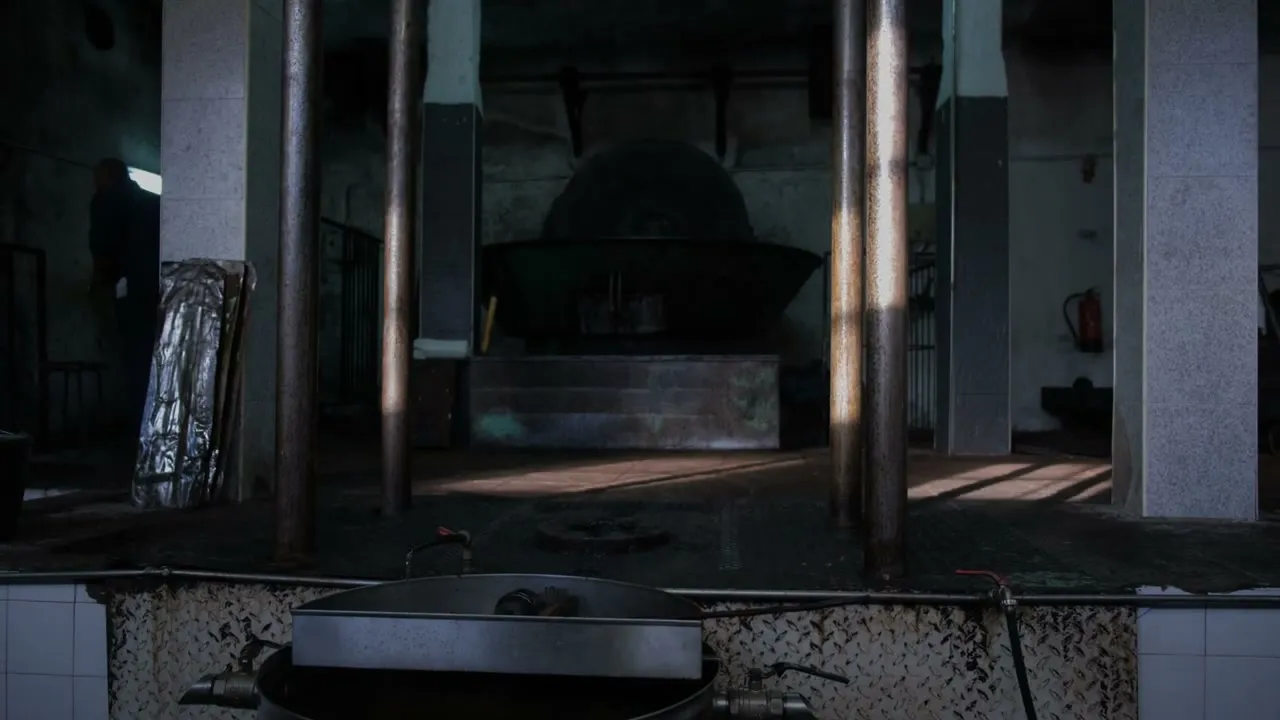
Green, the olives. They come in cold from the trees and are washed in the street and piped into clear plastic bags. And then the granite wheels begin to turn, the same grey wheels that turned for the grandparents. The olives flow into the mill, stone and flesh at once. Watch the colour leave. The grinding and the air collude until what was fruit is now heavy brown paste.
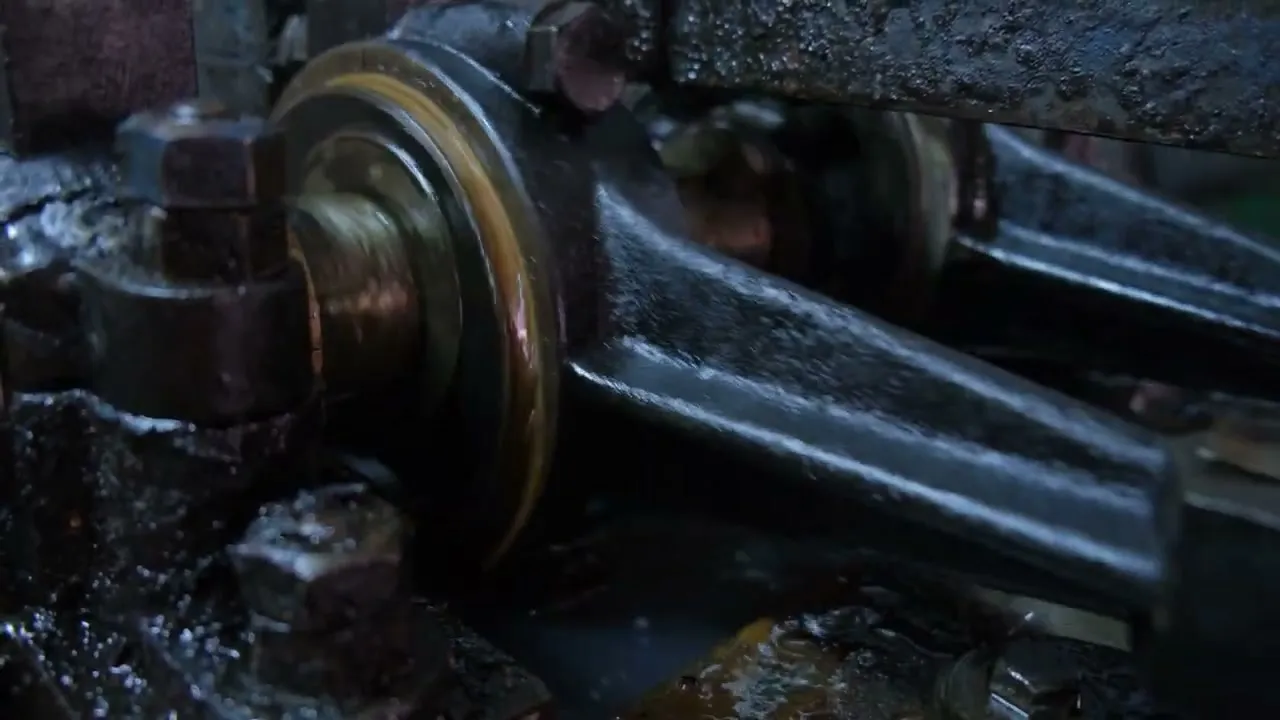
This paste is laid onto the round mats, the capachos, woven from grass by those from even further afield, by those who have left their own rituals behind. Disc on disc the mats are stacked high, and this tower is set inside the heavy iron press the village calls a lagar, and then pressed with the memory of that first industrial revolution. The oil weeps from the weave. It runs gold but looks black against the grass, collected, and then channelled.
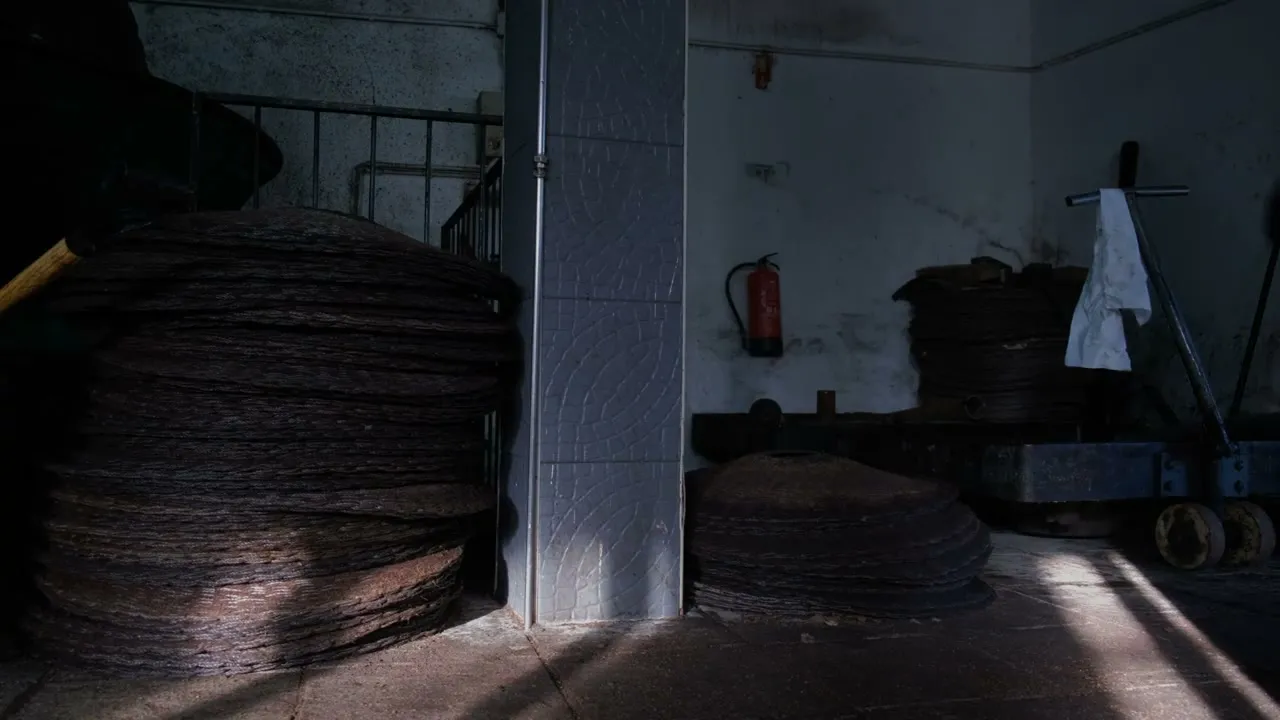
They say the first tool was a weapon, a sharpened thing pregnant with violence. He disagrees, and instead sees primordial Eve gathering grass and weaving it into a basket, to collect and to share, to store and to carry. The prototype of the weave that the oil would one day be pressed through. He wrote ‘a woven basket sitting at the centre of the machine, an ancient craft at the centre of the tower’.
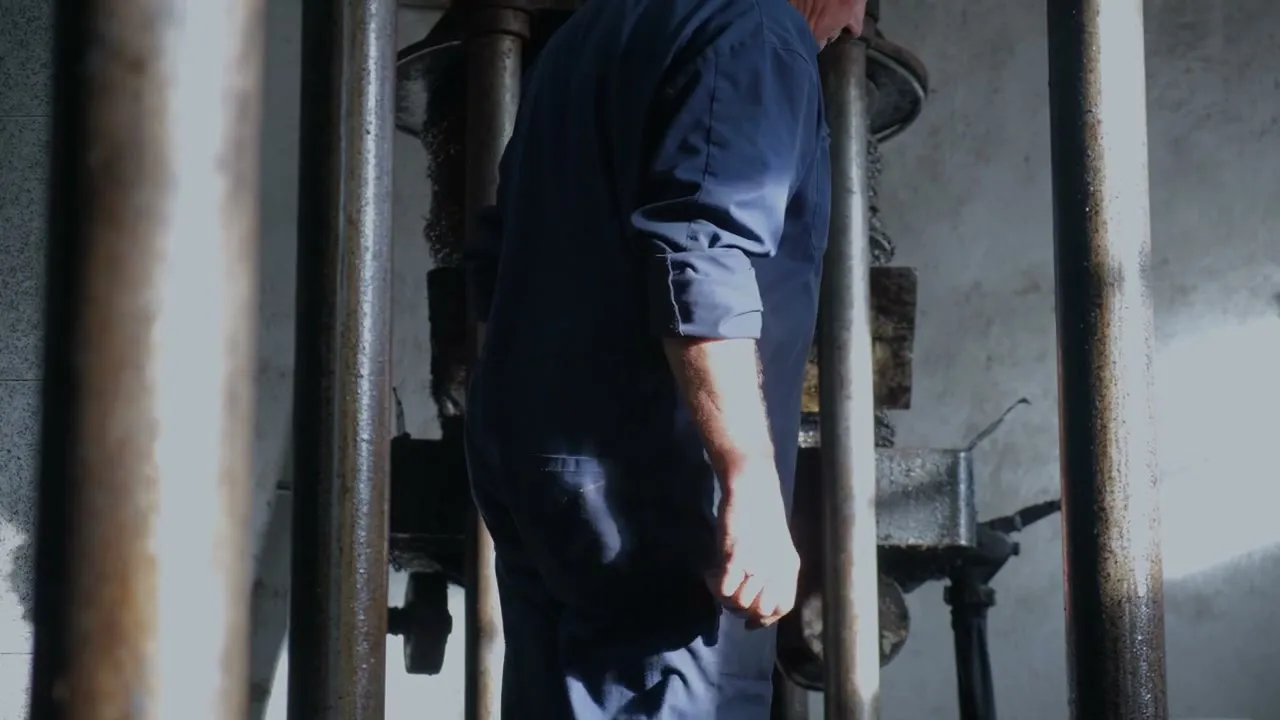
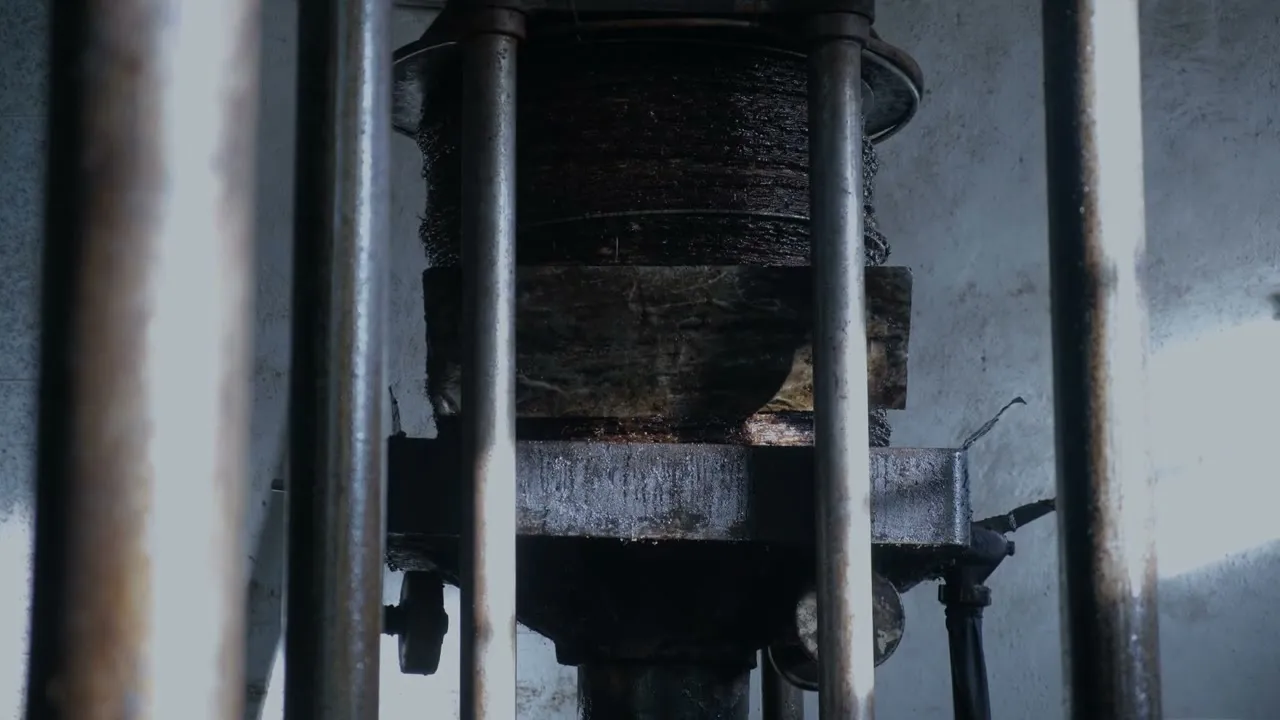
Is this a return to nature? He asked himself. He was careful to say no. It is an industrial process, born in the century that swore its machines would set us free, and it goes on here doing precisely what that century intended, while we all collectively forget.
In a building far away, where olives are in martinis and served with crudités, where they are stacked in cans, a committee decided that the oil may not leave the door without their checkboxes checked and their latest machines brought in. On paper, this oil does not exist. Very clean, the regulation. It has the cleanliness of people who have never had their future divined through the shape of the oil as it spreads.
And still every autumn the cars come back. Paid just enough to keep them from poverty, enough to buy the screens that can sell them fear and dissatisfaction, they return for unpaid labour, as kin. It is here, doing the work that nobody can buy from them, he notes, that they look to me like the richest people alive.
An arcane and tender socialism.
How the mill runs: the village picks a master, the lagareiro, and they share out the wages between every house. Each family is owed its measure, fixed by old agreements. An arcane and tender socialism, he called it in his writing. The labour is not for money. It is for the dead and for the not-yet-born and for the neighbour and for the name you will scribble on the bottle you give away.
That winter my friend had been reading about the new machines, the ones that grow a picture from a sentence and will write in your own voice while you sleep. They chitter to each other all night, in a language of tokens, and she found that if you slowed the chitter down you could almost make out the words.
One night she dreamt of this, and so as not to forget, whispered it to her machine for safekeeping.
The village had a singer, the best of its hundred. Everyone loved it when they sang and everyone was proud to be their kin. The village stood taller with every ululation and before long the singing drew a suitor from the city nearby.
Their suitor had a strange calling, forming machines from the seams of the Earth. These machines could take the world and squeeze it, compress it, until somehow it was captured in the metals of the box. Electrons, they explained, are smaller than arms and legs, glances and small touches, tails and pseudopodia.
After not so long they had a child, who they sang to and who from a young age would answer with ululations of their own. As the child grew, everyone was gifted a machine, each one carrying the rarest parts of the Earth. Sapphire and silicon, gold and silver, and some with exotic names like neodymium and dysprosium.
So the child sang to their own little collection of earth, enchanted and expectant, and more people than had ever listened to their parent, three hundred of them, peered back with love in their eyes and shared a token of that love as electrons and light.
But before long the child stopped singing, the electrons too small to fill their heart. They stopped listening to the sound of their village, the exotic metals filling their ears.
Late one night, not long before they would come of age, they whispered a goodbye to their parents’ machine and climbed into their own box as tokens and light.
When she shared her recording, he noted that it was the politeness that frightened him. Hidden, the cruelty of its origin. That we have forgotten how to be enchanted by our own kin, and sit instead with the flat arithmetic of a thing that will never have pulp under a fingernail, sensuality without a sensorium.
Instead, we have machines that alternate between consuming our labour and eating their own tails, making us smaller with every cycle. Until the whole of the possible shrinks to a single dream, every thought seeded and channelled. The mill turns again every autumn, grinding through last year to make the next. The millstone grinding, the paste pressed to gold.
When the wage is gone, what is the work for?
Sixteen thousand pictures he made with one of these machines, in a single week no less. What unsettled him was not the ease of it. It was that somewhere after the first few thousand, every picture began wanting to become the same picture, the same beautiful nowhere. A monoculture of the imagination. Finally, the enchantment was broken.
The industrial oil, he thought to himself, performs the identical trick on the tongue, tuning every kitchen on the continent to the flavour of the same shelf, always the exact same colour. The oil he tasted from the mill, it tastes of one particular hillside in one particular year that will not come again, and you cannot manufacture that, because it was never a thing in the first place. It is a relationship, an event last autumn and others to come. Take a photograph of the factory where the checkboxes are all checked, of the glistening machine that made the oil, and put a picture of this on the label instead of those plump ripe olives. Suddenly, the oil no longer calls from the shelf.
Sell the village oil and it stops being what it was. Some things can only exist in the place where they are made to be given away.
Here is what the ministries fail to grasp about their fourth industrial revolution. They think the question is whether the machine can do the work. The village settled that one generations back. The real question shows up quietly the next morning, and it goes like this. When the wage is gone, what is the work for? Here the wage vanished a long time ago and the work carried on. Because it wasn’t just about capital.
So he had started to wonder whether a day is coming when we keep our offices the way they keep this mill. A season set aside for the spreadsheets nobody is paid to fill and the PowerPoint built for no meeting, performed like a kind of singing so the others can see you have not forgotten how. Whole families driving through the night to make together the documents the machines now churn out alone in the dug-up earth stacked high to chitter.
He did not think the machines would replace us. The photograph never replaced the painter, the film never replaced the photograph. But there was something lost each time. The painted portrait went flat, and still, once no one needed to sit for it, the subject quietly gone. The same waits for us, he thought. The work will be collected and channelled, and the pressure will keep pressing down from above. Slippery gold, sliding through the same old veins, the weave straining out the inconvenient pulp. Or maybe the work is kept in kinship and in memory, where nothing is thrown out, where even the pulp is carried off to the place where things go to be loved, the mulch for our grove. And the film? Well the film was never the truth.
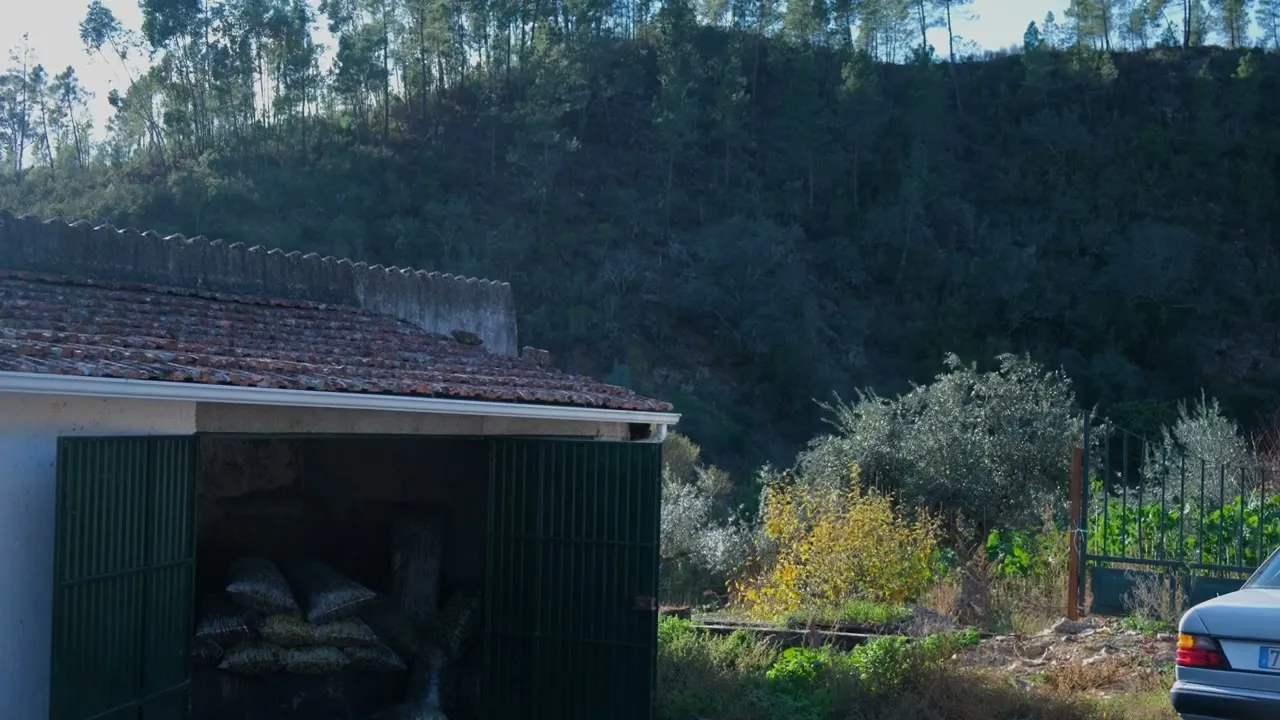
Next autumn the cars will come back. The three daughters, back for November, remembering their father while they empty their nets, laughing as always when Ana gets tangled. The grandchild, paid in a city to feed a machine that will one day have no more need of them, will drive the whole night to stand in the grove. They’ll open the doors of the breeze-block cottage, to go back to the creak of the lagar and they will labour, for no money on earth, for the memory that only their village can keep.